· 16 min read
Standard Takeoff Minimums Explained for IFR Pilots
Learn standard takeoff minimums under 14 CFR 91.175, which airports override them, and how ATC vectors change your IFR departure.

One statute mile of visibility is the default for an airplane with two engines or fewer when the airport publishes no takeoff minimum of its own; airplanes with more than two engines and helicopters fall back to 1/2 statute mile. Those figures are a regulatory floor for starting the takeoff roll, and they only apply when nothing more specific is published.
That's the part most pilots get right and then stop thinking about. The uncomfortable version of the same rule is this: you can launch legally at exactly 1 statute mile and still be unable to fly the departure that keeps you clear of the ridge off the departure end. Visibility answers whether you may go. Climb performance, navigation capability and workload answer whether the airplane can fly the protected path once the wheels leave the runway.
I've watched instrument students memorize the one-mile figure, recite it perfectly, and then brief a departure procedure without ever checking what it demanded of the airplane. The number passed the oral. The departure would not have passed the flight.
What follows is the decision sequence I'd walk any instrument candidate through before an IFR departure, in the order the checks matter, plus the places where the memorized figure misleads.
Table of Contents
- Standard Takeoff Minimums at a Glance
- Decide and Confirm Before Every IFR Departure
- Worked Example of a Departure Under IFR
- Why Airport Minimums Can Exceed the Default
- ATC Vectors and Part 91 Versus Commercial Operators
- Recent Rule Changes Pilots Should Check
Standard Takeoff Minimums at a Glance
Start with the number that matches the aircraft you're sitting in. Under the federal default, an airplane with two engines or fewer needs 1 statute mile of visibility to begin an IFR takeoff. An airplane with more than two engines needs 1/2 statute mile, and a helicopter needs 1/2 statute mile as well.
Default IFR takeoff visibility by aircraft category
| Aircraft category | Default takeoff visibility | When the default applies |
|---|---|---|
| Airplane with two engines or fewer | 1 statute mile | No Part 97 takeoff minimum is published for the airport |
| Airplane with more than two engines | 1/2 statute mile | No Part 97 takeoff minimum is published for the airport |
| Helicopter | 1/2 statute mile | No Part 97 takeoff minimum is published for the airport |
These values live in 14 CFR 91.175(f) as published in the eCFR, which applies the civil-airport takeoff-minimum framework to operations conducted under Parts 121, 125, 129 and 135. The same regulation is blunt about the weather side of the decision: a pilot may not depart under IFR unless the observed weather meets the applicable published or default minimum, unless the FAA has authorized otherwise.
The engine-count threshold is the detail that gets flattened into folklore. The familiar one-mile figure is category dependent, not a single rule for every operation. A pilot who flies a light twin and also flies a helicopter commercially is holding two different floors in mind, and a four-engine crew is holding a third.
What these numbers are not matters just as much. They're a visibility floor for beginning the takeoff, not a landing minimum, not a ceiling requirement, and not a promise of obstacle clearance. An airport with terrain, a displaced threshold, a short runway or an obstacle departure procedure can publish something stricter, and that stricter value wins.
Find the row that matches your aircraft in the table above. That number is where the preflight check starts.
Decide and Confirm Before Every IFR Departure
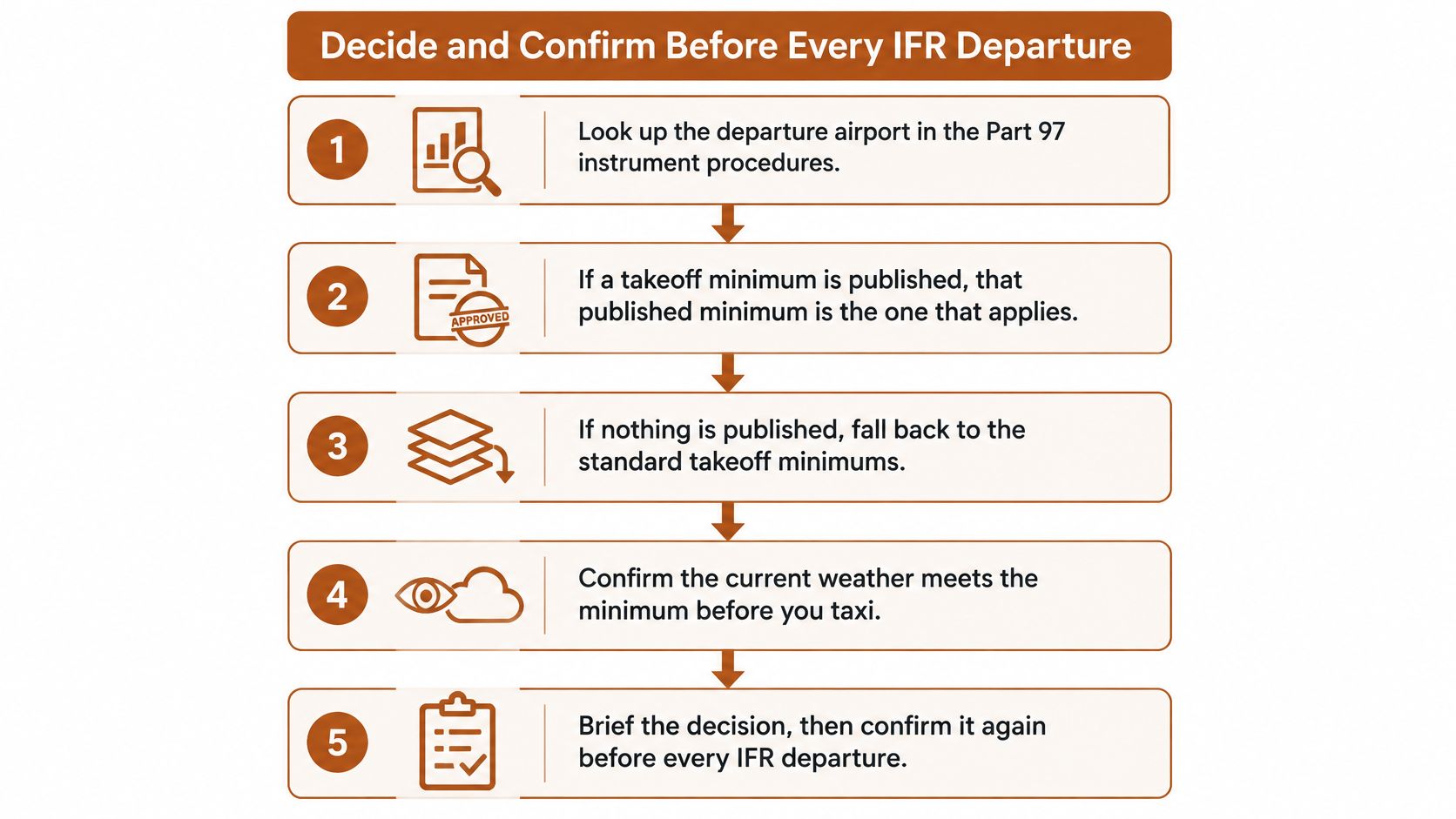
The regulation creates a sequence rather than a slogan. As 14 CFR 91.175 on the eCFR sets it out, a civil-airport IFR departure must meet the takeoff weather minimums published for that airport in FAA Part 97 unless the FAA has specifically authorized otherwise. That produces a two-step operational decision: inspect the departure airport's instrument procedure or airport-specific publication for a prescribed minimum first, and apply the regulatory default only when no Part 97 takeoff minimum is published.
Treating the default as automatically controlling is how pilots end up making an incorrect go/no-go call at an airport that publishes something higher.
Seven checks in order
- Open the Part 97 procedures for the departure airport. If a takeoff minimum is published there, it governs, because airport-specific values can exceed the default for terrain, obstacles, runway environment or the departure procedure's design. The common slip is briefing the destination plate in detail and never opening the departure airport's page at all.
- Fall back to the default only when nothing is published. Two engines or fewer means 1 statute mile; more than two engines or a helicopter means 1/2 statute mile. Do this out loud once, with the aircraft type in the sentence, so the category can't drift.
- Confirm the visibility you're reading is observed weather at that airport. A forecast is not an observation, and a station 30 miles away is a different airport's weather. Where the published minimum is stated in runway visual range, compare RVR to RVR instead of converting a mile figure in your head at the hold short line.
- Match the airplane, the runway and the clearance to the authorized procedure. A minimum built around a specific runway, a specific climb or a specific equipment set does not transfer to a different runway. Where the FAA has authorized something other than the default, that authorization belongs to the operator holding it, not to the next pilot on the ramp.
- Verify the departure can be flown on the published procedure. Take the required climb gradient, convert it to feet per minute at your expected groundspeed, and check it against the airplane's climb performance at the actual weight and temperature. A gradient you can't hold is a no-go even when the visibility is generous.
- Confirm the publication is current. Charts get revised, procedures get suspended, and an airport's minimum can change between your last visit and this morning.
- Decide, then write it down. One line in your notes: the minimum you used, where it came from, and the value the weather is reporting. If anyone ever asks why you went, or why you waited, that line answers the question.
The one-line test
Practical rule: if the observed visibility at the departure airport is below the value you identified in steps 1 and 2, you don't depart under IFR. Every check after that point is about whether the departure is flyable, not whether it's legal.
Step 6 deserves its own habit, because a stale chart is the quietest way to get this wrong. Reading the current notices for the departure airport before you compute anything else costs two minutes, and understanding how a NOTAM can change a procedure is worth the reading time rather than a skim.
The regulations, clearance phraseology and approach plates this sequence leans on are the same ground the flyCowboys study app covers with FAR/AIM questions, IFR clearance items and approach plate practice in exam format.
Worked Example of a Departure Under IFR
Take a hypothetical airport with a hypothetical departure plate, because the point is the sequence, not the field. A twin-engine airplane is planning an IFR departure. The plate publishes no takeoff minimum. Reported visibility is 1 1/4 statute miles.
The default for an airplane with two engines or fewer is 1 statute mile, so the visibility gate is open with a quarter mile to spare. Write it down: default 1 statute mile, no published minimum, observed 1 1/4 statute miles. Then move to the questions the visibility answer doesn't cover, starting with whether the airplane can make the climb that the departure area demands.
Change a single fact. The same plate now publishes a 1 1/2 statute mile minimum. The reported 1 1/4 miles no longer meets it. The pilot waits, or chooses another runway, or chooses another airport, even though the default would have permitted the takeoff a minute earlier. That's the whole lesson of the exercise: the published value replaced the fallback, and no amount of reciting one mile changes it.
Now vary the aircraft instead of the weather. A three-engine airplane at the same field falls under the 1/2 statute mile default, so 1 1/4 miles clears the visibility requirement comfortably if nothing is published.
Three written-down decisions, each with the number and its source:
- Twin, nothing published, 1 1/4 miles observed. Departure permitted on visibility. Climb gradient still to be verified.
- Twin, 1 1/2 miles published, 1 1/4 miles observed. No departure. Wait or replan.
- Three engines, nothing published, 1 1/4 miles observed. Departure permitted on visibility, same gradient verification to follow.
Some pilots will notice that they'd have reached the right answer in the first and third cases from memory. The second is the one memory loses, and it's the one where a published minimum is doing real work.
That's why I'd rather a student learn the order of the checks than the number at the end of them. The number changes with category and airport. The order doesn't. A clearance to depart doesn't replace the checks either, and how an IFR clearance is actually built is worth studying alongside this sequence, because the departure instruction and the obstacle plan are often delivered in the same transmission.
Why Airport Minimums Can Exceed the Default

Published airport minimums exist because the default visibility number cannot account for the ground around the runway. Ridges, towers, a shortened runway or an early turn can all require more than the federal fallback, and FAA departure procedure material is explicit that a runway-specific published minimum or obstacle departure procedure can impose greater visibility, a climb gradient, a routing requirement, or a combination of them.
The obstacle math behind a gradient
An obstacle departure procedure is a protected path, and the protection is geometric. FAA departure design normally uses a 40:1 obstacle-clearance surface and a standard 200 feet per nautical mile climb gradient, which yields 48 feet per nautical mile of obstacle clearance where no obstacle penetrates that surface. FAA departure procedure material The surface is the screening tool. The gradient is what you fly, with margin built in.
Now make it a number you can compare against a real airplane. At 90 knots groundspeed, 200 feet per nautical mile equals about 300 feet per minute of climb. That is the number to hold against the climb chart at your takeoff weight and temperature, not a figure to admire in the abstract.
If the chart gives you 250 feet per minute on a warm afternoon at gross weight, the departure is not available to you at that weight, whatever the visibility says. Reduce weight, wait for cooler air, take a different runway, or do not go. The hard part is that the airplane may meet the published visibility while lacking the climb needed to stay inside the protected path.
Legal under the standard minimum is a starting condition, not a safety margin. The airport can be reporting 2 miles and the airplane can still be unable to fly the procedure that keeps it clear of the terrain.
What to compare before the takeoff roll
Four items, in this order:
- Required climb gradient in feet per nautical mile, converted to feet per minute at your groundspeed.
- Actual climb rate from the performance chart at the actual weight, temperature and pressure altitude.
- Navigation capability for the specific procedure, since a gradient published for an RNAV departure assumes equipment you might not have powered up correctly.
- Workload margin in the first two minutes, which is where single-pilot IFR earns its reputation.
A departure can be legal under the standard minimum and still be unwise if any of those four comes up short. Pilots who treat the visibility floor as the whole decision tend to discover the gap somewhere past the departure end, and the approach plate for the field often carries the warning in small print they skipped.
ATC Vectors and Part 91 Versus Commercial Operators
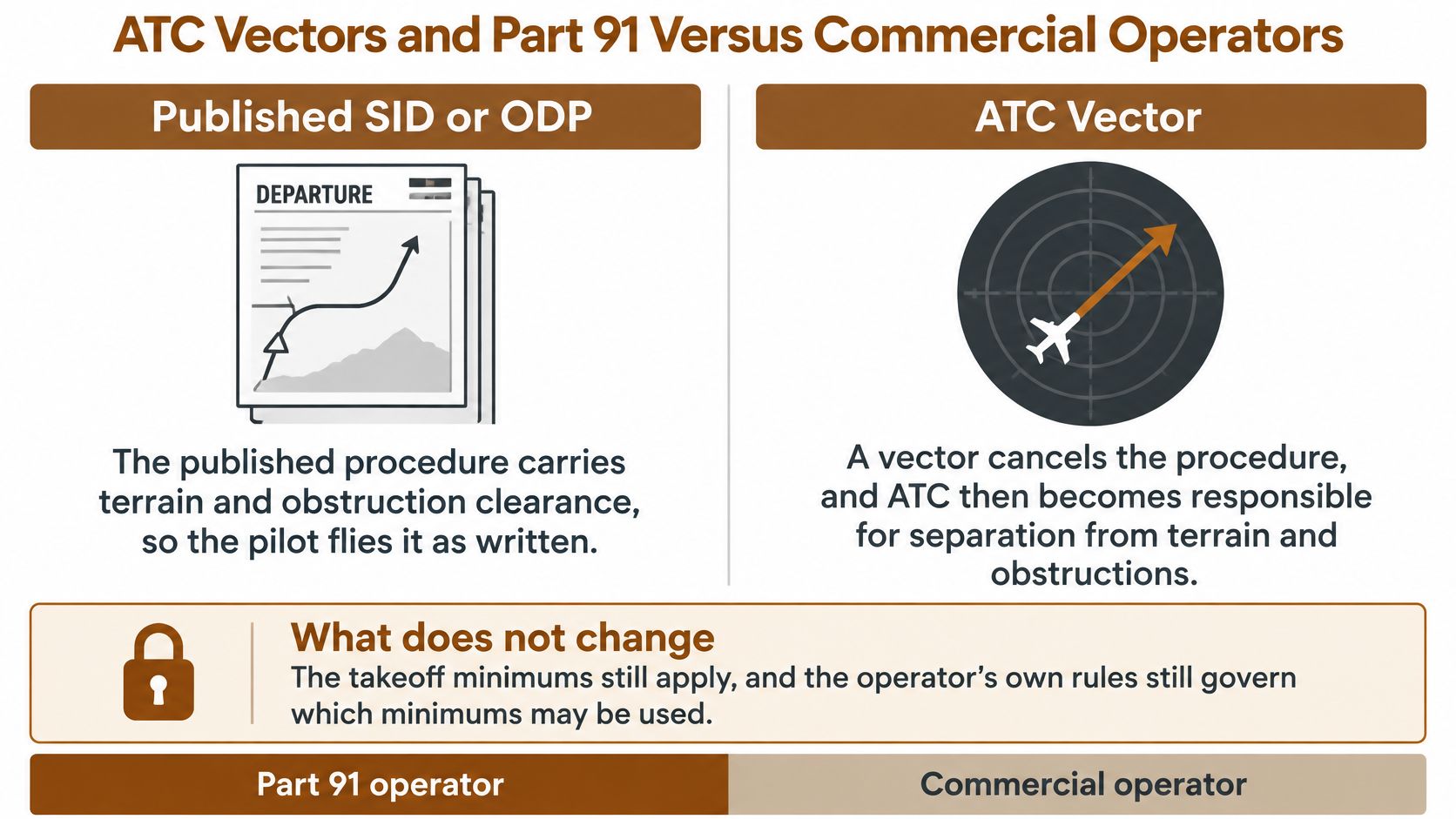
A takeoff clearance is not an obstacle-clearance guarantee. Under FAA air traffic procedures for IFR departures, when ATC vectors an aircraft off a published SID or ODP, that vector supersedes the departure procedure, and separation from terrain and obstructions shifts to the controller issuing the headings. That shift is real, and it is narrower than it sounds.
The vector does not move the pilot out of the loop. You still comply with the clearance, maintain control of the aircraft, and confirm the airplane can perform the initial climb as assigned. An ordinary takeoff clearance, issued with no vector and no departure procedure, carries no obstacle-clearance guarantee before the aircraft is established on a procedure. When the clearance leaves the obstacle question open, ask. The question costs one transmission.
Here is the practical shape of the decision. Assume the vector gives you terrain separation. Then verify what the vector cannot give you: climb performance. A heading around the high terrain still requires the airplane to outclimb whatever sits under that heading, and ATC has no idea what your performance chart says at tonight's weight and temperature. The controller's responsibility and your responsibility overlap at exactly the point where the airplane either climbs or doesn't.
The distinction that standard test prep skips is regulatory category. Part 91 operations use the default and airport-specific minimums already described. Part 121 and Part 135 operators must use an engine-inoperative takeoff obstacle-clearance or avoidance procedure meeting their own more demanding requirements, and that procedure lives in their approved operations specifications. This is why an airline crew briefs a one-engine-out path before the throttles move and a private pilot with one engine doesn't have the same document, or the same problem, in front of them.
Departure procedures themselves are living data. Rulemaking continually amends, suspends and removes instrument approaches, takeoff minimums and obstacle departure procedures at individual airports, so a procedure you flew last year may not exist in the form you remember. An old screenshot of a departure page is not a source.
| Situation | Who or what governs obstacle clearance | What the pilot still verifies |
|---|---|---|
| ATC vectors the aircraft off a published SID or ODP | ATC provides separation from terrain and obstructions | Compliance with the clearance and ability to climb safely |
| Ordinary takeoff clearance with no vector | The published departure procedure | Flying the procedure as published and the climb gradient |
| Part 91 operation | Default and airport-specific takeoff minimums | Current publication and aircraft climb performance |
| Part 121 or Part 135 operation | Operator's engine-inoperative procedure under its regulatory requirements | The procedure in the operator's approved operations specifications |
One row of that table deserves a second look. The middle rows put the full burden on the published procedure, which means a runway with no published ODP and no vector leaves you holding the terrain problem alone. I treat that combination as a reason to either request an initial heading or pick a different departure time with better visibility.
Before accepting any vector, confirm who is responsible for obstacle clearance during that segment. If the answer isn't clear from the transmission, ask ATC to confirm terrain separation. Nobody minds the question. Everybody minds the alternative.
Recent Rule Changes Pilots Should Check
Takeoff minimums are living data. A Federal Register rule effective May 7, 2025 amended, suspended or removed standard instrument approach procedures and the takeoff minimums attached to them at certain airports. If you learned a minimum at a particular field before that date, the chart in your head is due for an audit.
The second item is a reminder about how notices work. On May 22, 2025 the FAA issued Notice 8900.736 on OpSpecs for IFR lower-than-standard takeoff minimums under 14 CFR Part 125, and the notice was later cancelled. A cancelled notice neither restores an older value nor sets a new one. What governs is the current regulation and the current publication, so the cancellation changes nothing about your preflight check except your confidence in the paperwork trail.
Expand step 6 of the departure sequence into three quick actions:
- Check the current instrument procedure publication for the airport's takeoff minimums, and read the entry for your runway rather than the first line under the airport name.
- Scan for notices affecting the departure, including anything that suspends the procedure you intend to fly.
- Confirm the Chart Supplement entry for the airport, which is where runway and lighting details that support a lower minimum get recorded.
None of that takes long. All of it beats discovering the change on the ramp.
A takeoff minimum is only as current as the publication it came from, and the publication is only as current as the last time you looked.
If the departure decision is where your instrument studying feels thinnest, flyCowboys builds the FAR/AIM regulations, IFR clearances, and approach plate reading this article leans on into 3,500+ exam-style questions with plain-English explanations mapped to the ACS, in fifteen-minute daily sessions. The practice exams mirror the PSI interface you'll see at the testing center, and the Readiness Score tells you when you're ready to schedule rather than guessing. Start your IFR prep at flyCowboys and walk into the oral able to explain which number governs, and why.