· 15 min read
IFR Clearance Example: Sample Phrasing and How to Read It
See a complete IFR clearance example, decode each element, and learn how to read back and handle common variations.

You're sitting in the right seat, pencil ready, and clearance delivery starts talking faster than you can write. Numbers, a fix you don't recognize, an altitude, a frequency. By the time you get the squawk code, you're not sure if the route matched what you filed. That scramble is normal for new instrument students, and it isn't a memory problem. It's a routine problem.
Treat every IFR clearance example the same way. Write it in a fixed order, compare it with your plan and chart, then read it back to verify it. Once that routine sticks, a clearance stops sounding like one long blur. It becomes six predictable pieces you can check one at a time, even when ATC changes something you didn't expect.
Table of Contents
- A Sample IFR Clearance, Decoded Element by Element
- Why IFR Clearances Follow the Filed Route
- Read Back the Clearance and Handle a Mismatch
- Common Clearance Variations Compared Side by Side
- Mistakes That Cause Clearance Busts
- Practice Clearances Until the Readback Feels Automatic
A Sample IFR Clearance, Decoded Element by Element
Start with this sample and read it as one line.
Cleared to Denver International Airport via the RNAV SID, then as filed; maintain 5,000; departure control 124.35; squawk 4621; void time 1420.
That sentence follows the CRAFT sequence. The FAA Instrument Flying Handbook decodes a clearance as Clearance limit, Route, initial Altitude, departure control Frequency, and transponder code. Add void time at the end when ATC gives one, because that's the item pilots most often miss when they're rushing.
Reading the Sample in Order
| Element | Example | What It Tells You |
|---|---|---|
| Clearance limit | Denver International Airport | Where the clearance ends, normally the destination |
| Route | Via the RNAV SID, then as filed | The route to fly, including any departure procedure |
| Initial altitude | Maintain 5,000 | The altitude to hold after departure until ATC assigns another |
| Departure frequency | 124.35 | The frequency to contact after takeoff for departure control |
| Transponder code | Squawk 4621 | The code that identifies the aircraft on radar |
| Void time | 1420 | The time after which the clearance is void if you have not departed |
Clearance limit tells you where this authorization stops. On most training flights that's your destination airport, so "cleared to Denver International" means you're cleared that far, not beyond it.
Route is where students guess. Don't. The route is either a published SID with its transition, a changed segment, or your filed route after that departure. Pull the exact SID name from the chart. "Then as filed" only covers what comes after the issued departure, so you still need the departure itself briefed and loaded correctly.
Initial altitude is the altitude you maintain after departure until ATC says otherwise. That point matters because it's easy to confuse it with an altitude printed on the procedure. A restriction on a SID chart isn't the same as an ATC assigned altitude unless the clearance puts you on that procedure that way. Fly the altitude you were assigned.
The last items set up the handoff. 124.35 is who you'll talk to after tower, and 4621 makes your radar target identifiable. If you get a void time of 1420, you must be off by then or the clearance expires and you need a new one.
Every value in this IFR clearance example changes per flight. The order doesn't. Decode each new clearance in CRAFT order and you can make sense of it in under a minute without filling gaps from memory.
Why IFR Clearances Follow the Filed Route
The controller starts from your filed route because it is the one plan both sides can see. You requested a specific path, and ATC either approves it, shortens it, or changes part of it to fit traffic and airspace. Your job is to read back and verify that decision, not to memorize a new string of fixes on the spot.
Ordering from a familiar menu works the same way. The waiter does not list every ingredient when your order stands as written. He names only what changed, and you still confirm the whole order before the kitchen starts.

Abbreviated Versus Detailed
The FAA Aeronautical Information Manual guidance on IFR clearances explains that ATC may issue an abbreviated clearance when the filed route can be approved with little or no revision. You hear "cleared as filed" because no fix needs to be read aloud.
A detailed clearance comes when the filed plan has changed or when you ask for the full route. The controller then reads the complete routing so no new segment stays unclear. Listen for a different SID, a new transition, or fixes you did not file. Those details tell you the plan changed and you need to update your notes, your navigation, and your mental picture.
An abbreviated clearance shortens radio time. It leaves your workload the same. Keep the full filed route in front of you, with the departure chart open and the navigator loaded to match it. Reviewing the structure of routes in a guide to the ICAO flight plan format makes it easier to see which part ATC kept and which part it replaced, so your readback confirms the correct version.
At airports with pre-taxi clearance procedures, request clearance shortly before you are ready to taxi and follow the local procedure for which frequency to call first. You receive the clearance, or delay information if it cannot be issued yet, on that first call. Then you contact ground when you are ready to move. Call too early and the clearance can go stale while you wait. Call in sequence and each handoff stays clean.
Read Back the Clearance and Handle a Mismatch
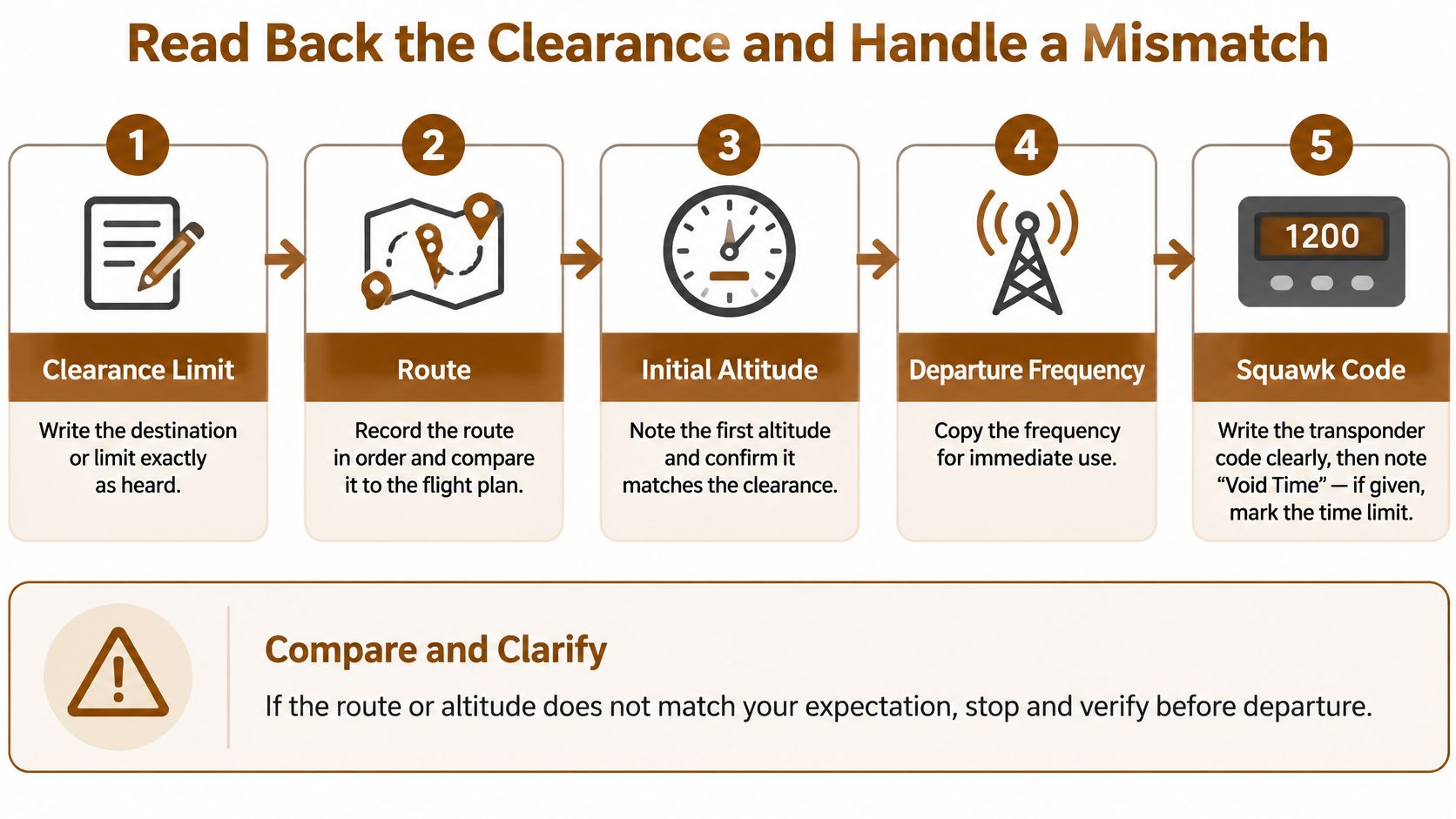
"N123AB, cleared to Denver International via direct RAVEN, then as filed, maintain 7,000, departure 119.2, squawk 5314." That one transmission contains your limit, your route change, your altitude, and your codes. Your job is to turn it into a verify loop. Copy it down, compare it to what you filed, then read back what ATC said.
Six Steps Before You Taxi
- Write in CRAFT order. Put clearance limit, route, initial altitude, departure frequency, and squawk code on separate lines. Add void time below them. Blank lines before the call help you drop each item in the right box as the controller speaks.
- Compare before you transmit. Check the route and altitude against your flight plan and the departure chart. Does the SID transition join your filed route where you expect? Is the initial altitude sensible for that procedure?
- Read back the critical items. Read back the route, altitude, frequency, and squawk code slowly, with extra care on numbers. For the Denver sample, say, "Cleared to Denver International Airport via the RNAV SID, then as filed, maintain 5,000, departure 124.35, squawk 4621, void time 1420."
- Check the clock. If you got a void time, compare it with your realistic taxi and takeoff time, not your hopeful one. A long run-up or a fuel stop changes the math.
- Clarify anything that does not fit. Ask before you accept. It is much easier to sort out a fix at the ramp than at 3,000 feet in cloud.
- Brief the departure. State the procedure, first fix or heading, and initial altitude out loud. Then comply promptly unless an emergency requires a different action.
The national airspace system handles a very large volume of IFR traffic every day, so a clearance works only when both sides hold up their end. The FAA Aeronautical Information Manual discussion of pilot and controller responsibilities describes that shared duty clearly. You acknowledge that you received and understood it, you ask for clarification when it is unclear or unsafe, and you comply. The controller assigns altitudes at or above minimums and verifies your readback of critical items like altitude and heading.
Notice what you do not need to read back word for word. Altitudes or restrictions that live only on a charted procedure generally do not require readback unless ATC specifically states them. When ATC states an altitude, a restriction, a vector, or a runway, read it back. That mutual verification keeps errors on the ground. Clean radio procedure and phraseology practice makes that verification sound short instead of strained.
Practical rule: If you cannot point to the issued departure and transition on the chart, you do not understand the clearance yet, even if ATC said "as filed."
When the Clearance Doesn't Match Your Plan
"As filed" is not a substitute for understanding. Identify the departure you were issued, the transition, and every change from your flight plan. If a fix, altitude, or routing does not match what you can fly safely, say so. You can refuse a clearance that is unacceptable for safety and request an amendment instead. That is your responsibility as pilot in command.
Watch a clearance exchange with that decision path in mind. Listen for where the pilot writes, compares, and asks instead of guessing.
A mismatch sounds like this in real life.
Controller: "N123AB, cleared to Denver International via direct RAVEN, then as filed, maintain 7,000, departure 119.2, squawk 5314."
You filed a SID, not direct RAVEN. Do not read back your expectation. Point to RAVEN on the chart, check that your navigator can go direct from your departure path, confirm 7,000 works for the terrain and procedure, then read back what was issued. If you cannot find RAVEN or the climb does not work, say, "N123AB, unable direct RAVEN as issued, request clarification or amendment." ATC would rather fix it on the ground.
Common Clearance Variations Compared Side by Side
Copy the same CRAFT order every time, then check what the wording asks you to verify. An abbreviated clearance tests your filed plan. An amended route tests your chart reading.
| Variation | Example Phrase | What Changes | Read Back |
|---|---|---|---|
| Abbreviated clearance | Cleared to Denver as filed, maintain 5,000, squawk 4621 | Route is not repeated in full | Altitude, code and frequency |
| Amended route | Cleared direct RAVEN, then V25 ABC, maintain 7,000 | Route differs from the filed plan | Route, altitude, frequency and code |
| Climb via SID | Cleared via the SID, climb via SID except maintain 5,000 | Climb profile comes from the procedure with an altitude override | Altitude and frequency |
| Expected altitude | Maintain 5,000, expect 9,000 in 10 minutes after departure | A future altitude change, not the current one | Read back only if ATC states it |
| Pop-up clearance | Clearance issued after a request, with no prior filed route | Flight plan is filed in the air | Full clearance as issued |
| Delay or release time | Hold for release, expect departure clearance at 1430 | Departure is delayed | Time and delay information |
Working Through an Amended Route
A typical amended route you might hear sounds like this: "N123AB, cleared direct RAVEN, then V25 ABC, maintain 7,000, departure 119.2, squawk 5314." Write each number separately, then point to RAVEN and V25 on the chart and confirm the airway connects in the direction you will fly. Slow down on 7,000, 119.2, and 5314. Similar sounding numbers create quiet mistakes that appear only when departure cannot find you or calls you on the wrong frequency. General readback rules for pilots and controllers are published in the FAA AIM guidance on radio communications and readbacks.
Read the table as a verify routine. An abbreviated clearance leaves the route unstated, so confirm the exact filed route is loaded in the navigator. A climb via SID puts the vertical profile on the chart, with the stated altitude as the limit you obey. An expected altitude is planning information. Hold 5,000 and wait for the new clearance. A pop-up clearance has no filed baseline to fall back on, so copy the full route and expect tighter limits or a less direct path. A delay or release time changes timing, so recheck fuel and passenger plans before engine start. Keeping an IFR chart legend guide nearby helps you confirm symbols, fixes, and airway labels while you compare each variation.
One rule ties amendments together. The latest clearance takes precedence. When ATC restates an altitude, restrictions from the prior clearance that are not repeated, including the related departure procedure restrictions, are canceled. Cross out the old numbers on your card. A kneeboard that still shows two altitudes will brief the wrong climb under pressure.
Mistakes That Cause Clearance Busts
Clearance busts rarely come from missing knowledge. They come from one skipped check in a routine you already know.
Refer to this checklist before departure.
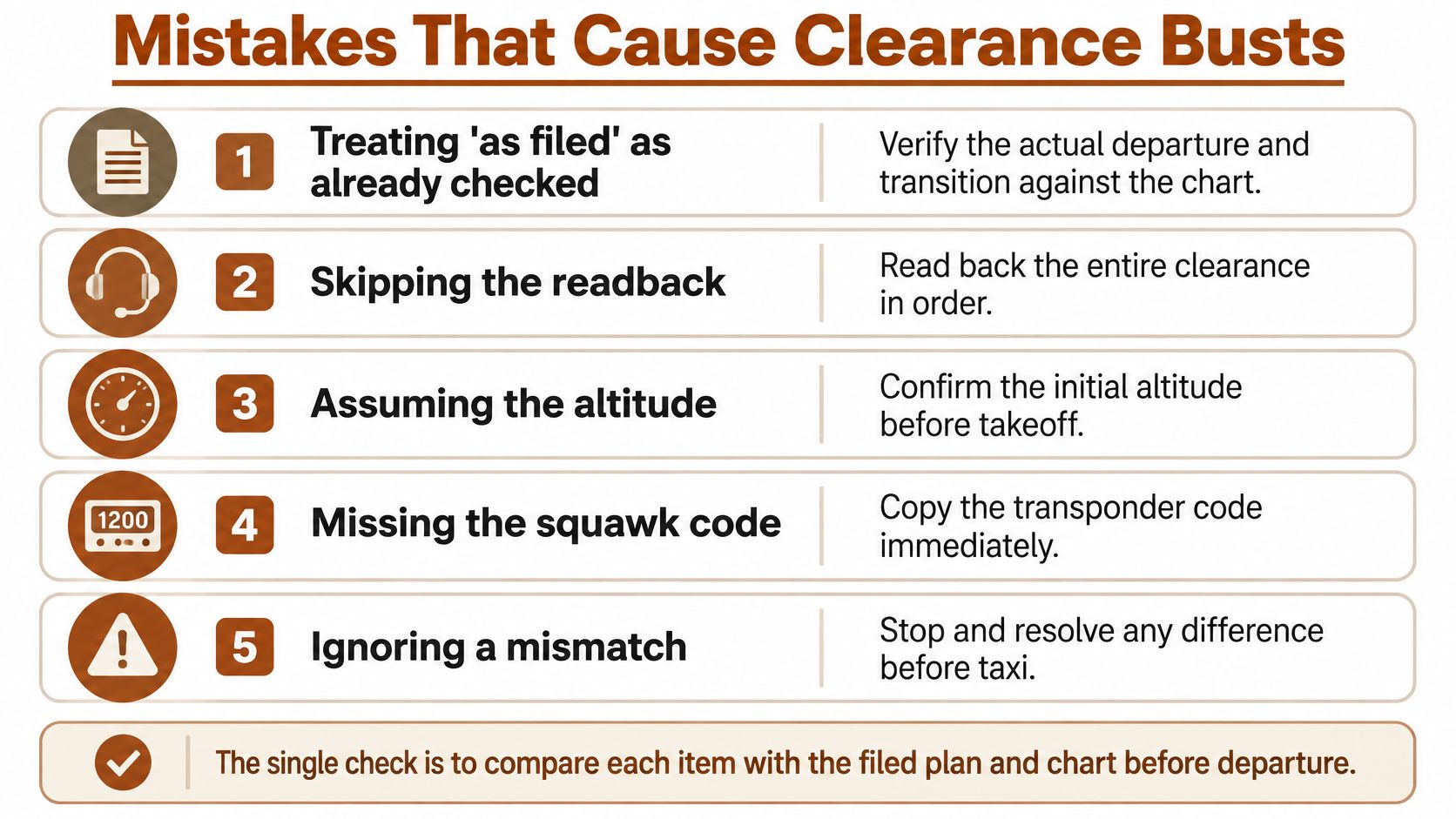
- Treating "as filed" as already checked. You hear familiar words and never confirm the issued SID and transition on the chart. Prevention check, point to the procedure name and transition fix before takeoff.
- Assuming the SID altitude is your assigned altitude. The chart prints a restriction, so you climb to it without an ATC assignment to match. Hold the altitude in the clearance and treat chart restrictions as separate limits unless ATC clears you via the procedure.
- Missing the void time. You copy the route perfectly, then start late after a long checklist and call for taxi with an expired clearance. Write the void time in large numbers and set your engine start against it.
- Mishearing similar numbers. 5,000 becomes 15,000 in your head, or 124.35 turns into 124.53 on the radio. Repeat each number clearly in the readback and compare it digit by digit with your written card before you set it.
- Reading back before setting up. You say the frequency correctly but never tune it, so your first call after takeoff goes nowhere. Set the departure frequency in standby and dial in the squawk code as part of the readback routine.
- Flying the old clearance after an amendment. ATC changes the route, you acknowledge it, and your navigator still flies the first plan. Strike superseded items, reload the route, and re-brief the first fix and altitude.
Most busts don't need more study. They need the same check, done every time, before the airplane moves.
Practice Clearances Until the Readback Feels Automatic
Repetition builds the speed that understanding alone won't. Try three short drills this week.
First, write ten sample clearances by hand in CRAFT order. Read each one back aloud and time yourself. You're building the hand movement and the spoken rhythm together, so your mouth doesn't race ahead of your pencil.
Second, pick a route on a sectional or low altitude chart. Build the clearance you'd expect, including the departure, initial altitude, frequency, and a made-up squawk code. Then check your invented clearance against the actual charted procedure and airway structure.
Third, take a clearance you've already practiced and add an amendment. Change the first fix and the altitude, cross out the old items, and read back the new version. That drill teaches the habit that the latest clearance wins.
For structured practice, flyCowboys covers IFR clearances along with radio procedures, navigation, approach plates, and holds, with detailed plain-English explanations written by real CFIs. Talk to Tower AI practice also lets you rehearse ATC phraseology until the readback sounds calm. Check your work against the current standard too. The FAA Airman Certification Standards page lists the Instrument Rating, Airplane ACS revision published in April 2024 and effective May 31, 2024.
Do one thing today. Pick the Denver IFR clearance example from the table, copy it in CRAFT order, and read it back aloud without looking at the sample line.
If clearances still blur together when the controller speeds up, practice them in the same CRAFT order until your readback checks itself. Visit flyCowboys to drill IFR clearances, radio procedures, approach plates, and the other instrument topics that show up on the FAA written, with plain-English explanations and Talk to Tower practice for real radio calls.