· 9 min read
IMSAFE Checklist, PAVE, and Aeronautical Decision Making (ADM)
IMSAFE is the pilot self-check: Illness, Medication, Stress, Alcohol, Fatigue, and Emotion or Eating. How PAVE, ADM, and 14 CFR 91.17 fit together.
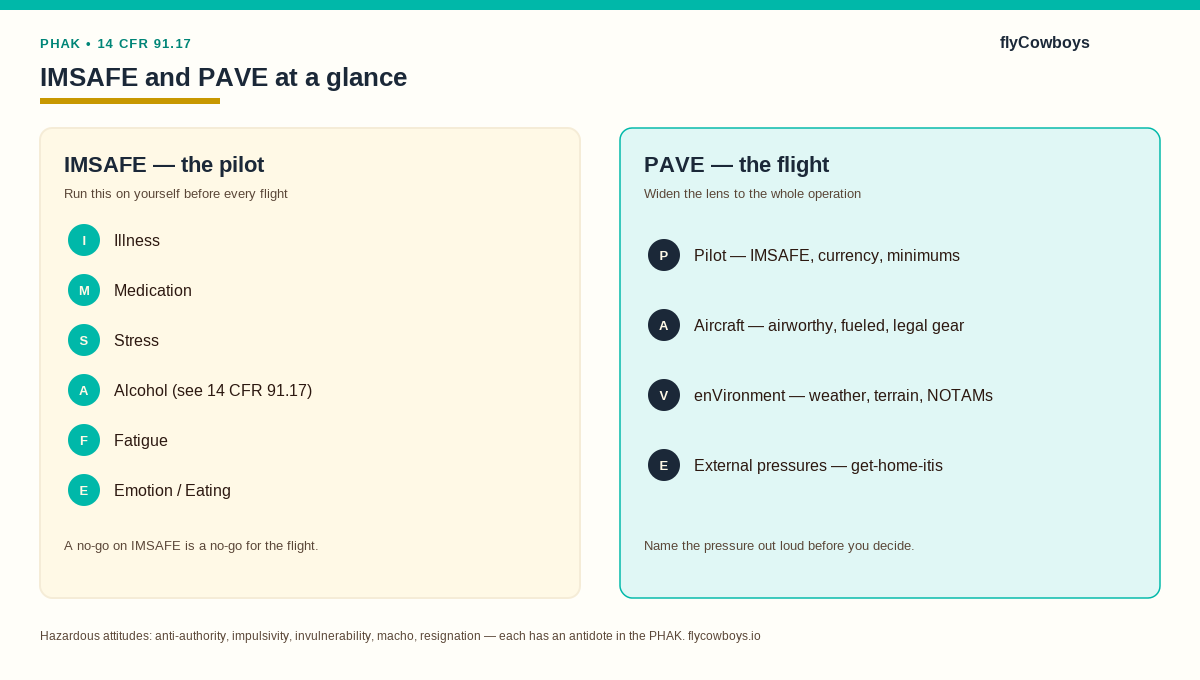
IMSAFE is a personal checklist — Illness, Medication, Stress, Alcohol, Fatigue, and Emotion or Eating — that you run on yourself before you fly. PAVE is the wider risk picture: Pilot, Aircraft, enVironment, and External pressures. Together they are the usual starting point for aeronautical decision making (ADM).
ADM is the habit of spotting a hazard, judging the risk, and choosing an action, including the decision not to go. 14 CFR 91.17 sets the legal floor for alcohol and impairing drugs. The five hazardous attitudes in the Pilot's Handbook of Aeronautical Knowledge, and their antidotes, are the other piece most written tests and orals expect you to know cold.
IMSAFE, PAVE, and ADM in one picture
Aeronautical decision making (ADM) is the process of detecting a hazard, assessing the risk, and choosing a course of action that keeps the flight within your limits. The Pilot's Handbook of Aeronautical Knowledge treats ADM as a skill you practice, not a personality trait. Two checklists are the usual starting point: IMSAFE for the pilot, and PAVE for the whole flight.
The IMSAFE checklist
IMSAFE is a personal go/no-go check you should run before every flight, including a local pattern session. The letters stand for:
| Letter | Means | Questions to ask |
|---|---|---|
| I | Illness | Do I have an illness or symptom that would interfere with flying, including a cold, an ear or sinus problem, nausea, or a fever? |
| M | Medication | Am I taking any prescription or over-the-counter drug that could affect alertness, judgment, or coordination? When in doubt, ask an Aviation Medical Examiner before you fly. |
| S | Stress | Is there psychological or financial pressure, a conflict, or a life event that will sit in the cockpit with me? |
| A | Alcohol | Have I had any alcohol, and is it legal and wise to fly? 14 CFR 91.17 is the regulation; the 8-hour "bottle to throttle" rule is the minimum, not a target. |
| F | Fatigue | Am I rested enough to fly this flight, including the unexpected delay or the extra landing? |
| E | Emotion / Eating | Instructors teach both: emotional upset, and whether you have eaten and hydrated. Either can degrade performance. |
14 CFR 91.17 prohibits acting as a crewmember within 8 hours after the consumption of any alcoholic beverage, while under the influence of alcohol, with a blood alcohol concentration of 0.04 percent or more, or while using any drug that affects the person's faculties in any way contrary to safety. The regulation is a floor. Many pilots add a longer personal buffer, and no one should fly hung over or exhausted even if 8 hours have passed.
Medication is a frequent trap. A legal over-the-counter cold tablet can still be a no-go. The FAA medical certificate process and an AME are the right places to sort a specific drug, not a forum thread the morning of a flight.
The PAVE checklist
PAVE widens the lens from the pilot to the whole operation:
| Letter | Means | What to examine |
|---|---|---|
| P | Pilot | IMSAFE, recent experience, currency, endorsements, and whether this flight is within your personal minimums. |
| A | Aircraft | Airworthiness, equipment (see ATOMATOFLAMES and 91.205), fuel, performance, and weight and balance. |
| V | enVironment | Weather, VFR minimums, terrain, night, airports, and NOTAMs. |
| E | External pressures | Passengers, a meeting, a holiday flight, "get-home-itis," or a desire not to disappoint the instructor or the people waiting on the ground. |
External pressure is the item students skip. The airplane and the weather can be legal, and the pilot can still feel pushed to go. Name the pressure out loud, then decide as if someone you respect were watching the decision, not the arrival time.
Hazardous attitudes and their antidotes
The PHAK lists five hazardous attitudes that distort ADM, and an antidote for each. Know these for the knowledge test and, more important, catch them in yourself:
| Attitude | Sounds like | Antidote |
|---|---|---|
| Anti-authority | "Don't tell me." | Follow the rules. They are usually written for a reason. |
| Impulsivity | "Do it quickly." | Not so fast. Think first. |
| Invulnerability | "It won't happen to me." | It could happen to me. |
| Macho | "I can do it." | Taking chances is foolish. |
| Resignation | "What's the use?" | I can make a difference. I am not helpless. |
Other ADM tools you may be asked about
Instructors and the PHAK also teach the DECIDE model (Detect, Estimate, Choose, Identify, Do, Evaluate), the 3P model (Perceive, Process, Perform), and the 5P check (Plan, Plane, Pilot, Passengers, Programming). You do not need to use every model on every flight. You do need one consistent way to notice a change, compare it with your minimums, and act, including the decision to divert or stay on the ground.
How this shows up on the FAA knowledge test and oral
Questions typically ask you to name the IMSAFE or PAVE letters, match a hazardous attitude with its antidote, or apply 91.17. Oral examiners like scenario questions: you feel a cold coming on, a passenger is late, or the weather is legal but deteriorating. Traps include:
- Treating the 8-hour alcohol rule as the only standard, and ignoring 0.04 BAC, "under the influence," or impairment from a hangover.
- Forgetting that medication includes over-the-counter drugs.
- Mixing up the five hazardous attitudes or inventing a sixth on the test.
- Saying PAVE's "V" is "visibility" instead of enVironment (visibility is only one part of the environment).
- Making a legal-but-unwise go decision because of external pressure.
Practice these scenarios with a FAA practice test and the ADM items in the private pilot checkride questions guide.
Sources
FAA Pilot's Handbook of Aeronautical Knowledge, chapter on aeronautical decision making and risk management; 14 CFR 91.17; and related Advisory Circulars on ADM. This page is a study aid, not medical advice.
Frequently Asked Questions
What does IMSAFE stand for?
Illness, Medication, Stress, Alcohol, Fatigue, and Emotion (many instructors also teach Eating for the last E). It is a self-assessment to decide whether you are fit to fly this flight.
What is the PAVE checklist?
PAVE stands for Pilot, Aircraft, enVironment, and External pressures. It is a preflight risk-management checklist that looks at the whole operation, not only the weather or the pilot.
What is aeronautical decision making (ADM)?
ADM is a systematic approach to the mental process of evaluating a given set of circumstances and deciding on a course of action, as described in the Pilot's Handbook of Aeronautical Knowledge. Checklists such as IMSAFE and PAVE, plus models such as DECIDE or 3P, are tools for doing that consistently.
What is the FAA 8-hour bottle-to-throttle rule?
14 CFR 91.17 says you may not act as a crewmember within 8 hours after the consumption of any alcoholic beverage, while under the influence of alcohol, or with a blood alcohol concentration of 0.04 percent or more, and you may not fly while using any drug that affects your faculties contrary to safety. Eight hours is a minimum, not a guarantee that you are fit.
What are the five hazardous attitudes?
Anti-authority, impulsivity, invulnerability, macho, and resignation. The PHAK pairs each with an antidote: follow the rules; think first; it could happen to me; taking chances is foolish; and I can make a difference.
How do you use IMSAFE and PAVE together?
Run IMSAFE on yourself first. Then run PAVE on the flight, using that IMSAFE result as the Pilot element. A no-go on either checklist is a no-go for the flight, even if the weather and the airplane are legal.