· 19 min read
Radio Etiquette Training: Practical Drills for Pilots
Radio etiquette training that actually sticks. Build ATC phraseology, readback discipline, and recovery skills with practical drills and scripts
The most popular advice about radio etiquette is incomplete: sound confident, use standard phraseology, and keep the call short. Those habits matter, but polished wording can hide a dangerous weakness. A pilot who delivers a smooth transmission and fails to verify a runway, altitude, heading, or frequency is less safe than a pilot who briefly stumbles, recognizes the uncertainty, and fixes it before acting.
Radio etiquette training should therefore measure recovery, not performance theater. The FAA research analyzed approximately 2,500 controller communication elements and 5,900 pilot communication elements, finding at least one communication error in 40% of controller elements and 59% of pilot elements (FAA communication analysis). The errors included omitted information, incorrect readbacks, and misunderstandings of clearances. More than half of the errors for both groups occurred during instructions, when controllers issued directions and pilots responded or complied.
That makes radio work a flight skill, not a personality test. Whether you're preparing for the private pilot knowledge areas covered in the Private Pilot ACS guide or already flying in controlled airspace, judge your radio performance by three observable behaviors:
- Readback accuracy: You repeat safety-critical information correctly.
- Call sign discipline: You identify the right aircraft and avoid acting on a transmission meant for someone else.
- Timely reporting: You communicate position, intentions, and uncertainty before the situation becomes harder to manage.
The practical error taxonomy has four parts: identification failure, comprehension failure, readback failure, and channel-discipline failure. The drills below target each one directly.
Table of Contents
- Why Radio Etiquette Training Is a Safety Skill, Not a Polish Skill
- The Foundational Vocabulary You Must Drill First
- Building and Scoring a Clean Initial Call
- Readbacks That Catch the Errors ATC Cares About
- Recovering When the Frequency Goes Sideways
- A Four-Week Practice Plan You Can Run on the Ground
- Pre-Flight Radio Checklist and Final Takeaways
Why Radio Etiquette Training Is a Safety Skill, Not a Polish Skill
Smooth delivery can hide unsafe understanding. A fluent pilot may confuse a heading with an altitude, omit a hold-short instruction, or accept a clearance meant for a similar call sign. The FAA analysis cited earlier links communication problems with operational safety events, including 1993 associations with 27% of confirmed operational errors, 40% of pilot deviations, and 15% of reported midair near-collisions.
Those figures put “professional sounding” in its proper place. The working standard is a pilot who can hear an instruction, identify its safety-critical parts, read them back, and stop when the meaning is uncertain.
What radio etiquette should measure
A useful evaluation focuses on actions:
- Did the pilot use the correct call sign?
- Did the pilot identify the runway, altitude, heading, route, frequency, or transponder code accurately?
- Did the pilot report position and intentions at the right time?
- Did the pilot request clarification instead of guessing?
A hesitant initial call can still meet that standard. A relaxed voice can fail it.
Radio discipline developed as aviation expanded and international operations exposed inconsistent language. The FAA incorporated its Pilot/Controller Glossary into the Aeronautical Information Manual after 1972. ICAO introduced English-language proficiency requirements in 2003, covering pronunciation, structure, vocabulary, fluency, comprehension, and interactions (aviation communication history).
The same principle applies when assessing the communication skills described in the Private Pilot ACS guide. Score recovery, not vocal polish. A student who catches a partial readback, challenges a questionable call sign, or asks ATC to repeat a clearance is demonstrating a safety skill.
Practical rule: Train students to detect uncertainty before it becomes an aircraft action.
That rule changes the debrief. Replace “You sounded nervous” with a specific diagnosis: “You repeated the heading correctly, but you missed the frequency change.” Or: “You responded after hearing your call sign without confirming which aircraft the controller addressed.” Recovery belongs in every radio drill, because the frequency rarely stays perfect.
The Foundational Vocabulary You Must Drill First
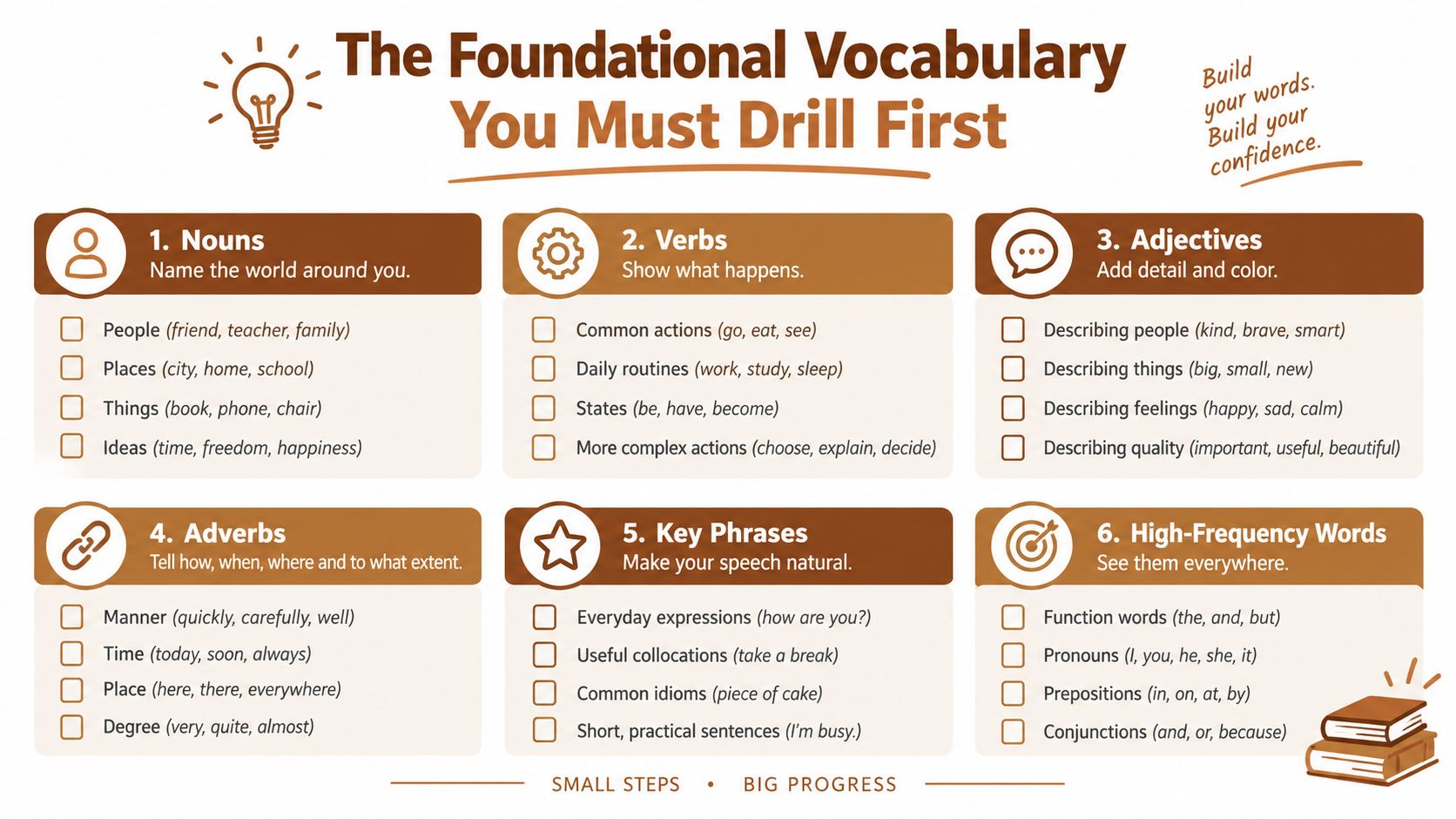
Higher-order radio judgment collapses when basic vocabulary isn't automatic. Students shouldn't spend working memory deciding how to pronounce a letter, separate digits, or format a call sign while also taxiing, navigating, and listening for traffic.
Make letters and numbers unambiguous
Start with the phonetic alphabet, but don't treat it as a poster to memorize once. Record yourself saying the letters that commonly blur under pressure, including Foxtrot, India, Juliett, Mike, and November. Compare the recording with a reliable aviation glossary, then repeat the drill while walking, reviewing a checklist, or listening to simulated traffic.
The FAA's pronunciation conventions also apply to numbers and frequencies. Say each frequency digit and use “POINT” where required. Practice headings, altitudes, transponder codes, and time as separate audio patterns. The objective isn't an accent. It's making each critical digit survive static, cockpit noise, and a busy frequency.
For altitude, use the procedure taught in your operating environment and current FAA guidance rather than inventing shortcuts. Say the assigned altitude clearly, preserve the relevant thousands and hundreds, and don't allow a conversational abbreviation to change the clearance. Treat a transponder code the same way. Read each digit distinctly, then compare it against the assigned code before selecting it.
Build the initial call from four parts
A reliable initial call answers four questions:
- Who are you calling? Name the facility or controller.
- Who are you? Give the full aircraft identification.
- Where are you? State your surface or airborne position when relevant.
- What do you want? Make the request or report.
A student at a non-towered airport might record this practice call:
“Centennial Ground, Skyhawk November One Two Three Four Five, at the east ramp, ready to taxi for a local flight with Information Alpha.”
Don't memorize that sentence as a script. Substitute the actual facility, identification, position, information code, and request. The FAA emphasizes communications that are brief but complete, with no unnecessary chatter, jargon, or nonstandard “CB” language (FAA AIM communications guidance).
Call signs deserve their own drill. Use the full identification on initial contact, and don't abbreviate when another aircraft has a similar-sounding call sign. If a controller is busy, listen for the complete identification before deciding that a transmission belongs to you.
The best same-day exercise is simple: write five facility names, five aircraft call signs, five positions, and five requests on cards. Draw one from each category, pause, press the recorder button, and deliver the call in one attempt. Play it back for missing words, swallowed digits, and unnecessary explanation.
Building and Scoring a Clean Initial Call
Students often evaluate a transmission by tone. Controllers evaluate whether they can act on it. Use a clearance exchange to force that distinction.
Suppose the clearance delivery exchange is:
“Skyhawk One Two Three Four Five, cleared to Kilo Alpha Foxtrot Foxtrot, squawk One Two Zero Zero, expect eight thousand five hundred, departure One Three Four Point Eight Five. Squawk Two Four Six Zero on departure.”
The student should identify and read back the operational elements, not merely say, “Skyhawk Three Four Five, cleared to Kilo Alpha Foxtrot Foxtrot, Roger.”
Score the clearance element by element
A six-element score might include:
- Call sign
- Route or destination
- Expected altitude
- Departure frequency
- Initial transponder code
- Departure transponder code
A student who gets five of six isn't “mostly right” if the missing item is the departure frequency or the code to set after takeoff. One omitted element can force a reissue, create cockpit uncertainty, or lead the pilot to configure the aircraft incorrectly.
Use the table below during every recorded drill.
| Readback Element | Required? | Points | If Missed |
|---|---|---|---|
| Full call sign | Yes | 1 | Repeat the complete identification and listen for correction |
| Route or destination | Yes | 1 | Request the route again and verify the clearance limit |
| Expected altitude | Yes | 1 | Read back the altitude without paraphrasing |
| Departure frequency | Yes | 1 | Ask for the frequency again before leaving the frequency |
| Initial transponder code | Yes | 1 | Recheck the assigned code before setting it |
| Departure transponder code | Yes | 1 | Confirm which code applies after takeoff |
The table isn't a substitute for the actual clearance or applicable procedure. It's a training device that prevents “good enough” scoring.
Use a repeatable recording routine
For each scenario, record the controller transmission once. Wait several seconds, then record the readback without looking at the script. Score one point for each correct item, then mark the exact word or digit that failed. Don't award points for a confident tone or a plausible paraphrase.
A useful remediation loop has three passes:
- Replay the original transmission.
- Write the critical elements from memory.
- Deliver the corrected readback and compare it with the written clearance.
Controller reissues most often become necessary when students miss the altitude, frequency, or transponder code, because each item changes what the pilot does next. The instructor should resist supplying the missing answer immediately. Ask the student to identify which part was uncertain, then request it using plain, standard language.
A clean readback isn't a performance. It's a shared check that the controller and pilot hold the same clearance.
This approach also reveals a different problem from weak phraseology. A student may know every expected word but still lose one number when the message arrives quickly. That student needs listening and number-discrimination drills, not more script memorization.
Readbacks That Catch the Errors ATC Cares About
A readback is a closed-loop verification, not a verbal acknowledgment. “Roger” tells ATC that you received something. It doesn't prove that you understood or will comply with the critical details. FAA guidance specifically distinguishes acknowledgment from accurate compliance, and pilots should clarify anything they don't understand rather than act on an ambiguous instruction (FAA radio communication guidance).
Cosmetic versus verifiable readbacks
Consider the difference:
- Cosmetic: “Roger, Skyhawk Three Four Five.”
- Verifiable: “Skyhawk One Two Three Four Five, cleared to Runway Two Eight Left, taxi via Alpha, hold short Runway Two Eight Right.”
The second transmission gives the controller something to compare. It exposes whether the pilot heard the runway, route, and hold-short restriction.
Use this four-part scoring test for every critical item:
- Correct item: Did the pilot repeat the instruction category?
- Exact value: Did the number, runway, route, or code match?
- Correct order: Did the response make the clearance easy to compare?
- Acknowledgment: Did the pilot identify the aircraft and respond decisively?
The most common student failures are predictable. A pilot paraphrases an altitude, swallows a frequency change while concentrating on taxi, or omits a hold-short instruction because it appears at the end of a long call. Each failure needs a narrow drill.
| ATC Item | Correct Readback | Common Failure | Fix Drill |
|---|---|---|---|
| Altitude | “Climb and maintain seven thousand” | “Going up to seven” | Repeat altitude phrases from random cards |
| Frequency | “Departure on One Two Four Point Five” | “Roger” | Circle every frequency in a script and read only those first |
| Hold short | “Hold short Runway Two Seven” | “Taxi to Runway Two Seven” | Insert hold-short instructions into taxi calls and score them separately |
| Runway | “Cleared to land Runway One Eight” | “Cleared to land” | Pair every landing call with a runway card |
| Heading | “Fly heading Two One Zero” | “Two One Zero” without context | Repeat the action and heading together |
| Transponder | “Squawk Four Six Two One” | Digits reordered | Read codes in groups, then verify against the written assignment |
Now apply the rule to a frequency mistake. If ATC says, “Contact Departure One Two Four Point Five,” and the student reads back “One Two Four Point Four,” the correction belongs on that transmission:
“Correction, Skyhawk One Two Three Four Five, departure One Two Four Point Five.”
If the student notices only after changing frequencies, transmit:
“Departure, Skyhawk One Two Three Four Five, previous frequency was unclear. Confirm departure frequency.”
Don't hide the error with “Roger.” Correct it while the shared context is still fresh.
Recovering When the Frequency Goes Sideways
A busy frequency exposes whether a student learned communication or memorized dialogue. Consider a student in Class C airspace who hears a controller issue a squawk code, reads back a similar but incorrect code, and then hears a similar-sounding aircraft called immediately afterward.
The wrong response is to keep talking until the student feels caught up. The correct response is a decision tree:
- Pause and listen. Determine whether the next transmission is for your aircraft.
- Request clarification. Don't infer a code, heading, or altitude from a partial call.
- Use the full call sign. This helps the controller separate you from the similar aircraft.
- State the uncertainty precisely. Identify the item you missed or may have copied incorrectly.
- Ask for explicit confirmation. Verify before selecting, turning, climbing, descending, or entering a runway.
Match the recovery phrase to the failure
Use these scripts in practice, then vary the details so the student learns the decision rather than the sentence.
- Wrong readback: “Correction, Skyhawk One Two Three Four Five, squawk Four Six Two One.”
- Stepped-on transmission: “Departure, Skyhawk One Two Three Four Five, say again the last transmission.”
- Lost frequency change: “Center, Skyhawk One Two Three Four Five, confirm next frequency.”
- Blocked call: “Skyhawk One Two Three Four Five, transmission was blocked. Say again.”
- Unsure call sign: “Approach, Skyhawk One Two Three Four Five, confirm that call was for Skyhawk One Two Three Four Five.”
- Unclear instruction: “Approach, Skyhawk One Two Three Four Five, unable to understand the last instruction. Say again slowly.”
Use “say again” when you need the transmission repeated. Use “verify” when you heard a specific item but need confirmation. Use “request clarification” when the words were audible but the meaning, limit, or required action remains uncertain.
Train the four failure categories
Identification failure requires similar-call-sign drills. Play two aircraft identifiers and make the student wait for the complete call sign before responding.
Comprehension failure requires audio variation. Use different speaking rates, accents, static, and partial reception, then score whether the student asks for help rather than guessing.
Readback failure requires randomized clearance cards. Change the runway, altitude, heading, route, and frequency so memorized dialogue stops working.
Channel-discipline failure requires congestion drills. Make the student listen for a pause, avoid stepping on another transmission, and keep the correction concise.
A defensible proficiency rule is 100% accuracy on safety-critical readback elements across repeated randomized scenarios, with no reliance on memorized scripts. The FAA also specifies brief, complete communications and supports clarification as a normal safety behavior.
If the transmission wasn't understood, nothing was communicated. Say so plainly before the aircraft acts on it.
A Four-Week Practice Plan You Can Run on the Ground
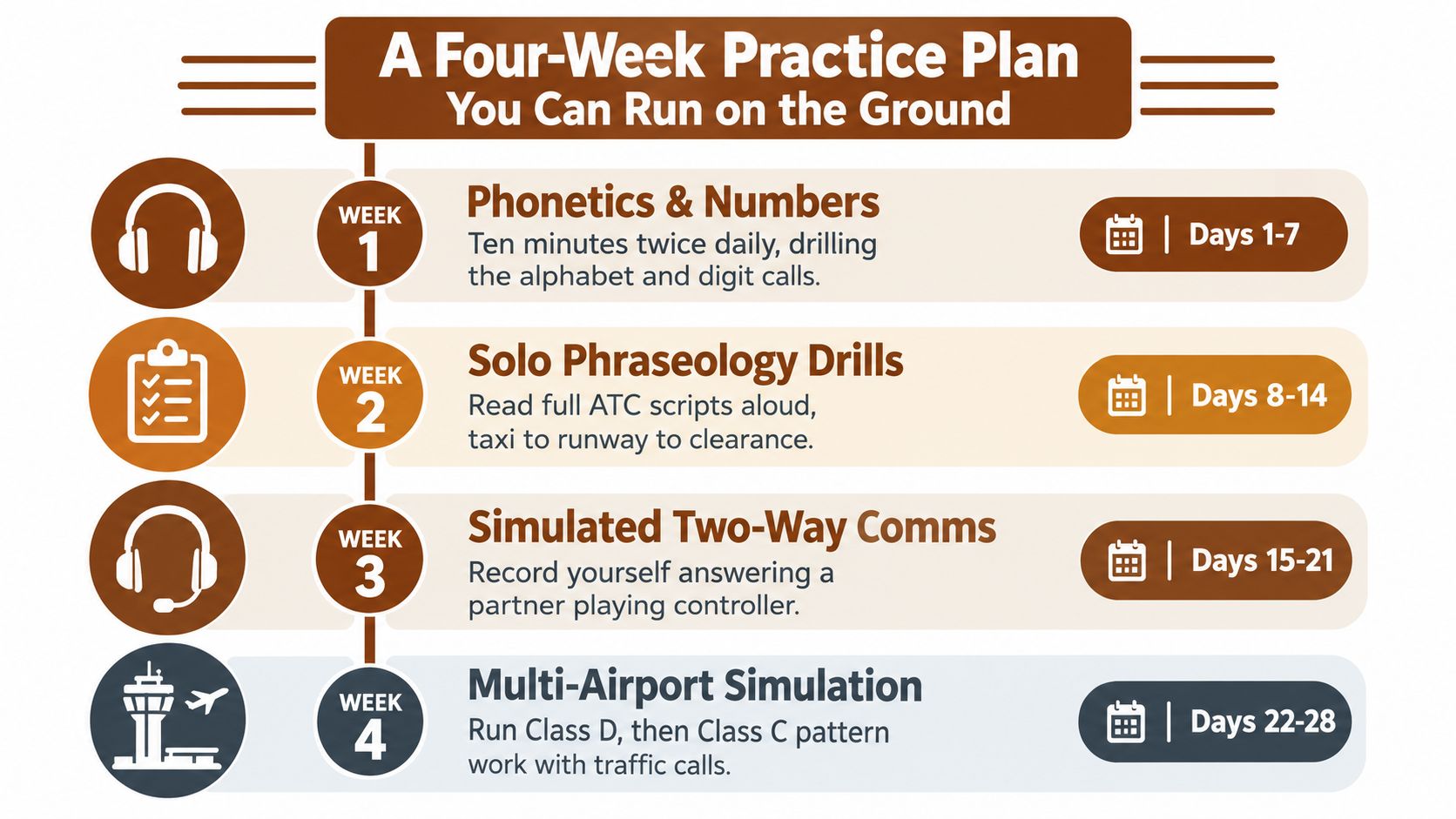
A useful radio etiquette training plan starts with production, adds comprehension, and then makes recovery the main test. Keep each session to 20 to 30 minutes, with short rest periods between drills. Fatigue makes students repeat an error while mistaking repetition for fluency.
Week 1 builds vocabulary and number accuracy
Drill phonetics, numerals, frequencies, headings, altitudes, and transponder codes. Spend 10 minutes twice daily recording short sequences, then compare what was spoken with the written card. Use a partner, timer, or audio prompts, but keep the answer covered during the transmission.
The pass condition is accuracy, not speed. The student should pronounce each digit distinctly, preserve the aircraft identification, and catch a mismatch between the spoken sequence and the written one.
Week 2 adds initial calls and readbacks
Construct calls from facility, aircraft, position, and request. Add clearance readbacks and score each safety-critical element separately. Begin with scripted transmissions, then vary the airport, runway, aircraft, and request so the student cannot recite one familiar exchange.
Keep an error log after every session:
- Missing call sign
- Omitted position
- Incorrect number
- Unclear request
- Incomplete readback
Use the log to choose the next drill. Practice time should follow the student's actual errors, not be divided evenly among skills already performed reliably.
Week 3 introduces deliberate disruption
Have a partner act as the controller while adding stepped-on calls, similar call signs, partial reception, and unclear instructions. The student must pause, listen, identify what is uncertain, and choose among “say again,” “verify,” or a clarification request.
This work matters more than another phraseology worksheet when the student freezes after an imperfect transmission. The drill supplies a specific action once the expected script fails. Recovery is the skill being trained, not an interruption to the lesson.
Week 4 combines frequencies and decisions
Run complete scenarios through ground, tower, and approach-style contacts. Vary airport layouts, traffic calls, taxi restrictions, departure frequencies, and unexpected corrections. A CFI or partner should review the recording and mark whether the student identified the correct aircraft, captured the critical information, and waited to act until uncertainty was resolved.
Advance only when the student records fewer than one readback error per ten transmissions for two consecutive sessions. This threshold is a training gate, not an FAA certification standard. Apply it to randomized scenarios, not memorized scripts.
Record controller prompts on a phone and respond without viewing a transcript. Students preparing for the knowledge test alongside radio practice can use a dedicated FAA written test prep course to keep both tracks on schedule. flyCowboys also offers an iPhone platform combining FAA knowledge preparation with an AI “Talk to Tower” feature for practicing ATC phraseology and radio calls. Pair app drills with real clearance review and CFI feedback, because simulated success does not replace operational judgment.
Pre-Flight Radio Checklist and Final Takeaways
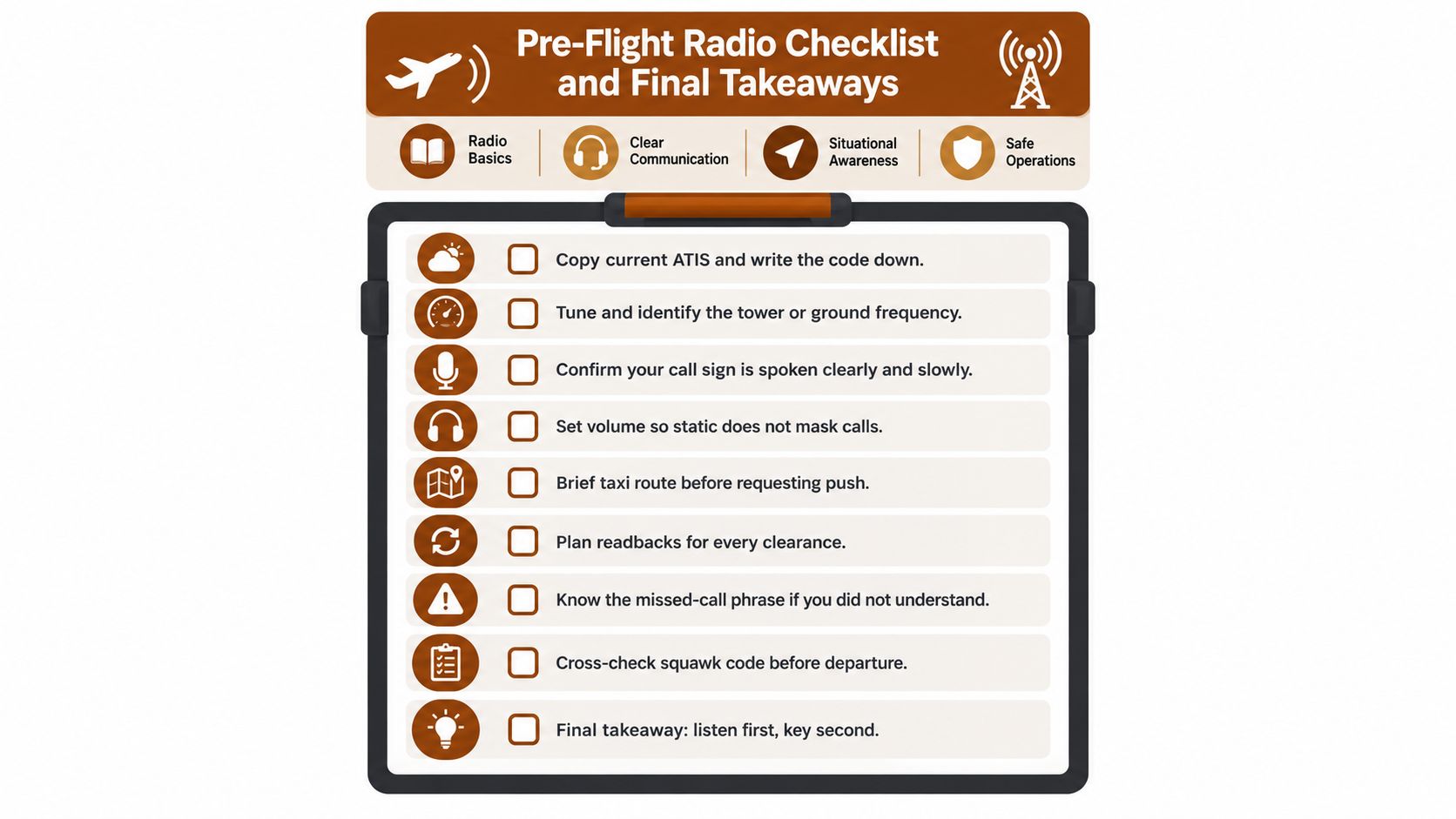
A kneeboard checklist should target specific communication failures. Run it before taxi:
- Copy the current ATIS and write down the code. Record the runway, weather, and airport information already broadcast.
- Set and identify the first expected frequency. Avoid searching for it while moving on the surface.
- Set the audio panel and volume before engine start. Incorrect audio selection or static can hide the opening words of a call.
- Confirm the full call sign. Note similar-sounding aircraft and any likely abbreviated identifier.
- Brief your position. Know the ramp, taxiway, intersection, or reporting point you will report.
- Review the four-part initial call. State facility, aircraft, position, and request.
- Mark expected readbacks. Flag the runway, route, altitude, heading, frequency, hold-short instruction, and code that require verification.
- Plan the recovery phrase. Use “say again,” “verify,” or a clarification request instead of guessing.
- Cross-check the transponder code. Compare the assigned code with the selected code before departure.
- Listen before transmitting. Avoid blocking another aircraft and use the traffic already on the frequency.
The FAA's communication expectations include intelligible speech, accurate comprehension, standard phraseology, and repair when a message is incomplete or misunderstood. The checklist turns those expectations into cockpit actions, especially when a call is blocked, a call sign sounds similar, or only part of an instruction reaches the cockpit.
Keep the debrief concrete
After each flight, log the exchange that required the most attention. Write the instruction as heard, your readback, the missing or incorrect detail, and the question you should have asked. Bring repeated failures to your CFI. Vague confidence-building will not correct a missed hold-short instruction or an incomplete clearance.
Record controller prompts on a phone and respond without viewing a transcript. Students studying for the knowledge test can use a dedicated FAA written test prep course alongside radio practice. flyCowboys also offers an iPhone platform that combines FAA knowledge preparation with an AI “Talk to Tower” feature for ATC phraseology and radio calls. Pair app drills with clearance review and CFI feedback, because simulated success does not replace operational judgment.
Keep three rules on the kneeboard:
- Recovery is a trained skill. Practice blocked calls, ambiguity, similar call signs, and partial reception.
- Completeness matters more than polish. Check every safety-critical value.
- Uncertainty requires a transmission. Ask ATC before acting.
Radio etiquette training works when it prepares you for a call that arrives incomplete. Practice recovery on the ground, measure readbacks in the cockpit, and debrief every moment when guessing nearly replaced clarification.
flyCowboys combines FAA knowledge-test preparation with adaptive study and “Talk to Tower” AI drills. Visit flyCowboys to add structured radio practice to private pilot or instrument training.