· 15 min read
FAA Written Exam: Structure, Scoring, and Prep Strategies
Master the FAA written exam with a clear breakdown of structure, scoring, PSI interface, scheduling, and prep strategies that actually move your readiness
The FAA written exam is a 60-question, 2-hour, 70-percent-pass multiple-choice test, and for the Private Pilot and Instrument Rating paths it's governed by the Airman Certification Standards. If you know that structure early, your prep stops being random and starts looking like a plan.
That matters on the day you sit down at PSI, because the exam rewards broad coverage, not lucky guessing in one favorite topic. The smartest students don't just chase a practice score, they learn how the test is built, what the score report means, and where their weak areas live inside the ACS.
Table of Contents
- What the FAA Written Exam Tests
- Inside the PSI Testing Center
- Reading the FAA's Own Pass-Rate Signals
- Mapping ACS Knowledge Areas to Real Study Moves
- Why a Higher Practice Score Isn't Always Better Prep
- A 23-Day Study Plan Built Around the ACS
- After the Results Email Arrives
What the FAA Written Exam Tests
The FAA's testing matrix lays out the exam clearly. For both PAR and IRA, the test uses 60 questions, lasts 2.0 hours, and requires a 70 percent passing score, with a minimum test age of 15 for the private pilot category, while the other certificate requirements still apply separately FAA testing matrix. That makes the written exam a standardized knowledge check, not a trivia quiz or a reading test. It asks whether you can work through aviation problems the way a pilot needs to.
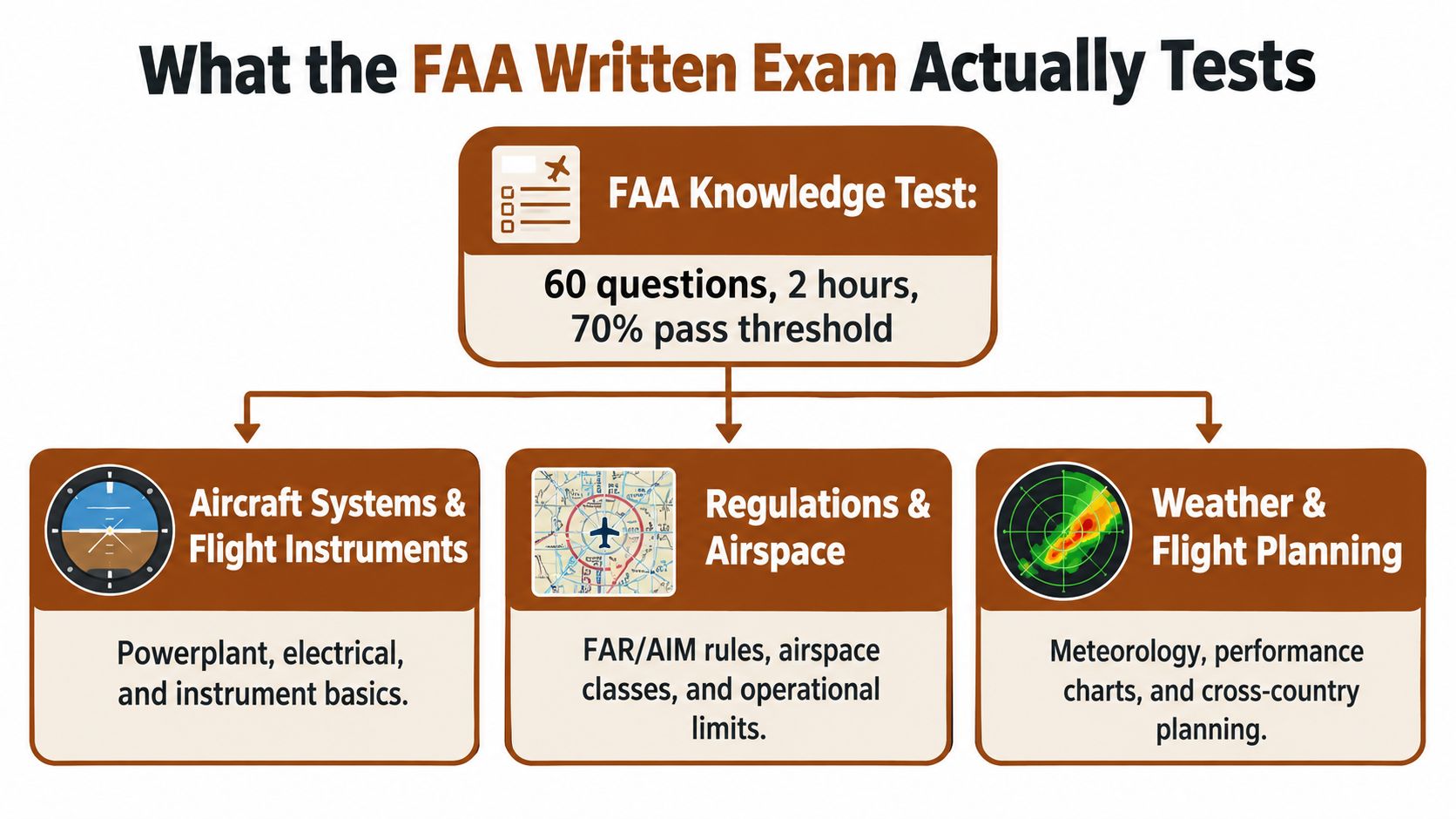
Each question has one correct response, and the questions are independent FAA testing matrix. A missed weather question does not spill into the next one. Scoring works item by item, so a strong area in weight and balance cannot cover a hole in a weak weather habit if the misses land in the wrong parts of the blueprint.
What the ACS blueprint means in plain English
The Private Pilot ACS spreads tested knowledge across regulations and accident reporting, performance charts, radio communications, weather, safe and efficient operations, density-altitude performance, weight and balance, aerodynamics, powerplants and aircraft systems, stalls and spins, aeronautical decision-making, and preflight actions Private Pilot ACS. Each area gets a meaningful slice of the test, so one favorite topic cannot carry the whole score.
The better study move is to match your prep to those areas. If regulations feel shaky, use the ACS to find the exact rule set behind the miss. If weather questions keep slipping, treat each wrong answer like a clue about interpretation, not a sign to memorize more random facts.
Practical rule: if you only study the topics you like, you leave holes elsewhere. Passing comes from broad coverage, not a narrow specialty.
The instrument side follows the same logic. The IRA still uses the same 60-question, 2-hour, 70-percent format, but the content pushes harder on interpretation, procedures, and operational judgment FAA ACS knowledge test table. The same FAA testing matrix also says the questions stand alone, which is why your review should focus on the deficient-area codes you see after the test. Those codes point straight back to the ACS areas that need work, and they give your next study session a target instead of a guess.

Inside the PSI Testing Center
Test day feels less mysterious once you can picture the room. You check in at the desk, a proctor confirms your identity, your personal items go away, and you're escorted to a computer terminal. The timer doesn't start until you begin, so the first minutes are about setup and settling your nerves, not solving questions under pressure.
At most centers, you'll be asked for the identification documents the testing site requires, then you'll store your belongings in a locker or other secured space. Phones, notes, and other outside materials stay out of reach, which is why students who arrive organized usually feel calmer right away. The room itself is quiet, controlled, and a little more formal than a classroom, which is exactly why the exam feels different from practice at home.
What the screen usually feels like
The screen layout is built for focus. You move through one question at a time, can flag items for review, and later return to a review screen that shows what you marked. A scratch area or note board is usually available for working through chart logic, simple math, or a quick cross-check of options.
That setup matters because it changes how you should pace yourself. If you get stuck, flag it and move on instead of burning five minutes on one item. The objective is to keep momentum and preserve mental energy for the questions you can still solve cleanly.
A few small details catch first-timers off guard. The headphones can make the room feel oddly insulated, the proctor can see your session from a monitor, and the end-of-test survey appears after the last question, so the experience doesn't just vanish when you click the final answer.
The FAA knowledge-test environment is also easier to handle when you've already seen the style of interface in practice. For a grounded walkthrough of that kind of prep, flyCowboys offers PSI-style practice exams and written-test study tools that mirror the way the session feels. That doesn't replace learning the material, but it does reduce the "first time at the terminal" shock.
You're not trying to feel perfect in the testing center. You're trying to feel familiar.
Reading the FAA's Own Pass-Rate Signals
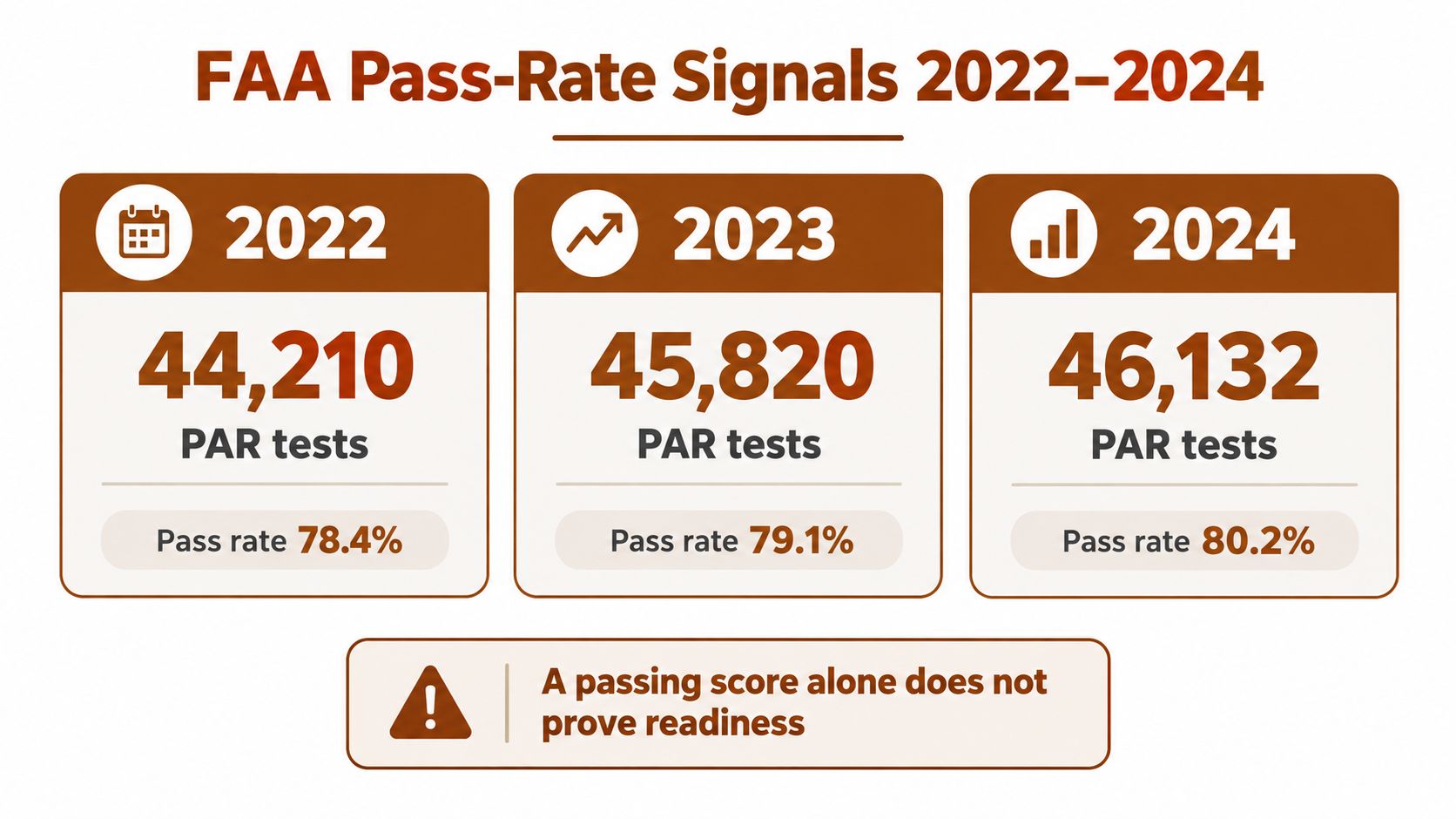
A candidate who leaves the PSI center feeling unsure often thinks the exam was unusually hard. The FAA's recent PAR data suggests a different picture. In the 2024 AKT volume report, PAR volume grew from 45,820 tests in 2023 to 46,132 in 2024, while the first-attempt pass rate rose from 90.30 percent to 91.90 percent and the average score moved from 82.05 percent to 82.89 percent.
Why the average score matters less than the shape of your misses
The same report shows the annual pass rate stayed in a narrow 89.83–91.90 percent range across 2022–2024. That points to a test with a steady difficulty profile, not a moving target that changes shape from month to month.
A lot of students still read the score report the wrong way. A 78 percent can hide a cluster of misses in weather or regulations, and an 88 percent can still leave a weak spot in a high-value ACS area. The total score matters, but it does not tell you which knowledge block needs work.
A better readiness signal is consistency across the ACS. A student who can explain weather, performance, and airspace on different days is usually in stronger shape than someone who memorized one question bank and hit a nice score once. The exam rewards that kind of coverage because the deficient-area codes on the results email point to what broke down, much like a hangar inspection tag tells you which system needs attention rather than whether the airplane looked good at a glance.
Practical takeaway: the FAA's data says the exam is passable. Your job is to make weak areas visible before they show up in the deficient-area codes.
Mapping ACS Knowledge Areas to Real Study Moves
The ACS is easiest to use when you stop treating it like a list and start treating it like a drill plan. A student who studies “weather” as one giant topic usually gets vague. A student who splits weather into METARs, TAFs, fronts, icing, and performance impact gets specific, and specificity is what sticks.
Turn each category into a repeatable habit
For private pilot candidates, the biggest wins usually come from regulations, performance charts, weight and balance, density altitude, aerodynamics, stalls and spins, weather interpretation, navigation, and radio communications. For instrument candidates, add clearances, holds, and approach plates, because those topics demand procedural fluency, not just recognition.
A good drill looks boring on purpose. Decode one METAR every morning. Work one weight-and-balance scenario at night. Read one airspace question out loud and say why each wrong choice fails before you pick the right one.
| ACS Area | Why Candidates Miss It | Best Drill |
|---|---|---|
| Weather | They memorize terms without interpreting the report | Decode a METAR and TAF together, then explain the flight decision in plain language |
| Weight and Balance | They rush the math and ignore loading context | Solve one loading scenario from scratch, then check the CG result against the limits |
| IFR Holds and Clearances | They know the words but not the sequence | Read a clearance aloud, then draw the hold entry or approach flow on paper |
The strongest study systems also tie the topics together. A performance chart question gets easier when you connect it to density altitude. A radio call becomes cleaner when you already understand the procedure behind it. If you want a compact ACS reference while you study, the Private Pilot ACS overview is a useful companion to the FAA documents themselves.
Why a Higher Practice Score Isn't Always Better Prep
A bigger practice score can hide the wrong kind of progress. A student may retake mock tests until the number looks reassuring, while the same weak point keeps surfacing underneath. If that weak point sits in a core ACS area, the score looks better than the readiness is.
The FAA's retake rule changes the calculation too. If you retake the same test to earn a higher passing score, you must wait 30 days from the previous attempt and show the applicable Airman Knowledge Test Report with the earlier passing score to the proctor FAA testing matrix. That delay can disrupt a training timeline, which is why a marginal pass can create practical problems even when it is valid on paper.
Read the report, not just the number
The FAA's June 2025 community advisory adds another layer. It says only 31 of its 89 airman knowledge tests showed ACS codes on the matching test reports, so some applicants leave with a score sheet that does not clearly point back to the standard FAA community advisory. That is why the report matters. Keep it, record each deficient code if it appears, and match it to the current ACS instead of trusting memory.
The better habit is to look for patterns in the misses. Weather misses may mean you are slow decoding reports, or they may mean you do not understand the decision the report supports. Regulations misses can come from airspace, privileges, or operating rules. Each one calls for a different drill.
Readiness is not perfection. It means knowing which mistakes repeat and how to remove them.
A practice score also cannot tell you whether you are studying the right material. A student can hit a passing number by memorizing familiar questions, then miss the same ACS area again on test day. That is why a tighter study loop starts with deficient-area codes and moves outward from there. If you want a reference built around that kind of prep, see this FAA written test guide for a PSI-style study approach.
A 23-Day Study Plan Built Around the ACS
A short daily routine beats a cram session for most students because it keeps the material active. The pace does not need to be extreme. About 15 minutes a day can build momentum if the work stays focused, cumulative, and tied to the ACS rather than to random question streaks.
Days 1 to 7 build the baseline
Start with a diagnostic that shows where you are weak, not just where you feel uncertain. Take one full practice set under timed conditions, then sort every miss by ACS area. That first pass gives you the list you will revisit all month, and it keeps you from spending time on topics you already have under control.
After the diagnostic, rotate the study blocks. One day for weather interpretation, one day for performance and weight and balance, one day for regulations and airspace, then back through the cycle. Short, repeated exposure works better than one long sitting because the FAA written exam covers broad ground, one question at a time.
Days 8 to 15 tighten the weak areas
This middle stretch is where students often improve fastest. Use spaced repetition, but keep it tied to application. A missed weather item should turn into another weather scenario, not just another flashcard.
A student who keeps missing airspace questions usually does not need more random practice items. They need to trace the rule to the airspace class, the equipment, or the operating limit that the question is testing. The same pattern applies to performance, regulations, and weight and balance. Each miss should point to a specific ACS area and a specific correction.
On the final day of this block, review the ACS gaps you keep missing and ask one blunt question, can you explain why the correct answer is correct without looking at the key? If not, the topic still needs work. That is the moment to slow down and fix the pattern instead of collecting more practice questions.
Days 16 to 23 make it feel real
Run a full-length practice exam in PSI-style timing during the third week, then review the misses by category. The point is not to chase a perfect score. The point is to see whether your pace, stamina, and decision-making hold together under the clock.
The last few days are logistics and final polish:
- Verify ID and appointment details: Make sure the documents and test code match the appointment.
- Review your weak ACS areas once more: Focus on the codes or topic clusters that caused repeat misses.
- Pack the night before: Keep the test-day routine simple so you are not improvising in the morning.
- Check travel time to the center: Arriving early beats arriving rushed.
If you want a single-study-platform version of that cadence, flyCowboys's practice workflow follows a similar 23-day rhythm and keeps the emphasis on ACS coverage instead of score chasing.
By test day, you are not looking for a miracle score. You are looking for a calm, repeatable process that has already worked more than once.
After the Results Email Arrives
The score report matters because it shows where the next round of study should begin. If it includes deficient-area codes, treat them as directions, not a verdict. Each code points back to an ACS area, which tells you whether the gap sits in weather, procedures, performance, or another specific skill.
A useful habit is to write the codes beside your training notes and match each one to the current ACS language. That step matters because a label alone can hide the underlying issue. If the miss was a weather question, the fix is weather planning and interpretation. If it was procedural, review the sequence until you can explain each step without guessing.
If you passed without obvious deficiency codes, keep the report anyway. A passing score gets you through the test, but it does not tell you whether every answer felt solid. A student who can mark the right box but cannot defend the choice will usually feel that gap later in the oral.
The 30-day retake wait discussed earlier still applies here. Use that time to decide whether a retake helps your training timeline, then focus on the exact ACS areas that caused the miss. The smartest move is usually simple: save the report, name the weak area, and build the next study block around that code instead of chasing a bigger number.
If you want a clear rule after the results email arrives, use this one. A good retake decision comes from the deficient-area codes and your ability to explain the correct answer, not from the scoreboard alone.