· 9 min read
FAA Medical Certificate vs BasicMed (What Student Pilots Need)
How first-, second-, and third-class FAA medical certificates work under 14 CFR 61.23, how long they last, and how BasicMed differs for student pilots.
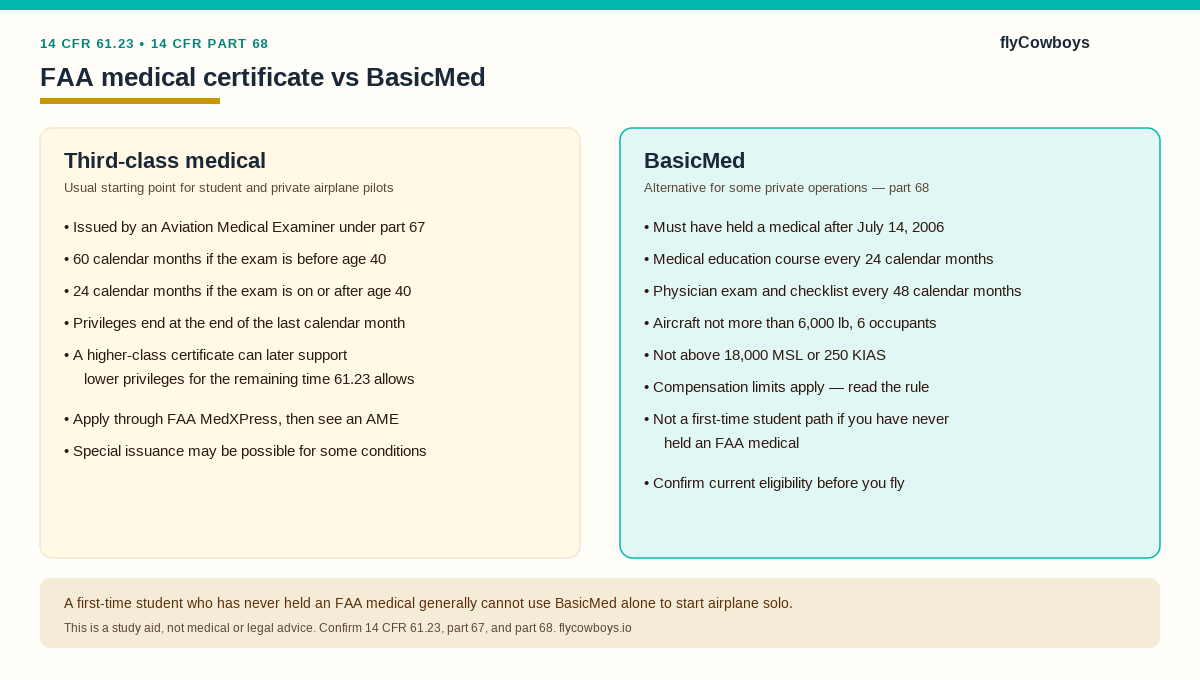
Most student and private airplane pilots need an FAA medical certificate issued by an Aviation Medical Examiner. A third-class medical is the usual starting point. Under 14 CFR 61.23, a third-class medical is valid for 60 calendar months if the exam is before age 40, and 24 calendar months if the exam is on or after the 40th birthday. First- and second-class certificates have shorter periods for their higher privileges, and may later be used for lower privileges for the remaining time the rule allows.
BasicMed is a separate program under 14 CFR part 68. It can let some pilots fly certain aircraft without a current medical certificate, but only if they have held a qualifying medical after July 14, 2006, complete the education and physician exam on schedule, and stay within the aircraft and operating limits. A first-time student who has never held an FAA medical generally cannot use BasicMed alone to start airplane solo.
What an FAA medical certificate is
For most people learning to fly an airplane, an FAA medical certificate is the aviation medical issued by an FAA-designated Aviation Medical Examiner (AME) under 14 CFR 61.23 and part 67. There are three classes. The class you need depends on the privileges you intend to exercise, and a higher class can also be used for lower privileges after those higher privileges expire, for the remainder of the time the certificate is valid as a lower class. Read the current text of 14 CFR 61.23 for the exact durations; they are measured in calendar months from the date of the exam.
| Certificate | Typical privileges | Duration of those privileges (summary of 61.23) |
|---|---|---|
| First class | Airline transport pilot operations that require a first-class medical | 12 calendar months if the exam is before the applicant's 40th birthday; 6 calendar months if the exam is on or after the 40th birthday. After those privileges lapse, the same certificate may still be valid as a second- or third-class medical for the remaining time allowed in 61.23. |
| Second class | Commercial pilot operations that require a second-class medical | 12 calendar months for commercial privileges, regardless of age, then possibly valid as a third-class medical for the remaining time allowed in 61.23. |
| Third class | Private, recreational, and student pilot privileges (other than pathways that use BasicMed or a driver's license) | 60 calendar months if the exam is before the applicant's 40th birthday; 24 calendar months if the exam is on or after the 40th birthday. |
Those periods end at the end of the calendar month, not on the same date the exam was done a set number of days later. A third-class exam on January 15 for a 30-year-old remains valid, for those third-class privileges, through the end of January five years later, under the current 60-month rule. Confirm the date on your own certificate and in 61.23; do not rely on a memory of "two years" or "five years" without checking age and class.
BasicMed is an alternative, not a first medical
BasicMed, in 14 CFR part 68 and 61.23, lets some pilots exercise certain private-pilot privileges without holding a current FAA medical certificate. It is not a free pass, and it is usually not the starting point for a brand-new student.
To use BasicMed you must, among other things:
- Have held an FAA medical certificate after July 14, 2006, and not have had it revoked, suspended, or withdrawn (see the current rule for the exact conditions).
- Complete a medical education course every 24 calendar months.
- Receive a comprehensive medical examination from a state-licensed physician and complete the Comprehensive Medical Examination Checklist every 48 calendar months.
- Comply with the aircraft and operating limits in the rule, including an aircraft with a maximum certificated takeoff weight of not more than 6,000 pounds and not more than six occupants, flight not above 18,000 feet MSL, and not more than 250 knots indicated airspeed, and not flying for compensation or hire except as the regulation specifically allows.
Because BasicMed requires that you have held a medical after July 14, 2006, a first-time student who has never been issued an FAA medical generally cannot start training solo in a standard airplane on BasicMed alone. That student typically gets at least a third-class medical (or uses another pathway the regulations allow, such as a sport-pilot path with a U.S. driver's license in an eligible light-sport aircraft). After you have held a qualifying medical, BasicMed may become an option later if you meet every other requirement. See student pilot certificate and private pilot requirements for how the certificate and the medical fit together.
How to get a medical certificate
- Create or log into your MedXPress account and complete the application before you see the AME.
- Find an FAA-designated Aviation Medical Examiner and book an exam for the class you need. Most student and private pilots start with a third-class exam.
- Bring identification, glasses or contacts if you use them, and a list of medications and medical history. Be honest. Incomplete or inaccurate answers can cause bigger problems than a known condition that can be certified.
- If the AME issues the certificate, carry it when you act as pilot in command as required, and know the expiration of the privileges you are using. If the AME defers the decision to the FAA, follow the FAA correspondence and do not exercise privileges that require the medical until it is issued.
What disqualifies a person is a medical-legal question that depends on the condition, the class of certificate, and sometimes a special issuance. This page will not list every disqualifying condition. If you have a known medical issue, talk to an AME before you spend heavily on flight training, and use official FAA medical guidance rather than forum anecdotes.
Operations that do not require a medical certificate
Not every flight requires an FAA medical. Examples that often come up, each with its own limits in 14 CFR 61.23 and related rules, include: acting as a required crewmember in a balloon or glider in some cases; exercising sport-pilot privileges with a U.S. driver's license in lieu of a medical when you meet the sport-pilot rule; and exercising certain privileges under BasicMed as described above. You still need the correct pilot certificate, endorsements, and aircraft eligibility. Do not assume "no medical" means "no requirements."
How this shows up on the FAA knowledge test and oral
Written-test and oral questions usually ask how long a third-class medical is valid for a given age, whether a first-class certificate can later be used for private privileges, or what BasicMed does and does not allow. Traps include:
- Using 24 months for a 30-year-old third-class medical (the current third-class period under 40 is 60 calendar months).
- Counting duration from the exam date in days instead of calendar months.
- Thinking a new student can start airplane solo on BasicMed without ever having held a medical.
- Ignoring BasicMed aircraft, altitude, speed, and compensation limits.
- Forgetting that a first-class certificate can later support lower privileges for the remainder of the time allowed in 61.23.
This topic also shows up in private pilot checkride questions under certificates and documents. Practice the duration rules with a FAA practice test.
Sources
14 CFR 61.23 (medical certificates: requirement and duration), 14 CFR part 67 (medical standards), 14 CFR part 68 (BasicMed), and current FAA guidance for AMEs and BasicMed. Durations and eligibility change only by regulation; always confirm the current text and the dates on your own certificate. This page is a study aid, not medical or legal advice.
Frequently Asked Questions
How long do FAA medical certificates typically last?
It depends on the class of certificate, the privileges you are exercising, and your age at the exam, as set out in 14 CFR 61.23. A third-class medical is currently valid for 60 calendar months if the exam is before age 40, and 24 calendar months if the exam is on or after the 40th birthday. Second-class commercial privileges last 12 calendar months. First-class ATP privileges last 12 calendar months if the exam is before age 40, and 6 calendar months on or after age 40. Privileges end at the end of the calendar month.
What medical certificate does a student pilot need?
To solo a standard airplane, a student typically needs at least a third-class medical (or another pathway the regulations specifically allow). A first-time student who has never held an FAA medical usually cannot use BasicMed for that first solo, because BasicMed requires having held a medical after July 14, 2006. Sport-pilot privileges have a different medical or driver-license path. Confirm the path you are training under with your instructor.
What is BasicMed?
BasicMed is an alternative to holding a current FAA medical certificate for certain private operations, described in 14 CFR part 68 and 61.23. You must have held a qualifying medical after July 14, 2006, complete a medical education course every 24 calendar months, complete a physician exam and checklist every 48 calendar months, and stay within the aircraft and operating limits, including weight, passenger count, altitude, speed, and compensation rules.
What aircraft can I fly without a medical certificate?
It depends on the privilege you are exercising. Possibilities in the current rules include some glider and balloon operations, sport-pilot operations with a U.S. driver license in an eligible aircraft, and BasicMed operations if you meet every BasicMed requirement. Each path has limits. Read 14 CFR 61.23 and the rule that applies to the certificate you hold.
How do I check my FAA medical status?
Look at the certificate the AME issued and the expiration of the privileges you want to use under 14 CFR 61.23. Applications and correspondence go through FAA MedXPress and, when needed, the FAA medical office. The FAA also provides official tools and contact information for medical certification questions. This site cannot look up your medical record.
What disqualifies you from a first-class medical?
Medical standards are in 14 CFR part 67 and in FAA medical guidance. Whether a condition can be certified, sometimes through a special issuance, depends on the facts. See an Aviation Medical Examiner for a condition-specific answer rather than relying on a general article or a forum post.