· 10 min read
Holding Pattern Entries: Direct, Teardrop, and Parallel (AIM 5-3-8)
How to choose a direct, teardrop, or parallel holding entry under AIM 5-3-8, including standard vs nonstandard turns, holding speeds, and leg timing.
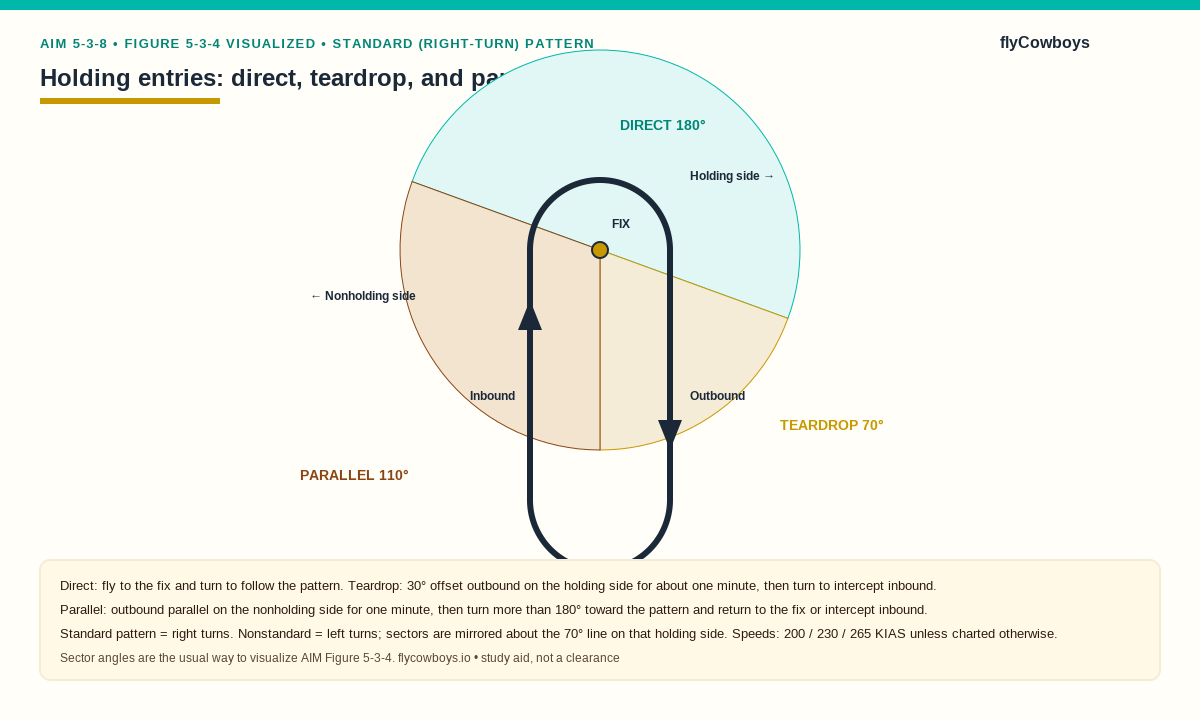
AIM 5-3-8 recommends three holding pattern entries: direct, teardrop, and parallel. A standard pattern uses right turns; a nonstandard pattern uses left turns. The usual way to visualize AIM Figure 5-3-4 is a 70-degree teardrop sector on the holding side, a 110-degree parallel sector on the nonholding side, and a 180-degree direct sector.
Maximum holding speeds, unless a charted restriction or exception applies, are 200 KIAS through 6,000 feet MSL, 230 KIAS from 6,001 to 14,000, and 265 KIAS above 14,000. Time the inbound leg for 1 minute at or below 14,000 feet and 1.5 minutes above, unless a DME or RNAV leg is assigned. Be at or below the applicable speed before you first cross the fix.
The three recommended entries
When ATC clears you to hold, or a procedure publishes a hold, you fly a racetrack pattern at a fix: an inbound leg to the fix, a turn, an outbound leg, and a turn back to intercept the inbound course. AIM 5-3-8 recommends three entry procedures — direct, teardrop, and parallel — so you can join that pattern and stay inside protected airspace. Other entries may work, but these three are the ones the protected airspace was designed around, and they are what the instrument knowledge test and the instrument ACS expect.
A standard pattern uses right turns. A nonstandard pattern uses left turns. If no turn direction is assigned or charted, use a standard (right-turn) pattern. Entry sectors for a nonstandard hold are oriented to the 70-degree line on the holding side, just as they are in a standard pattern (AIM 5-3-8).
How to visualize the sectors
AIM Figure 5-3-4 divides arrivals to the fix into sector (a) parallel, sector (b) teardrop, and sector (c) direct, with a 70-degree line drawn on the holding side. Instructors usually translate that figure into three wedges at the fix:
| Entry | Sector (standard hold) | What you do after crossing the fix |
|---|---|---|
| Direct | The remaining 180-degree sector (sector (c)) | Fly to the fix and turn to follow the holding pattern. |
| Teardrop | About 70 degrees on the holding side, next to the outbound course (sector (b)) | Turn outbound to a heading 30 degrees from the holding course, on the holding side, for about one minute, then turn in the direction of the pattern to intercept the inbound course. |
| Parallel | About 110 degrees on the nonholding side (sector (a)) | Turn to a heading that parallels the holding course outbound on the nonholding side for one minute, then turn in the direction of the pattern through more than 180 degrees and return to the fix or intercept the inbound course. |
AIM 5-3-8 notes that a heading within 5 degrees of a sector boundary is within good operating practice for choosing an entry. If you are right on the line, pick the entry you can fly cleanly and stay on the protected side.
A common cockpit method is to put the inbound holding course on the heading indicator (or visualize it on the HSI), draw the 70-degree line on the holding side, and see which sector your arrival heading falls in. Another teaching aid is the "thumb method" on a heading indicator: use the right thumb for a standard (right-turn) hold and the left thumb for a nonstandard hold. Use whichever method your instructor taught, and then confirm it against the AIM figure — mnemonics are not a substitute for the published procedure.
Worked example
You are cleared to hold south of a VOR on the 180-degree radial, standard turns, 3,000 feet. The inbound holding course is 360 degrees (you fly north to the fix, then turn right to the south outbound). If you arrive at the fix on a heading of 360, you are essentially already inbound and a direct entry is the natural fit: cross the fix and turn right outbound. If you arrive from the southwest on a heading that falls in the 70-degree teardrop wedge, you cross the fix, fly a 30-degree teardrop heading on the holding side for about a minute, then turn right to intercept the inbound 360 course. If you arrive from the east-southeast in the parallel sector, you cross the fix, fly outbound parallel on the nonholding side for a minute, then turn right through more than 180 degrees back to the fix or the inbound course.
Airspeed, timing, and the clearance itself
AIM Table 5-3-24 (maximum holding airspeeds for civil aircraft, unless a charted restriction or exception applies):
| Altitude (MSL) | Maximum holding airspeed (KIAS) |
|---|---|
| Minimum holding altitude through 6,000 feet | 200 |
| 6,001 through 14,000 feet | 230 |
| 14,001 feet and above | 265 |
A charted speed, such as (175), or a 210 KIAS restriction depicted by an icon, overrides the table. Be at or below the applicable maximum before you first cross the fix. If you cannot comply, tell ATC. When you are 3 minutes or less from a clearance limit and have no clearance beyond it, start slowing so you will cross the fix at or below the maximum holding speed (AIM 5-3-8).
Timing: at or below 14,000 feet MSL the inbound leg is 1 minute; above 14,000 feet it is 1.5 minutes, unless a DME or RNAV leg length is published or assigned. Fly the first outbound leg for that same time, then adjust later outbound legs so the inbound leg comes out at the correct time. When holding at a VOR, start the outbound turn at the first complete reversal of the TO/FROM flag.
If the pattern is charted and ATC does not issue complete instructions, hold as depicted. They may say, for example, "hold east as published." If the pattern is not charted, the clearance should include the direction of holding from the fix, the fix, the radial or course, the leg length or time if used, and an expect-further-clearance (EFC) time. If you arrive at a fix without holding instructions, ask before you get there. If you cannot get them, AIM 5-3-8 says to enter a standard pattern on the course on which you approached the fix and request further clearance as soon as possible.
Report reaching the clearance limit (time and altitude) and report leaving it. In a lost-communications situation, follow 14 CFR 91.185 and the EFC; our squawk codes guide covers 7600.
How this shows up on the FAA knowledge test and the instrument oral
Instrument written questions ask you to pick the entry from a heading and a hold depiction, recall 200 / 230 / 265, or choose 1-minute versus 1.5-minute legs. Orals add wind correction, a published speed restriction, and what to do if you have no EFC. Traps include:
- Using left turns in a standard pattern, or forgetting that "standard" means right turns.
- Putting the teardrop on the nonholding side (the 30-degree offset is on the holding side).
- Starting a parallel entry and turning the wrong way, which can take you outside protected airspace.
- Using 1-minute legs above 14,000 feet when no DME length is assigned.
- Crossing the fix still fast, above the maximum holding speed.
- Confusing holding speeds with the 14 CFR 91.117 aircraft speed limits; both can apply.
Holding is an instrument-rating skill, but private pilots meet published holds as charted features and as IFR knowledge if you are studying ahead. Keep building with instrument rating ground school and a practice test when you are still on the private curriculum.
Sources
AIM 5-3-8 (holding), including Table 5-3-24 and Figure 5-3-4; 14 CFR 91.185 (IFR two-way radio failure) and 91.117 (aircraft speed); and the Instrument Flying Handbook / Instrument ACS for how the maneuver is evaluated. Always use the current AIM and the charted procedure. This page is a study aid, not a clearance.
Frequently Asked Questions
What are the three holding pattern entries?
Direct, teardrop, and parallel, as recommended in AIM 5-3-8. Direct: fly to the fix and turn to follow the pattern. Teardrop: fly a 30-degree offset outbound on the holding side for about one minute, then turn to intercept inbound. Parallel: fly outbound parallel on the nonholding side for one minute, then turn more than 180 degrees toward the pattern and return to the fix or intercept inbound.
How do you know if a hold is standard or nonstandard?
Standard patterns use right turns. Nonstandard patterns use left turns. If no direction is assigned or charted, use a standard right-turn pattern.
What are the maximum holding airspeeds?
Unless a charted restriction or an exception in AIM 5-3-8 applies: 200 KIAS from the minimum holding altitude through 6,000 feet MSL, 230 KIAS from 6,001 to 14,000 feet, and 265 KIAS at 14,001 feet and above. A published speed in parentheses, or a 210 KIAS icon, takes precedence. Be at or below the limit before first crossing the fix.
How long is a holding pattern leg?
At or below 14,000 feet MSL, time the inbound leg for 1 minute. Above 14,000 feet, use 1.5 minutes. If ATC or the chart assigns a DME or RNAV leg length, fly that distance instead. Adjust later outbound legs so the inbound leg comes out correctly.
What is a teardrop entry?
When you approach from the teardrop sector, you fly to the fix, turn outbound to a heading 30 degrees from the holding course on the holding side for about one minute, then turn in the direction of the pattern to intercept the inbound holding course (AIM 5-3-8).
What do you do if you reach a fix with no holding instructions?
Ask ATC for holding instructions before you arrive. If you cannot get them, AIM 5-3-8 says to enter a standard pattern on the course on which you approached the fix and request further clearance as soon as possible. The altitude at the clearance limit is protected in that situation.