· 15 min read
Instrument Rating Ground School Formats Compared
Compare instrument rating ground school formats, ACS-based sequencing, and how to pair written prep with real IFR flight training.
The popular advice to finish the written by grinding through questions gets the priority backward. Instrument rating ground school should prepare you to explain and use IFR procedures, not just recognize familiar answers. Choose a format by what it reveals about your misunderstandings and how well it prepares you for the next flight lesson.
Table of Contents
- Why Instrument Rating Ground School Comes First
- How the IRA Exam Maps to the ACS
- Comparing Instrument Ground School Formats
- Matching a Format to Your Training Situation
- Sequencing IFR Knowledge Before the Checkride
- Connecting Written Prep to Actual IFR Flying
- Choosing a Study Path and Your Next Step
Why Instrument Rating Ground School Comes First
A high pass rate isn't a reason to treat ground study casually. Applicants generally must pass the Instrument Rating–Airplane knowledge test before the practical test, so knowledge preparation is a formal certification stage, not optional enrichment. That doesn't mean you must finish every ground lesson before beginning dual instruction.
The exam establishes a measurable target. The FAA knowledge-test table lists 60 multiple-choice questions, a 70% passing score, and a two-hour allowance for IRA. However, the FAA testing matrix lists 2.5 hours, so confirm the applicable allowance when scheduling rather than assuming every preparation resource agrees.
Study for an operating system
The organizing framework is the Instrument Rating–Airplane Airman Certification Standards, or ACS. The current standard is FAA-S-ACS-8C, published in April 2024 and effective May 31, 2024, as identified in the FAA knowledge-test material linked above.
Its operational areas give ground school a practical structure:
- Weather information: Interpret conditions and forecasts in the context of a proposed flight.
- Charts and navigation: Understand where you are, where you're going, and what information supports that route.
- Clearances and approaches: Interpret instructions and understand procedure sequences.
- Emergencies and risk management: Recognize when the original plan needs to change.
Think about an approach chart. Recognizing a symbol is useful, but explaining how that symbol affects your planned arrival requires more connected knowledge. A course should help you make that connection before you're trying to do it while flying.
Practical rule: Treat every correct answer as unfinished learning until you can explain why it matters to a pilot.
The study target is therefore breadth under a fixed clock, not perfection in a favorite subject. Materials also need revision when the governing standards change. Before committing to a course, ask which ACS it follows and how its authors handle revisions.
Passing is an important milestone. It isn't the same as demonstrating that you can manage an IFR flight.
How the IRA Exam Maps to the ACS
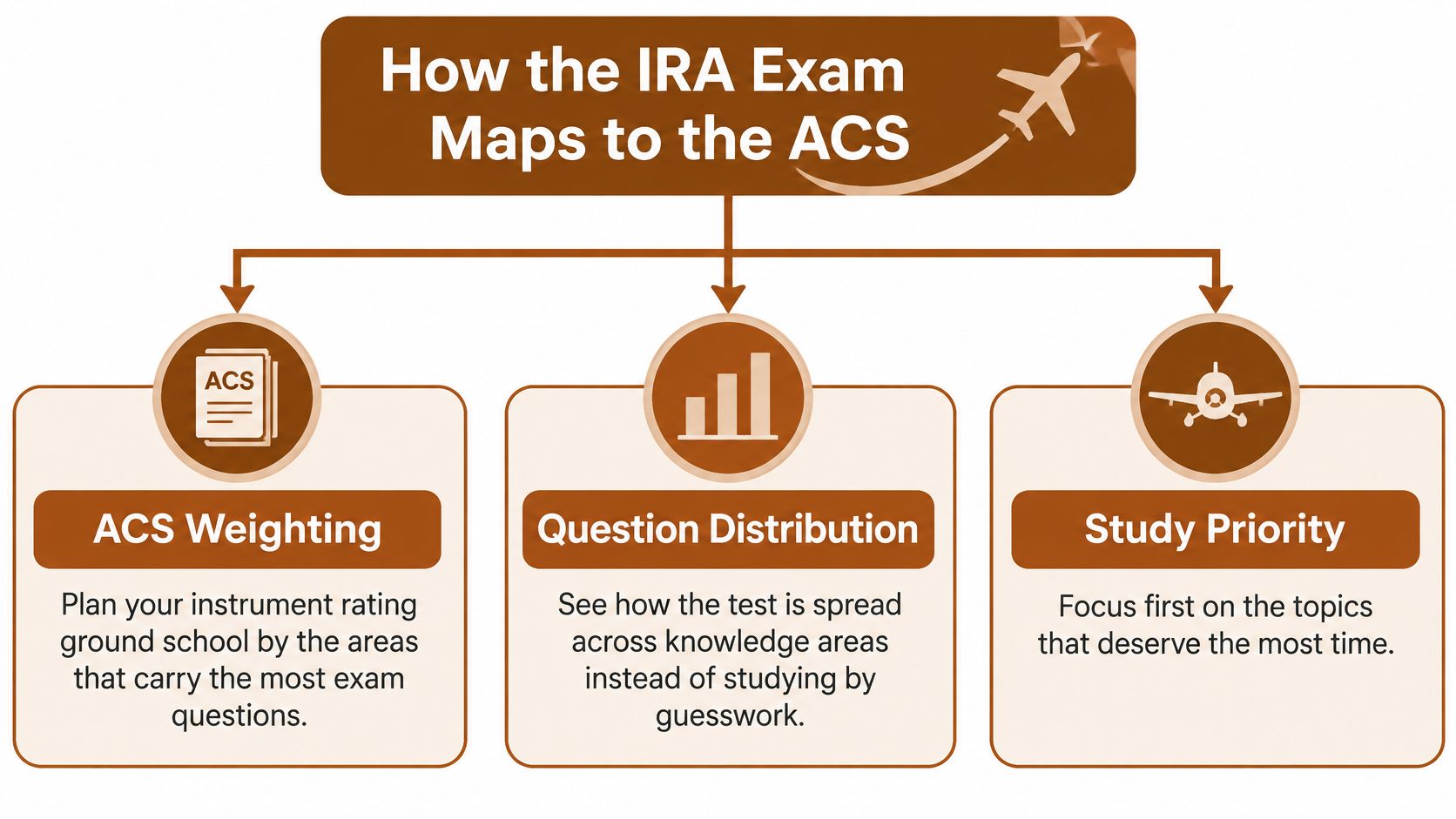
Don't divide study time according to whichever questions feel easiest. Use the content blueprint to identify substantial subjects, then adjust your effort according to your own weaknesses.
The FAA's published IRA content blueprint gives these approximate ranges:
- Regulations: 5–15%.
- IFR en-route and approach procedures: 5–15%.
- ATC procedures: 5–20%.
- IFR navigation: 5–20%.
- Weather reports and forecasts: 10–20%.
- Safe and efficient IFR operations: 5–10%.
- Aeronautical decision-making: 5–10%.
- Crew resource management: 5–10%.
These are planning ranges, not a promise about the exact composition of your test. Weather, navigation, and ATC together can represent roughly 20–60%, based on those published ranges. Don't interpret their combined upper bounds as a guaranteed allocation.
Read the pattern behind the score
Suppose you answer regulation questions comfortably but struggle whenever a clearance requires chart interpretation. More regulation practice may improve your overall percentage without addressing the problem that will matter during your next lesson.
The ACS also includes route planning, altitude selection, IFR airworthiness, and inoperative-equipment limitations. Those subjects belong together in scenarios. Ask whether the proposed aircraft and route support the flight before treating the navigation question as an isolated exercise.
The FAA's 2024 Airman Knowledge Test report recorded 25,647 Instrument Rating Airplane examinations, a 94.24% pass rate, and an 85.64% average score. Compared with the preceding year, volume rose approximately 9.8%, while the pass rate fell 0.20 percentage points and the average declined 0.20 points, according to the same report.
Those results describe examinees, not the effectiveness of a particular course. They also don't establish how well an individual pilot will perform in the airplane.
Track mastery by domain, then use timed practice to see whether you can combine those domains without losing accuracy. An overall score should summarize your preparation, not conceal the areas that still need instruction.
Comparing Instrument Ground School Formats
A useful comparison starts with the evidence each format gives you. Does completion mean you attended, watched, recognized answers, or demonstrated understanding across the ACS?
Instrument Ground School Formats at a Glance
| Format | How progress is judged | Radio and scenario practice | Best training fit |
|---|---|---|---|
| In-person ground school | Instructor questioning, assignments, and checks, depending on the school | Can include live clearance exercises and discussion | Pilots who need scheduled accountability and immediate clarification |
| Self-paced video | Lesson completion and accompanying quizzes | Depends on whether the course requires active responses | Pilots who benefit from replaying explanations |
| Static question bank | Accuracy on repeated practice items | Usually requires a separate activity | Focused review after concepts are understood |
| ACS-mapped mobile course | Domain results, adaptive review, and readiness checks, depending on the product | May integrate radio drills alongside written practice | Pilots coordinating short study sessions with flight lessons |
What completion can hide
In-person instruction lets an instructor interrupt a mistaken explanation and work through it with you. The trade-off is the school's schedule. Ask whether classroom assessments identify individual ACS weaknesses or record attendance and an overall quiz grade.
Video lessons are useful when you need to replay an explanation of navigation or approach structure. But finishing a video doesn't show that you can apply it. Look for exercises that make you interpret unfamiliar figures rather than repeat the instructor's example.
A static question bank makes repetition convenient. Its weakness is diagnostic: a familiar prompt can trigger the right answer even when the reasoning remains uncertain. Check whether explanations identify the underlying concept, whether revisions are visible, and whether full practice exams resemble the PSI interface.
Pilots moving beyond private pilot ground school should evaluate those details again rather than automatically keeping the same study method.
An integrated app example
flyCowboys is an iPhone subscription covering Private Pilot and Instrument Rating written preparation. Its stated offering includes ACS-mapped exam-style questions with plain-English explanations, adaptive spaced repetition, PSI-style practice tests, and a Readiness Score.
It also combines Talk to Tower AI radio drills, an IFR-capable flight logbook, a study library, and a glossary. The publisher describes its content as maintained by active DPEs and CFIs.
That combination is relevant when your problem is fragmented preparation: written questions in one place, radio practice elsewhere, and flight progress in another tool. It doesn't remove the need for instructor feedback.
For any app, ask what the readiness measure evaluates. An ACS coverage indicator isn't an assessment of cockpit proficiency, and simulated radio practice isn't an instructor observing how you communicate while controlling an airplane.
Choose the format that exposes your errors, not the one that makes completion look easiest.
Matching a Format to Your Training Situation
Consider a private pilot who wants the written completed before IFR lessons begin. A self-paced course can fit, but only if the student follows a daily plan and uses a readiness check before booking PSI. If independent study repeatedly slips behind other commitments, a scheduled classroom may solve the underlying problem better than another app subscription.
A student already flying approaches has a different constraint. Short, targeted sessions can fit nights and weekends and prepare the exact clearance, hold, or approach coming next. A long video sequence is less useful if the relevant lesson remains buried behind unrelated material.
Choose around the failure mode
- The retaker: If misses cluster in weather or holding procedures, choose domain diagnostics and explanations that rebuild the concept. Another pass through familiar questions may reproduce familiarity without correcting the misunderstanding.
- The instructor or flight school: Look for traceability from a missed item to an ACS area that can be briefed. A resource should help identify what to teach next, not merely report that a student completed the course.
- The radio-anxious pilot: Choose spoken phraseology practice and instructor-led clearance exercises. More multiple-choice questions won't directly address hesitation when it's time to transmit.
These are hypothetical training situations, not reasons to declare a universal winner. A pilot who understands explanations quickly may still need live accountability. Another may study independently without difficulty but need targeted help translating procedures into spoken responses.
Pick the resource that addresses why you're getting stuck, not the format your most confident friend preferred.
Check whether the language is current
The FAA's April 2025 community advisory describes revisions that remove negatively phrased prompts, replace second-person wording with third-person wording, and seek a single response instead of “both” or “neither.” It also describes expanding the use of ACS codes on knowledge-test reports.
Ask providers to show revision dates and explain changes, not merely advertise a large bank. Current wording and code-level explanations make it easier to distinguish a knowledge gap from confusion caused by the way an old question was written.
Reject a frozen bank when you can't determine what standard it follows or why its answers remain applicable.
Sequencing IFR Knowledge Before the Checkride
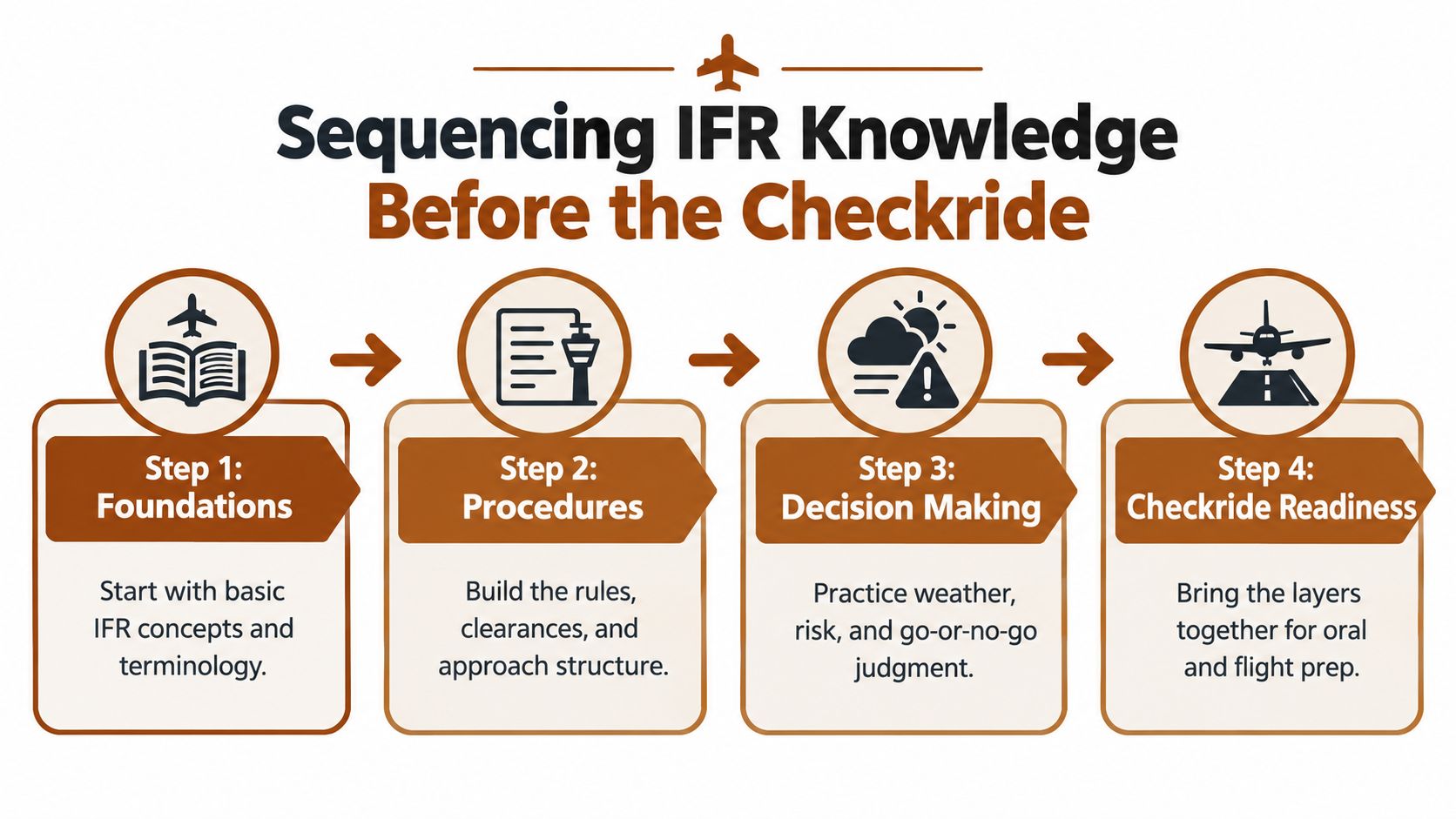
Build your study order around dependencies. A shuffled question bank can test recall, but it isn't a sensible starting curriculum when later procedures assume knowledge you haven't learned yet.
Start with IFR qualifications, airworthiness, and inoperative equipment. Before planning how to fly a procedure, learn how to evaluate whether the pilot and aircraft support the proposed operation. Have your instructor help you distinguish a legal requirement from a conservative personal decision.
Next, study weather reports and forecasts as planning inputs. Don't stop at decoding a report. Explain whether the conditions support departure, how they affect the route, and what would make you change the plan.
Build procedures on a usable foundation
Move into en-route charts, navigation systems, and altitude selection. Practice identifying your position and intended route before adding the demands of a clearance or approach.
Then introduce ATC clearances, holding entries, and approach-plate briefing. A useful ground exercise is to trace a proposed route, explain an assigned altitude, and describe what you'll do when the next instruction arrives. If the explanation becomes uncertain, return to the prerequisite concept rather than memorizing the final response.
Aeronautical decision-making and crew resource management belong throughout this process. Include distractions, uncertainty, and changing conditions in discussions instead of saving judgment for a final chapter.
Use a repeatable practice rhythm
- Target the weak area: Complete short adaptive drills, then explain the reasoning without looking at the choices.
- Combine the subjects: Take a full-length timed practice exam. A two-hour rehearsal is a conservative study target given the published timing discrepancy noted earlier.
- Review the cause: Sort misses by domain and distinguish misunderstood concepts, chart-reading errors, and rushed decisions.
- Check transfer: Ask your instructor to change a scenario and see whether your explanation still works.
Use this FAA Instrument Rating knowledge-test preparation guide alongside your training syllabus, not as a substitute for coordinating with your instructor.
Scheduling becomes reasonable when your performance remains dependable across unfamiliar practice, your weak-domain results no longer depend on lucky questions, and you can explain the concepts behind your answers. A readiness signal can support that decision, but it shouldn't override unresolved misunderstandings.
Recognizing a repeated prompt isn't mastery. Being able to reason through a changed situation is a stronger check.
Connecting Written Prep to Actual IFR Flying
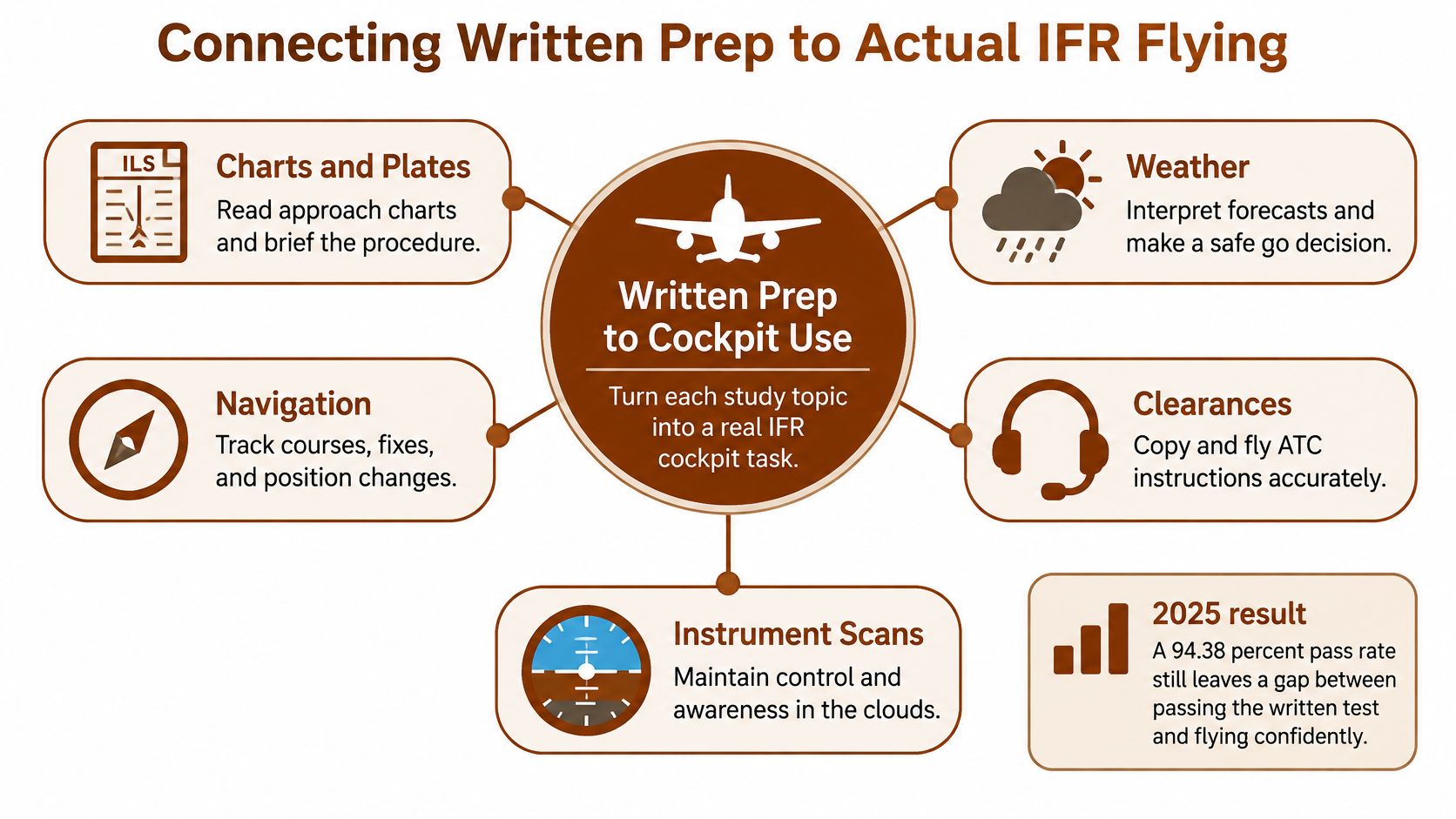
The FAA's ACS and associated testing information frame certification around knowledge, risk management, and skill. The reported 2025 IRA results, a 94.38% pass rate across 27,143 attempts and an 86.15% average score, provide context, but written-test performance doesn't directly measure instrument scan, workload management, or execution under pressure.
That's the gap ground study must help you prepare to close during dual instruction. A question can isolate a concept. In the airplane, you must use it while doing other work.
Translate knowledge into a cockpit job
Holding-pattern knowledge means more than selecting an entry on a diagram. Practice selecting and briefing that entry while maintaining position awareness and managing communications. A plausible failure is correctly naming the entry but becoming uncertain about the next action.
Weather study should lead to a decision. Given a forecast and a proposed route, explain whether you'd delay, revise the route, or discuss a different altitude with your instructor. Decoding the weather correctly doesn't guarantee that you've recognized its implications.
For an approach, turn chart interpretation into a concise briefing and an explicit missed-approach plan. Then have your instructor change the expected clearance. The exercise tests whether you can revise your plan without losing sight of the immediate flying task.
- Risk management: Identify the threat before beginning the procedure, such as distraction during a transition.
- Clearance interpretation: Explain what you understood and identify uncertainty before acting.
- Workload management: State what needs attention now and what can wait.
Pair each lesson with preparation and a debrief
Before dual instruction, study the relevant plate and clearance language. Use radio procedure practice to rehearse speaking, not just recognizing a correct call.
After the flight, debrief the same ACS area. Record whether the difficulty came from knowledge, interpretation, execution, or competing tasks. Those problems call for different remedies.
Debrief question: Did I misunderstand the procedure, or did I understand it and fail to manage the workload?
Keep the appropriate flight-hour categories current with your instructor's guidance so study progress and aeronautical experience remain visible together. A passing score can still leave a pilot unable to copy a changed clearance, maintain an effective scan, or execute a missed approach reliably. Those are training tasks, not reasons to dismiss the written.
Choosing a Study Path and Your Next Step
Choose live ground school when you need a fixed cohort, an instructor in the room, and the ability to ask follow-up questions immediately. Accept the schedule trade-off deliberately. A class only helps if you can attend and do the preparation between meetings.
Choose video plus a current question bank when replayable explanation suits you and you'll maintain your own domain tracking. Don't let watched lessons become your only progress measure. Add timed exams and instructor review of concepts you can't explain independently.
Choose an ACS-mapped app when your main need is targeted practice that fits around flying. An integrated option makes sense when weak-area drills, test-interface practice, radio repetitions, and requirement tracking would otherwise remain disconnected.

Make the provider demonstrate the fit
Before committing, ask to see the actual student workflow:
- Current ACS alignment: Can you identify the standard and revision status without guessing?
- Separate domain results: Can you inspect weather, navigation, and procedure performance independently?
- Timed full tests: Can you rehearse completing a whole exam rather than only short quizzes?
- A useful correction path: Does a miss lead to an explanation you can discuss and apply during flight training?
These criteria matter more than the medium. An instructor-led class with weak assessment can miss individual problems, while a disciplined self-study student can bring precise questions to a ground briefing.
Your next step is to list your next three IFR lessons and mark the ACS areas each will use. Ask your instructor to check that map, then begin a short daily study block aimed at those areas.
If an app fits your situation, begin the Instrument Rating course, complete its diagnostic, and keep your logbook current. Use the readiness signal to inform knowledge-test scheduling while your instructor evaluates how the learning transfers into flight.
flyCowboys offers ACS-mapped Instrument Rating practice, radio drills, and a flight logbook in an iPhone app. Visit flyCowboys to begin the course diagnostic, then use your results to plan focused study alongside your next IFR lessons.