· 17 min read
How to Learn to Fly: Steps, Costs and FAA Exam Prep
Learn to fly step by step: certificate requirements, real costs, timelines and how to prepare for the FAA written exam.
Your browser probably has three tabs open. One is a flight school's discovery flight page. One is a forum thread arguing about what a private pilot certificate really costs. The third is a weather briefing you can read the words of but don't yet fully understand.
You've wanted to do this for years, and the thing stopping you isn't a fear of flying. It's the fog around the process. What you need, what it costs, how long it takes, and whether you'll be the student who stops showing up at hour twelve.
Most of that fog is avoidable. The requirements are published numbers. The exams are scored. The costs follow a pattern you can predict once you know which levers move them. What follows is the path in the order the decisions really arrive.
Table of Contents
- Private Pilot Requirements at a Glance
- The Seven Stages From First Lesson to Checkride
- What Learning to Fly Really Costs and How Long It Takes
- Study Sequence for Passing the FAA Written Exam
- Radio Calls to Practice Before Your First Solo
- Instrument Rating Changes the Study Workflow
Private Pilot Requirements at a Glance
The private pilot certificate is the first certificate new students chase, and its requirements are fixed, published minimums. Before the table, one piece of scale that reframes the whole project. Boeing's 2024 Pilot and Technician Outlook projects the commercial aviation industry will need nearly 2.4 million new personnel between 2024 and 2043, including approximately 674,000 pilots worldwide. You're not joining a hobby lane. You're entering the front end of a workforce pipeline.
Here are the Part 61 minimums for a private pilot certificate with an airplane category rating.
| Requirement | Minimum | What It Means in Practice |
|---|---|---|
| Minimum age for certificate | 17 | Solo flying is permitted from 16, so training can start a year before you can hold the certificate |
| Total flight time | 40 hours | A floor; most students log more before the checkride |
| Dual flight instruction | 20 hours | Logged with a certificated flight instructor (CFI) |
| Solo flight time | 10 hours | Includes solo cross-country time |
| Dual cross-country | 3 hours | Cross-country flight logged with an instructor |
| Night training | 3 hours | Includes 10 takeoffs and landings at night |
| Instrument training | 3 hours | Basic flying by reference to instruments |
| Written knowledge test | 70% passing score | Taken at an FAA-approved testing center |
| Practical test | Pass the oral and flight portions | Conducted by an FAA examiner at the checkride |
Why 40 Hours Is a Floor and Not a Finish Line
Forty hours is what the regulation permits, not what a typical student needs. The checkride is a performance standard. An examiner watches you plan a cross-country, handle stalls and steep turns, recover from unusual attitudes, and answer oral questions about airspace, weather and privileges. Students who arrive at hour 40 with inconsistent landings buy the hours that fix them.
The other fork is Part 61 versus Part 141. A Part 141 school teaches an FAA-approved syllabus and can certify you at a lower total, 35 hours under its program. Part 61 training through a local club or independent CFI gives you more control over scheduling, instructor choice and how fast you move.
Neither structure is better in the abstract. A structured school suits someone training full time with a deadline. A club suits someone fitting lessons around a job and a family.
The certificate is not issued for time served. It's issued when you can demonstrate the standards on demand, which is why the logbook total and the readiness date rarely match.
Take the table row by row this week. Mark what's already within reach, such as your age or a medical appointment you can book now. Then mark what needs a schedule: dual hours, solo cross-country, night work, the written exam. A requirement you can name is a requirement you can plan around.
The Seven Stages From First Lesson to Checkride
The path runs through seven stages. Each one has a reason it exists and a predictable place where students lose weeks.
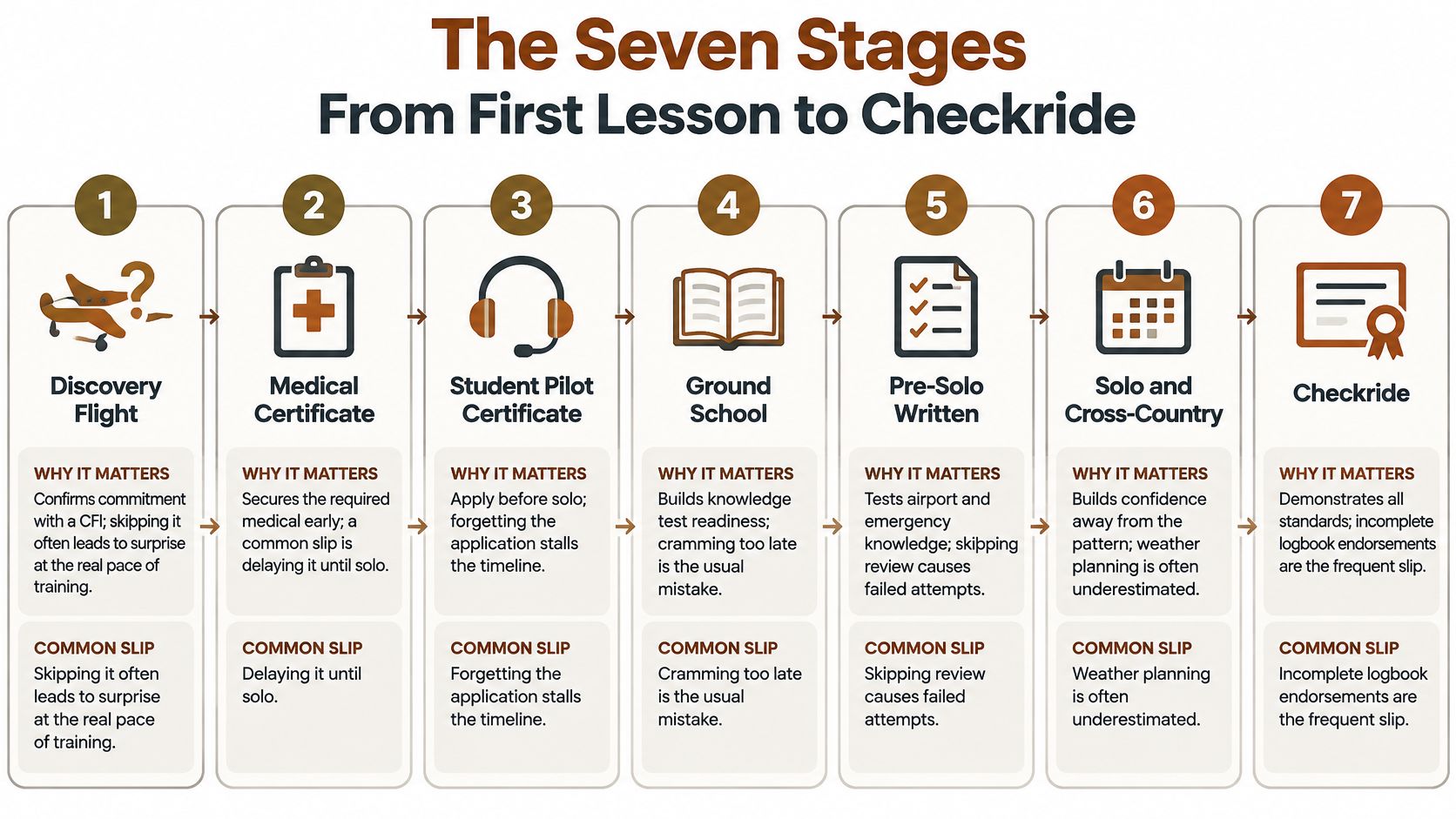
Discovery flight. One hour with a CFI who lets you handle the airplane, answers your questions, and shows you the rhythm of the local airport. Skipping this step is how people discover in month three that they hate the 6 a.m. starts or the ninety-minute drive to a distant field. The flight costs little next to choosing the wrong school.
Medical certificate. An Aviation Medical Examiner issues the certificate you need before you fly solo. Go early. A deferral or a request for more documentation stalls everything downstream, and a denial ends the path entirely. You want that answer before you've paid for twenty hours.
Dual instruction and ground study. Two tracks run in parallel. In the airplane you learn attitude flying, airport operations and radio work. At the desk you learn weather, regulations and performance. The knowledge track doesn't wait for the flying track, and it doesn't require a solo or even a first lesson. A study plan that starts from zero and builds in order means you arrive at the airplane already understanding the why.
Pre-solo endorsement and first solo. Your CFI signs you off after a written pre-solo quiz, the required logbook endorsements, and a demonstration that you can fly the pattern consistently. You also need your student pilot certificate in hand. The common slip is an application that was never filed, which grounds you on the exact morning you planned to solo.
Cross-country, night and instrument training. You'll fly dual cross-countries, then solo ones, and log the night and instrument time toward the minimums. Students who leave night work until late in the season lose weeks to weather and short days. Book those flights early and keep one flexible evening free each week.
Knowledge test and endorsements. You sit the FAA written exam and collect the endorsements your examiner will inspect. Book the test when your practice scores are consistent, not when the calendar creates pressure. Scheduling early to force discipline usually exposes the weak areas you never fixed.
Practical test. The checkride is an oral exam followed by a flight with an FAA examiner. The slip here is arriving before your maneuvers hold steady under pressure, which produces a discontinuance, a repeat fee and a longer wait for the next available date.
What a Healthy First Ten Hours Looks Like
Progress in early training is easy to feel and hard to measure, so measure it. You should be able to brief your own takeoff, hold a heading within a few degrees, and land with coaching rather than rescue. After each lesson your CFI should hand you a short written list of what's next, so you arrive prepared instead of reactive.
Bite-sized study sessions between flights keep the ground knowledge moving through a week when weather cancels everything. That matters more than long cram sessions, because the knowledge test rewards spaced review rather than one heroic weekend.
Book the discovery flight, then ask that CFI for two things before you commit to a schedule: a written lesson plan for the first five hours, and a combined hourly rate that includes both the aircraft and the instructor.
What Learning to Fly Really Costs and How Long It Takes
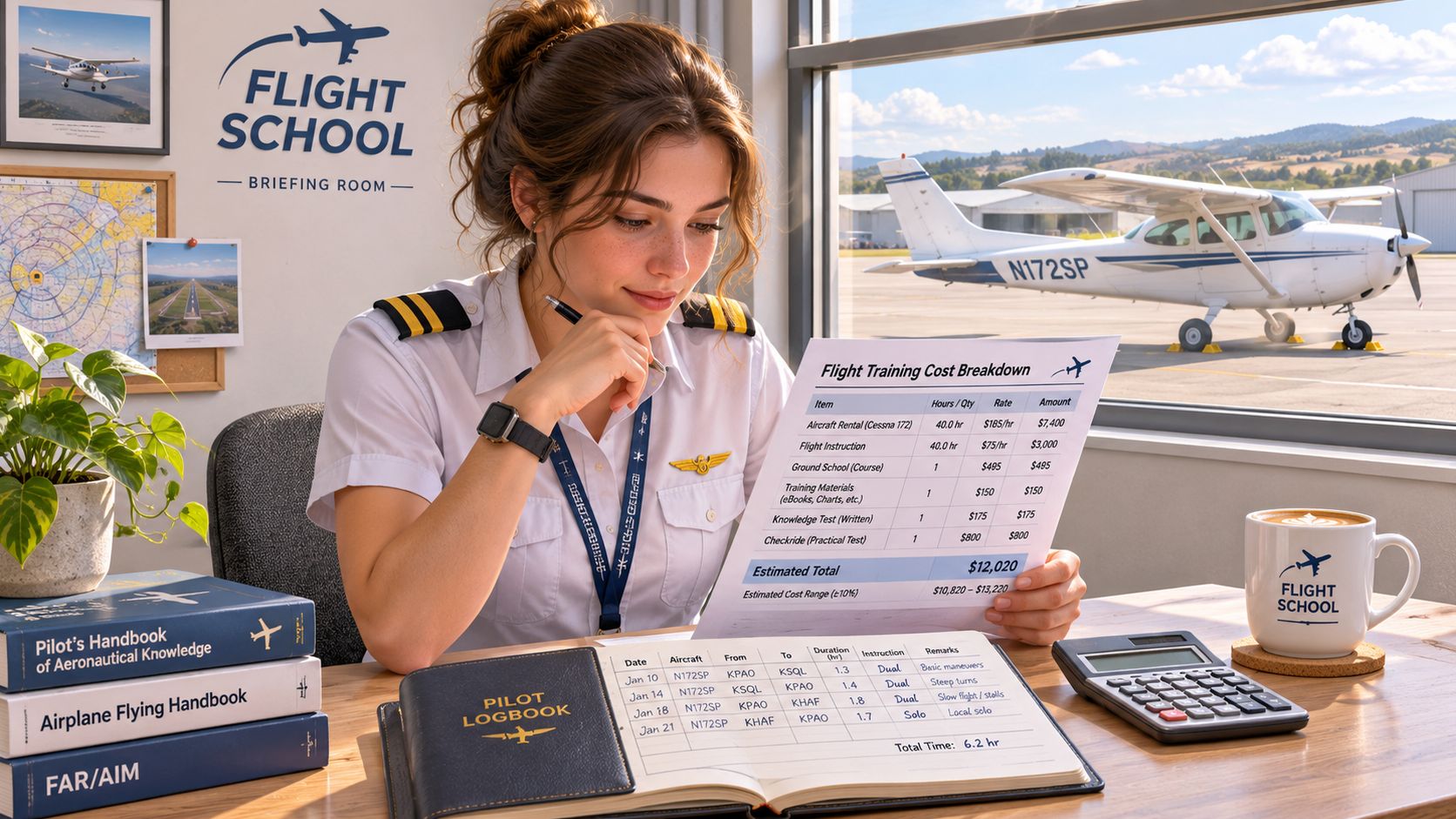
Ask three schools what a private pilot certificate costs and you'll get three confident answers that disagree by thousands of dollars. Part of that is regional, part is the aircraft, and part is how transparently each school accounts for the hours a student needs.
Industry survey data places the median U.S. private-pilot certificate cost near $14,000 with average completion time around six months, while a separate updated estimate reaches $18,025. Both figures are real. The gap between them is the lesson: one headline price understates the range you may meet, and most of that range comes from decisions you control.
What Actually Moves the Number
Three decisions set your real timeline before the first lesson: how often you fly, when you take the medical, and when you sit the written exam. The rest is how well you handle the variables nobody controls.
| Cost Driver | Effect on Total | How to Control It |
|---|---|---|
| Lesson frequency | Infrequent lessons cause re-learning and stretch the timeline | Schedule at least two lessons a week when possible |
| Aircraft rental rate | Usually the largest hourly cost; varies by aircraft type and region | Compare hourly rates and billing terms before booking |
| Instructor rate | Often billed separately from the aircraft | Ask schools for a combined hourly quote |
| Weather and maintenance delays | Cancelled lessons cost time and sometimes fees | Keep a budget buffer and a flexible weekly schedule |
| Medical certificate timing | A late or failed medical can pause training | Get the medical before heavy spending on lessons |
| Written exam timing | Booking too early wastes fees and delays progress | Book when practice scores are consistently in the passing range |
Build Three Budgets, Not One
Take the school's combined aircraft and instructor rate, multiply it by the hours you expect to fly, then add the fixed items: medical exam, written test fee, examiner fee, headset, charts and a kneeboard. Run that calculation three times.
The low case assumes two lessons a week, no cancellations, and the aircraft you booked every time. The expected case adds a buffer for weather, maintenance and the extra dual hours most students need. The high case covers a school change, an aircraft upgrade, or ten more hours of instruction than you planned.
Budget rule: Always hold one lesson's cost unspent, so a cancelled flight is an inconvenience rather than a reason to stop training.
Then set three checkpoints: first solo, written test passed, checkride scheduled. At each one, compare your spend against your plan and your skill against your hours. If the hours climb without a matching gain, that's the moment to change instructors or schools.
One caution on the numbers you'll see quoted elsewhere. Student-pilot certificate counts keep accumulating once issued, so the raw totals don't reliably show how many learners are actively training or finishing on schedule. Don't read a rising count as evidence about your own timeline. Yours is set by the decisions in the table above.
If you want to see how a training flight unfolds before you book one, this walkthrough is twenty useful minutes.
One timing decision belongs in the budget itself. Study is the cheapest component of the certificate, and it's the component that protects the expensive one. Schedule the written test around readiness rather than around the calendar, because a retest costs both a fee and the weeks you lose waiting for a new date.
Study Sequence for Passing the FAA Written Exam
The knowledge test pairs a low bar with a narrow margin. Passing is 70%, and the FAA's 2025 airman knowledge test volume report puts the average Private Pilot Airplane applicant at 81.64% across 44,657 tests, with an 89.56% pass rate. That sounds comfortable until you do the arithmetic: the average leaves about eleven points of cushion, and one cluster of ambiguous chart questions plus a unit-conversion error eats most of it.
| Certificate | Tests Taken | Pass Rate | Average Score |
|---|---|---|---|
| Private Pilot (airplane) | 44,657 | 89.56% | 81.64% |
| Instrument Rating (airplane) | 27,143 | 94.38% | 86.15% |
Work six steps in this order.
Divide the material into ACS knowledge areas. Regulations, weather, airspace, navigation, performance and human factors. The Airman Certification Standards frame every task around knowledge, risk management and skill, and this breakdown of the private pilot ACS shows how those tasks turn into test questions.
Take a diagnostic quiz before you build a schedule. A baseline tells you where the hours go. Guessing at your weak areas wastes the first two weeks on material you already know.
Calculate accuracy by topic, not overall. A single percentage hides the pattern. One area at 60% beside five at 90% is a different problem from everything sitting at 78%, and it needs different treatment.
Read the governing FAA reference, then work scenarios. Study the regulation or the chart legend first, then answer questions that apply it to situations worded in ways you haven't seen. Recognition is cheap; application is what the exam scores.
Use spaced retrieval until each area holds. Short daily sessions beat weekend marathons because the forgetting curve is the main opponent. A missed topic returns to the queue until it stops missing.
Run timed, full-length simulations before you schedule. Untimed bank sessions are practice. A timed exam that mirrors the testing center is a rehearsal, and the first real attempt should feel familiar.
Readiness gate: Book the test only when repeated timed scores sit comfortably above 85% and no knowledge area lags materially behind the others.
Three pitfalls account for most of the wasted effort. Memorizing an answer without the regulation behind it collapses the moment the wording changes. Unit-conversion errors sink performance questions, where a wrong temperature or pressure altitude propagates through every later step. And re-studying your strongest topic feels productive while the weakest area keeps its score.
An error log catches all three. Tag every miss by cause: knowledge gap, misread question, computation, or time pressure. Require a corrective explanation before you mark the item mastered, and review the log weekly to see which cause dominates.
A placement quiz is a fast way to start one. flyCowboys asks which rating you're studying for, PPL or IFR, runs a short placement quiz, and builds a personalized study plan around the areas you missed. Most users are ready for the written exam after four to six weeks of daily study. For the written test it covers the ground-school portion, while flight training with your CFI stays exactly as it is. It doesn't replace certified instruction, official FAA publications, an approved Part 61 or Part 141 program, the FAA tests themselves, or the aircraft flight manual.
Radio Calls to Practice Before Your First Solo
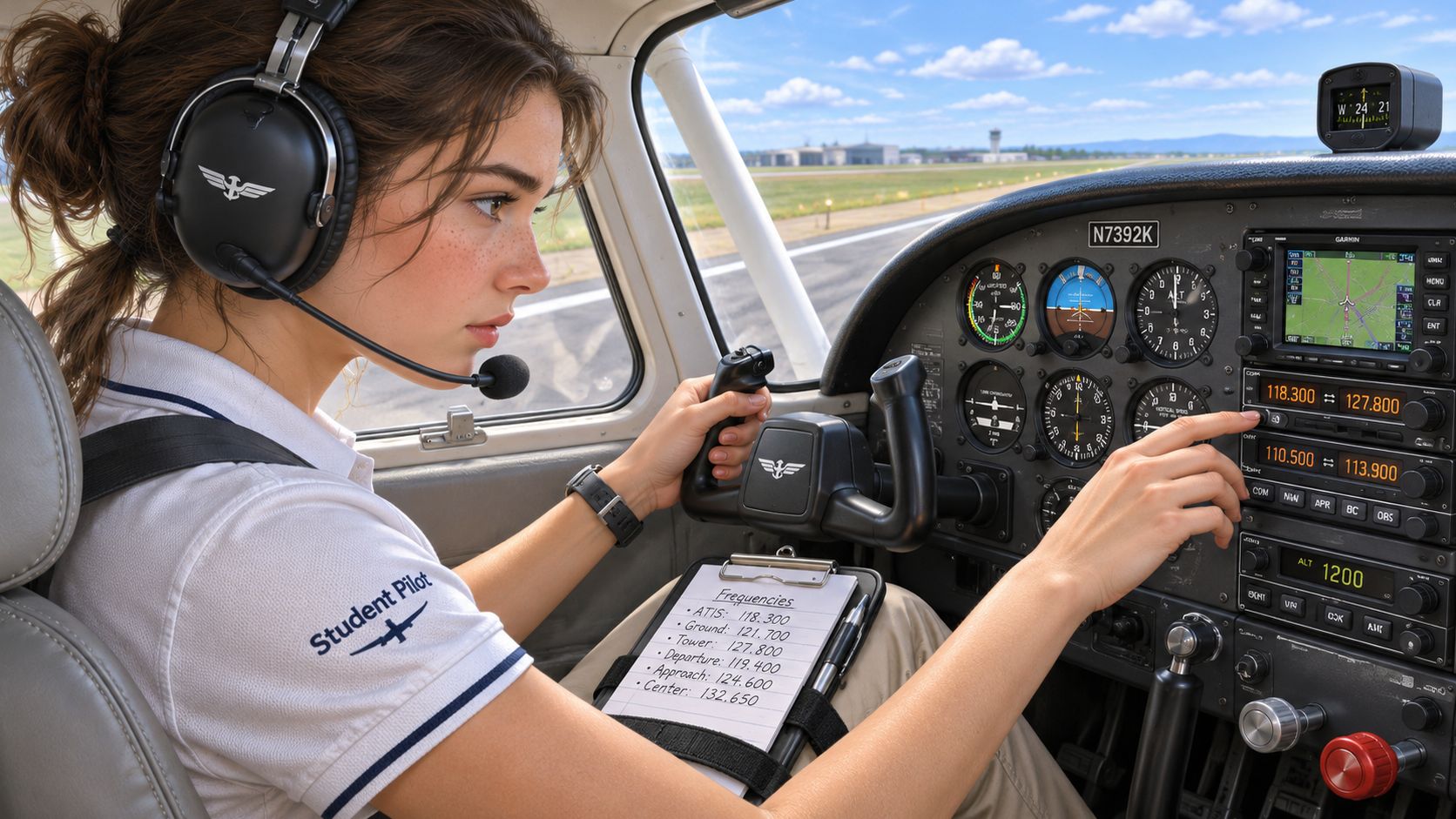
Radio work is the skill students practice least and worry about most. Train at a non-towered airport and you may go weeks without hearing a complex clearance. Then you fly into Class C airspace and the controller's first instruction arrives at the speed of speech while you're managing airspeed, heading and a taxi route.
Student pilot numbers keep climbing, and a busier frequency doesn't slow down for a hesitant readback. The students who cope best on a crowded channel are the ones who rehearsed the words before they ever keyed the mic.
Four Habits, in the Order They Pay Off
Know when to call and what matters. Every initial call answers the same short list: who you are, where you are and what you want, plus altitude when it's relevant. "Cessna 12345, holding short of runway 27, ready for departure" covers every item that applies before you even roll.
Read back what changes your flight. Altitudes, headings, frequencies, runway assignments, hold-short instructions. A readback isn't a courtesy. It's the controller's only confirmation that you heard the same clearance they issued.
Recover out loud instead of guessing. If a clearance arrives faster than you can copy it, say "say again" or ask the controller to speak slower. Nobody on frequency is scoring you, and a wrong altitude readback is far more expensive than a second request.
Rehearse before the cockpit. Script the calls for one scenario, say them at speaking pace, record them, and compare against standard phraseology. A guide to radio procedures and phraseology for student pilots covers the calls you'll make most often. The flyCowboys app includes a Talk to Tower AI feature for practicing radio calls and ATC phraseology, so you can drill a clearance out loud until the timing feels normal.
None of that replaces time in the airplane with your CFI. What it does is move the awkward first attempts somewhere free. Practicing phraseology in a chair costs nothing; learning it while the Hobbs meter runs is the expensive version of the same lesson.
Run three scenarios each week: a departure from a towered field, a traffic call at a non-towered field, and a clearance that changes mid-taxi. Rotate them until the words arrive before the workload does.
Instrument Rating Changes the Study Workflow
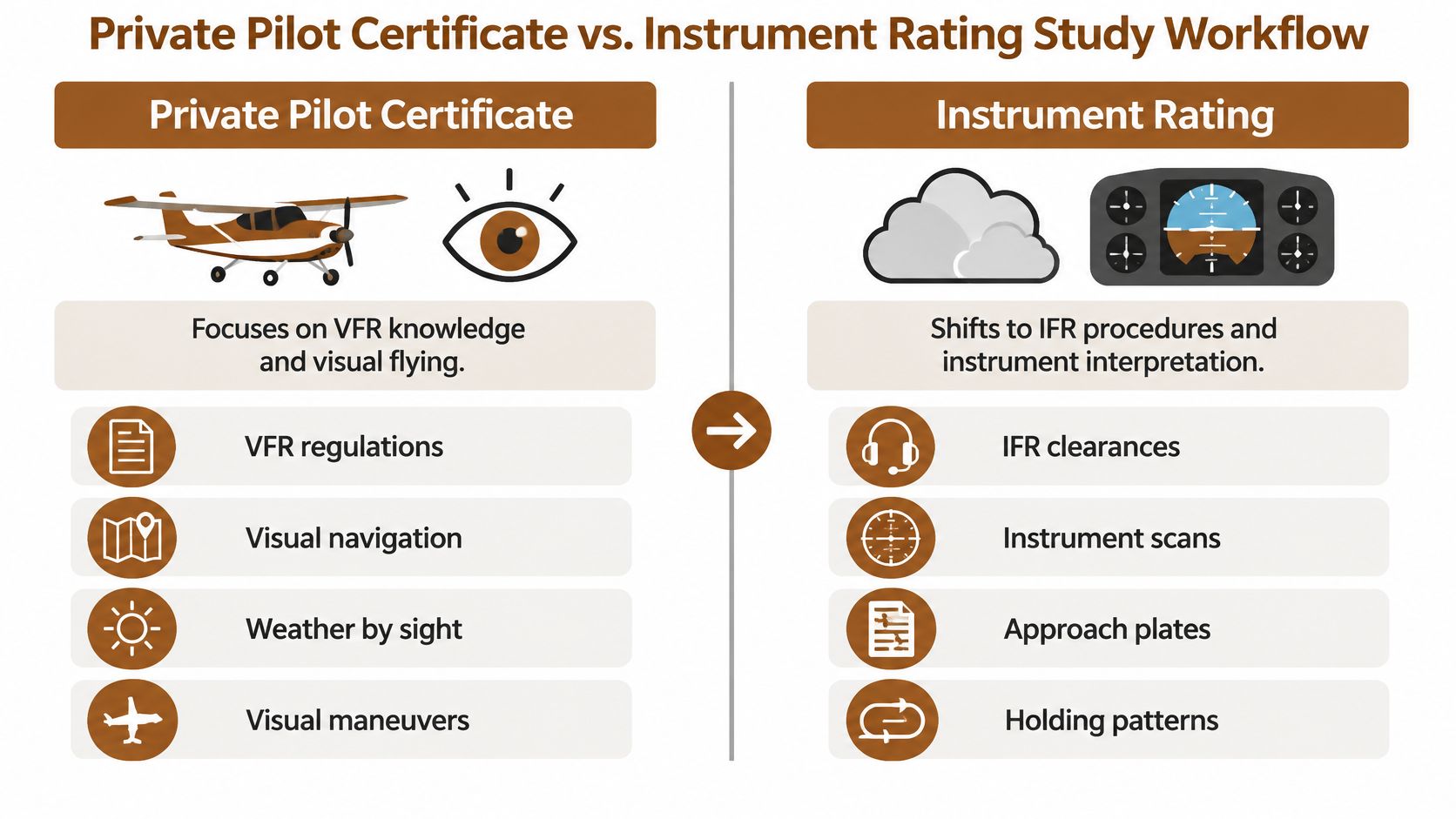
A private pilot certificate teaches you to fly by looking outside. An instrument rating teaches you to fly by trusting the panel when your body is telling you something different, and to do it inside a clearance you can't deviate from without permission. That single shift changes what studying means.
A private pilot candidate studies VFR regulations, visual navigation, weather by sight and maneuvers judged against the horizon. An instrument candidate studies clearances, instrument scans, approach plates and holding patterns, and gets graded on procedure as much as on control.
The Six-Step Workflow
Learn the regulatory and meteorological prerequisites first, since everything else assumes them. Decode METARs, TAFs, PIREPs, charts and NOTAM-style information until reading them is mechanical. Practice departure, en-route, holding and approach scenarios using actual clearance logic rather than isolated figures. Solve navigation and minimums questions with a written sequence, not mental math. Rehearse phraseology and readback accuracy out loud. Finish with timed, mixed-domain exams under realistic conditions.
If you're still weighing the rating, this overview of IFR flight requirements covers the experience and currency rules that catch people out.
Where Instrument Candidates Lose Points
Four mistakes repeat. Candidates confuse clearance limits with approach minimums, which are different numbers serving different purposes. They pull the wrong altitude or visibility value off a plate, often because they read the wrong column. They treat a forecast as observed weather. And they omit a required readback element under workload.
The fix is a show-your-work drill for every question.
Show-your-work drill: Identify the controlling document. Extract the exact value. State what that value means operationally. Only then choose the answer.
Keep separate error logs for chart symbology, regulations, calculations and communications. Memorizing one hold, one clearance or one approach plate proves nothing transferable, so require error-free repetition across varied scenarios. The instrument test compares favorably with the private test on both pass rate and average score, as the table above shows, and the figures come from the FAA 2025 airman knowledge test volume report. A higher average still leaves a real failure rate, and those four mistakes explain most of it.
The written exam is the part of training you can start tonight, before you've booked a lesson or met a CFI. flyCowboys builds a study plan from your rating and a short placement quiz, then tracks your practice scores until they sit in the passing range, covering PPL and IFR written prep, AI radio drills and a logbook that tracks your hours against requirement categories. Visit flyCowboys when you're ready to turn the fog into a schedule.