· 18 min read
Weight and Balance in Aviation: Calculation and CG Limits
Learn weight and balance in aviation: calculate total weight and moment, check CG limits, and avoid out-of-envelope loading before every flight.
You've loaded the cabin, tucked the bags behind the rear seats, and topped off the tanks for a cross-country. On a hot afternoon, the airplane might still climb away even though its takeoff run is longer than expected and the nose feels unusually light. Getting airborne wouldn't prove the loading was safe. You need that answer before you start the engine.
Table of Contents
- What Weight and Balance Means Before You Fly
- How to Calculate Weight and Balance Step by Step
- Why Center of Gravity Matters More Than Weight
- Where to Find Your Aircraft's Limits and Data
- Regulatory Requirements From Part 23 to Part 121
- How Excess Weight Changes Performance and Safety
- Confirm the Numbers Before Every Flight
What Weight and Balance Means Before You Fly
Weight and balance in aviation means checking how much the aircraft carries and where that weight sits. The loaded aircraft must satisfy its weight limit and its center-of-gravity limits together, not as unrelated checks.
Think of a seesaw. Adding a child changes the total weight, but moving that child toward the end changes the balance without adding anything. Aircraft loading works similarly: a bag placed far aft can have a substantial effect on balance even when it adds little to the total load.
One loading decision, not separate approvals
The things you change most often are people, baggage, and fuel. Their combined weight affects performance, while their locations determine the loaded balance point.
An aircraft can be below maximum gross weight and still be out of balance. Full fuel also doesn't automatically mean a safer loading if carrying it leaves insufficient capacity for the people and baggage aboard.
Loading begins with knowing what goes into the aircraft.

If you're learning the terminology, the private pilot study guide provides a route through the knowledge you'll use during flight planning. Keep the aircraft's current loading documents beside your worksheet so the arithmetic stays connected to the airplane you'll fly.
Before loading: Don't decide that the flight works just because everyone fits. Add the weights, add the moments, and check the resulting loading against the complete approved envelope.
How to Calculate Weight and Balance Step by Step
Use a worksheet, a calculator, and the current records for the specific aircraft. Keep units visible throughout the calculation. Gallons measure fuel volume, pounds measure weight, and inches identify location; mixing them produces an answer that may look reasonable but means nothing.
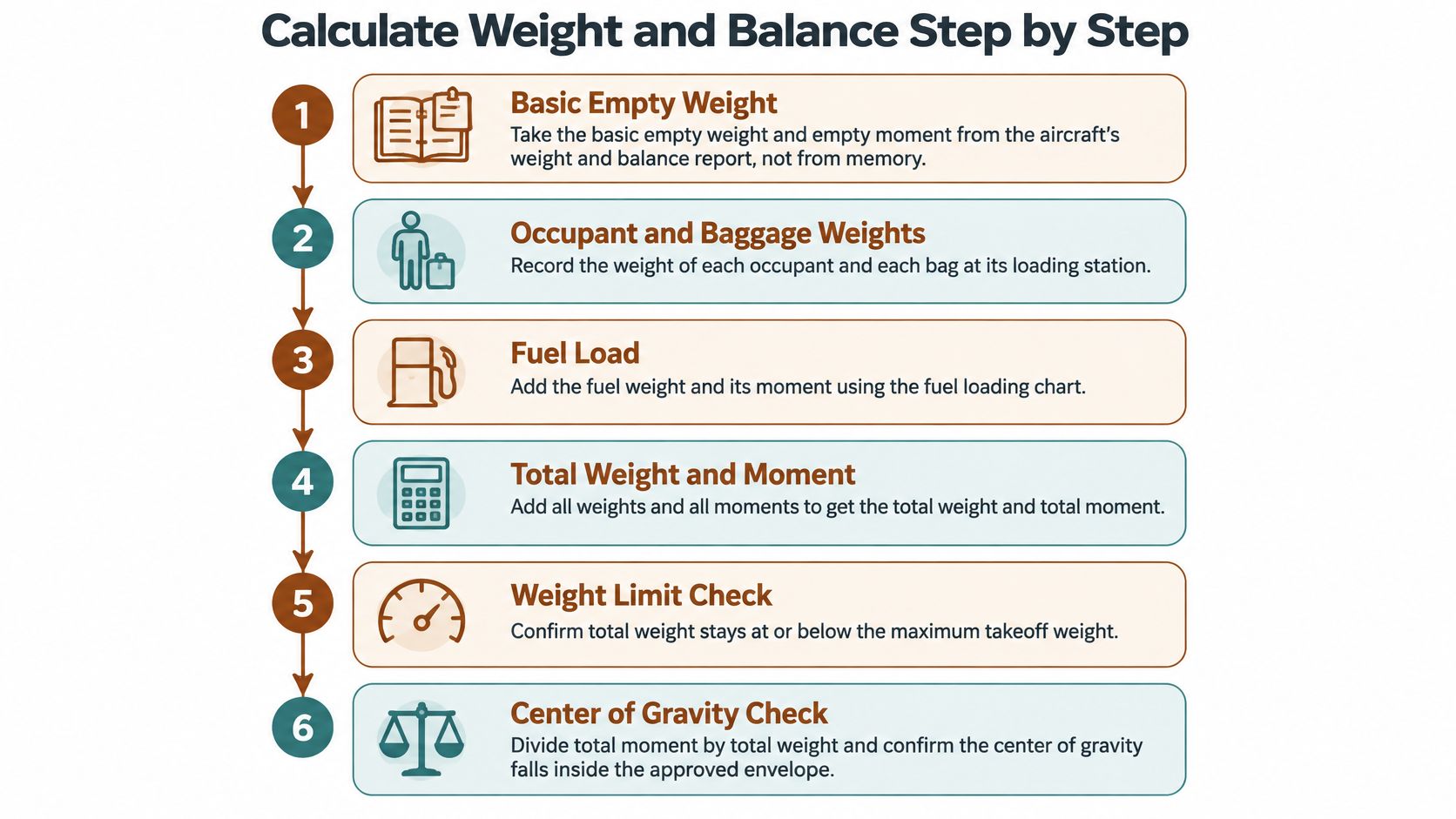
This visual summarizes the workflow; the detailed procedure also separates calculating moments from finding the final CG.
Build the worksheet from the aircraft outward
Enter basic empty weight and empty moment. Copy these from the current aircraft weight-and-balance report. Don't substitute a remembered value or a handbook's sample aircraft.
Record occupants and baggage. Use actual weights or the planning method your operation permits. Include carried items, and assign each load to its actual seating or baggage station.
Convert usable fuel to weight. Multiply fuel volume by the appropriate fuel weight per gallon, using the aircraft's approved planning information. Confirm what the basic empty weight already includes so you don't count unusable fuel twice.
Calculate each loaded item's moment. Multiply weight by arm. The arm is the distance from the manufacturer's reference datum, and the moment represents that weight's turning effect about the datum.
Add the weights and moments separately. Don't add arms or average them. A heavy item must contribute more to the balance calculation than a light item.
Find the loaded CG. Divide total moment by total weight. The result is a location measured from the same datum as the station arms.
Check the complete loading envelope. Compare total weight with the applicable weight limit, then plot the CG at that weight. Also check individual compartment and seating restrictions.
The formulas are:
Moment = weight × arm
CG arm = total moment ÷ total weight
Follow a hypothetical trainer calculation
The following is a hypothetical arithmetic exercise, not loading data for an aircraft model. Every weight, arm, fuel assumption, and limit must be replaced with the values in the actual aircraft's flight manual and current weight-and-balance report.
Worked loading example for an illustrative trainer
| Item | Weight (lb) | Arm (in) | Moment (lb-in) |
|---|---|---|---|
| Empty aircraft | 1,680 | 39 | 65,520 |
| Pilot and front passenger | 340 | 37 | 12,580 |
| Baggage area | 50 | 95 | 4,750 |
| Fuel (40 gal at 6 lb/gal) | 240 | 48 | 11,520 |
| Total | 2,310 | CG 40.85 | 94,370 |
In this hypothetical example, the empty aircraft contributes the largest moment because it accounts for most of the weight. The front occupants share an assumed loading arm, so their weights can be combined for this exercise. In a real aircraft, combine entries only when the approved loading method assigns them the same arm.
The baggage weighs less than the occupants, but its longer arm gives it a meaningful contribution to total moment. The fuel entry first converts volume to weight, then multiplies that weight by the assumed fuel arm.
Dividing the hypothetical total moment of 94,370 lb-in by 2,310 lb gives a CG of approximately 40.85 inches. If this fictional trainer has a maximum takeoff weight of 2,550 lb, it passes the weight check. It passes the balance check only if its approved envelope includes that CG at that loaded weight.
Catch errors before accepting the result
Watch for a rear-seat arm entered on the baggage row, gallons entered as pounds, or a moment index mistaken for an unscaled moment. Some manuals divide moments by a stated factor to make their charts easier to use; follow that convention consistently.
Account for fuel burned during start, taxi, and run-up when determining takeoff loading. Don't subtract that fuel and then forget to check the heavier ramp condition where a separate ramp limit applies.
For a visual walkthrough alongside your worksheet, use the calculation demonstration below.
Why Center of Gravity Matters More Than Weight
Balance a broom across your palm, then slide your hand along the handle. The broom hasn't become heavier, but your hand must move to support its balance point. Moving baggage within an aircraft changes its balance in a comparable way.
The FAA's Pilot's Handbook of Aeronautical Knowledge defines CG as the theoretical point where the aircraft's entire weight is concentrated and explains that safe loading must satisfy both approved weight and manufacturer-established forward-and-aft CG limits.
The heading's distinction is important: CG deserves more attention than a weight-only check, but it doesn't make the weight limit less binding. Neither limit compensates for exceeding the other.
How the balance point changes handling
For a conventional airplane, moving the CG forward generally increases longitudinal stability. The tradeoff is greater control effort and potentially less ability to raise the nose when the airplane is slow.
Moving it aft generally reduces natural pitch stability. Light control forces can feel pleasant, but they aren't evidence of a generous recovery margin.
How CG position changes handling
| CG condition | Pitch stability | Stall speed | Control margin | Typical risk |
|---|---|---|---|---|
| Forward of limit | Generally greater | Generally higher | More back pressure needed to rotate and flare; available authority may be insufficient | Difficulty rotating or flaring, with a possible hard touchdown |
| Within limits | Within the approved stability range | Use AFM information for the loading and configuration | Designed control and recovery margins | Handling consistent with approved flight-manual guidance |
| Aft of limit | Reduced | May be lower than with a forward CG | Lighter forces don't ensure sufficient nose-down recovery authority | Excessive pitch response and more difficult stall or spin recovery |
These are directional tendencies, not permission to predict handling outside the envelope. Beyond a limit, the pilot can't assume that familiar control inputs will produce familiar responses.
Check the loading combinations that look harmless
A light pilot with substantial rear baggage can produce an aft-loading problem without approaching maximum weight. A heavy front occupant and little load farther aft can create the opposite concern. Empty seats aren't automatically helpful if the remaining load is concentrated unfavorably.
Fuel burn also changes the balance on many designs. The direction depends on the fuel's location relative to the loaded CG, so don't assume that burning fuel always moves the balance forward or always improves it.
A lighter airplane later in the flight isn't automatically a better-balanced airplane.
Use the aircraft's loading method to examine departure, expected arrival, and any relevant intermediate fuel condition. Where tank selection or fuel transfer affects balance, include the planned sequence rather than checking only the total fuel quantity.
The practical goal isn't to place the CG as far forward or aft as possible. It's to maintain an acceptable loading throughout the flight, with enough understanding to recognize which change could make the limiting condition worse.
Where to Find Your Aircraft's Limits and Data
Use the documents as a map: design information establishes the aircraft's boundaries, operating documents explain how to apply them, and the current airframe records establish your starting weight and moment.
Where each weight and balance limit is published
| Document or placard | What it gives you | When you use it |
|---|---|---|
| Type Certificate Data Sheet | Certified weight limits and CG range, with applicable conditions | Reference for design limits, not a substitute for a loading worksheet |
| Aircraft Flight Manual or Pilot's Operating Handbook | Operating limits, loading graphs or tables, and sample problems | Planning and checking each flight using the applicable aircraft documents |
| Weight-and-balance report and equipment list | Basic empty weight and empty moment for the specific airframe | Starting each calculation and verifying the effect of configuration changes |
| Placards and loading plates | Applicable baggage, seating, and loading restrictions | Checking the actual cabin and compartments before departure |
Match the records to the airplane
Find the aircraft identification on the weight-and-balance report before copying its values. Then confirm that the installed equipment agrees with the current equipment list and any relevant supplements.
A new avionics installation, removed seat, replacement battery, or interior change can alter the starting weight and moment. Maintenance personnel must assess the effect of changes and update the applicable records when needed. Don't assume that a recent-looking worksheet includes the latest work.
Stale data can be especially misleading because the calculation itself still works. Your calculator won't recognize that the empty aircraft in its memory no longer matches the one on the ramp.
Separate useful load from passenger capacity
Useful load is the applicable maximum gross weight minus basic empty weight. It must accommodate occupants, baggage, and usable fuel, not passengers alone.
In a hypothetical trainer with a maximum gross weight of 2,550 lb and an empty weight of 1,680 lb, the useful load is 870 lb. That arithmetic doesn't establish how much can go into a particular compartment, nor does it guarantee an acceptable CG.
Use that distinction when someone asks whether the airplane can carry a full cabin. The answer depends on the fuel plan and the location of the remaining load, not just the number of seats.
Record check: A precise calculation using an obsolete empty moment is still the wrong loading calculation.
Before trusting a planning app, compare its empty-weight entry, station arms, envelope, and applicable operating category with the aircraft's current documents. Check whether the software displays raw moments or indexed moments, too.
The aircraft's applicable flight manual, supplements, and limitations govern. A generic online table or a saved profile for a similar airplane can help you understand the method, but it can't authorize the loading.
Regulatory Requirements From Part 23 to Part 121
The rules scale with the aircraft and the operation, but the pilot's duty stays pointed at the same target: the weight limit and the CG limit form one approved envelope, and the airplane has to be inside both at the same moment. Being below maximum gross weight while loaded too far forward is still an outside-the-envelope condition.
Under 14 CFR § 121.153, air-carrier operation depends on satisfying applicable aircraft certification and airworthiness requirements, so a loading calculation must support those requirements rather than merely produce a convenient dispatch figure.
Distinguish certification from operation
Certification rules define what the design must demonstrate. Operating limitations and loading procedures then govern an individual flight, with the pilot or operator responsible for making the actual load match the approved condition.
Weight and balance requirements by rule and operation
| Rule or operation | Applies to | What it requires |
|---|---|---|
| Normal-category airplane certification | Normal-category airplanes, typically small aircraft | Safe weight and CG limits demonstrated at critical combinations across the approved loading range |
| Transport-category airplane certification | Transport-category airplanes | Weight and CG ranges for which safe operation is demonstrated, including practicable operating conditions |
| General flying under applicable operating limitations | Pilots operating the aircraft | Loading consistent with approved aircraft limitations and applicable procedures |
| Commercial air-carrier weight-and-balance control | Operators using an approved control system | Approved loading methods that continue to satisfy airworthiness and operating limitations |
Weight-and-balance control therefore continues beyond the preflight worksheet. Equipment changes, recordkeeping, loading procedures, and the final loading decision all affect whether the operating aircraft matches its approved condition.
For a student preparing to explain that responsibility, the private pilot ACS guide helps connect knowledge preparation with the decisions you'll need to describe and demonstrate.
Approved averages aren't permission to guess
Commercial operators may use average, assumed, or estimated passenger and baggage weights through an approved weight-and-balance system. That approval belongs to a defined method and operation. It doesn't mean an individual pilot can borrow a convenient average and assume it provides the same assurance.
Averages also require attention to the group that is traveling. A loading method must address the operation's characteristics rather than treat every cabin as interchangeable. Estimated passenger weights can look reasonable while gradually shrinking the margin, especially when bags, fuel, and seating position are added to the same airplane.
For everyday flight planning, follow the method permitted for your operation and resolve uncertain inputs before accepting the result. If you use actual occupant weights, ask discreetly and include carried belongings rather than relying on visual estimates. The arithmetic follows a consistent sequence: establish the empty condition, account for loaded items, total their weights and moments, and verify the resulting loading. Flying outside the approved envelope can leave the aircraft uncontrollable or exceed other operating limitations, which is why the loading must be verified against the flight manual before departure.
How Excess Weight Changes Performance and Safety
The first signs of a heavy loading may appear during acceleration. The airplane takes longer to reach its required takeoff condition, and after liftoff it has less climb performance available. A runway departure that usually feels unhurried can become uncomfortable before the pilot has much altitude to work with.
More weight requires more lift. Producing that lift also affects drag, leaving less excess power available for climbing. Adding back pressure can change the flight path briefly, but it doesn't create the power needed to sustain an obstacle-clearing climb.
Performance planning needs to happen while there's still time to change the loading.

Weight and weather affect the same departure
Stall speed rises as weight increases, with configuration and other conditions held constant. Don't apply a remembered speed adjustment casually; use the flight manual's speed and performance guidance for the actual loading.
Hot conditions and high field elevation can reduce the airplane's performance further. Depending on the aircraft, reduced air density can affect engine power, propeller thrust, and the true airspeed needed to produce the required lift. The practical result can be a longer ground roll and less climb capability.
An airplane that meets its loading limits may still lack acceptable performance for the runway, obstacles, and conditions. Inside the envelope is necessary, but it isn't a takeoff-performance guarantee.
Estimated inputs can hide a poor margin
Say you plan with passenger estimates that are lower than the occupants' actual weights. The worksheet may show an acceptable load while understating what the airplane must lift. If the extra weight is concentrated in the rear cabin, the displayed CG may also be misleading.
Clothing, backpacks, camera equipment, and other carried items belong somewhere on the worksheet. Ask whether the passenger's stated weight includes them, and weigh baggage rather than describing it as light.
This is the point where stale aircraft data and optimistic passenger estimates can combine. The aircraft profile may understate the empty condition while the loading entries understate the payload. A reassuring display then reflects the inputs, not the actual departure.
Don't use a green result on a screen as evidence that the people, bags, and fuel were entered correctly.
Turn performance planning into a departure decision
Use the POH or AFM performance charts with the actual loaded weight and the expected conditions. Follow the chart's assumptions for runway surface, wind, configuration, technique, and aircraft condition, and don't extrapolate beyond its stated range.
- Read the complete chart: Check notes and correction instructions, not just the distance at the intersection of the main axes.
- Evaluate climb separately: Getting off the runway doesn't establish that you can clear terrain or obstacles.
- Plan the rejection decision: Use aircraft-specific guidance and an appropriate prebriefed decision point rather than improvising after slow acceleration.
- Change the plan early: Reduce the load, choose more favorable conditions, use a suitable runway, or postpone the flight when the available margin isn't acceptable.
For landing, use the applicable loading and configuration guidance rather than carrying an unnecessarily fast approach as insurance. Excess speed can create another problem by increasing the distance needed to stop.
Confirm the Numbers Before Every Flight
Use a deliberate final check before departure:
- Verify the inputs: Match the aircraft profile to current records, then confirm occupants, baggage locations, and fuel aboard.
- Check applicable weights: Confirm ramp, takeoff, and landing loading against the limits that apply.
- Check the CG path: Verify acceptable loading at departure, arrival, and any other critical fuel condition.
- Check local restrictions: Review baggage compartments, seating limitations, and load security.
- Keep the worksheet: Retain the completed calculation with your flight-planning paperwork, following your operation's procedures.
If the loading doesn't work, consider moving or removing baggage first, then changing passenger arrangements where permitted. Any relocation must use an approved location with suitable restraint. Removing weight from the wrong location can worsen a CG problem, so recalculate after each change.
Reduce fuel only when the revised plan still provides the required fuel and an appropriate operational margin. A fuel stop or a different aircraft may be the sensible solution.
Practise until the result makes sense
At flyCowboys, our written-exam content covers weight and balance, performance charts, and aerodynamics, with bite-sized sessions that fit between flight lessons. Use the checkride oral exam guide to practise explaining your loading decision as well as calculating it.
Our app doesn't replace authorized flight instruction, official FAA publications, approved training programs, knowledge or practical tests, or the aircraft's AFM and POH. Your study answer builds understanding; the aircraft's current documents govern the flight.
We offer written-exam practice and plain-English explanations to help you understand loading calculations and their effect on aircraft performance. Visit flyCowboys to practise weight and balance between lessons, then work through an aircraft-specific loading problem with your instructor.