· 9 min read
ATOMATOFLAMES, ARROW, and FLAPS: Required Equipment for Pilots
ATOMATOFLAMES is the day-VFR equipment mnemonic in 14 CFR 91.205(b). FLAPS covers night additions; ARROW is the document list. Tables and test traps.
ATOMATOFLAMES is the standard mnemonic for the day-VFR instruments and equipment in 14 CFR 91.205(b): airspeed indicator, tachometer, oil pressure, manifold pressure (for an altitude engine), altimeter, temperature gauge (liquid-cooled), oil temperature (air-cooled), fuel gauges, landing-gear position indicator, anticollision lights, magnetic compass, ELT, and safety belts.
FLAPS covers additional night-VFR items in 91.205(c). ARROW is a separate list of required documents, not equipment. Some letters apply only if the airplane has that system, so always read the regulation and your POH together.
ATOMATOFLAMES is a memory aid for 14 CFR 91.205(b)
14 CFR 91.205 lists the instruments and equipment required for U.S. civil aircraft. Paragraph (b) is the day-VFR list. ATOMATOFLAMES (sometimes written A TOMATO FLAMES) is the mnemonic most instructors use to walk that list. Every letter is a reminder, not a substitute for reading the regulation: some items apply only if the airplane has that system (for example, retractable landing gear or a constant-speed, altitude engine).
| Letter | Item | Notes from 91.205(b) |
|---|---|---|
| A | Airspeed indicator | Required. |
| T | Tachometer | For each engine. |
| O | Oil pressure gauge | For each engine using a pressure system. |
| M | Manifold pressure gauge | For each altitude engine (typically a turbocharged or constant-speed installation that uses manifold pressure). |
| A | Altimeter | Required. |
| T | Temperature gauge | For each liquid-cooled engine. |
| O | Oil temperature gauge | For each air-cooled engine. |
| F | Fuel gauge | For each tank. |
| L | Landing-gear position indicator | If the airplane has retractable landing gear. |
| A | Anticollision lights | An approved red or white anticollision light system, as required by 91.205. Know whether your airplane is required to have one and whether it must be on. |
| M | Magnetic direction indicator | The magnetic compass. |
| E | ELT | An emergency locator transmitter when 14 CFR 91.207 requires one. |
| S | Safety belts / shoulder harnesses | Seat belts, and shoulder harnesses as required for the seats and the date of aircraft certification. |
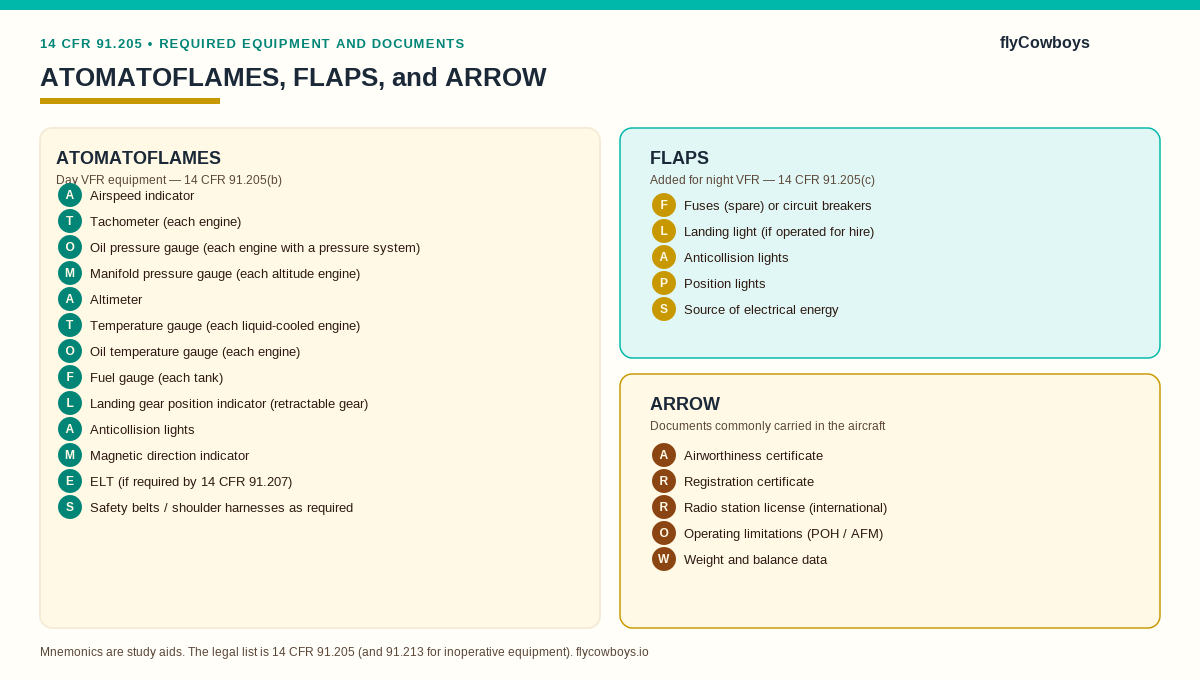
FLAPS: extra equipment for night VFR (14 CFR 91.205(c))
If you operate under VFR at night, 14 CFR 91.205(c) adds equipment on top of the day-VFR list. FLAPS is the usual mnemonic:
| Letter | Item | Notes |
|---|---|---|
| F | Fuses | Spare fuses, or circuit breakers that can be reset in flight, as required by the regulation. |
| L | Landing light | Required if the aircraft is operated for hire. |
| A | Anticollision lights | Already in the day list for many airplanes; required for night operation. |
| P | Position lights | The navigation lights (red, green, and white). 14 CFR 91.209 also addresses when aircraft lights must be used. |
| S | Source of electrical energy | An adequate source of electricity for all installed electrical and radio equipment. |
A landing light is not required for a typical private, not-for-hire night flight, but it is still a very good idea. Position lights and a functioning electrical system are not optional at night.
ARROW is about documents, not equipment
Students often lump ARROW into the same breath as ATOMATOFLAMES. ARROW is a memory aid for airworthiness-related documents and data that must be on board (and, for some items, displayed), not for the instruments in 91.205. A common version is:
- A — Airworthiness certificate
- R — Registration certificate
- R — Radio station license, when required (typically for international operations)
- O — Operating limitations, usually the POH or AFM and any placards
- W — Weight and balance data
Other required items, such as a compass correction card, an external data plate, and current charts appropriate to the flight, get asked on orals too. For a longer list of what a DPE may ask about documents, see the PPL checkride oral exam questions.
IFR adds another list (14 CFR 91.205(d))
If you fly IFR, 91.205(d) requires the VFR day instruments and equipment plus items such as a gyroscopic rate-of-turn indicator, a slip-skid indicator, a gyroscopic pitch-and-bank (attitude) indicator, a gyroscopic direction indicator, a clock with a sweep-second or digital seconds display, a generator or alternator, and the appropriate radios and navigation equipment for the route. Instructors often teach this with a separate mnemonic (for example, GRABCARD). Do not try to force those items into ATOMATOFLAMES. When you start instrument training, use our instrument rating ground school guide alongside the regulation.
A worked example
You show up for a day VFR training flight in a fixed-gear, air-cooled, normally aspirated 172. The oil-temperature gauge is inoperative, the landing light is burned out, and the ELT is installed and within date. Can you go?
The landing light is a night / for-hire item under 91.205(c), not a day-VFR requirement, so a burned-out landing light does not, by itself, stop a not-for-hire day VFR flight. The oil temperature gauge is required for each air-cooled engine under 91.205(b). Unless the item is deferred under an approved minimum equipment list or another legal process that applies to that airplane, you should not depart until it is fixed or the airplane is otherwise legally released. The ELT still has to satisfy 14 CFR 91.207.
Inoperative equipment is also covered by 14 CFR 91.213. That rule, not the mnemonic, is what tells you whether you can deactivate and placard an item and still fly. Learn ATOMATOFLAMES first, then learn 91.213 with your instructor before you start making go or no-go calls about inoperative gear.
How this shows up on the FAA knowledge test
Questions usually name a flight condition (day VFR, night VFR, or IFR) and ask which instrument or light is required, or they give a missing item and ask if the flight is legal. Traps include:
- Requiring a landing light for a private night flight that is not for hire.
- Forgetting that a manifold pressure gauge is for an altitude engine, not every trainer.
- Mixing ARROW documents with 91.205 equipment.
- Using the day list at night and omitting position lights or an electrical source.
- Assuming an inoperative required instrument is fine if the weather is good.
Drill these with a FAA practice test and keep the regulation nearby. A mnemonic only helps if you can still explain what each letter actually requires.
Sources
14 CFR 91.205 (power-civil aircraft: instrument and equipment requirements), 14 CFR 91.207 (ELT), 14 CFR 91.209 (aircraft lights), 14 CFR 91.213 (inoperative instruments and equipment), and the FAA Pilot's Handbook of Aeronautical Knowledge discussion of required equipment. This page is a study aid; the current regulation and your aircraft's documentation control.
Frequently Asked Questions
What does ATOMATOFLAMES stand for?
Airspeed indicator, Tachometer, Oil pressure gauge, Manifold pressure gauge, Altimeter, Temperature gauge, Oil temperature gauge, Fuel gauge, Landing-gear position indicator, Anticollision lights, Magnetic direction indicator, ELT, and Safety belts or shoulder harnesses. It maps to the day-VFR list in 14 CFR 91.205(b).
What is FLAPS in aviation?
In this context, FLAPS is the mnemonic for extra night-VFR equipment under 14 CFR 91.205(c): fuses (or resettable circuit breakers), a landing light if the aircraft is operated for hire, anticollision lights, position lights, and a source of electrical energy. It is not about wing flaps.
What does ARROW mean for pilots?
ARROW is a document mnemonic, not an equipment list: Airworthiness certificate, Registration, Radio station license when required, Operating limitations (POH or AFM and placards), and Weight and balance data. Keep it separate from ATOMATOFLAMES.
Do I need a landing light for night VFR?
14 CFR 91.205(c) requires a landing light if the aircraft is operated for hire. A private, not-for-hire night flight does not make the landing light a required item under that paragraph, but position lights, anticollision lights as required, and an adequate electrical source are still required, and 91.209 addresses when lights must be used.
Can I fly if one required instrument is inoperative?
Not just because the weather is VFR. 14 CFR 91.213 is the rule for inoperative instruments and equipment. If the item is required by 91.205, the type certificate, or an airworthiness directive, you generally cannot go unless you are operating under an approved MEL or another procedure that 91.213 allows, including deactivating and placarding when that path applies.
Is a manifold pressure gauge required in a Cessna 172?
91.205(b) requires a manifold pressure gauge for each altitude engine. A typical normally aspirated, fixed-pitch trainer does not have an altitude engine, so that letter often does not apply. Check the regulation and the equipment actually installed in your airplane.