· 14 min read
PPL Study Guide for the FAA Written: A Practical Plan
A PPL study guide with a 4-6 week plan, ACS topic roadmap, practice question routine and readiness checks for the FAA Private Pilot knowledge test.
You can miss 18 questions and still pass the FAA Private Pilot Airplane written exam, calculated from the passing standard in the FAA Private Pilot Airplane Airman Certification Standards. That's a useful exam fact, but a poor study goal. If your missed questions concern weather, airspace, or aircraft limitations, a passing total can hide knowledge you'll need in the cockpit.
A useful PPL study guide helps you distinguish remembering an answer from understanding a decision. Build your preparation around the FAA's standards, track which subjects you can explain, and give safety-critical weaknesses more attention than your overall score suggests.
Table of Contents
- What the PPL Written Exam Actually Tests
- PPL Topic Roadmap Organized by ACS Area
- A Week-by-Week PPL Study Plan with Milestones
- Practice Question Strategy for PPL Knowledge Tests
- Sample PPL Study Sessions You Can Copy
- Measure PPL Readiness and Book the Written
What the PPL Written Exam Actually Tests
The PPL knowledge test gives you 150 minutes to answer 60 questions. That works out to an average of 2.5 minutes per question, though chart and performance problems may take longer.
PPL knowledge test at a glance
| Exam element | Published value | What it means for study |
|---|---|---|
| Questions | 60 | Practice in full 60-question sets |
| Time allowed | 2.5 hours (150 minutes) | Budget an average of 2.5 minutes per question |
| Passing score | 70 percent (42 correct) | Aim above the passing line and check for weak areas |
| Governing standard | FAA Airman Certification Standards | Connect each answer to the knowledge and decisions it tests |
The test measures more than recall. Its questions cover knowledge pilots apply to regulations, weather, navigation, aircraft performance, and human factors. Those subjects interact in flight, much like parts of a route plan: a change in weather can affect the route, fuel, and decision to go.
What the format means for preparation
Use the average time as a pacing guide, not a limit for every question. Answer straightforward recall questions efficiently, then spend more time where a chart or calculation requires careful work. Repeatedly reconsidering an answer you understand can use time better spent on a harder item.
Readiness also takes more than one practice score. Track ACS-related patterns: frequent errors show where your understanding is thin, while errors involving weather decisions, airspace, or aircraft limits deserve extra attention because they can affect safety. A familiar answer is not proof of understanding. Try explaining why it is correct, then see whether your reasoning holds when the question's conditions change.
Before booking, confirm the requirements for your test authorization with your instructor or the FAA. The knowledge-test requirements and the requirements for earning a private pilot certificate are separate.
Record the test's time limit and passing score in your study notes. Set a second target too: explain your answer without relying on the choices.
PPL Topic Roadmap Organized by ACS Area
The FAA Private Pilot Airplane ACS links knowledge, risk management, and skill elements, giving you a practical way to group written-test topics. Use the FAA Private Pilot Airplane ACS as the reference, and check that your study materials follow the applicable edition. For a plain-language guide to how the Private Pilot ACS organizes test areas, use the same topic structure as you review questions.
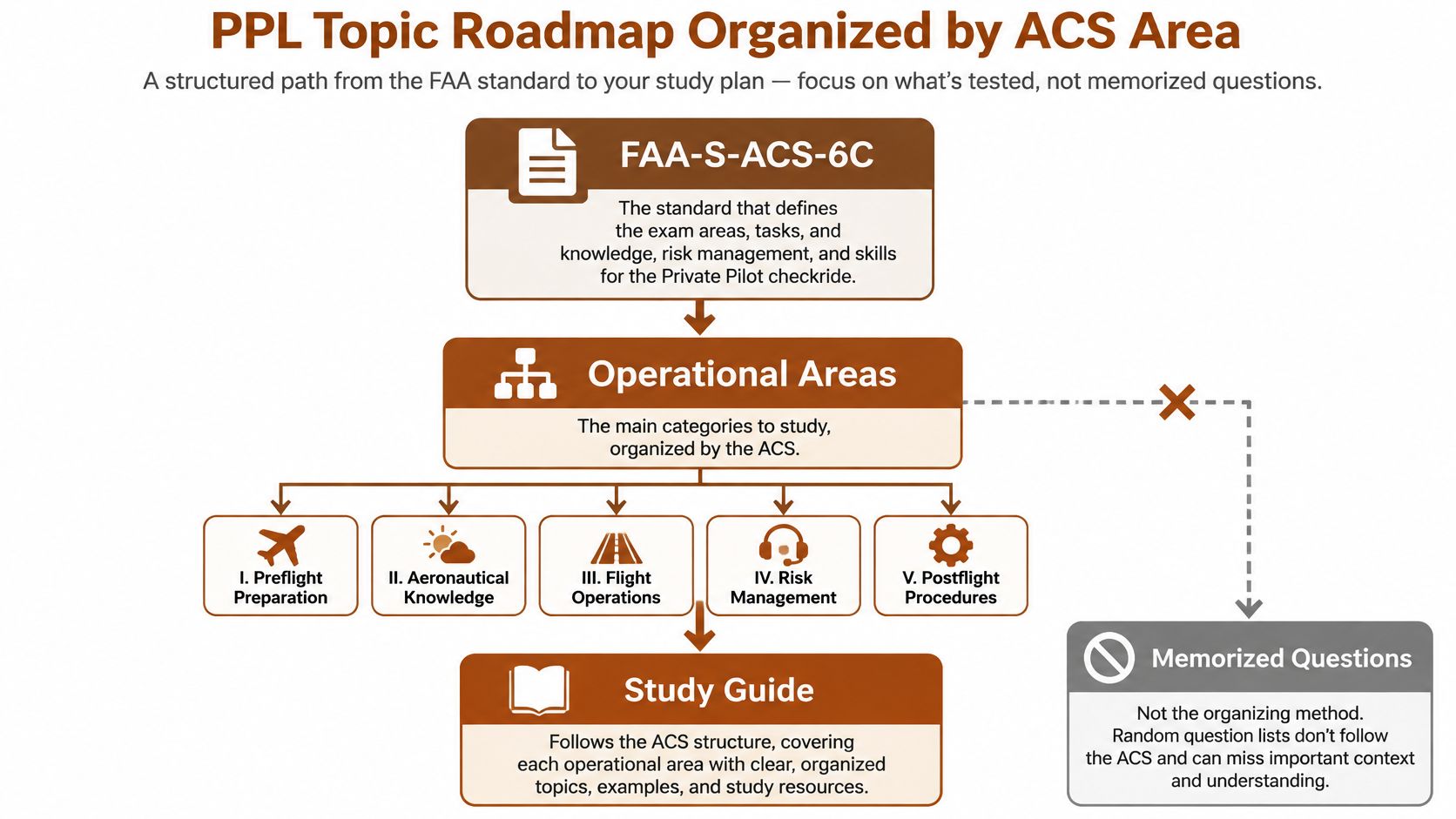
ACS study areas and priority
| ACS area | What to master | Study priority |
|---|---|---|
| Regulations (FAR/AIM) | Privileges, currency, recordkeeping, airspace rules | High, rules shape many flight decisions |
| Airspace | Class requirements, visibility and cloud clearances | High, defines where and how you may operate |
| Weather theory and products | METARs, TAFs, fronts, icing, weather decisions | High, informs go-or-no-go decisions |
| Performance and weight and balance | Charts, density altitude, loading limits | High, shows whether the aircraft can perform the planned flight |
| Navigation and charts | Sectionals, VOR, GPS, dead reckoning | Medium to high, links route planning with in-flight navigation |
| Human factors and risk | Decision models, fatigue, impairment, risk controls | Medium, errors can carry serious consequences |
| Aerodynamics and aircraft systems | Lift, stalls, engine and systems basics | Medium, supports understanding of aircraft behavior |
| Radio procedures and emergencies | Phraseology, lost communications, emergency procedures | Review regularly, even if these questions appear less often |
This sequence is a study guide, not a forecast of the questions on your exam. Regulations establish operating limits; airspace and weather apply those limits to a proposed flight. Performance and navigation then help you decide whether the aircraft and route can support the plan.
Connect subjects instead of isolating chapters
If lowering clouds make your planned cruise altitude unsuitable, decoding the forecast is only the first step. You also need to consider terrain, airspace requirements, alternate routes, and aircraft performance. The written exam tests knowledge, while the ACS structure helps you see how that knowledge supports decisions.
Track two kinds of weakness: frequent errors and high-consequence errors. A missed chart question may recur in practice, while a question on an emergency procedure may be less common but deserves careful review because of its safety implications. Give study time to both patterns rather than relying on question frequency alone.
When a practice question identifies an ACS code, record it and group your results by topic. Then choose a small set of weak areas to study together. One student may need more weather and airspace practice; another may need more work with charts and performance calculations.
A Week-by-Week PPL Study Plan with Milestones
At flyCowboys, we recommend 20–30 minutes of focused study per day. Most flyCowboys users are ready to take the written after 4–6 weeks of daily study, but your demonstrated understanding should determine your pace, not the calendar.
Use this schedule as a proposed routine. The milestones are study recommendations, not additional FAA requirements, and full simulations require longer appointments than ordinary daily sessions.
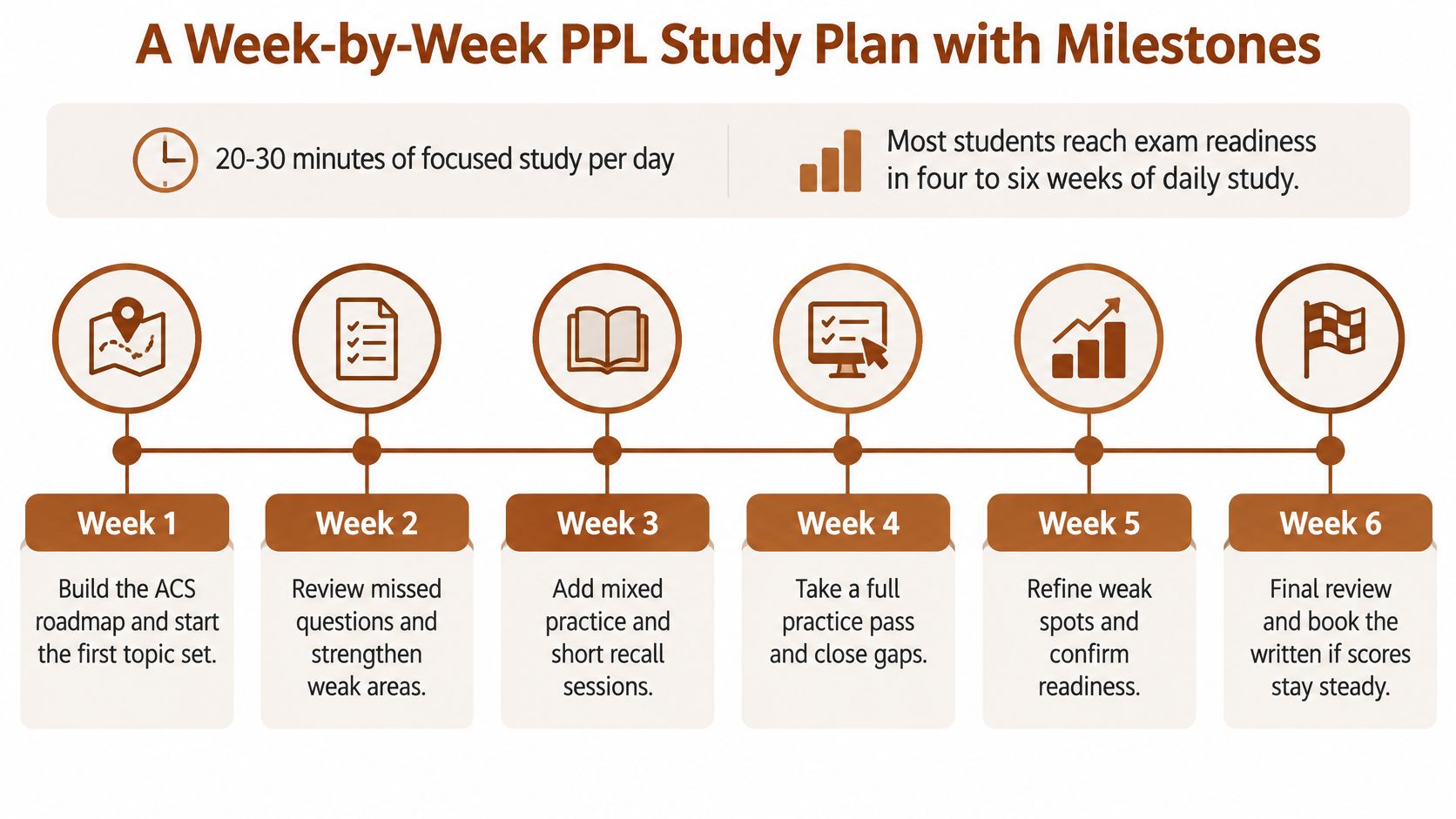
Six-week PPL study schedule with milestones
| Week | Focus | Daily time | Milestone check |
|---|---|---|---|
| Week 1 | Regulations and airspace basics | 20–30 minutes | Explain the main airspace classes from memory |
| Week 2 | Weather theory, METARs and TAFs | 20–30 minutes | Decode a full METAR and TAF without notes |
| Week 3 | Navigation, charts and performance | 30 minutes | Solve a chart problem and a weight-and-balance problem |
| Week 4 | Human factors, aerodynamics and systems | 30 minutes, with a separate full-set appointment | Tag every miss on a mixed practice set by ACS area |
| Weeks 5–6 | Weak areas and timed simulations | 30 minutes, plus separate simulation appointments | Meet the consecutive-run booking criteria |
| After week 6 | Weakest ACS area if a simulation falls short | A suggested three-day repair block, then retest | Book only when the readiness signals align |
Make each milestone a go-or-no-go decision
Choose a fixed daily slot, such as after dinner, and prepare your materials before it starts. Keep a sectional, notebook, calculator or flight computer, and the appropriate study references within reach so setup doesn't consume your attention.
Each ordinary session should contain new learning and retrieval of older material. Don't interpret “new learning” as an obligation to finish an entire ACS area in one sitting. A manageable objective might be identifying airspace boundaries or explaining a forecast's timing.
For the early milestones, use a strict completion rule: perform the listed task without prompting and explain every important step. A correct result with unexplained guessing isn't a completed milestone.
- If the explanation breaks down, revisit that concept before adding another demanding subject.
- If a calculation is wrong, identify whether the cause was the setup, chart reading, arithmetic, or interpretation.
- If you miss a week, reduce the next block's new material, but preserve the review block.
Don't repay missed study time by rushing through more chapters. Reduce the scope and keep the quality.
Reserve longer appointments for simulations
During the final study phase, clear your desk of notes and use an uninterrupted, exam-length timed setting. Use fresh mixed questions where possible, and save the explanations until you've submitted the run.
If a later simulation falls short of your preparation margin, return to the weakest ACS area rather than immediately repeating another whole test. Use the repair block to relearn the concept, apply it in a changed scenario, and then retest.
Choose your exam date after your results stabilize. A booking deadline can encourage attendance at the desk, but it can't establish understanding.
Practice Question Strategy for PPL Knowledge Tests
Memorizing answer choices feels productive because repeated questions become easier. The weakness appears when the wording changes, a chart uses different conditions, or you must select the safest action rather than recall a definition.
Use every practice set to test both accuracy and confidence. A correct guess belongs in your review queue just as surely as a wrong answer.
A repeatable review routine
- Answer before opening the explanation. Mark your confidence as sure, unsure, or guessed. This prevents a lucky selection from looking like mastery.
- Read the complete explanation for every missed or guessed answer. If you were confidently wrong, identify the assumption that led you there.
- Record the ACS area and the principle. Write a sentence in your own words explaining the rule, relationship, or decision the question tests.
- Schedule another attempt after a gap. Revisit missed and guessed concepts sooner, then test them again using different wording or a different application.
Separate frequent errors from consequential errors
Keep distinct notes for how often you miss a concept and what misunderstanding it could cause in flight. Repeated trouble reading a performance chart deserves prompt attention because both the learning gap and the potential consequence matter.
A rarely missed emergency concept still needs deliberate review. Conversely, an isolated terminology mistake may need correction without taking over your entire study session.
- High frequency and high consequence: Relearn the concept, work an application, and discuss unresolved confusion with your instructor.
- Low frequency and high consequence: Preserve it in recurring scenario review.
- Frequent but lower-consequence mistakes: Look for a recurring reading or memory problem and use focused retrieval practice.
Mix regulations, chart work, and weather interpretation instead of staying inside a comfortable chapter. For retakers, begin with the missed-topic information from the actual attempt rather than repeating an undirected question bank.
The FAA's 2025 knowledge-test report records an 81.64 percent pass rate for Private Pilot Airplane knowledge tests, meaning roughly one in five attempts didn't pass. That national result doesn't predict your outcome, but it's a good reason to value a careful review habit over a large completed-question count.
Sample PPL Study Sessions You Can Copy
Suppose you arrive home tired but still able to concentrate. You don't need to finish a chapter, you need a defined task and a way to tell whether you learned it.
Prepare a workspace that supports solving problems, not just tapping answers.
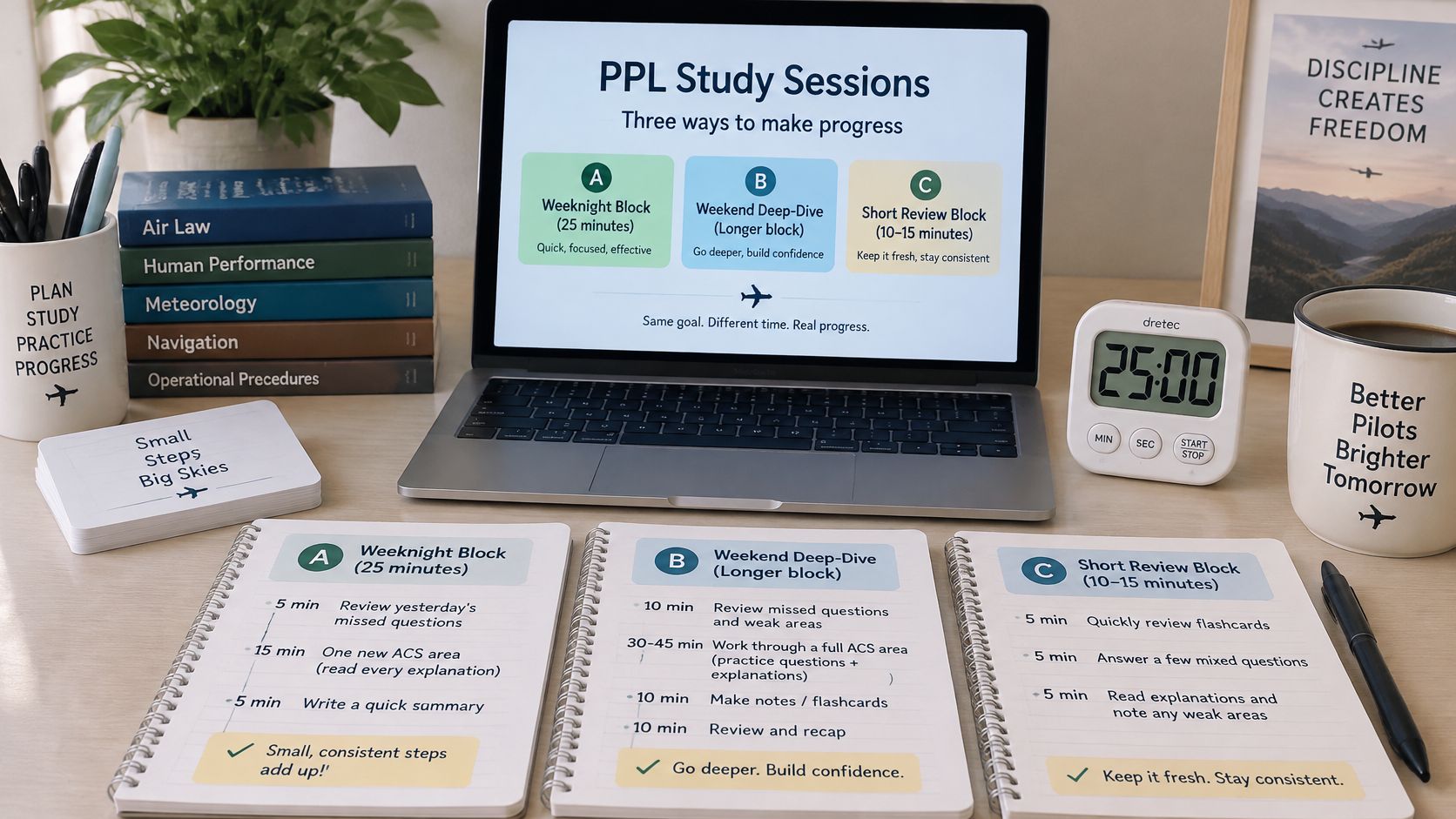
A short weeknight session
Try this 25-minute session template: spend 5 minutes retrieving yesterday's missed concepts, 15 minutes studying a narrow ACS topic and reading explanations, then 5 minutes writing the principle you learned. These are suggested practice allocations, not exam specifications.
For weather, your final sentence might distinguish what a current observation tells you from what a forecast tells you. Say the correct answer aloud, then write why the alternatives don't fit the question.
A longer weekend problem session
For a suggested 60-minute block, allow 10 minutes for spaced review, 30 minutes for a mixed set of 20 questions, and 20 minutes for a chart or weather problem on paper. Select questions from contrasting subjects so you must identify which method applies rather than repeat the same operation.
When flight-computer setup causes trouble, use our E6B flight computer guide. Write the inputs, units, and expected type of result before operating the tool.
If you include video in your study block, pause it to explain or work the relevant concept rather than watching passively.
A timed mock exam
The FAA testing matrix specifies 60 questions in 150 minutes, which gives calculated pacing checkpoints of approximately 50 minutes at question 20 and 100 minutes at question 40. Use these as checks, not reasons to rush a difficult problem.
After submitting, schedule a separate review block. Tag missed concepts by ACS code, distinguish knowledge errors from setup errors, and select the weakest areas for your next study cycle.
During ordinary learning sessions, stop when your attention deteriorates. During a planned simulation, practice sustaining attention under the full test conditions.
Measure PPL Readiness and Book the Written
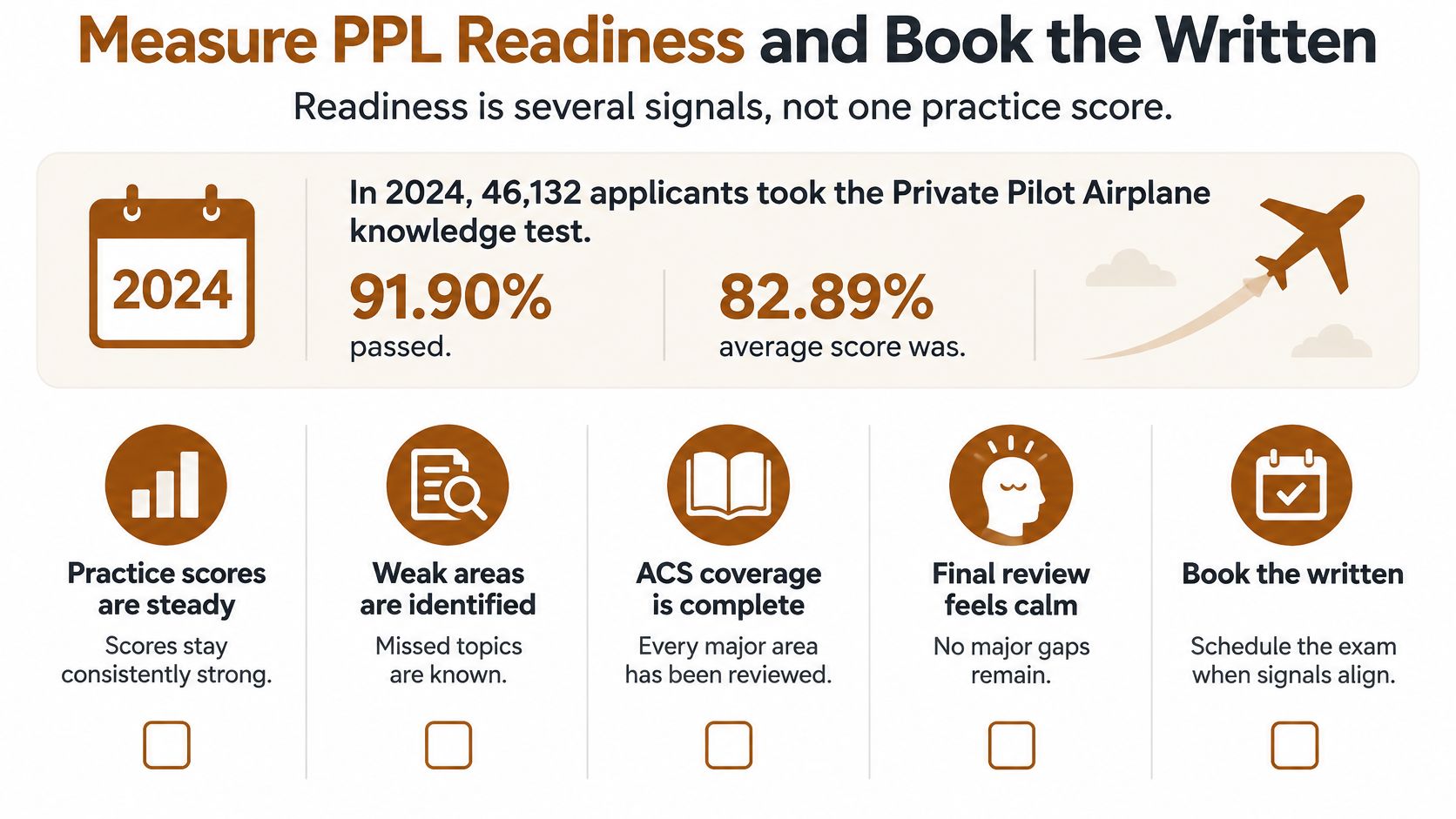
A passing practice result and a convincing readiness record aren't the same thing. The FAA's 2024 knowledge-test report lists 46,132 Private Pilot Airplane test takers, a 91.90 percent pass rate, and an 82.89 percent average score.
Those figures describe the national testing cohort, not a guaranteed result or a personal booking target. Use your own ACS coverage, explanations, and repeated performance to make the decision.
Check the signals before choosing a date
For this study plan, use two consecutive timed simulations at or above 80 percent as a suggested minimum preparation gate, not an FAA rule or a guarantee. Even then, don't book if important subject gaps remain.
Use the following checklist alongside the total score:
- Stable timed performance: Meet the proposed simulation gate without notes or mid-test explanations.
- No recurring weak ACS area: A subject shouldn't remain a consistent problem across both runs.
- No unresolved safety-critical pattern: Repeated misses involving weather, airspace, performance limits, regulations, or emergencies require repair.
- Independent explanations: Explain why the correct choice fits the conditions without looking at the solution.
- Successful retesting: Demonstrate improvement on changed questions, not just immediate repetitions of the ones you missed.
If a signal fails, assign a specific task. “Study more weather” is too broad; “interpret the forecast period correctly and explain how it affects the departure decision” gives you something observable to assess.
Use a different starting point after an unsuccessful attempt
A first-time applicant needs broad coverage followed by confirmation. A retaker has additional diagnostic evidence: use the Airman Knowledge Test Report codes to identify what needs attention, then work with your instructor on the applicable retesting requirements.
Don't assume the reported misses represent every gap, and don't discard the rest of your study routine. Repair the identified concepts while keeping stronger subjects active through mixed review.
Once your signals align, use the FAA written-test scheduling guide to prepare for the booking process. Confirm current authorization, identification, and testing requirements before committing to an appointment.
This week, take a diagnostic and write a short explanation of each weak area. At flyCowboys, our process starts with your rating and a placement quiz, then we build a personalized study plan around those weaknesses. Our content is for educational and supplemental study purposes only; the FAA standards remain the authority.
Visit flyCowboys to start with a placement quiz and a personalized weak-area study plan. Both plans include the PPL and IFR written courses, with explained practice questions and PSI-style simulations to help you test understanding before booking the written.
Private Pilot Knowledge Areas: Quick Reference
Use these 10 areas as a checklist while you study. Each one lists the key concepts the written test likes to ask about and a study tip.
Area 1 of 10
Pilot Qualifications
Before you can earn your Private Pilot Certificate, you must meet specific eligibility requirements set by the FAA under 14 CFR Part 61. Understanding these requirements early prevents surprises and helps you plan your training timeline effectively.
Key concepts
- You must be at least 17 years old to receive a Private Pilot Certificate (16 for a student pilot certificate) and be able to read, speak, write, and understand English.
- A valid Third-Class Medical Certificate (or BasicMed) is required. Third-Class medicals are valid for 60 months if you are under 40, or 24 months if 40 or older on the date of exam.
- Minimum flight time: 40 hours total (20 hours dual instruction, 10 hours solo), though the national average is closer to 60–75 hours before checkride.
- You need a written endorsement from your CFI before taking the FAA Knowledge Test, and a separate endorsement before the practical test (checkride).
- Solo cross-country flights require at least 150 nautical miles total distance, with full-stop landings at a minimum of three points and one segment of at least 50 NM straight-line distance.
Study tip: Create a personal checklist of every requirement in 14 CFR 61.103 and 61.109. Check items off as you complete them so nothing falls through the cracks before your checkride.
Area 2 of 10
Preflight Procedures
Thorough preflight preparation is the foundation of every safe flight. This area covers everything you should do before the engine starts, from reviewing weather to calculating whether your aircraft can safely perform the planned flight.
Key concepts
- Obtain a standard weather briefing from Flight Service (1800wxbrief.com or ForeFlight). Know the three types: standard, abbreviated, and outlook. Always check METARs, TAFs, AIRMETs, SIGMETs, and PIREPs.
- Check NOTAMs (Notices to Air Missions) for your departure, en-route, and destination airports. TFRs (Temporary Flight Restrictions) are NOTAMs—busting one can mean certificate action or interception.
- Weight & balance calculations must confirm the aircraft is within CG limits and under max gross weight for every phase of flight, including takeoff, cruise, and landing (accounting for fuel burn).
- Performance calculations use the POH charts to determine takeoff roll, rate of climb, cruise speed/fuel flow, and landing distance for the current density altitude, weight, and wind conditions.
- Use the PAVE checklist (Pilot, Aircraft, enVironment, External pressures) and IMSAFE checklist to evaluate personal fitness before every flight.
Study tip: Practice reading real METARs and TAFs daily—decode them in your head before checking an auto-decode tool. The written exam loves questions about weather abbreviations and symbols.
Area 3 of 10
Airport & Airspace Operations
Knowing your way around airports and the airspace system is critical for safe flight. The FAA expects you to understand airport markings, lighting, signage, and how to communicate and operate correctly in each class of airspace.
Key concepts
- Airspace classes: Class A (18,000’ MSL to FL600, IFR only), Class B (major airports, clearance required), Class C (radar service, two-way radio required), Class D (control tower, two-way radio), Class E (controlled, various floor altitudes), Class G (uncontrolled).
- Airport signs: red signs with white text are mandatory instruction signs (runway hold-short markings). Black signs with yellow text are location signs. Yellow signs with black text are direction/destination signs.
- CTAF (Common Traffic Advisory Frequency) procedures: at non-towered airports, self-announce your position and intentions on the CTAF. Standard traffic pattern entry is a 45-degree angle to the downwind leg.
- Runway incursion avoidance: always read back hold-short instructions, verify your position on the airport diagram, and never cross a runway hold-short line without explicit ATC clearance (or verifying clear at non-towered fields).
- Right-of-way rules (14 CFR 91.113): aircraft in distress have priority. When converging, the aircraft to the right has the right-of-way. Aircraft being overtaken have the right-of-way.
Study tip: Draw each airspace class from memory as a vertical cross-section (the "wedding cake" diagram). If you can reproduce it on a blank sheet, you own this topic for the exam.
Area 4 of 10
Takeoffs, Landings & Go-Arounds
Takeoffs and landings are the most demanding phases of flight and where most accidents occur. The ACS expects you to understand the aerodynamic principles and proper techniques for various runway and wind conditions.
Key concepts
- Normal takeoff: full power, maintain centerline with rudder, rotate at Vr (specified in POH). In a crosswind, start with aileron deflected into the wind, gradually reduce deflection as speed increases, and use rudder to maintain centerline.
- Short-field takeoff: hold brakes, full power, release when engine is stabilized, rotate at the POH-recommended speed, climb at Vx (best angle) until clearing the obstacle, then accelerate to Vy (best rate).
- Soft-field takeoff: keep the yoke full back to keep weight off the nosewheel, apply power smoothly, lift off at the lowest possible airspeed, and accelerate in ground effect before climbing.
- Go-around procedure: full power, carb heat off, pitch for Vy, retract flaps incrementally (not all at once), maintain runway alignment, and communicate your intentions to ATC or on CTAF.
- Crosswind landing: use the sideslip (wing-low) method—lower the upwind wing into the wind and apply opposite rudder to keep the nose aligned with the runway. Touch down on the upwind main wheel first.
Study tip: Memorize your aircraft’s V-speeds from the POH: Vs0, Vs1, Vx, Vy, Vfe, Vno, Vne, and Va. The exam will test these, and your DPE will absolutely ask about them during the oral.
Area 5 of 10
Performance & Limitations
Aircraft performance is not constant—it changes with altitude, temperature, weight, and configuration. Understanding how to use your POH performance charts and what factors degrade performance can literally save your life on a hot, high-altitude day.
Key concepts
- Density altitude is pressure altitude corrected for non-standard temperature. High density altitude (hot, high, humid) = degraded performance: longer takeoff rolls, reduced climb rates, and higher true airspeeds for the same indicated airspeed.
- Load factor (G-force) increases dramatically in steep turns: 1.15G at 30° bank, 1.41G at 45°, 2.0G at 60°. Higher load factors increase stall speed and structural stress. The stall speed increases by the square root of the load factor.
- V-speeds to know: Vs0 (stall speed, landing config), Vs1 (stall speed, clean), Vx (best angle of climb), Vy (best rate of climb), Va (maneuvering speed—decreases with lighter weight), Vfe (max flap extended), Vno (max structural cruise), Vne (never exceed).
- Weight affects everything: a heavier aircraft has a higher stall speed, longer takeoff roll, reduced climb rate, higher approach speed, and longer landing roll. Always calculate performance at your actual weight, not max gross.
- Use the POH performance charts by entering the correct pressure altitude and temperature. Interpolate between values when your conditions fall between chart entries. Never round in the favorable direction.
Study tip: The most common exam trap is confusing pressure altitude with density altitude. Remember: pressure altitude comes from the altimeter set to 29.92, while density altitude further corrects for temperature. Practice both calculations until they are automatic.
Area 7 of 10
Emergency Operations
Emergencies are rare, but how you respond in the first few seconds can determine the outcome. The ACS requires knowledge of the proper procedures for engine failures, fires, and other abnormal situations as described in your aircraft’s POH.
Key concepts
- Engine failure after takeoff: pitch immediately for best glide speed (Vg)—do NOT attempt to turn back to the runway unless you have sufficient altitude (often cited as 1,000’ AGL minimum, but this varies by aircraft). Land straight ahead or with slight turns to avoid obstacles.
- Engine fire in flight: mixture IDLE CUT OFF, fuel selector OFF, master switch OFF (after establishing a field), establish best glide, and plan for an immediate emergency landing. For an electrical fire: master switch OFF, all avionics OFF, ventilate the cabin.
- Emergency landings: the ABCs—Airspeed (best glide), Best field (select a suitable landing area), Checklist (attempt restart if altitude permits: fuel selector, mixture, magnetos, carb heat). Fly a normal pattern to your chosen field if possible.
- Lost procedures: climb for better visibility and radio/radar reception, attempt to identify your position using pilotage, contact ATC on 121.5 MHz (emergency frequency), and squawk 7700 on your transponder. ATC can provide radar vectors.
- The PIC has the final authority in an emergency and may deviate from any rule to the extent required to meet that emergency (14 CFR 91.3). If you deviate, you may be asked to submit a written report, but your first job is to fly the airplane.
Study tip: Practice the engine failure flow in your chair at home: pitch for glide speed, pick a field, attempt restart, then prepare for landing. Speed and muscle memory matter when adrenaline spikes. Also, memorize your aircraft’s best glide speed cold.
Area 8 of 10
Night Operations
Night flying introduces unique challenges related to vision, spatial orientation, and equipment requirements. While a private pilot certificate allows you to fly at night, the reduced visual references demand extra preparation and awareness.
Key concepts
- Dark adaptation takes approximately 30 minutes for full night vision. Rods (responsible for night vision) are concentrated outside the center of the eye—use off-center viewing (look slightly to the side) to detect dim objects at night.
- Required equipment for night VFR (in addition to day VFR equipment): position lights (navigation lights), anti-collision lights, landing light (if for hire), and an adequate power source for all electrical equipment. Remember the mnemonic FLAPS for night: Fuses, Landing light (if for hire), Anti-collision lights, Position lights, Source of power.
- Night currency: to carry passengers at night, you need 3 takeoffs and 3 landings to a full stop within the preceding 90 days, made during the period from 1 hour after sunset to 1 hour before sunrise (14 CFR 61.57).
- Visual illusions at night: a runway that slopes upward (or is narrower than usual) creates the illusion of being too high, tempting a dangerously low approach. Featureless terrain can cause the "black hole" approach—always use VASI/PAPI when available.
- Autokinesis is a night illusion where a stationary light appears to move. Avoid fixating on a single point of light—scan regularly. Pilots sometimes mistake ground lights for stars or other aircraft.
Study tip: The written exam frequently tests night vision physiology and the required equipment. Make a flashcard for the dark adaptation timeline, the difference between rods and cones, and the FLAPS mnemonic for night VFR equipment.
Area 9 of 10
Aeromedical Factors
Your body is not naturally designed for flight. Altitude, acceleration, and disorientation can impair your ability to fly safely without warning. The FAA expects pilots to understand these physiological risks and to self-assess their fitness before every flight.
Key concepts
- Hypoxia: reduced oxygen to the body. Symptoms include euphoria, impaired judgment, headache, dizziness, and cyanosis. At cabin altitudes above 12,500’ MSL for more than 30 minutes, supplemental oxygen is required for the flight crew; above 14,000’ it is required at all times (14 CFR 91.211).
- Spatial disorientation occurs when your body’s senses conflict with actual aircraft attitude. The most dangerous type is the "leans" (banking illusion after a gradual unnoticed turn). Rule: always trust your instruments over your body.
- Carbon monoxide (CO) poisoning: exhaust gas can leak into the cabin via the heater. CO binds to hemoglobin 200x more readily than oxygen. Symptoms include headache, dizziness, and cherry-red skin. If suspected: shut off the heater, open fresh air vents, and land as soon as practicable.
- The IMSAFE checklist is your pre-flight self-assessment: Illness, Medication, Stress, Alcohol (8 hours bottle-to-throttle AND below 0.04% BAC, per 14 CFR 91.17), Fatigue, Emotion (Eating in some versions). If any item is compromised, do not fly.
- Middle ear and sinus blocks: during descent, trapped gas in the sinuses or middle ear expands and can cause severe pain. Use the Valsalva maneuver (gently blow against pinched nostrils) to equalize. Avoid flying with a cold or upper respiratory infection.
Study tip: The IMSAFE checklist and alcohol rules (8 hours, 0.04% BAC) are almost guaranteed exam questions. Also know the oxygen requirements by altitude—draw a simple chart for 12,500’, 14,000’, and 15,000’ (passengers) to lock it in.
Area 10 of 10
National Airspace System
The NAS is the complex network of airspace, navigation facilities, airports, and ATC services that makes organized aviation possible in the United States. Understanding TFRs, special use airspace, and how to communicate with ATC is essential for safe and legal VFR flying.
Key concepts
- TFRs (Temporary Flight Restrictions) are issued for presidential movements, sporting events, wildfires, space launches, and other reasons. Violating a TFR can result in certificate suspension, civil penalties, or even military interception. Always check TFRs during preflight planning.
- Special Use Airspace: Prohibited areas (P-areas, e.g., P-56 over the White House) are no-fly zones. Restricted areas (R-areas) have hazardous activities (artillery, missiles) and require permission when "hot." MOAs (Military Operations Areas) are used for military training—VFR traffic may enter but should exercise caution.
- Radar services for VFR aircraft: Flight Following (VFR advisories) is available on a workload-permitting basis. Contact the appropriate approach/departure control or Center frequency. You will receive traffic advisories and safety alerts, but it does not replace see-and-avoid.
- ATC communication basics: use the format WHO you are calling, WHO you are, WHERE you are, WHAT you want. Read back all hold-short instructions and altitude assignments. If unsure, ask ATC to "say again.” Never guess.
- Transponder codes: 1200 is the standard VFR code. 7500 is hijack. 7600 is communication failure (lost comm). 7700 is emergency. The memory aid: 75—taken alive, 76—need a fix, 77—going to heaven.
Study tip: Squawk codes 7500, 7600, and 7700 appear on nearly every PPL written exam. Memorize the mnemonic. Also, know the difference between a MOA, Restricted Area, Prohibited Area, and Alert Area—the exam will test subtle distinctions.