· 15 min read
Slip and Skid: What Pilots Must Recognize in Flight
Slip and skid explained for pilots: the ball position that tells them apart, what each feels like, why skids cause spins, and how to correct each in flight.
You're turning base to final. The runway drifts toward the top of the windscreen, so you add a little inside rudder to help the nose around, and the ball slides off center. Nothing feels wrong, which is exactly the problem. The airplane is in a skid now, and a skid is the setup for the cross-control stall that catches pilots in the traffic pattern. A slip, which looks like its mirror image on the panel, rarely carries the same penalty.
Most training treats the two as a matched pair: ball left, left rudder, ball right, right rudder. That symmetry is a teaching convenience, not an aerodynamic fact. Once you see where the risk lives, the correction order changes, and the checkride answer stops being a memory item and becomes a decision you can defend.
Table of Contents
- Slip and Skid Defined Side by Side
- Recognize and Correct a Slip or Skid
- Why the Ball Goes Off Center
- Slips and Skids in Real Flight Situations
- Where the Slip and Skid Rule Changes
- Decide What to Practice Before Your Next Flight
Slip and Skid Defined Side by Side
The FAA treats coordination as something you can see rather than something you feel. Coordinated flight exists when the airplane's nose is aligned with the relative wind and the inclinometer ball sits centered in its glass tube, and the FAA Airplane Flying Handbook builds its entire discussion of uncoordinated flight on that definition. Everything else follows from the mismatch between how much the airplane is banked and how fast it is turning.
A slip is a bank angle too steep for the rate of turn. A skid is a rate of turn too high for the bank angle. Same family of error, opposite direction, and very different consequences.
| Feature | Slip | Skid |
|---|---|---|
| Cause | Bank too steep for rate of turn; insufficient or delayed rudder relative to aileron | Rudder excessive for bank angle; tail travels outside nose's curved path |
| What the pilot feels | Pressed toward the inside of the turn | Pushed toward the outside of the turn |
| Inclinometer ball | Off center toward the low wing | Off center toward the high wing |
| Drag and speed | More parasite drag; useful descent with no airspeed gain | Extra drag and a tightened turn with back pressure; airspeed can hide the approaching stall |
| Stall consequence | Little yawing tendency; unlikely to spin directly, though still a stall | Yaw plus unequal wing angles of attack can autorotate into a spin faster than the pilot expects |
| Typical scenario | Forward slip on final, crosswind landing, deliberate descent steepening | Tightened base-to-final turn with inside rudder and back pressure |
Read the cause row first and the rest follows. When the rudder lags the aileron, the airplane banks faster than it yaws, so it slides toward the low wing and drags its flank through the air. When the rudder leads, the tail swings wide of the arc the nose is drawing, and that yaw keeps feeding bank and load factor into a turn that's already tight.
The stall row is where the pair stops being symmetrical. A slipping stall tends to arrive without much yaw, so it behaves like an ordinary stall. A skidding stall arrives with yaw already in place, and yaw is half of what a spin needs.
Two cues confirm the diagnosis before you look at anything else. Your seat tells you which way the airplane is throwing you: inward pressure in a slip, outward pressure in a skid. The ball tells the same story in instrument form, sitting toward the low wing in a slip and toward the high wing in a skid. If a term here is unfamiliar, the flyCowboys aviation glossary covers the vocabulary.
Carry this into the oral: in a slip the nose points toward the inside of the turn while the whole airplane slides inward. In a skid the tail swings outside the curved path the nose is tracing.
A car makes the picture concrete. A slip is a car sliding sideways through a corner while still pointed through it. A skid is a car whose rear end has swung wider than the front wheels can follow.
The three states look like this on the panel.
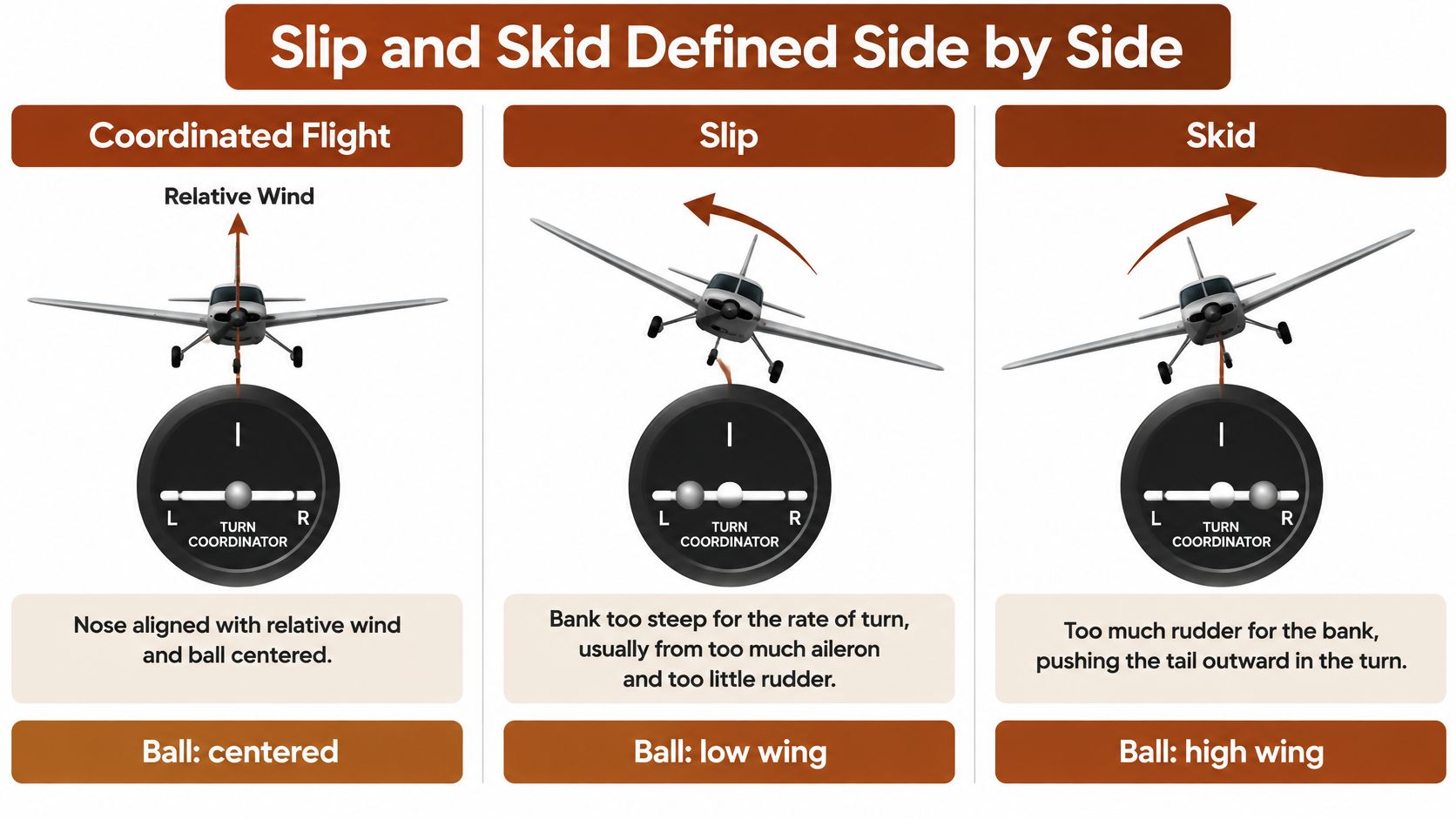
Treat the centered ball as your working definition of coordination, and correct with rudder and aileron together rather than chasing bank angle alone. The FAA frames both conditions as loss-of-control concepts, not minor handling imperfections, because both raise drag and cut efficiency while only one of them reliably feeds a spin.
Recognize and Correct a Slip or Skid
Correction is a sequence, not a reflex. The FAA's full Airplane Flying Handbook describes a skid as rudder input that's excessive for the bank, sending the tail outside the nose's curved path, and it names the badly flown base-to-final turn as the most common setting for a skidding cross-control stall. That context matters because the order of your corrections decides whether a tight turn ends with a go-around or a spin.
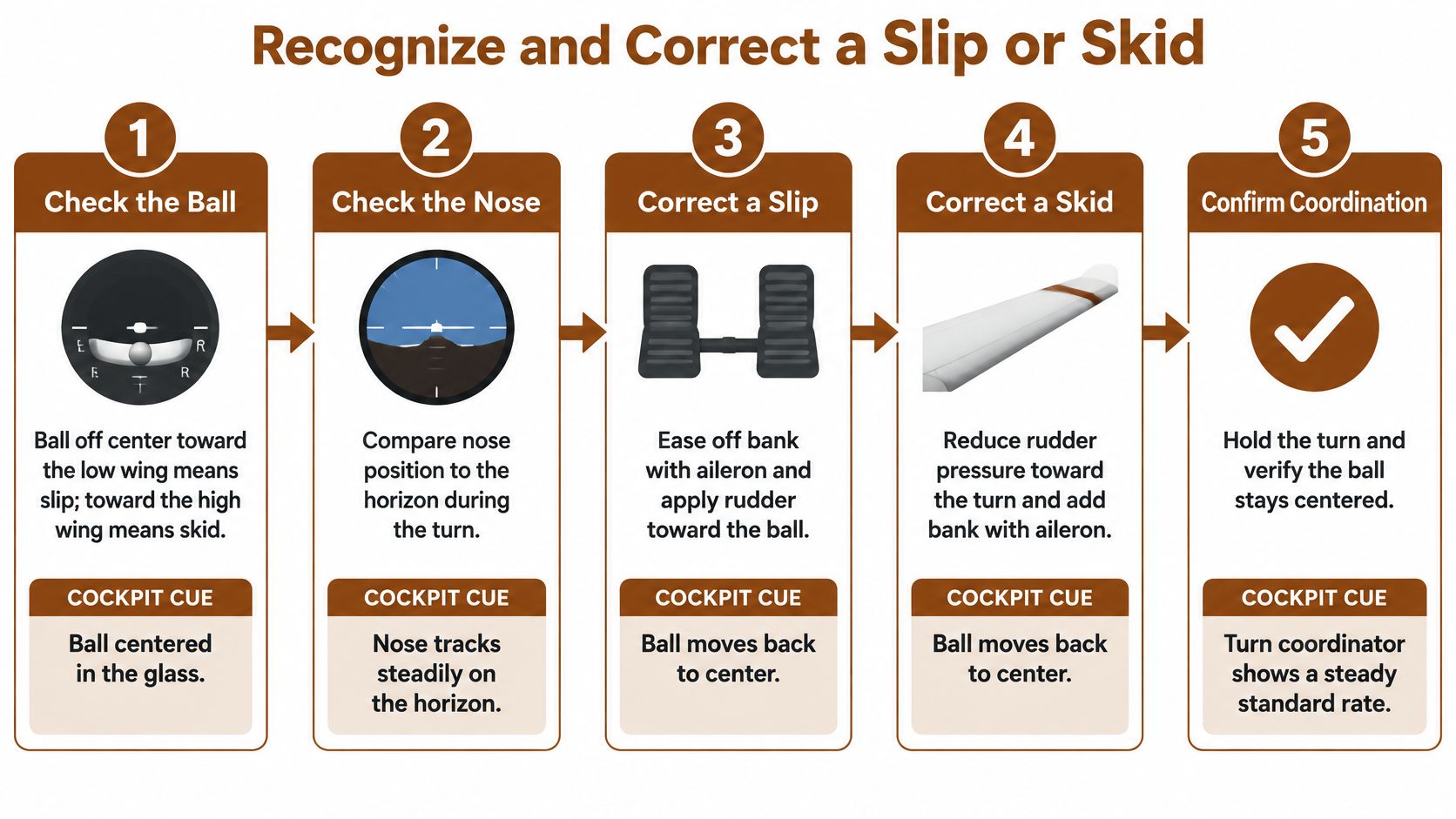
Work through these in order, and note that every step ends with something you can verify from the left seat.
- Read the ball first. Off center toward the low wing means slip. Off center toward the high wing means skid. Cue: you can name the condition out loud before your hand moves.
- Confirm with the sight picture and your seat. The nose tracking inside the turn while the ground track slides wide is a slip. A tail swung outside the nose's path with a push toward the outside of the turn is a skid. Cue: the visual and the seat agree with the ball.
- Fix a slip by stepping on the ball. Add rudder toward the ball, ease aileron pressure, re-center, then re-check the ball in the new bank. Cue: the ball settles in the middle as the bank stabilizes.
- Fix a skid by unloading first. Reduce angle of attack and bank before easing the inside rudder, then apply coordinated rudder and aileron. Never hold back pressure to save the turn. Cue: the sideways push in your seat disappears.
- Treat a skid near the stall as a stall. Lower the nose immediately and recover only once the ball is centered and airspeed is safe. Cue: buffet stops and the wing is flying again.
- On a base-to-final overshoot, go around. Cue: the runway comes back into the windscreen without the nose being forced around.
Here's the same logic as a flow you can review before a lesson.
When you're airborne and something feels off, scan for the symptom instead of reasoning from first principles.
| Symptom | Likely cause | Fix |
|---|---|---|
| Ball off center toward the low wing; nose inside the turn but tracking wide | Slip; insufficient or delayed rudder relative to aileron | Add rudder toward the ball, ease aileron, re-center and re-check |
| Ball off center toward the high wing; tail swung outside the nose's path | Skid; excessive rudder for the bank | Reduce angle of attack and bank, ease inside rudder, coordinate |
| Yoke firm and airspeed near usual stall speed while tightening a turn | Accelerated cross-control stall building | Push the nose down first; do not sacrifice altitude or the turn for recovery |
| Slip at approach speed but angle of attack rising | Deliberate slip moving toward a stall | Lower angle of attack first, then coordinate before re-establishing the flight path |
| Same inputs in a new type or a multiengine aircraft | Aircraft-specific limits not checked | Consult the POH or AFM before using slip or spin recovery techniques |
Treat that table as a training aid. It doesn't override the pilot operating handbook for the airplane you're flying, and it doesn't replace an instructor watching your feet.
Instructor habit worth copying: say the cue out loud during the maneuver. "Ball high wing, skid, unloading." Naming it out loud stops the hands from fixing the wrong problem.
Why the Ball Goes Off Center
The stakes justify the precision. Stall and spin accidents accounted for about 13 percent of all fixed-wing general aviation accidents in 2002 and 28 percent of fatal fixed-wing general aviation accidents that year, according to the accident data the FAA cites in its stall and spin awareness advisory circular. Nearly half of those stall and spin accidents produced fatal injuries, against a 20 percent fatality rate across general aviation overall, and they killed 147 people and seriously injured 44 others in 2002.
A turn is a balance between two things: the horizontal component of lift pulling the flight path around, and the yaw that points the nose along that path. The ailerons control the first. The rudder controls the second. Coordination means the two are matched.
A slip appears when the aileron wins that race. The FAA's guidance on slips and skids describes it as bank angle excessive for the actual rate of turn, usually because rudder input is insufficient or delayed relative to aileron input. The longitudinal axis points inside the turn while the fuselage travels laterally through the relative wind, which is why parasite drag climbs and why a forward slip can steepen a descent without adding airspeed.
A skid appears when the rudder wins. The tail swings outside the flight path, the yaw accelerates one wing through the air and slows the other, and the slower wing meets the relative wind at a higher angle of attack. Load factor pushes stall speed up at the same time. The result is a wing that reaches its critical angle of attack at an indicated airspeed that still looks safe on the gauge.
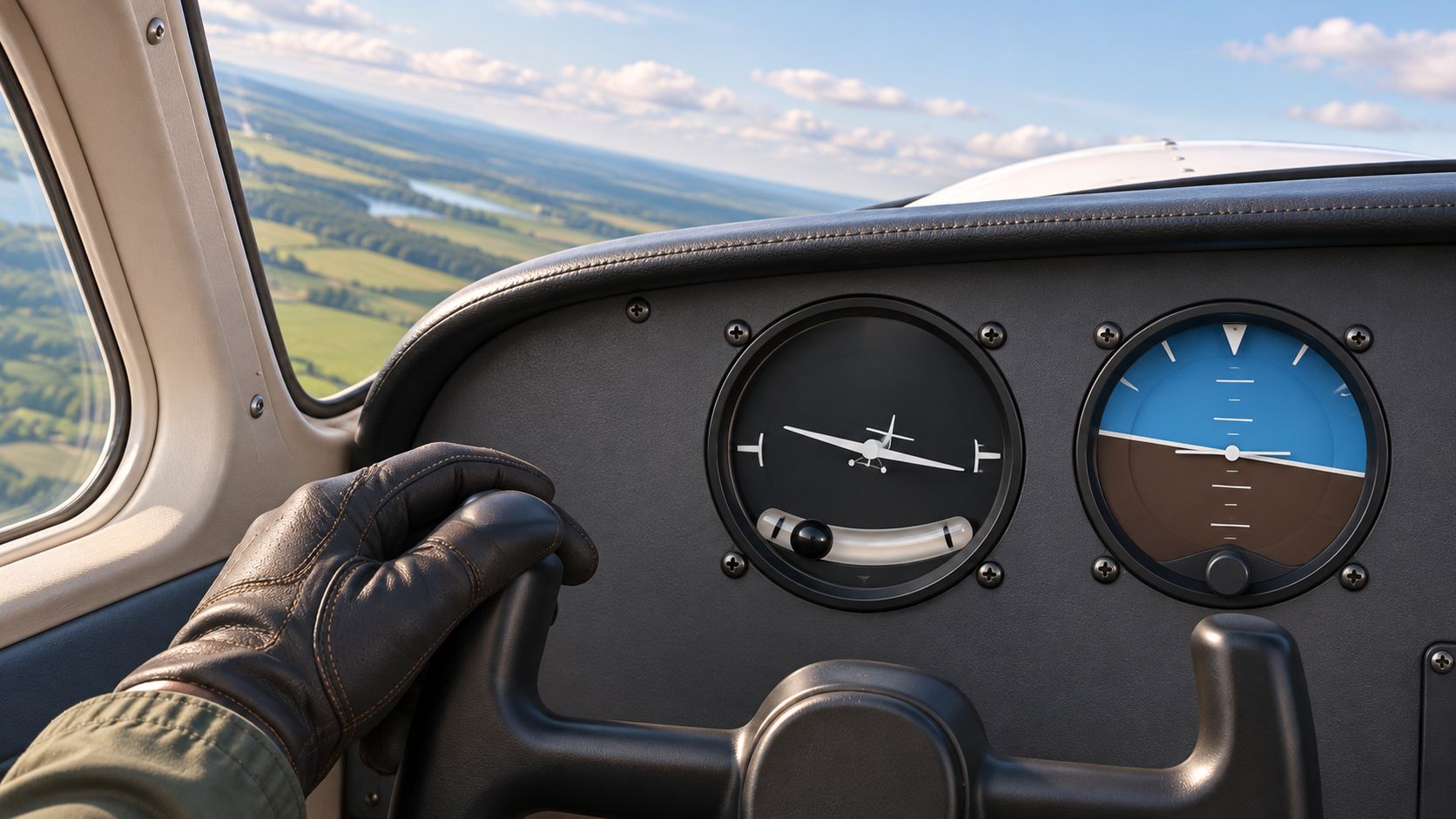
The pilot at the yoke during a crosswind approach.
The ball is a pendulum, not a yaw gauge
That little ball doesn't measure yaw directly. It rides in a curved glass tube and swings with lateral acceleration, which is why it responds to the sideways force you feel in your seat rather than to the nose's rate of movement. This is also why the sight picture matters. Watch where the nose is aiming relative to the runway or the horizon and compare that to the ground track. If the nose points one way and the airplane travels another, the ball is telling you the truth.
Where cross-control comes from
Inside rudder plus outside aileron is the classic cross-control setup, and inside rudder plus back pressure gets you to the same place faster. Both push the inside wing toward its critical angle of attack while the yaw keeps the airplane rotating. That's the reason a skid outranks a slip in your correction priority. You can fly a slip for a thousand feet of descent and never approach a stall. A skid can put you past the critical angle in a few seconds of a tightening turn.
Slips and Skids in Real Flight Situations
Three situations cover nearly everything a private pilot will meet.
Crosswind landing with a sideslip. You bank into the wind, apply opposite rudder to keep the nose aligned with the runway centerline, and pitch to hold your approach airspeed. The ball sits slightly toward the low wing, which is expected and correct. At approach speed with a low angle of attack, the wing has a wide margin before the critical angle, so the condition is benign. Your cue is the upwind main wheel touching first while the nose stays straight. Get greedy with the bank and stop feeding in opposite rudder, and you drift off centerline instead.
The base-to-final overshoot. Say you roll out of base wide of the centerline and the nose needs another ten degrees to get around. Tightening the turn with inside rudder and a pull feels like the efficient fix. It isn't. Yaw slows the inside wing, back pressure raises its angle of attack, and load factor pushes stall speed up while the airspeed indicator still reads something comfortable. The yoke goes firm, the ball moves toward the high wing, and the airplane can rotate in the direction of your rudder input before you recognize the attitude. Pattern work is where this decision gets made, so it's worth reviewing what "cleared for the option" actually authorizes before your next lesson. The correct response is a go-around. The wrong one costs you the altitude you needed.
A steep turn in slow flight. You're holding altitude at high angle of attack and the nose lags behind the bank, so you add rudder to force it around. The ball swings toward the high wing, your body presses toward the outside of the turn, and the airplane is skidding with very little margin left. Ease the rudder, shallow the bank slightly, and let coordination do the work.
A useful rule for the pattern: if the correction requires your feet to save the turn, the correction is wrong. Reduce bank, accept the overshoot, and fly the go-around.
Where the Slip and Skid Rule Changes
The persistent myth is that a slip is always benign. It's the safer of the two, but "safer" is a comparison, not a clearance. A slip is an approved maneuver only inside the limits published for your airplane, and near the stall it still demands the same first action as anything else: reduce angle of attack.
Aircraft specifics come next. Spin recovery technique belongs to the manufacturer's pilot operating handbook or airplane flight manual, not to a generic rule you memorized for one trainer. The Airplane Flying Handbook's coverage of aircraft-specific handling is blunt on this point, noting that no multiengine airplane is approved for spins and that multiengine spin recovery characteristics are generally poor. That single fact should end any idea that a technique learned in a single-engine trainer transfers cleanly to a twin.
The same logic limits how far a forward slip travels as a technique. Knowing that a slip is useful for increasing descent rate or compensating for a crosswind doesn't authorize identical inputs at high power, at high altitude, in a different category, or with a configuration the handbook restricts. Some airplanes carry limitations on slips with flaps extended, and some warn about prolonged slips with low fuel. Those limits live in the limitations section, not in a YouTube summary.
One more correction deserves attention. Using aileron alone to recover from a stall, or to pick up a dropping wing, can deepen the problem. The down-deflected aileron on the low wing raises that wing's angle of attack and can drive a fuller stall on the wing that's already closest to the critical angle. Reduce angle of attack first. Everything else waits.
So, is a slip ever acceptable near the stall? Yes, as an intentional maneuver flown within approved limits. Neither a slip nor a skid removes your obligation to prevent an aggravated stall or to recover from one promptly.
The rule to carry: check the POH limitations for the type before you experiment with slip technique, and check them again when you move to a new category or a more complex airplane.
Decide What to Practice Before Your Next Flight
Reading about the asymmetry won't change what your feet do under pressure. Schedule two specific flights and one ground session, and the distinction becomes muscle memory instead of trivia.
Slow flight in both configurations. Ask your instructor for a lesson that puts the airplane in a slip and then a skid at altitude, with enough room to feel the ball, the yaw, and the buffet margin. The point isn't to explore the stall. It's to feel how much closer the skid brings you to it.
A base-to-final go-around drill. Fly the pattern and deliberately arrive wide on base, then go around instead of salvaging the turn. Repeat until the go-around feels like the normal answer rather than a failure. That habit is the one that protects you when the airplane is slow and the runway is sliding out of view.
Ground study on your own type. Read the limitations section of the POH for slip restrictions, flap restrictions, and spin approval. Then sit in the cockpit and confirm how the inclinometer is marked in that specific panel, because not every installation looks like the training diagram.
The testable version of this topic shows up across aerodynamics, stall and spin awareness, and loss of control, and the Private Pilot ACS maps those areas into specific knowledge and risk management tasks. If you can explain slip and skid aloud without notes, including which one sets up the cross-control stall and why, you've covered ground that shows up in more than one exam area.
flyCowboys builds its question bank around the ACS, so aerodynamics and stall awareness questions get practiced in the same format the exam uses, with plain-English explanations behind every answer. The iPhone app adds adaptive drills, PSI-style practice tests, and a Readiness Score that tells you whether you're ready to book the written. Work through the flyCowboys question bank this week and turn the slip and skid distinction into recall you can trust under pressure.