· 6 min read
Squawk Codes Explained: 7700, 7600, and 7500
Squawk 7700 is a general emergency, 7600 is lost communications, and 7500 is hijack. When to use each code and how they appear on the FAA knowledge test.
Squawk 7700 is the transponder code for a general emergency, 7600 means lost communications, and 7500 is reserved for unlawful interference (hijack). Entering one of these codes alerts ATC to the nature of the problem, even if you cannot talk on the radio.
If you can still communicate, fly the airplane first, tell ATC what is happening, and set the code they assign or the emergency code that fits. Never use 7500, 7600, or 7700 for testing or practice on a live transponder.
The three emergency squawk codes
A squawk code is the four-digit number you enter in the transponder so ATC can identify your radar return. Most of the time the facility assigns a discrete code, or you use 1200 for VFR when that is appropriate. Three codes are reserved for emergencies and are never assigned as routine discrete codes:
| Code | Meaning | When you would use it |
|---|---|---|
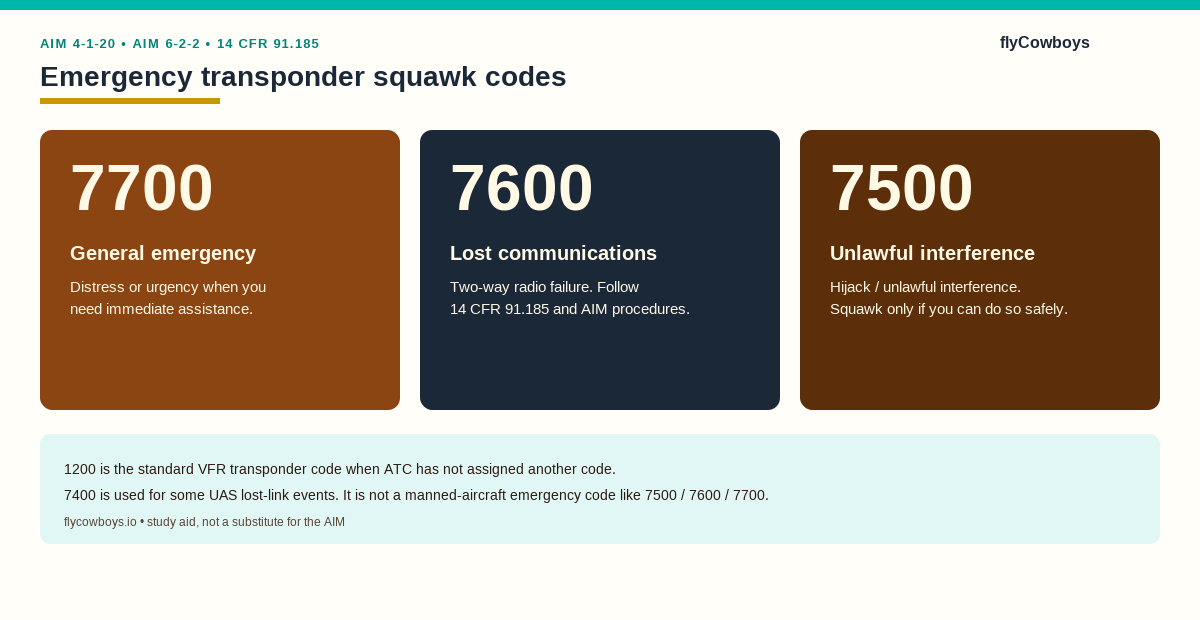
| 7700 | General emergency | A distress or urgency situation when you need immediate assistance, such as an engine failure, a medical emergency, or a serious aircraft problem. |
| 7600 | Lost communications | You cannot communicate on the radio and need ATC to know you have a communication failure. Lost-comm procedures are in 14 CFR 91.185 (IFR) and the AIM. |
| 7500 | Unlawful interference (hijack) | Only when the aircraft is subject to unlawful interference. Do not use 7500 for practice, testing, or as a joke. |
The AIM (including 4-1-20 on transponder operation and 6-2-2 / 6-3-2 / 6-4 on emergency, lost-comm, and hijack procedures) is the practical reference. Setting one of these codes makes your target stand out on the controller's display. It does not replace talking to ATC when you still have a radio.
Is squawk 7700 the same as a Mayday?
They often go together, but they are not the same thing. Mayday is a spoken distress call on the radio. Pan-pan is a spoken urgency call. Squawk 7700 is a transponder setting that alerts ATC even if you cannot talk, or while you are talking.
If you can communicate, the usual order is: fly the airplane, tell ATC what is wrong and what you need, and squawk 7700 if they ask you to or if you want the emergency to be unmistakable (for example, when you are changing frequencies, going to a different facility, or have a lot to manage). If you already declared an emergency on frequency and ATC has identified you, they may already have you tagged; still follow their instructions about the transponder. If you cannot talk, 7700 may be the first way anyone knows you need help.
What 7600 and 7500 add
Squawk 7600 tells ATC your radios have failed. Under IFR, 14 CFR 91.185 then tells you how to continue (leave, fly the route and altitude you were last assigned or expected, and so on) depending on whether you are in VFR conditions and can remain that way. In VFR, stay VFR, squawk 7600, and think about landing at a suitable airport while watching for light-gun signals if you arrive at a towered field. Practice radio work so you are less likely to need this code; our guides on radio procedure and ATC phraseology are a good start.
Squawk 7500 is reserved for hijacking or other unlawful interference. ATC and other authorities treat it as a security event. Never select it to test a transponder, to demonstrate a code to a passenger, or because you fat-fingered the knobs. If you enter it by mistake, tell ATC immediately on the frequency you are on.
Other codes you will actually use
- 1200 is the standard VFR code in the United States when you have not been given a discrete code.
- A discrete code (any assigned four-digit code other than the reserved ones) is what ATC gives you with flight following, in Class C or B, or on an IFR clearance. Use it until they tell you to change or squawk VFR.
- 7400 is used in some lost-link situations for unmanned aircraft. It is not a general-aviation emergency code you should plan to use in a typical training airplane.
- Codes such as 0000 and 7777 have specific or reserved uses. Do not invent a code. Use 1200, the code you were assigned, or one of the emergency codes when it applies.
Ident, standby, and turning the transponder to ALT (Mode C) or the equivalent ADS-B OUT setting also matter. In general, keep the transponder on ALT with altitude reporting from before takeoff until after landing, unless ATC says otherwise, as described in the AIM.
How this shows up on the FAA knowledge test
Expect questions that ask which code is hijack, lost comm, or a general emergency, and questions about 1200 versus a discrete code. Traps include reversing 7500 and 7600, thinking 7700 is only for engine failures, or believing that squawking 7700 is a substitute for flying the airplane and communicating. Memorize the three reserved codes, then practice them in FAA practice tests and in your oral exam prep.
Sources
FAA Aeronautical Information Manual 4-1-20 (transponder and ADS-B operation) and Chapter 6 emergency procedures, including lost communications and unlawful interference; 14 CFR 91.185 (IFR two-way radio communications failure). This is a study aid. Follow the current AIM, your POH, and ATC instructions in an actual emergency.
Frequently Asked Questions
Is squawk 7700 a Mayday?
Not exactly. Mayday is a spoken distress call. Squawk 7700 is a transponder setting that flags a general emergency on the radar display. You may do both: declare Mayday (or pan-pan for urgency) and squawk 7700 so ATC can see the emergency if the radio fails or you change frequencies.
What do 7500, 7600, and 7700 mean?
7500 means unlawful interference or hijack, 7600 means lost communications, and 7700 means a general emergency. A common memory order is 75-76-77: hijack, lost comm, emergency.
What is squawk 7400?
7400 is used in some unmanned-aircraft lost-link situations. It is not one of the three emergency codes you train to use in a typical manned training airplane. For GA flying, focus on 1200, your assigned discrete code, and 7500 / 7600 / 7700 when they apply.
Should I squawk 7700 if I have already declared an emergency?
Follow ATC. If they already have you identified and have acknowledged the emergency, they may tell you to remain on your discrete code. If you lose the radio, change facilities, or want the emergency to be obvious on every scope, 7700 is appropriate. When in doubt, setting 7700 and telling ATC is reasonable.
What squawk code do VFR pilots use?
Use 1200 unless ATC assigns a discrete code, such as when you request flight following or enter certain airspace. After the service ends they will usually tell you to squawk VFR, which means return to 1200.
What should I do if I squawk 7500 by mistake?
Tell ATC immediately on your current frequency that the 7500 entry was unintentional. Do not just change the code and hope no one noticed. Controllers treat 7500 as a security event until they can confirm otherwise.