· 13 min read
Flying Tigers Cap: History, Authenticity, and Buying Guide
Discover the true meaning behind the Flying Tigers cap, from WWII origins to modern reproductions. Learn how to authenticate your cap and avoid common mistakes.
Shoppers looking for a Flying Tigers cap are choosing among three different products: WWII American Volunteer Group memorabilia, postwar Flying Tiger Line airline badges, or modern sports merchandise. The original AVG had nearly 80 American pilots and 62 combat-ready Curtiss P-40 fighters by December 7, 1941.
The popular advice to “just look for the shark teeth” is incomplete. Shark-tooth artwork can point toward the wartime AVG, but a modern cap can borrow that imagery without being an original military artifact. A careful buyer first identifies the object's category, then examines its construction, documentation, and condition.
Table of Contents
- Why Your Flying Tigers Cap Search Is Probably Confusing You
- How the Shark Teeth Became a Flying Tigers Mark
- Three Types of Flying Tigers Caps and How to Tell Them Apart
- How to Authenticate a Flying Tigers Cap Before You Buy
- Understanding Value and Provenance in Flying Tigers Collectibles
- Making Your Final Flying Tigers Cap Purchase Decision
Why Your Flying Tigers Cap Search Is Probably Confusing You
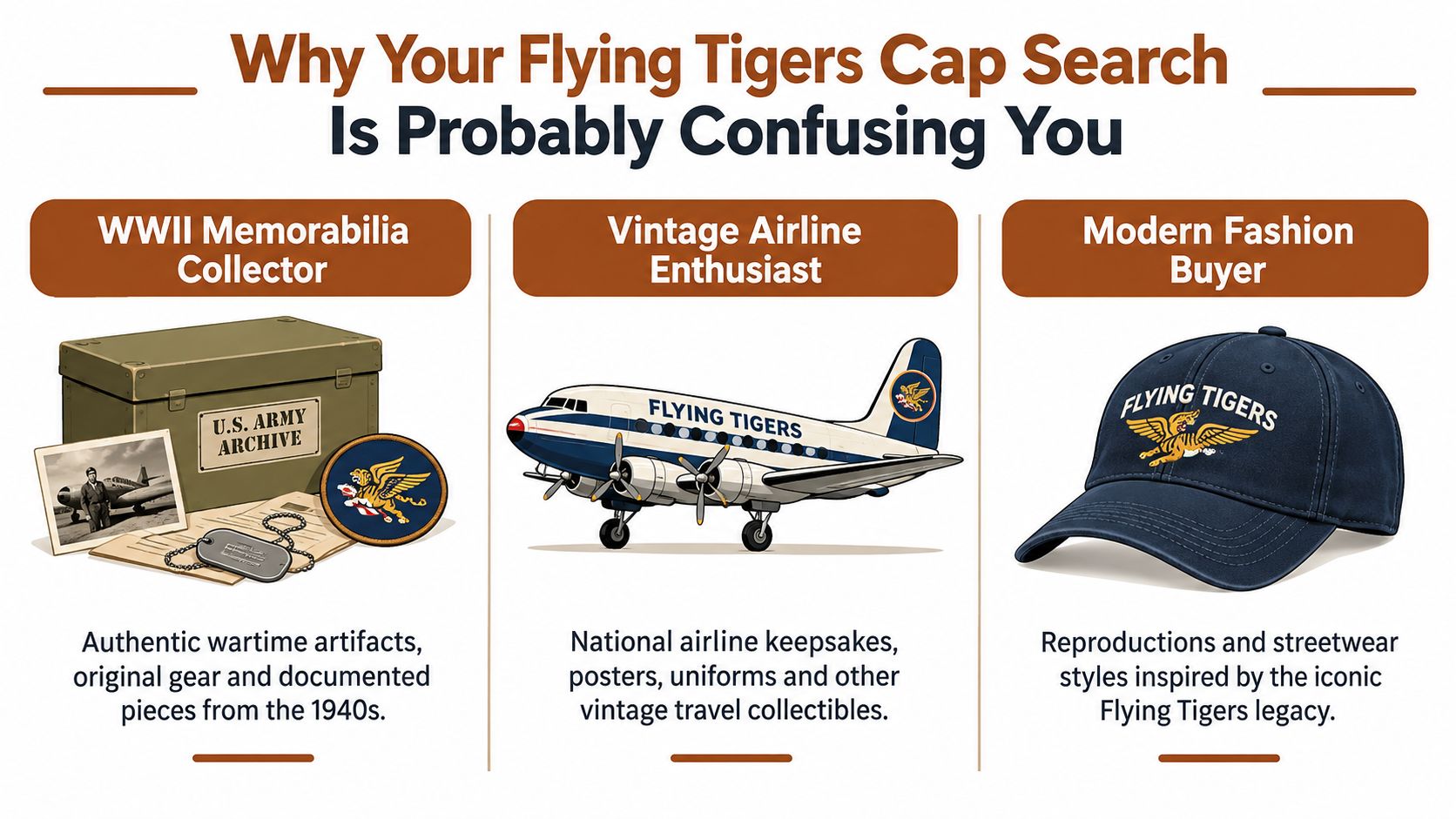
The phrase Flying Tigers cap creates a classification problem before it identifies an object. Search engines collapse separate buyer intentions into one results page, so the same listing can reach a military collector, an airline historian, and a baseball fan at once. Their interests overlap visually, but their standards for authenticity do not.
A collector may be seeking a connection to the First American Volunteer Group. An airline historian may be tracing a postwar Flying Tiger Line crew badge. A sports shopper may want a current cap with a winged tiger logo. Similar colors and graphics can therefore conceal very different origins.
Three shopping universes
| Category | What it represents | What to inspect first |
|---|---|---|
| WWII AVG memorabilia | Material connected with American volunteers who supported China before U.S. entry into World War II | Wartime imagery, stated reproduction status, provenance, and construction |
| Flying Tiger Line material | A separate postwar cargo airline and its crew identity | Badge materials, maker, dimensions, and airline attribution |
| Modern sports merchandise | Contemporary team branding built around a flying tiger motif | Official team name, model designation, licensing, and retail construction |
The key distinction is between appearance and evidence. An olive cap with a leaping tiger may be a careful reproduction, a fashion item, or team merchandise. Its color, embroidery, or dramatic logo cannot establish wartime ownership.
International shoppers face another layer of ambiguity. The same English query may reflect military-history collecting, airline research, or baseball fandom. Translation and marketplace listings can also blur terms that sellers use loosely, making a precise product description more valuable than a familiar-looking image.
Decide what role the cap should play before opening listings. A wearable tribute can be well served by a reproduction, while a documented artifact requires an account of origin, materials, and ownership history. That provenance checklist should come before excitement about the graphic. For broader aviation terminology and more buying explainers, see the flyCowboys blog.
How the Shark Teeth Became a Flying Tigers Mark
The shark teeth on a Flying Tigers cap point first to aircraft, not headwear. The original Flying Tigers were the First American Volunteer Group, a U.S.-manned force that supported China before the United States formally entered World War II. Established in 1941 with President Franklin D. Roosevelt's approval, the group trained in Burma during that year, as documented by the Texas State Historical Association's Flying Tigers history.
By December 7, 1941, the AVG had nearly 80 American pilots and 62 combat-ready Curtiss P-40 fighters. Its squadrons used distinct names: the 1st Squadron, the Adam and Eves, the 2nd Squadron, the Panda Bears, and the 3rd Squadron, the Hell's Angels.
The imagery combines two related marks. Shark teeth were painted across the noses of the P-40s, while a tiger emblem represented the group itself. On a cap, those symbols function like a historical shorthand, linking the object to American volunteers defending Chinese cities and protecting the Burma Road, a vital supply route.
A short combat history
The AVG fought from December 20, 1941, to July 4, 1942, roughly seven months, in the China-Burma-India Theater. On July 4, 1942, it ended as an independent organization and was absorbed into the U.S. Army Air Forces as the 23rd Fighter Group.
That change matters when reading a cap's description. AVG imagery may commemorate the volunteer group, while a similar design may refer to its later Army Air Forces connection. Familiar artwork does not make those historical contexts interchangeable.
Curator's principle: A Flying Tigers emblem is meaningful because it identifies a specific unit and moment, not because it contains a tiger.
The phrase also carries a human story involving U.S.-China wartime cooperation, volunteer military service, and early air combat in Asia. A reproduction cap can honor that history without posing as a surviving wartime garment. Accurate labeling protects both the buyer and the meaning of the artifact.
For readers building an aviation vocabulary, an aviation glossary can clarify terminology. Identification still depends on the cap itself, its documentation, and physical evidence such as construction and materials.
Three Types of Flying Tigers Caps and How to Tell Them Apart
Three categories dominate the phrase Flying Tigers cap, and each requires a different reading method. Start with history, then check the graphic.
WWII American Volunteer Group memorabilia
The first category uses imagery linked to the AVG, especially the shark-tooth P-40 motif and a leaping tiger emblem. A modern olive cap with embroidered or applied artwork may be an inspired reproduction rather than a period object. That isn't a defect if the seller describes it accurately.
A serious listing should identify whether the cap is inspired by, a licensed reproduction, or an original period item. A historical-looking patch alone doesn't establish wartime ownership, military issue, or manufacture during the AVG's combat period.
Flying Tiger Line material
The second category belongs to the Flying Tiger Line, a separate postwar cargo airline. Its crew badges and uniform insignia can be mistaken for AVG material because both use aviation language and tiger imagery.
Here, the buyer should look for the badge's material, maker, dimensions, and stated airline connection. A crew badge is not automatically a WWII AVG insignia, and a cap fitted with an airline-style badge shouldn't be marketed as wartime military memorabilia without supporting evidence.
Modern baseball merchandise
The third category is contemporary sports merchandise. Current official team listings include cap silhouettes such as the 3930 Winged Tiger and 940 Winged Tiger Snapback, product designations that belong to modern baseball branding rather than the original AVG.
Those models may use visual references that appeal to aviation and military-history enthusiasts, but their retail identity is sportswear. The correct questions are whether the listing names the team, identifies the model, and discloses licensing.
The practical test is simple:
- Read the noun after Flying Tigers. Is it a military reproduction, an airline badge, or team merchandise?
- Inspect the graphic. Shark teeth suggest AVG-inspired design, but they don't prove age.
- Check the seller's language. “Inspired by” and “licensed” mean something different from “original.”
- Match the price logic to the category. A modern cap should be evaluated as merchandise, while a claimed artifact requires provenance.
The most recognizable design isn't necessarily the most authentic. A contemporary olive baseball cap can borrow the wartime shark teeth and still be entirely modern.
How to Authenticate a Flying Tigers Cap Before You Buy
Authentication begins with the object's physical construction, not the emotional power of its graphic. The Smithsonian records a Flying Tigers piece made from enameled silver, where the colored design is a fired, glass-like enamel layer bonded to a metal substrate rather than printed onto fabric. That distinction gives the buyer a practical inspection route through the Smithsonian National Air and Space Museum record for the wearable-style insignia.
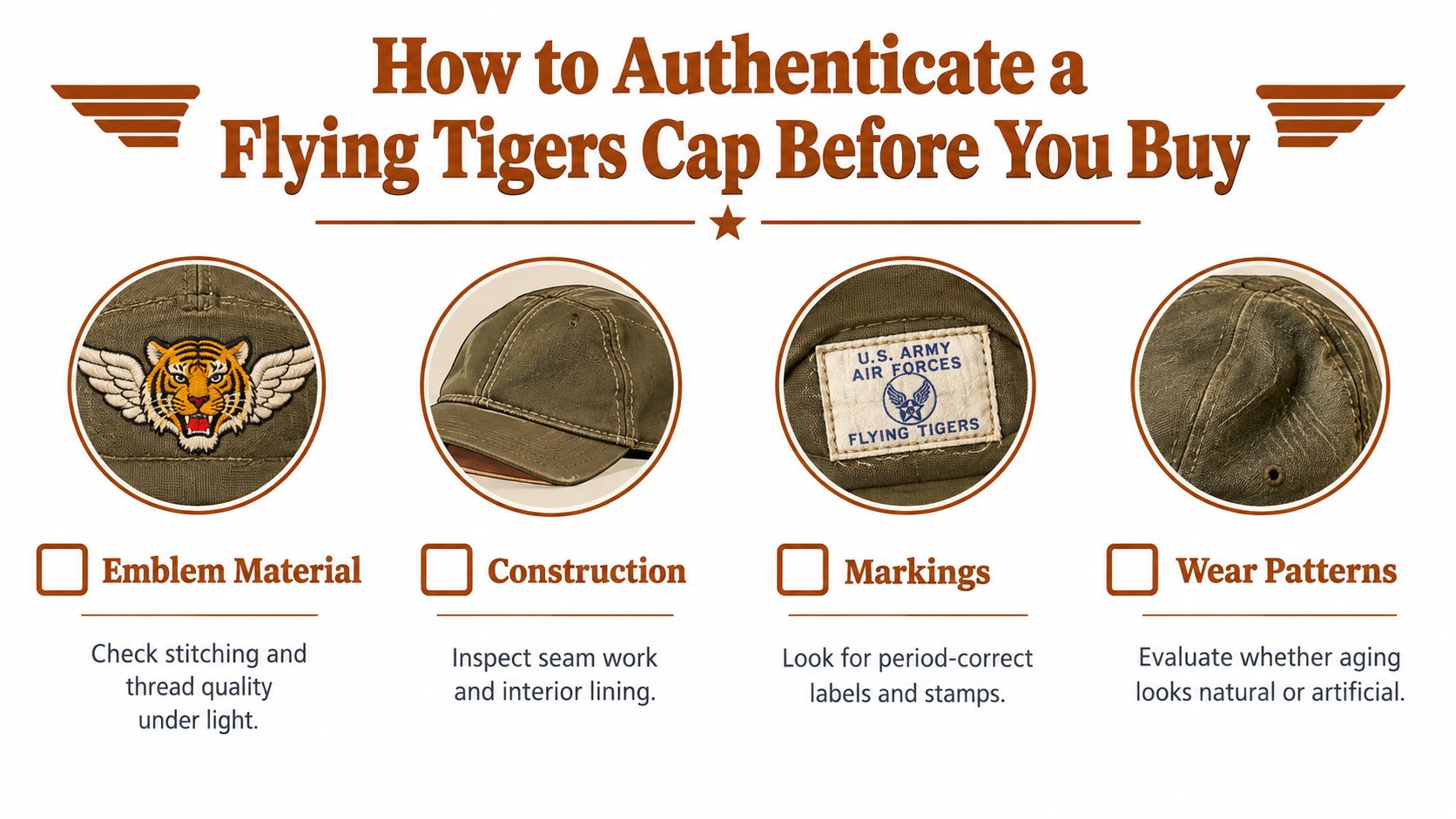
Four inspection points
1. Examine the emblem material. Look for a rigid metal base when the listing claims a metal insignia. Enamel should appear bonded to that base, not merely printed on cloth. Check the edges under good light and note whether the surface has chips, pooling, or firing irregularities.
2. Study the attachment. Stitching, thread quality, backing, and the way the emblem meets the cap can reveal whether the piece was built as a wearable badge or added later. A textile-only patch doesn't carry the same technical evidence as an enameled metal insignia.
3. Record dimensions. The Smithsonian's wearable-style emblem measures 4.5 cm at its largest dimension, while a separate National Air and Space Museum record documents an AVG insignia measuring 61 × 61 × 1.9 cm and weighing 2 kg. These are radically different objects, so a seller who calls either one a “Flying Tigers cap” has not supplied enough information.
4. Compare the motif. One documented AVG design has an olive-green background with a Bengal tiger, blue wings, and two blue rays. Compare the seller's photographs with documented museum examples, paying attention to the complete composition rather than just the tiger's face.
Practical rule: Provenance, construction, and scale must agree. Graphics alone are weak evidence.
Questions for the seller
Ask for clear photographs of the front, back, edge, interior label, closure, and any attached badge. Request the manufacturer, approximate period, source of acquisition, and whether the cap is a reproduction. A confident seller may not know every answer, but should distinguish known facts from assumptions.
The Smithsonian record for the American Volunteer Group insignia is useful for cataloging because it demonstrates why material, dimensions, and object type matter. If a listing supplies only a dramatic front photograph, treat the historical claim as unverified.
Understanding Value and Provenance in Flying Tigers Collectibles
Value follows identity. Before judging condition or rarity, decide whether the object is a modern interpretation, a licensed reproduction, team merchandise, or an original period item.
Inspired by describes a design relationship. It may use shark teeth, a tiger, or an olive military palette while remaining a contemporary product. Licensed reproduction suggests an authorized modern item based on a historical or institutional mark. Team merchandise belongs to current sports branding, even when its graphics echo aviation history. Original period item makes the strongest historical claim and therefore requires the strongest documentation.
A patch attached to a cap doesn't prove that the cap served with the AVG or the Flying Tiger Line. Sellers can combine modern headwear with old, reproduction, or unattributed insignia. Collectors should evaluate the cap and emblem as separate components before treating the assembled object as one historical unit.
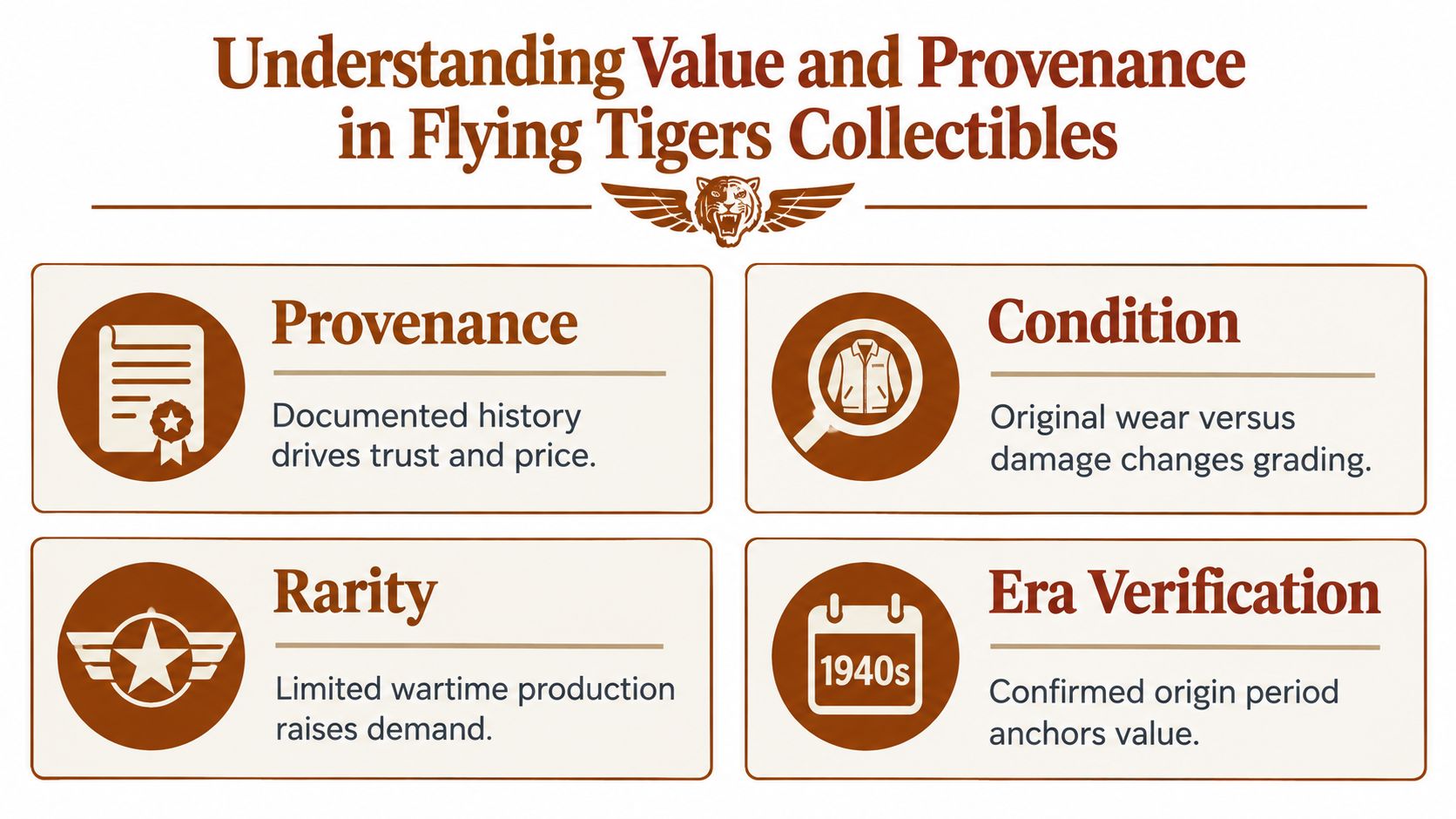
What provenance should contain
A useful provenance file doesn't need to be theatrical. It needs to be specific.
- Seller documentation: Ask where the item came from and whether the account is based on records, family history, or an unverified assumption.
- Manufacturer information: Record labels, makers, hallmarks, stitching, closures, and any interior markings.
- Construction evidence: Note whether the emblem is metal, enameled, embroidered, printed, or applied later.
- Condition history: Separate original wear from damage, cleaning, fading, replacement parts, or artificial distressing.
- Category statement: Require the seller to say whether the item is AVG-related, Flying Tiger Line-related, sports merchandise, or a modern interpretation.
Historical Flying Tiger Line insignia deserve particular caution. Documented mid-century crew badges include enameled sterling-silver examples measuring around 1 13/16 by 2 9/16 inches, as described in the Flying Tiger Line badge reference. That evidence can help a collector compare scale and materials, but it doesn't authenticate every badge with similar dimensions.
Why category affects value
An original period item may carry historical and research value that a reproduction doesn't. A licensed reproduction may offer excellent design fidelity and wearable durability. Team merchandise can be the right choice for a fan who wants a current cap, while an inspired design may suit someone who values the visual language more than provenance.
Current sports listings with 3930 fitted-style and 940 snapback models show how modern merchandising expands the number of products using related imagery. More silhouettes create more choice, but they also make search results harder to interpret.
A fair price starts with an honest description. A modern cap shouldn't be judged as a failed antique, and an alleged antique shouldn't be accepted as authentic because it looks convincing.
Making Your Final Flying Tigers Cap Purchase Decision
Your final choice should follow your purpose, not the strongest photograph in the listing. A historian, a casual wearer, and a sports fan can all make sensible purchases, but they shouldn't use the same standard.
Choose an AVG-inspired cap if you want a wearable connection to the wartime story and accept modern manufacture. Choose a Flying Tiger Line item if your interest is postwar airline history, and insist on airline attribution rather than assuming every tiger emblem belongs to the AVG. Choose modern sports merchandise if you want an official team product, a contemporary silhouette, or a cap identified by models such as the 3930 or 940.
Use this decision sequence
- Name your category before opening checkout. Write “AVG reproduction,” “Flying Tiger Line collectible,” or “modern baseball cap.”
- Read the exact product description. Look for words such as “inspired,” “licensed,” “team merchandise,” or “original period.”
- Request evidence for historical claims. Ask for labels, badge backs, dimensions, material details, and acquisition history.
- Reject category shortcuts. Shark teeth don't prove wartime age, and a tiger badge doesn't prove AVG origin.
- Save the documentation. Keep photographs, seller correspondence, receipts, and catalog references with the item.
For a broader set of practical aviation questions, consult the flyCowboys FAQ, but use museum records and specialist documentation when the purchase involves claimed historical provenance.
The best cap is the one that matches what you want to own. A modern reproduction can be honorable and well made. A collectible can be historically important while showing wear. What matters is that the seller identifies the object truthfully and that your expectations match the evidence.
flyCowboys helps pilots study for FAA knowledge tests with adaptive practice, AI radio drills, a flight logbook, and ACS-aligned preparation in one iPhone app. If aviation history has sharpened your interest in flying, visit flyCowboys to explore a structured way to build practical knowledge and prepare for your next aviation milestone.