· 13 min read
ATC Phraseology Training: Practical Guide for Pilots
Master ATC phraseology training with actionable exercises, real radio examples, and error correction techniques designed for student pilots preparing
You're holding short final, the controller issues a clearance, and the part that sounded perfectly clear in your headset arrives in your brain as fragments: a heading, an altitude, a frequency, perhaps a call sign. You key the microphone, hesitate, and hope the right words appear.
That hesitation is common, but it isn't solved by memorizing longer lists of aviation terms. Effective ATC phraseology training builds a complete communication habit: listen for the operational meaning, construct a full call, read back what matters, and recover quickly when either side becomes unclear. The radio won't always follow the script, so your training shouldn't either.
Table of Contents
- Why Standardized Radio Communication Saves Lives
- Building a Foundation with FAA Guidance
- Simulating Real-World Cognitive Load
- Mastering Recovery When Phraseology Fails
- Evaluating Practice Tools and Methods
- Creating a Daily Training Workflow
- Maintaining Proficiency Beyond the Checkride
Why Standardized Radio Communication Saves Lives
A clearance arrives while you are busy flying, monitoring traffic, and preparing the next task. You hear the words, but a call sign, altitude, or restriction fails to register. Standardized phraseology gives both sides a predictable structure, reducing the number of ways a clearance can be interpreted.
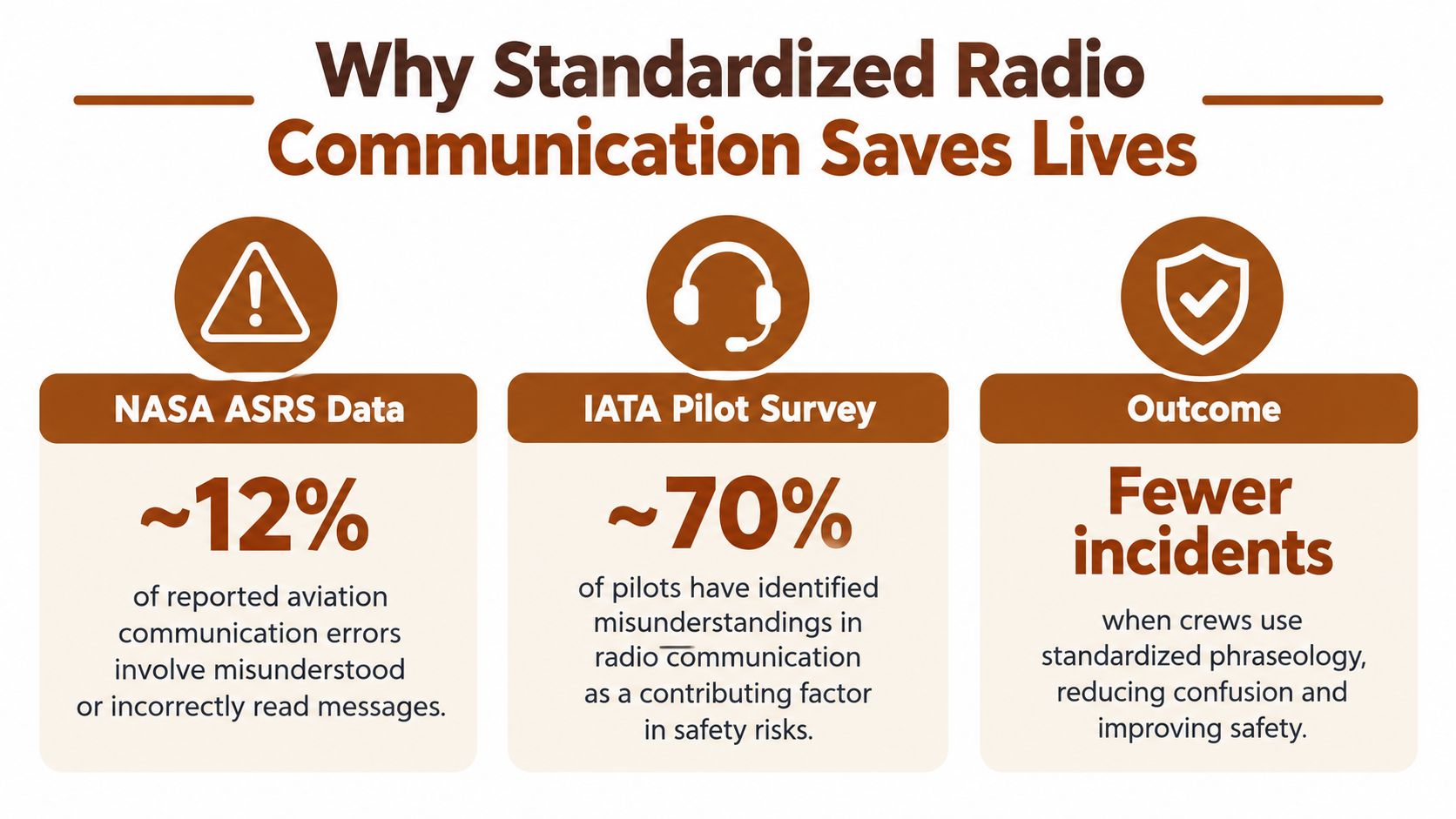
The safety case is practical, not academic. An analysis of 28,000 incident reports submitted to NASA's Aviation Safety Reporting System during its first five years found that more than 70% involved information-transfer problems, mainly voice communication, as described in this analysis of aviation communication failures. Communication errors therefore belong beside aircraft handling and system performance as recurring human-factors concerns.
Why familiar words still fail
Vocabulary recognition is not reliable performance under workload. A pilot may know “climb,” “heading,” and “maintain,” then omit the call sign, transpose a numeral, or read back only the instruction that received immediate attention.
An IATA survey of 2,070 airline pilots identified non-standard or ambiguous ATC phraseology as the leading communication problem. 44% reported encountering non-standard phraseology at least once per flight, according to the same Flight Safety Foundation discussion of the IATA survey. The problem reaches beyond student pilots and any single national system.
Practical rule: Standard phraseology reduces ambiguity. Disciplined listening and a complete readback confirm that the message was understood.
Train the whole exchange, including recognition, accurate production, listening discipline, and recovery after confusion. A pilot who can rebuild a call, request clarification, and verify the clearance is safer than one who can recite isolated terms perfectly. The goal is clear shared understanding, even when the radio exchange stops following the script.
Building a Foundation with FAA Guidance
Start with the FAA's own reference material rather than an informal list of “what pilots usually say.” The Aeronautical Information Manual and Pilot/Controller Glossary give you the prescribed structure and the meanings behind common terms. The glossary matters because it creates common expectations between pilots and controllers.
Use a three-stage practice loop.
Study the structure
Take one type of exchange, such as a departure call or frequency change, and identify its required elements. A complete call normally needs the appropriate facility or controller, your full aircraft call sign, the request or clearance, and the operational details ATC needs to act on it.
Don't memorize a sentence as a sound pattern. Memorize the order of information and the reason each element exists. That makes the call easier to rebuild when the airport, runway, route, or instruction changes.
Rehearse full exchanges
Next, speak both sides of a short scenario. Include the call sign, clearance or request, position or altitude information when relevant, and the required readback. Practicing only the pilot's first transmission leaves a major gap, because many errors occur in hearing, interpreting, and acknowledging instructions.
Record yourself. Listen for clipped numbers, swallowed call signs, unnecessary filler, and a rushed readback. If you're building broader checkride knowledge alongside radio skills, the private pilot ACS guide can help you keep communication practice connected to the standards your training must address.
Review observable elements
Score each transmission instead of asking whether it “felt confident.” Check:
- Call sign: Did you identify the correct aircraft?
- Instruction or request: Did you state the operational purpose clearly?
- Numbers: Did you transmit and hear altitudes, headings, frequencies, and runway information accurately?
- Readback: Did you repeat the items that require confirmation?
- Amendments: Did you respond correctly when the original clearance changed?
Concise communication isn't the same as incomplete communication. FAA guidance supports brevity, but it also recognizes that pilots may need additional words when standardized phraseology doesn't adequately explain the situation. Remove chatter, not information.
Simulating Real-World Cognitive Load
A student who can recite a perfect call in a quiet room may still freeze when the call arrives during a climb, a frequency change, and a navigation task. Radio competence depends on managing information while flying, not on producing vocabulary in isolation.
Build difficulty progressively. Start with scripted calls where the learner has time to prepare. Then increase speed, reduce preparation, and introduce competing tasks. The sequence should feel uncomfortable before it feels routine.
A practical progression
Begin with a single request and one expected response. Once that becomes reliable, add the elements that pilots commonly lose under pressure:
- Low load: Read a prepared call using the full call sign and a simple request.
- Normal exchange: Receive one instruction, identify the critical numbers, and give a complete readback.
- Mixed demands: Combine a clearance with a frequency change or a request to report a position.
- High density: Handle headings, altitudes, frequencies, and an amended clearance in the same exchange.
- Time pressure: Respond while another task, interruption, or competing transmission demands attention.
Simulator research cited in a peer-reviewed analysis found average communication accuracy of 57%, with incorrect-transmission rates of 37% for native English speakers and 49% for non-native English speakers, as reported in this analysis of aviation communication under cognitive load. The referenced study reported an average error rate of approximately 43%, with information density, speech rate, and cognitive load affecting omissions and mistakes involving words or numerals.
Log the error type
A failed call is more useful when you know why it failed. Mark whether the problem involved an omitted item, an incorrect number, a misunderstood instruction, poor timing, or a faulty readback. Then repeat the scenario until the pilot can perform the same task under comparable workload.
Don't reward speed by itself. A fast, incomplete call creates more work for the controller and more uncertainty for everyone sharing the frequency. The standard is accurate, intelligible, appropriately timed communication, even when the situation becomes busy.
Mastering Recovery When Phraseology Fails
Rigid phraseology is valuable until it stops communicating the problem. If a controller's instruction is unclear, or if you can't comply, forcing a memorized phrase can be less safe than using plain language that makes the situation unmistakable.
FAA guidance specifically recognizes this boundary. The FAA communication guidance on clarification and inability recommends knowing when to use terms such as “say again,” “verify,” and “unable,” while also allowing pilots to use whatever words are necessary when standard wording isn't enough.
Detect the gap early
Recovery starts with recognizing uncertainty before acting on it. If you heard a heading but not the altitude, don't fill in the missing piece from memory. If the readback doesn't match what you believe you heard, treat that mismatch as a warning rather than a minor verbal imperfection.
Practice identifying the exact uncertainty:
- Unclear transmission: Ask the controller to repeat the relevant instruction.
- Possible conflict: Use “verify” when you need confirmation of a specific clearance or detail.
- Inability: Say “unable” when you can't accept or perform the instruction, then explain enough for ATC to understand why.
- Faulty readback: Correct your readback promptly instead of waiting for the controller to discover the error.
Use plain language when needed
The communication goal is shared understanding, not ritual compliance. A student who knows every ideal departure call but cannot explain an unfamiliar hazard still has a serious gap. Practice concise plain-English descriptions of problems, including what you see, what you need, and what you can or cannot do.
FAA research found communication problems in about 4% of sampled pilot and controller messages, including readback errors, incorrect call-sign use, requests to repeat traffic information, and call-sign confusion, according to the FAA communication research report. That evidence supports training recovery behavior as a core skill rather than an afterthought.
The safest transmission is the one that restores a common picture of the situation.
International operations add another layer. ICAO-related guidance identifies risks involving incorrect standardized phraseology, weak plain-language proficiency, and multiple languages in the same airspace, as outlined in this aviation language proficiency guidance. Your practice should include accents, unfamiliar wording, unexpected questions, and situations with no memorized script.
Evaluating Practice Tools and Methods
Passive listening has a place, but it creates a misleading sense of progress. You can follow a busy frequency while sitting safely on the ground and still fail to produce a timely, complete response when a controller addresses you directly.
Compare the training methods
| Method | What it develops | Where it falls short |
|---|---|---|
| Recorded radio | Recognition of cadence, accents, and realistic frequency flow | It doesn't require you to transmit or recover |
| Flashcards | Recall of terms and definitions | They rarely test sequencing, timing, or workload |
| Instructor role-play | Interactive listening, corrections, and scenario judgment | Quality depends on the instructor's time and scenario design |
| Simulator practice | Repeated exchanges with operational context | Weak simulations can reward scripted responses |
| Adaptive AI drills | Repetition targeted at omissions, numerals, readbacks, and recovery | The tool still needs careful alignment with FAA guidance and instructor feedback |
The strongest practice method changes the task when you improve and returns to weak areas when you struggle. It should evaluate the complete exchange, not just whether your response contains a familiar keyword.
A useful platform may also place radio work beside knowledge review. flyCowboys offers “Talk to Tower” AI for ATC radio practice, along with FAA-style question practice and explanations, so pilots can use it as one option within a broader PPL or IFR study workflow. For the knowledge-test side, compare its approach with a FAA written test preparation resource, but judge any tool by the quality of its feedback, not by the number of scenarios it advertises.
The following video can help illustrate how a digital flight-training workflow fits into preparation, but watching it shouldn't replace speaking aloud and reviewing your own transmissions.
Choose tools that expose your weak behavior. If you repeatedly omit the call sign, the next drill should make that omission visible. If you confuse a heading with an altitude, the exercise should present both and require an accurate readback.
Creating a Daily Training Workflow
Radio confidence grows through frequent contact with the skill, not occasional marathon sessions. A short routine works best when each part has a distinct purpose and produces something you can review.
Use this workflow on a normal study day:
- Review one reference point. Open the AIM or Pilot/Controller Glossary and study one call structure, term, or readback expectation. Say the example aloud instead of reading in your head.
- Drill a weak element. Practice the item you most often miss, such as numerals, call signs, frequency changes, or amended clearances. Use adaptive repetition when available, but don't let the app become a substitute for transmitting aloud.
- Run one scenario. Start with a departure, arrival, or approach exchange. Include at least one instruction that requires a complete readback.
- Add one recovery event. Have the controller speak too quickly, issue an unclear instruction, change the clearance, or give you something you can't accept. Practice choosing between repetition, verification, correction, and inability.
- Record and score. Listen once for intelligibility and once for operational completeness. Mark the exact error, then repeat the call correctly.
Keep the record simple. A page in your private pilot study guide can hold the scenario, the missed element, and the next drill to repeat.
The final step matters most: perform the scenario again after a break or on a later session. Spaced repetition helps turn a fragile response into a dependable habit, while immediate repetition confirms that you understood the correction rather than merely guessed your way through it.
Maintaining Proficiency Beyond the Checkride
Passing the checkride proves that you met the required standard at that point in training. It doesn't guarantee that radio skills will remain sharp after a period of infrequent flying.
Keep communication visible in your normal flying routine. After each flight, record one radio success and one item to review. Periodically run a simulator or role-play session that includes a changed clearance, a difficult transmission, and a situation requiring plain language. Ask your instructor to listen for the habits that are easy to miss from the cockpit, especially incomplete readbacks and over-compressed calls.
A practical maintenance checklist includes:
- Review: Revisit the relevant glossary terms and local procedures.
- Rehearse: Practice full calls, not isolated vocabulary.
- Recover: Use “say again,” “verify,” and “unable” appropriately.
- Confirm: Correct mismatches before acting on uncertain instructions.
- Adapt: Explain unfamiliar or abnormal situations clearly when a script doesn't fit.
The capable pilot isn't the one who never encounters a confusing transmission. It's the pilot who notices the gap, communicates it precisely, and restores shared understanding before the aircraft moves on.
flyCowboys combines FAA knowledge-test study, adaptive practice, AI ATC drills through “Talk to Tower,” and a flight logbook in an iPhone app for pilots preparing for PPL or IFR training. Visit flyCowboys to explore a structured way to add radio recovery practice to your regular study routine.