· 11 min read
Student Pilot Certificate and Private Pilot Requirements (and What It Costs)
How to get a student pilot certificate, solo limits under 61.89, and private pilot requirements in 61.103 and 61.109. Which training costs you can confirm.
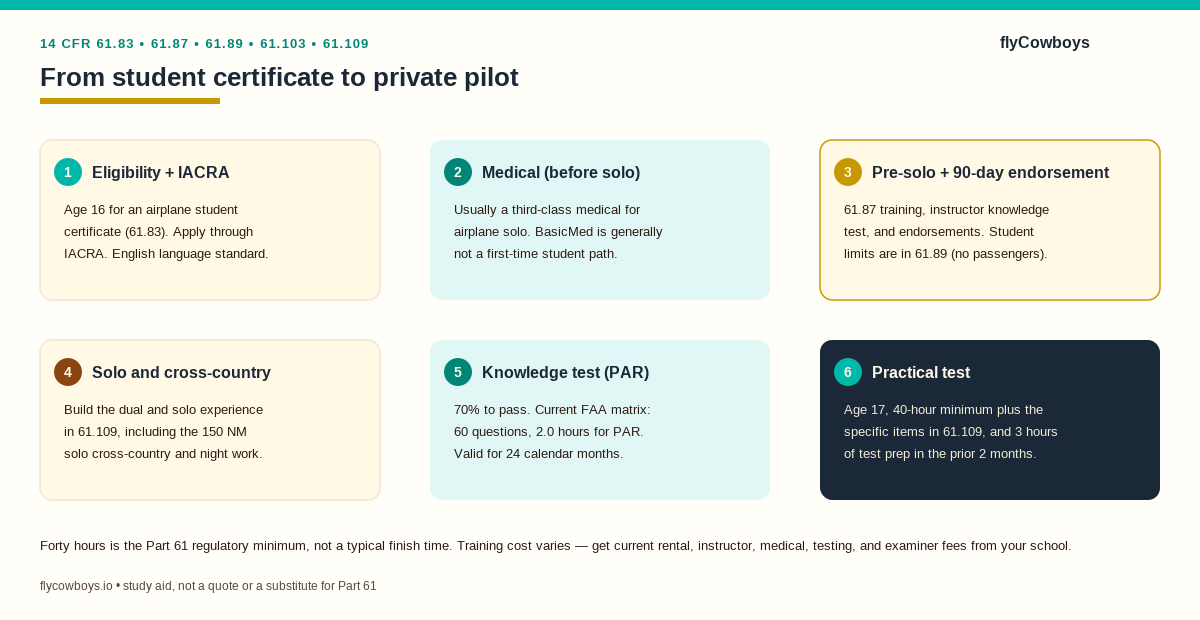
A student pilot certificate is the FAA certificate you hold while you train. You apply through IACRA, meet the eligibility in 14 CFR 61.83 (including age 16 for an airplane), and then solo only with the training, knowledge test, medical, and instructor endorsements required by 61.87. Certificates issued on or after April 1, 2016, do not expire; the 90-day solo endorsement does.
A private pilot airplane certificate has its own bar in 61.103 and 61.109: you must be 17, complete the required training, meet a 40-hour flight-time minimum with specific dual and solo items inside it, pass the knowledge test, and pass the practical test. Forty hours is the regulatory floor, not a promise. Training cost varies by aircraft, instructor, location, and hours, so treat any single average as unofficial and get rates from your school.
Student pilot certificate, in brief
A student pilot certificate is what the FAA issues so you can train toward a private (or other) pilot certificate and, with the right endorsements and medical, fly solo. You apply through IACRA. A certificated flight instructor, an FAA inspector, or another authorized person reviews your identity and eligibility under 14 CFR 61.83 and 61.85.
Student pilot certificates issued on or after April 1, 2016, do not have an expiration date under 14 CFR 61.19. Your solo endorsements do expire. A 90-day solo endorsement from your instructor (14 CFR 61.87) is what keeps a solo flight legal, and your medical certificate must be valid for the privileges you are exercising.
Eligibility for a student pilot certificate (14 CFR 61.83)
To be eligible for a student pilot certificate you must, in general:
- Be at least 16 years old for an airplane, or 14 for a glider or balloon (14 CFR 61.83).
- Be able to read, speak, write, and understand the English language, with the exception process in the rule if that is not possible because of a medical condition.
You do not have to hold a medical certificate merely to apply for the student pilot certificate. You typically do need a medical (or another pathway the regulations specifically allow) before you solo a standard airplane. Most airplane students start with a third-class medical. A first-time student who has never held an FAA medical generally cannot use BasicMed alone for that first solo. Details are in our FAA medical vs BasicMed guide.
Flight training in the United States also has security rules. U.S. citizens complete identity verification with the trainer. Non-U.S. citizens generally must go through the TSA Alien Flight Student Program before flight training in an aircraft over 12,500 pounds, and in many cases for training toward a sport, recreational, or private certificate in a smaller aircraft as well. Confirm the current TSA process with your school before you start.
Solo: endorsements and student limitations
Before your first solo, 14 CFR 61.87 requires training in specified maneuvers and procedures, a pre-solo knowledge test your instructor administers, and instructor endorsements in your logbook. For each solo flight you need a current 90-day endorsement, and other endorsements apply to solo cross-country, specific airports, and certain airspace.
14 CFR 61.89 limits what a student pilot may do. Among other things, a student may not act as pilot in command of an aircraft carrying passengers, carrying property for compensation or hire, or flying for compensation or hire; may not fly in furtherance of a business; may not fly with a flight or surface visibility of less than 3 statute miles in the day or 5 statute miles at night; and may not fly without visual reference to the surface. Additional limits apply to international flight and to flying contrary to any limitations your instructor places in the logbook.
Private pilot certificate requirements (14 CFR 61.103 and 61.109)
To be eligible for a private pilot certificate you must, under 14 CFR 61.103, be at least 17 years old for an airplane (16 for a glider or balloon); be able to read, speak, write, and understand English; hold at least a student, sport, or recreational certificate (or a qualifying foreign equivalent as the rule provides); receive and log the ground and flight training required by 61.105 and 61.107; meet the aeronautical experience in 61.109; pass the knowledge test; and pass the practical test.
For a private pilot certificate with an airplane single-engine rating, 14 CFR 61.109(a) sets a minimum of 40 hours of flight time that includes at least 20 hours of flight training from an authorized instructor and 10 hours of solo flight training in the areas of operation, with more specific minimums inside those hours:
| Category | Minimum in 61.109(a) |
|---|---|
| Total flight time | 40 hours |
| Flight training with an authorized instructor | 20 hours, including the items below |
| Dual cross-country | 3 hours |
| Dual night | 3 hours, including one cross-country over 100 nautical miles total distance, and 10 takeoffs and 10 landings to a full stop (each involving a flight in the traffic pattern) at an airport |
| Dual instrument | 3 hours of flight training by reference to instruments |
| Practical-test preparation | 3 hours in the preceding 2 calendar months from the month of the test |
| Solo flight training | 10 hours, including the items below |
| Solo cross-country | 5 hours, including one solo cross-country of 150 nautical miles total distance with full-stop landings at 3 points, and one segment of more than 50 nautical miles between takeoff and landing airports |
| Solo at a towered airport | 3 takeoffs and 3 landings to a full stop at an airport with an operating control tower |
Those numbers are regulatory minimums, not a prediction of how long you will take. Many students log more than 40 hours before they are ready for the practical test. Part 141 schools may use a different approved minimum in their training course outline; ask your school which path you are on. The knowledge test (PAR, for airplane) and the practical test are separate events. See the FAA written exam guide and the private pilot ACS for how those tests are structured, and the checkride oral exam guide for oral practice.
What it costs (and what you can actually pin down)
There is no official FAA price for a private pilot certificate. The total varies with aircraft rental rates, instructor rates, how many hours you need above the minimum, where you train, how often you fly, and whether you pay for a formal ground school. Treat any single "average cost" you see online as a rough conversation starter, not a quote.
The bill is usually a stack of separate items:
| Item | What to expect |
|---|---|
| Aircraft rental and fuel | Usually the largest share. Rates vary widely by airplane and airport. You pay for dual and solo hours. |
| Instructor time | Charged for flight and, often, ground briefing. Varies by school and instructor. |
| Ground school or self-study | Varies from free FAA handbooks up to a paid course or in-person class. See private pilot ground school. |
| Knowledge test (PAR) | Paid to the FAA's testing vendor (currently PSI) when you schedule at faa.psiexams.com. Confirm the current fee on the booking screen. A retake requires another fee and an instructor endorsement (14 CFR 61.49). |
| FAA medical exam | The Aviation Medical Examiner sets the exam fee. It is not a single national price. |
| Examiner (DPE) fee for the practical test | Set by the individual examiner and varies by location. Ask your school which examiners they use and what they currently charge. |
| Headset, charts, testing supplement, renter insurance | Optional or situational, but often part of a first-year budget. |
A practical way to budget is to get the school's current wet rental and instructor rates, multiply by a realistic hour estimate your instructor is willing to discuss (which may be above 40), and then add the medical, knowledge test, examiner, and equipment line items as actual quotes. Flying often, arriving prepared, and finishing ground study before the checkride are the levers you control; rental rate and weather are not.
How this shows up on the FAA knowledge test and oral
Questions often ask the minimum age, whether a student may carry passengers, visibility limits in 61.89, the 40-hour and sub-hour minimums in 61.109, or how long a solo endorsement lasts. Traps include:
- Using 16 as the age for the private airplane certificate (that is the student-certificate age; the private airplane certificate is 17).
- Thinking the student pilot certificate expires every 24 months (current plastic certificates issued on or after April 1, 2016, do not expire; the solo endorsement does).
- Forgetting the 3-hour practical-test prep must be in the 2 calendar months before the test.
- Treating 40 hours as a typical finish time rather than a regulatory minimum.
- Missing the 150-nautical-mile solo cross-country details (three points, one 50-mile segment).
Sources
14 CFR 61.19, 61.83, 61.85, 61.87, 61.89, 61.103, 61.105, 61.107, 61.109, and 61.49; FAA IACRA guidance; and the current Airman Knowledge Testing Matrix for the PAR test format. TSA rules and examiner fees change; confirm those with your school and the current official sources. This page is a study aid, not a quote or legal advice.
Frequently Asked Questions
How do I get a student pilot certificate?
Create an IACRA profile and apply for a student pilot certificate. An authorized instructor, FAA inspector, or other authorized person verifies your identity and eligibility under 14 CFR 61.83 and 61.85. You can apply before you are ready to solo, but you typically need a medical (or another allowed pathway) before you solo a standard airplane.
Does a student pilot certificate expire?
Student pilot certificates issued on or after April 1, 2016, do not have an expiration date under 14 CFR 61.19. Your instructor's 90-day solo endorsement does expire, and your medical certificate has its own duration under 61.23.
Can a student pilot carry passengers?
No. 14 CFR 61.89 prohibits a student pilot from acting as pilot in command of an aircraft carrying passengers, among other limits. Solo means you are the only occupant, except for specific authorized training situations with an instructor.
How many hours do you need for a private pilot license?
For an airplane single-engine rating under 14 CFR 61.109(a), the minimum is 40 hours of flight time, including at least 20 hours of dual instruction and 10 hours of solo, with additional minimums for cross-country, night, instrument, test preparation, and specific solo cross-country and towered-airport landings. Many students need more than 40 hours. Part 141 programs may use a different approved minimum.
How much does it cost to get a private pilot license?
There is no official FAA price, and totals vary too much by airport, aircraft, hours, and instructor rates to quote a single figure here. Budget for rental and fuel, instructor time, ground study, an Aviation Medical Examiner fee, the knowledge-test fee charged by the testing vendor when you book, the examiner fee for the practical test, and equipment. Ask your school for current rates and a realistic hour estimate.
What is the minimum age for a private pilot certificate?
17 years old for an airplane, rotorcraft, or airship, and 16 for a glider or balloon, under 14 CFR 61.103. You may hold a student airplane certificate and take the knowledge test earlier (the testing matrix lists age 15 for the PAR knowledge test), but you cannot be issued the private airplane certificate until you are 17.
What score do I need on the private pilot written test?
The Private Pilot Airplane (PAR) knowledge test requires a 70 percent passing score. The current FAA Airman Knowledge Testing Matrix lists 60 questions and 2.0 hours for PAR. Confirm the current matrix before you schedule, and see our FAA written exam guide for how the test is organized.