· 8 min read
What Is a NOTAM? How Pilots Read Notices to Air Missions
A NOTAM (Notice to Air Missions) is time-sensitive information about airports, navaids, TFRs, and procedures. How to read one and what 91.103 requires.

A NOTAM, or Notice to Air Missions, is a time-sensitive notice about the National Airspace System that has not made it onto the charts yet, or that is temporary. It can close a runway, take a navaid offline, restrict airspace, or change a published procedure.
Before you fly, 14 CFR 91.103 requires you to become familiar with all available information concerning the flight. That includes current NOTAMs for your departure, destination, alternates, and route, not just the weather. Read the location, the condition, and the effective time, and get clarification if a notice is unclear.
What a NOTAM actually is
A Notice to Air Missions (NOTAM) is time-sensitive information about the National Airspace System that is not already known far enough in advance to appear on aeronautical charts. Typical subjects include a closed runway, an out-of-service navaid, a temporary flight restriction, a crane near an approach path, or a change to published instrument procedures.
14 CFR 91.103 requires the pilot in command to become familiar with all available information concerning the flight before departure. For a flight under IFR or a flight not in the vicinity of an airport, that includes weather reports and forecasts, fuel requirements, alternatives if the planned flight cannot be completed, and any known traffic delays. NOTAMs are part of that available information. A chart or an EFB snapshot from last week is not a substitute for a current briefing.
The main kinds of NOTAMs you will see
The FAA's current system is built around digital NOTAMs, but student and instrument pilots still meet these practical categories in briefings and on the knowledge test:
| Kind | What it usually covers | Why it matters |
|---|---|---|
| NOTAM (D) | Airport, runway, taxiway, lighting, navaid, and similar information disseminated widely | The everyday airport and navaid changes you must check for departure, destination, and alternates |
| FDC NOTAM | Regulatory information issued by Flight Data Center: TFRs, airway and procedure amendments, some chart corrections | These can change what you are legally allowed to do, not just what is convenient |
| Pointer NOTAM | A short notice that points you to another, often FDC, NOTAM | Do not stop at the pointer; open the NOTAM it references |
| Military NOTAM | Information about military airports and some special-use airspace | Relevant if your route uses a joint-use field or skirts a military area |
You will also see GPS and other RAIM or service-availability notices, snow and winter-condition notices at some airports, and international or oceanic notices if you fly outside the lower 48. Temporary flight restrictions are commonly issued as FDC NOTAMs. Special-use airspace, including TFRs, is also discussed in our guide to airspace classifications.
How to read a NOTAM without getting lost
Modern digital briefings often present NOTAMs in plainer language than the old all-caps teletype format, but you should still read them with a checklist:
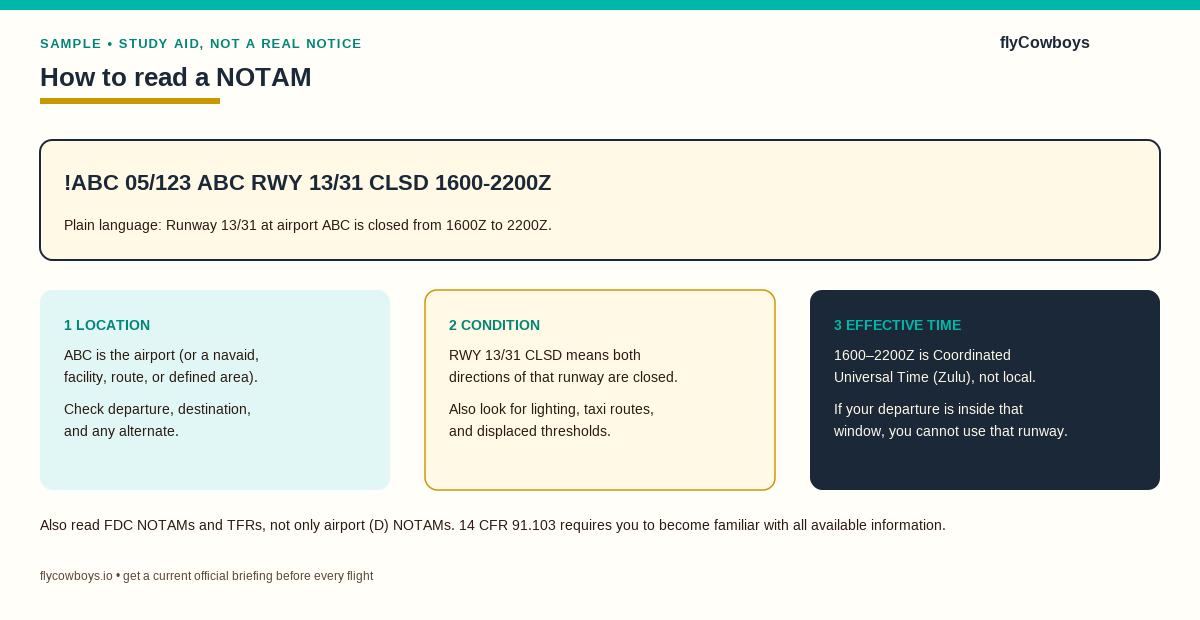
- Where does it apply? An airport identifier, a navaid, a facility, a route, or a defined area.
- What is happening? Closed, unlighted, out of service, restricted, changed procedure, obstacle.
- When is it effective? A start and end time, or a condition such as "until further notice." Times are usually Coordinated Universal Time (UTC, or Zulu).
- Does it affect your runway, approach, fuel plan, or legal route? If yes, change the plan or get clarification.
Abbreviations are dense. RWY, TWY, APCH, NAV, COM, OBST, AIRSPACE, and SVC appear constantly. CLSD means closed, U/S means unserviceable, and a runway listed as 16/34 CLSD means both directions of that pavement are closed. If a decoding is ambiguous, treat it as a problem to resolve on the ground, not a puzzle to guess in the run-up area.
Worked example: a departure-airport NOTAM that says runway 13/31 is closed from 1200Z to 2000Z today, and your planned takeoff is 1500Z, means you cannot use that runway during your departure window. Check whether the crossing runway is open, whether taxi routes still reach it, and whether lighting or a displaced threshold on the remaining runway is also NOTAMed. Then check the destination and any alternate the same way.
Where to get NOTAMs (and what not to rely on alone)
Official sources include a standard weather briefing from Flight Service (including 1-800-WX-BRIEF), the FAA's public NOTAM search tools, and briefings delivered through approved providers. Many electronic flight bags display NOTAMs for the airports and route you load. Those apps are useful, but they are only as good as their data feed, the airports you selected, and whether you actually read the list.
Common briefing traps: checking only the departure airport; ignoring FDC or TFR NOTAMs that sit in a different section of the briefing; assuming a closed runway will be open "by the time we get there" without a later update; and flying with an EFB cache that was not refreshed. Get a new briefing if the plan or the delay changes. The AIM discusses preflight briefings and NOTAM services; use those official channels when something is unclear.
How this shows up on the FAA knowledge test and oral
Written-test questions often ask what a NOTAM is, where you find it, which type carries regulatory or TFR information, or what 91.103 requires you to review. Oral questions may hand you a sample NOTAM and ask whether you can legally or safely depart. Traps include:
- Thinking a sectional chart already includes temporary closures and TFRs.
- Confusing a pointer NOTAM with the actual restriction it points to.
- Mixing METAR/TAF weather with NOTAM status (they answer different questions). See how to read a METAR and TAF.
- Skipping FDC NOTAMs because the airport looked open in the (D) list.
- Forgetting alternates and the departure taxi routes, not just the destination runway.
Practice decoding sample briefings with a FAA practice test, and be ready to talk through a NOTAM in private pilot checkride questions.
Sources
14 CFR 91.103 (preflight action), AIM guidance on preflight briefings and Notices to Air Missions, and current FAA NOTAM publications and search tools. NOTAM format and distribution details change as the FAA modernizes the system; always use a current official briefing. This page is a study aid, not a briefing.
Frequently Asked Questions
What is a NOTAM in aviation?
A Notice to Air Missions is official, time-sensitive information about airports, navaids, procedures, or airspace that pilots need and that may not already appear on aeronautical charts. Examples include a closed runway, an unlighted obstruction, or a temporary flight restriction.
What does NOTAM stand for?
NOTAM now stands for Notice to Air Missions. Older materials may still say Notice to Airmen. The purpose is the same: timely information about the National Airspace System.
What is the difference between a NOTAM and an FDC NOTAM?
NOTAM (D) information is the widely disseminated airport, runway, and navaid category most pilots see first. FDC NOTAMs are Flight Data Center notices and often carry regulatory information, including many TFRs and amendments to instrument procedures or charts. You need both.
Where do pilots get NOTAMs?
From a standard briefing through Flight Service (including 1-800-WX-BRIEF), FAA NOTAM search tools, and approved briefing providers or electronic flight bags that display current NOTAM data. Confirm that the briefing covers every airport and the route you will actually use, and refresh it if the plan changes.
Are temporary flight restrictions issued as NOTAMs?
Yes. TFRs are commonly issued as FDC NOTAMs. A pointer NOTAM may also alert you that a TFR exists. Read the actual restriction, including the lateral and vertical limits and the effective time, before you depart.
Do I have to check NOTAMs for a short local VFR flight?
14 CFR 91.103 still requires you to become familiar with all available information concerning the flight. Even a pattern flight can be affected by a closed runway, a crane off the departure end, or a TFR. A short hop is not an exemption.