· 8 min read
Density Altitude: Formula, How to Calculate It, and Why It Matters
Density altitude is pressure altitude corrected for nonstandard temperature. The formula, a worked example, and a study calculator—then POH charts.
Density altitude is pressure altitude corrected for nonstandard temperature. It tells you how the airplane will perform in the air you actually have, not the altitude printed on the airport sign. When the air is hotter (and, to a lesser extent, more humid) than standard, density altitude is higher and takeoff, climb, and landing performance get worse.
First find pressure altitude (set 29.92, or adjust field elevation for the altimeter setting). Then apply a temperature correction. A common training rule of thumb is density altitude ≈ pressure altitude + 120 × (OAT°C − ISA°C). Use that for understanding, then use your POH charts for actual distances.
What density altitude is, in practical terms
Density altitude is pressure altitude corrected for nonstandard temperature. It is the altitude in the standard atmosphere at which the air density would be the same as the air you are actually sitting in. Pilots care because air density drives engine power, propeller thrust, and wing lift. When density altitude is high, the airplane behaves as if it is at a higher airport than the one on the sign.
Pressure altitude is the first input. If you set 29.92 inches of mercury in the Kollsman window, the altimeter reads pressure altitude. You can also calculate it: pressure altitude equals field elevation plus 1,000 feet for every inch the current altimeter setting is below 29.92 (and minus 1,000 feet for every inch above 29.92). Our pressure altitude guide walks that step in more detail. This page picks up where that one leaves off.
The density altitude formula students actually use
In the standard atmosphere, sea-level temperature is 15°C (59°F) and temperature falls about 2°C (3.5°F) per 1,000 feet of pressure altitude. That expected temperature is ISA, the International Standard Atmosphere value at that pressure altitude:
ISA (°C) = 15 − 2 × (pressure altitude in feet / 1,000)
A widely taught rule of thumb, and the one used in the calculator on this page, is that density altitude changes about 120 feet for every 1°C the outside air temperature differs from ISA:
Density altitude ≈ pressure altitude + [120 × (OAT°C − ISA°C)]
If the air is hotter than standard, density altitude is higher than pressure altitude. If the air is colder than standard, density altitude is lower. Humidity also reduces air density slightly, but knowledge-test and early training problems almost always use pressure and temperature only. This formula is an approximation for study and awareness. For takeoff and landing distances, use the performance charts in your Pilot Operating Handbook, which already combine pressure altitude and temperature (and often require you to interpolate).
A worked example
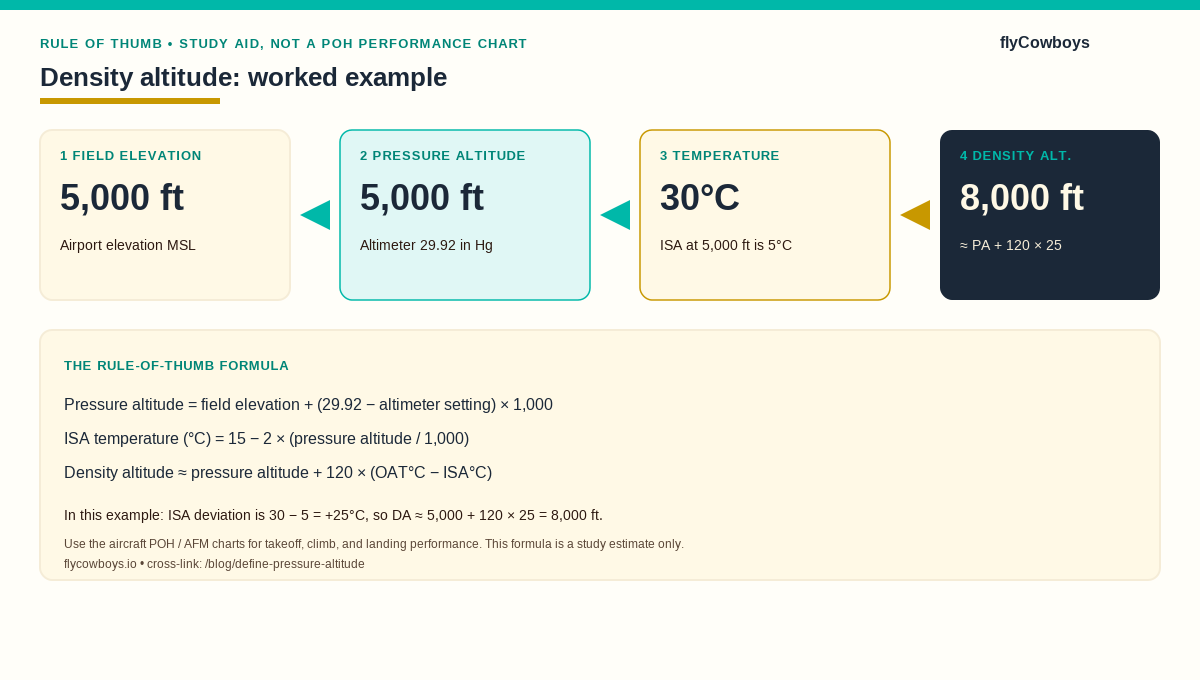
You are departing an airport at 5,000 feet MSL. The altimeter setting is 29.92 in Hg, and the outside air temperature is 30°C. What is the density altitude using the rule of thumb?
- Pressure altitude = 5,000 + (29.92 − 29.92) × 1,000 = 5,000 feet.
- ISA temperature at 5,000 feet = 15 − 2 × 5 = 5°C.
- The air is 30 − 5 = 25°C hotter than ISA.
- Density altitude ≈ 5,000 + (120 × 25) = 5,000 + 3,000 = 8,000 feet.
The airplane will perform more like it is at 8,000 feet than at a 5,000-foot standard-day airport: a longer takeoff roll, a poorer climb, a higher true airspeed for a given indicated airspeed, and a longer landing roll. High, hot, and humid is the combination to treat with extra caution, and it is worse with a short runway, a downslope that hides the climb, or a heavy airplane.
If the altimeter setting had been 29.42 instead of 29.92, pressure altitude would already have been 5,500 feet before the temperature correction, and density altitude would have been even higher. That is why you cannot skip the pressure-altitude step and just add a temperature fudge factor to field elevation.
How high density altitude shows up in the airplane
- Longer takeoff roll and a shallower climb. The wing and propeller have less air to work with, and a normally aspirated engine makes less power.
- Higher true airspeed for the same indicated airspeed, which lengthens landing distance as well.
- A higher service ceiling in effect: the airplane may not climb like it did on a cool morning at a sea-level airport.
- Lean the mixture for the altitude, as your POH and instructor teach. An over-rich mixture at a high-density-altitude airport makes the performance problem worse.
Density altitude is also a weight-and-balance and runway-length problem. If the computed takeoff distance plus a safety margin does not fit the runway, you wait for cooler air, reduce weight, or choose a longer runway. See weight and balance in aviation and how to calculate weight and balance before you treat a high-DA departure as a normal one.
How this shows up on the FAA knowledge test
Typical questions ask you to compute density altitude from a field elevation, an altimeter setting, and a temperature, or they ask what happens to takeoff performance when density altitude increases. Traps include:
- Using field elevation as pressure altitude when the altimeter setting is not 29.92.
- Using 15°C as ISA at a 5,000-foot airport (ISA there is 5°C, not 15°C).
- Confusing a high density altitude (worse performance) with a high indicated altitude.
- Thinking humidity makes density altitude lower. Moist air is less dense, which raises density altitude slightly.
- Skipping the POH charts after doing the rule-of-thumb math.
Practice the arithmetic with a FAA practice test, and be ready to explain the performance effects on your checkride oral.
Sources
FAA Pilot's Handbook of Aeronautical Knowledge (density altitude, pressure altitude, and performance), the Airplane Flying Handbook discussion of takeoff and climb performance, and your aircraft POH performance charts. The 120-feet-per-degree rule of thumb is a training approximation, not a regulatory formula.
Frequently Asked Questions
What is the density altitude formula?
A common training formula is: density altitude ≈ pressure altitude + 120 × (OAT°C − ISA°C), where ISA°C is 15 − 2 × (pressure altitude in thousands of feet). Pressure altitude itself is field elevation + (29.92 − altimeter setting) × 1,000. The formula is an approximation; use POH charts for performance numbers.
How do you calculate density altitude?
Get pressure altitude, get the standard temperature at that pressure altitude, compare it with the actual outside air temperature, and apply about 120 feet of density-altitude change per °C of difference. You can also use an E6B, an app, or the calculator on this page, then confirm takeoff and landing data in the POH.
What is the difference between pressure altitude and density altitude?
Pressure altitude is the altitude in the standard atmosphere corresponding to the existing pressure. It ignores temperature. Density altitude starts from pressure altitude and then corrects for nonstandard temperature (and, in real air, humidity). Two days can have the same pressure altitude and very different density altitudes if one is much hotter.
Why does high density altitude reduce performance?
Thinner air means the engine produces less power, the propeller produces less thrust, and the wing produces less lift at a given indicated airspeed. The result is a longer takeoff roll, a weaker climb, a higher true airspeed, and a longer landing distance.
Does humidity affect density altitude?
Yes, but most training calculations use only pressure and temperature. Water vapor is less dense than dry air, so humid air raises density altitude slightly compared with dry air at the same pressure and temperature. In the airplane, treat a hot, humid day as worse than the dry-air calculation suggests.
Is a density altitude calculator a substitute for the POH?
No. A calculator is useful for understanding and for a first look at whether the day is high, hot, and demanding. Takeoff and landing distances, climb gradients, and weight limits come from the aircraft performance charts, used the way the POH instructs.