· 14 min read
Cleared for the Option: Meaning, Rules and Radio Calls
Learn what cleared for the option means, the five landing outcomes it allows, when to call the tower, and how to practice it for your FAA exam.
Cleared for the option is an ATC authorization letting the pilot choose one of five outcomes, a touch-and-go, low approach, missed approach, stop-and-go, or full-stop landing, granted only at towered airports and subject to ATC approval. That sounds like freedom to decide late and say nothing, and that's exactly where students get tripped up.
The clearance does move the choice to you. It doesn't remove your duty to tell the tower when your choice changes how long you'll occupy the runway, or when you can't comply with an instruction. Think of it as two separate jobs running at the same time. You're flying the maneuver, and you're keeping the controller's picture of the runway accurate. If you learn only the list of five, you'll pass a definition question and still sound unsure on the radio. If you learn when choice ends and reporting begins, the phrase stops being confusing.
Table of Contents
- What Cleared for the Option Means and Why ATC Uses It
- Where the Clearance Applies and Common Misreadings
- How to Request and Fly the Option
- When You Must Call the Tower
- Sample Radio Calls to Learn by Heart
- Practice the Radio Calls Before Your Exam
What Cleared for the Option Means and Why ATC Uses It
Cleared for the option is an ATC authorization that lets you choose one of five outcomes instead of receiving a clearance for one specific landing. The controller still controls the runway and the traffic around it. You get the maneuver decision, within limits that ATC has already approved.
That differs from a standard landing clearance in one practical way. You don't have to announce the specific maneuver before you reach the runway. Your instructor, an examiner, or you as pilot in command can let the approach develop and then pick the outcome that fits.
The Five Outcomes Under Cleared for the Option
Read the table as a matching exercise. Each name describes exactly what the airplane does, and the reporting note tells you where runway time becomes the controller's concern.
| Outcome | What the pilot does | Reporting note |
|---|---|---|
| Touch-and-go | Touch down and take off again without stopping | Stays in the traffic pattern |
| Low approach | Descend near the runway and go around without landing | No runway-delay call listed; follow ATC instructions |
| Missed approach | Go around from an approach and climb away | Follow the missed approach instruction |
| Stop-and-go | Land, stop on the runway, then take off | Report any runway delay to ATC |
| Full-stop landing | Land, stop, and clear the runway | Report any delay clearing the runway |
A touch-and-go keeps you rolling. You touch down, reconfigure as your instructor has taught you, add power, and climb back into the pattern. Because you don't stop, runway occupancy stays brief and predictable.
A low approach never becomes a landing. You descend toward the runway, then go around without touching down. A missed approach is the go-around outcome tied to an instrument approach, where you climb away and follow the instruction you've been given for what comes next.
The last two involve stopping, and stopping is where your radio duty grows. In a stop-and-go, you land, bring the airplane to a stop on the runway, then take off again from that point. In a full-stop landing, you land and clear the runway, so you're done with that approach rather than continuing for another circuit.
Why ATC and Instructors Use It
The purpose isn't convenience for its own sake. According to FAA guidance in the Aeronautical Information Manual, the procedure can benefit an instructor, flight examiner, or pilot because the student or examinee doesn't know whether the result will be a touch-and-go, low approach, missed approach, stop-and-go, or full-stop landing.
That uncertainty is the training value. Your instructor can watch your judgment, aircraft control, runway occupancy awareness, and compliance with ATC instructions in a single pattern or approach sequence, instead of grading only a rehearsed landing. The FAA Pilot/Controller Glossary frames it the same way, as a procedure normally used for training so an instructor can evaluate performance under changing situations.
It's similar to a driving test where the examiner doesn't tell you the turn until you're close to the intersection. You aren't being tricked. You're being asked to show that you can keep controlling the vehicle, notice what's around you, and adapt without needing the whole plan announced minutes earlier. In an airplane, that also means you don't get to occupy the runway indefinitely while you sort things out, and you must notify ATC about a delay on the runway, a delayed stop-and-go, a delayed runway exit, or an inability to comply.
Plain rule: One clearance can cover five outcomes, but it never covers silent runway delay.
On the radio, the phrase is short and easy to recognize once you've heard it a few times. A controller might say, "Cessna 12345, runway two seven, cleared for the option." If a sample question gives you that wording, you should immediately think of the five possible outcomes, not just a normal landing.
Where the Clearance Applies and Common Misreadings
This clearance lives in towered airspace, not everywhere you fly. FAA guidance reproduced in the FAR/AIM section on option approaches states that the procedure is used at locations with an operational control tower and remains subject to ATC approval.
Before you ask, do a simple check. Confirm the tower on your chart or airport listing, and notice the surrounding airspace while you're there, since students often study that alongside airspace classifications explained for towered and non-towered fields. If there's no operating tower, there's no controller who can issue this clearance.
Three Misreadings to Correct
You can request the option at any field. You can't. The procedure depends on tower approval and local traffic considerations, so a busy tower may not approve it even at a towered airport. At a non-towered field, pilots self-announce on the common frequency, which isn't the same thing as receiving cleared for the option.
Option means you must eventually land. It doesn't. The FAA definition explicitly includes a low approach and a missed approach, neither of which ends in a touchdown. Students who assume landing is required often eliminate correct answers too quickly.
The clearance lets you improvise around other instructions. It doesn't do that either. It isn't a blanket authorization to improvise at any airport, and it doesn't eliminate the need to follow an assigned instrument missed-approach procedure or comply with later ATC instructions.
Why Context Decides Whether It Fits
Controllers weigh VFR pattern work, instrument-approach training, runway occupancy, and their own workload. A quiet pattern with one trainer is different from a runway with arrivals stacked behind you. Your flexibility increases with this clearance. Your responsibility for timely communication and compliance doesn't shrink to match.
How to Request and Fly the Option
Ask early, read back cleanly, and decide before the runway forces a rushed choice. The sequence below works because each step gives the next one time to happen.
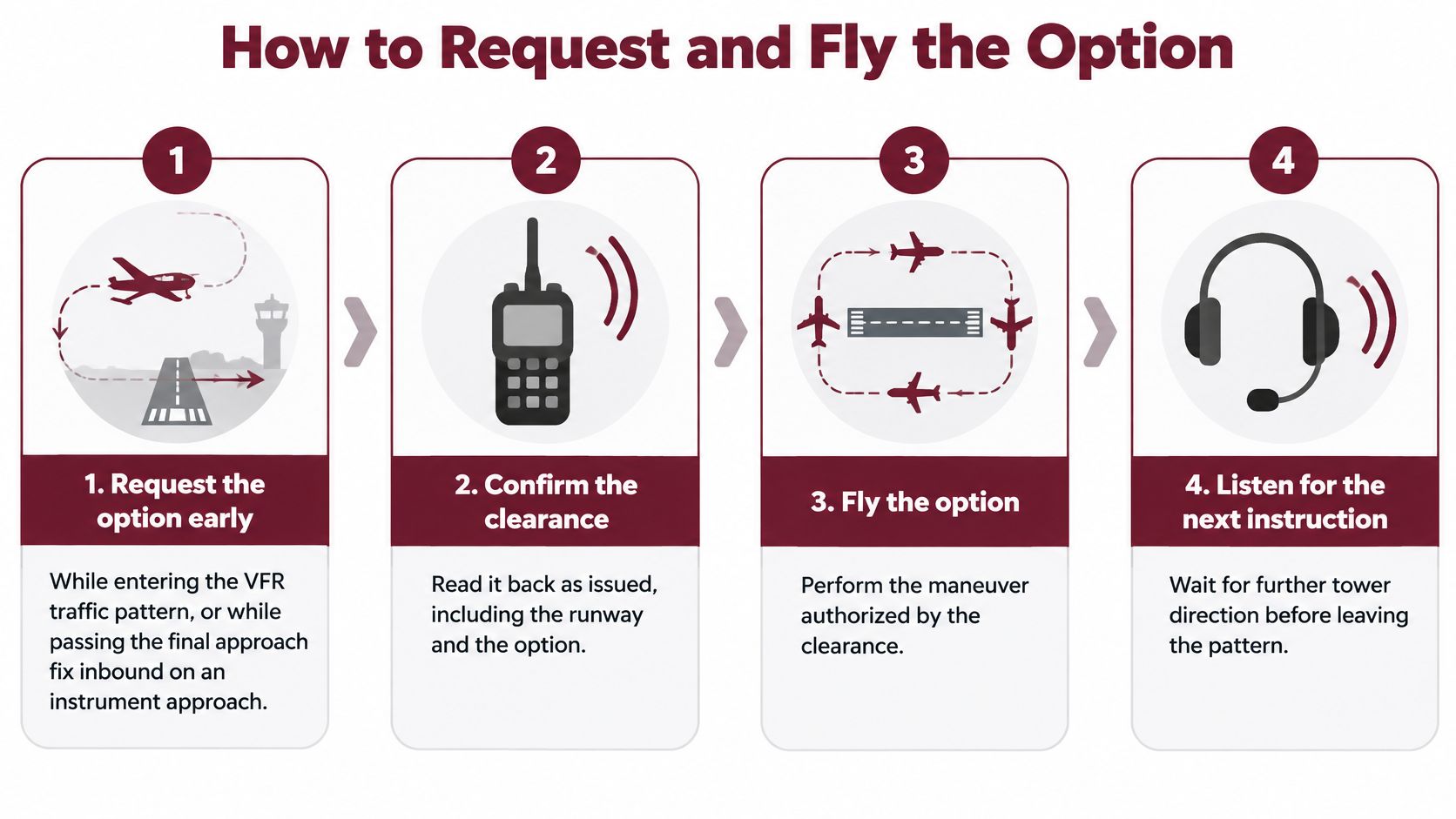
Request the option early. Ask while entering the VFR traffic pattern, or while passing the final approach fix inbound on an instrument approach. Early notice lets the controller plan spacing instead of reacting on short final.
Confirm the clearance as issued. Read back the runway and cleared for the option. A correct read-back catches a wrong runway or call sign mix-up while there's still altitude and time to fix it.
Decide as the approach develops. Traffic, runway length, aircraft condition, and your instructor's or examiner's direction all shape the choice. You're allowed to decide late, but you shouldn't start thinking late.
Fly the outcome with runway time in mind. A touch-and-go keeps you moving, while a stop-and-go or full-stop means stopping on or clearing the runway. That difference matters to the airplane behind you, just as stopping correctly matters at a runway hold short line before you enter.
Report problems as soon as possible. If you'll block the runway, your stop is delayed, or you can't comply, tell ATC right away. The controller can't re-sequence traffic around a delay nobody has mentioned.
Follow the next instruction. After your outcome, listen for pattern direction, a runway exit, or missed approach guidance. Cleared for the option covers that one approach outcome, not the rest of your flight.
The most common slip is waiting until you're over the runway to think through the choice. By then you're busy with flare, centerline, and configuration, so the radio and the decision both get sloppy.
Decide your likely outcome on downwind or inbound, then let conditions confirm or change it.
A clean sequence sounds unremarkable, which is the point. You request the option entering the pattern, the tower clears you for the option on runway two seven, you read it back with your call sign, fly the touch-and-go your instructor calls for, and then follow the tower's next pattern instruction without extra chatter.
When You Must Call the Tower
Choosing an outcome and reporting an outcome aren't the same task. After cleared for the option, not every landing choice needs an advance call, because ATC has already authorized all five. Changes that affect runway use are different, and those do require your voice.
The FAA Pilot/Controller Glossary entry for cleared for the option supports the FAA guidance that pilots should advise ATC if they intend to remain on the runway, experience a delay during a stop-and-go, delay clearing after a full stop, or cannot comply with the instruction. The FAA's January 2025 AIM repeats that distinction.
Reporting Obligations by Scenario
| Scenario | Call ATC? | Why it matters |
|---|---|---|
| Choose touch-and-go and keep rolling | No extra call needed | Routine outcome with no runway change |
| Stop-and-go with a runway delay | Yes, as soon as possible | Keeps runway flow predictable |
| Full-stop with a delayed runway exit | Yes | Following traffic waits on the delay |
| Intend to remain on the runway | Yes | Controller must know runway occupancy |
| Cannot comply with an instruction | Yes | Controller needs to re-plan |
| Fly a missed approach as instructed | Follow the instruction issued | Route or altitude changes come from ATC |
Say you're cleared for the option and your instructor tells you to make it a touch-and-go. You touch, roll, and climb. No extra call is needed because nothing about runway occupancy surprised the controller.
Now change one fact. You stop on the runway for a stop-and-go and need longer than expected before you can depart. That delay changes the controller's plan for following traffic, so you report it as soon as possible. The same logic applies if you land full-stop and can't clear promptly, or if you realize you can't comply with an instruction at all.
Exam questions love that boundary because memorizing five nouns won't save you. The testable skill is separating pilot discretion from communication obligation. Keep your delay wording simple and recognizable, such as stating your call sign and that you'll have a delay on the runway during the stop-and-go.
Sample Radio Calls to Learn by Heart
Short exchanges stick better than isolated definitions. Practice these aloud, because your mouth needs the pattern before a busy frequency tests it, and review them alongside general radio procedure basics for student pilots if call structure still feels new.
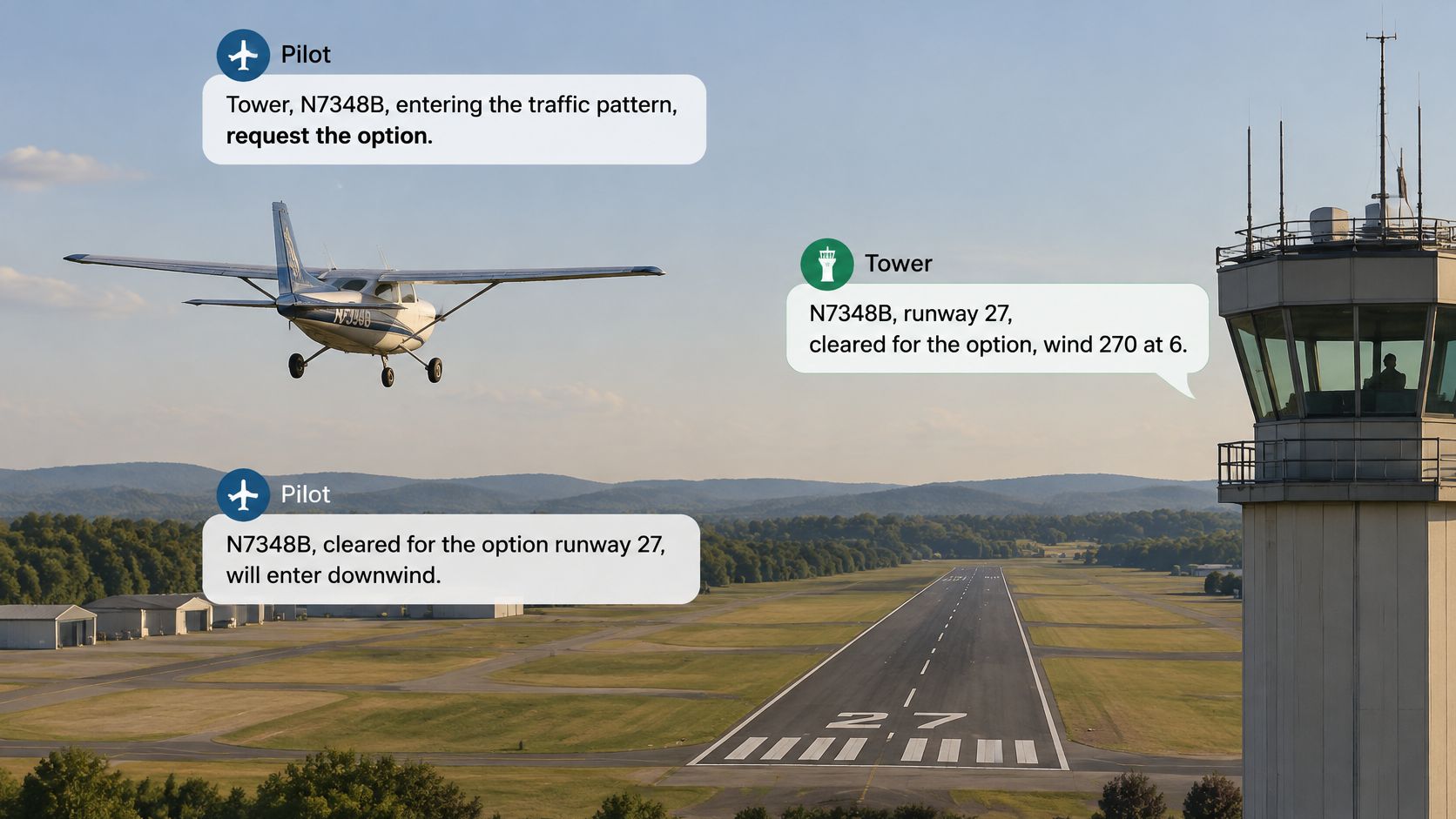
VFR Pattern Request
Pilot: "Tower, Cessna 12345, entering left downwind runway two seven, request the option."
Tower: "Cessna 12345, runway two seven, cleared for the option."
Pilot: "Runway two seven, cleared for the option, Cessna 12345."
Your first line says who you are, where you are, and what you want while entering the pattern. The controller's line names the runway and grants the choice of outcomes. Your read-back includes the runway because landing on the wrong runway is exactly the kind of error a read-back exists to catch.
Instrument Approach Request
Pilot: "Tower, Cessna 12345, passing the final approach fix inbound, request the option."
Tower: "Cessna 12345, runway two seven, cleared for the option."
Pilot: "Runway two seven, cleared for the option, Cessna 12345."
The timing changes, not the clearance wording. You make the request passing the final approach fix inbound, which tells the controller you're committed to the approach segment. If you then fly a missed approach, you follow the missed approach instruction rather than inventing your own climb-out plan.
Delay Report After a Stop-and-Go
Pilot: "Tower, Cessna 12345, we'll have a delay on the runway during the stop-and-go."
Tower: "Cessna 12345, roger."
That call comes as soon as possible because the controller may need to send following traffic around or adjust spacing. It doesn't ask permission to pick the stop-and-go, since cleared for the option already covered that outcome. It reports the runway time, which is the part ATC still needs from you.
Compare that with a standard landing clearance, "cleared to land." That phrase points to one outcome, a landing. Cleared for the option points to five possible outcomes and fits training scenarios where the maneuver isn't revealed in advance. When a question describes an instructor or examiner waiting to choose, that wording is your clue.
Practice the Radio Calls Before Your Exam
Use a short routine that separates recall from judgment, then put both under your voice. Reading to yourself isn't enough for a radio clearance.
Recite the five outcomes cold. Say touch-and-go, low approach, missed approach, stop-and-go, and full-stop landing until you don't need to look. That's your base layer for definition questions.
Drill the call-or-no-call decision. Give yourself scenarios and answer out loud. A rolling touch-and-go needs no extra call, while a delayed runway exit puts the key fact right in front of you, and that one needs a report.
Say the request and read-back aloud. Repeat the pattern request, the final approach fix request, and the delay report until the runway and call sign land in the right places automatically. Record yourself if you don't have a partner, since playback exposes dropped words quickly.
Review the limits last. Run through the towered-only rule, ATC approval, and the non-towered airport trap before you stop. Many wrong answers sound plausible until you notice there's no tower in the scenario.
Pair written questions with spoken repetition during the same study session. We include 3,500+ practice questions, each with an explanation of why, and both plans include unlimited Talk to Tower AI ATC practice, so you can test the rule and then say the call. This week, rehearse the request and delay calls aloud with your flight instructor, a study partner, or a recording, and review the written explanation for every question you answer on this topic.
When you're ready to turn cleared for the option from a memorized list into a call you can make without hesitation, visit flyCowboys to practice FAA-style questions with plain-English explanations and rehearse tower phraseology with Talk to Tower. You'll build the judgment behind the clearance and the radio confidence to use it in the pattern, on an instrument approach, and on exam day.