· 15 min read
Private Pilot ACS: What It Is and How to Use It to Pass
Learn what the private pilot ACS covers, how tasks and knowledge areas are organized, and how to use the ACS to study smarter and pass the FAA written exam.
You've finished a handful of lessons, your instructor keeps mentioning the checkride, and a thick FAA PDF is sitting open beside your sectional. You may be wondering what the examiner will expect, which topics deserve your limited study time, and whether the knowledge test is separate from the practical test. The Private Pilot Airman Certification Standards, or Private Pilot ACS, answers those questions when you use it as a working guide instead of a document you read once before the checkride.
Table of Contents
- What the Private Pilot ACS Actually Is
- How the ACS Document Is Organized
- Areas of Operation and What Each One Tests
- Connecting Knowledge, Risk Management, and Skill
- Using the ACS to Drive Your Study Plan
- When to Take the Knowledge Test and Why Timing Matters
- Building Lasting Study Habits Around the ACS
What the Private Pilot ACS Actually Is
The FAA introduced the Airman Certification Standards framework for Private Pilot, Airplane and Instrument, Airplane certification on June 15, 2016, replacing the corresponding Practical Test Standards, or PTS. The important change wasn't just a new title. The ACS brought the knowledge test and practical test into one reference document and connected three parts of certification, aeronautical knowledge, risk management, and flight proficiency. The FAA Private Pilot Airplane ACS describes the framework as building on the PTS while adding risk-management elements to applicable tasks.
In plain language, the ACS is the FAA's answer to three questions:
What must you know? Regulations, weather, aircraft systems, navigation, performance, and other aeronautical subjects.
What risks must you recognize? Hazards, changing conditions, personal limitations, and reasonable ways to reduce exposure.
What must you demonstrate? The planning, procedures, maneuvers, and aircraft-control skills evaluated during the practical test.
That structure gives your training a common direction. Your ground study shouldn't prepare you for one test while your flight lessons prepare you for an unrelated event. A cross-country planning discussion, for example, should help you answer knowledge questions, brief an examiner, and make a sound decision before departure.
What the ACS isn't
The ACS isn't a textbook. It won't teach weather interpretation from the beginning, replace the Pilot's Handbook of Aeronautical Knowledge, or explain every aircraft-specific procedure. It also isn't a complete syllabus, because your instructor still has to sequence lessons, select exercises, and adapt training to your aircraft and experience.
It isn't a list of trick questions either. Each task describes the standard an evaluator may use. Your job is to turn those standards into understanding and repeatable performance.
The document is also living guidance, not a frozen syllabus. The Private Pilot airplane standard progressed from FAA-S-ACS-6, issued in June 2016, through revisions including 6A, 6B, a 6B change, and FAA-S-ACS-6C, issued in November 2023. The FAA's current listing identifies the April 2024 edition of FAA-S-ACS-6C as effective May 31, 2024, so version control matters when you download study material.
Practical rule: Study from the current ACS, then use textbooks, regulations, aircraft manuals, and your instructor to fill in the explanation behind each standard.
How the ACS Document Is Organized
The ACS reads like a hierarchy. At the top are Areas of Operation, broad chapters that follow the major phases and responsibilities of private-pilot training. Inside each Area are Tasks, such as weather information, cross-country planning, or normal takeoffs. Each Task then divides the expectation into Knowledge, Risk Management, and Skill elements.
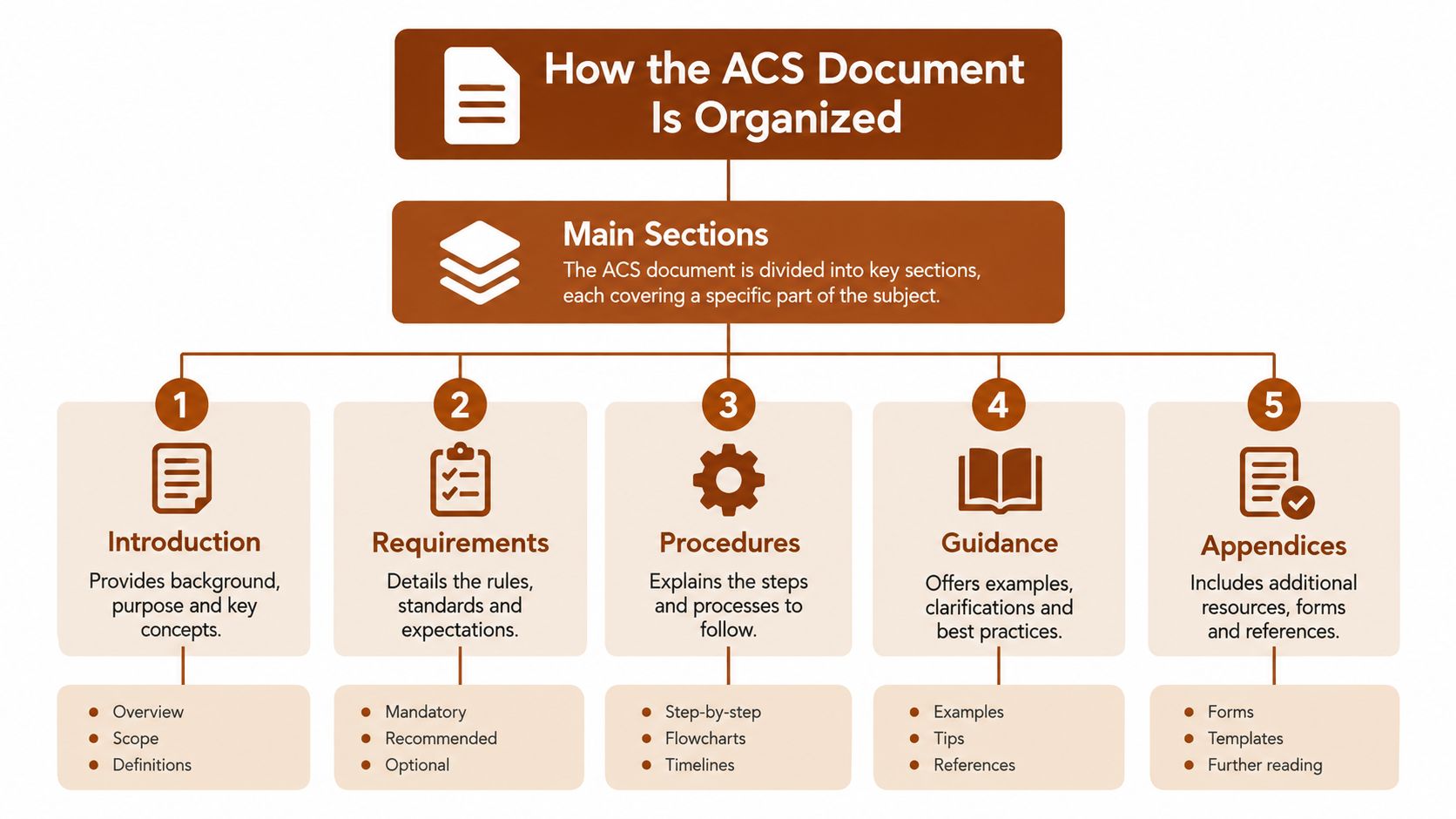
Suppose you're working with a preflight-preparation task. The knowledge elements may require you to understand weather reports, aircraft performance, weight and balance, or applicable operating rules. The risk-management elements ask how you identify hazards and reduce them. The skill element may involve producing a practical flight plan and explaining how you'll use it.
A code such as PA.I.B.K1 narrows the reference to one exact place:
PA identifies Private Pilot, Airplane.
I identifies the Area of Operation.
B identifies the Task.
K1 identifies the first Knowledge element in that Task.
An R in place of K points to Risk Management, while S identifies Skill. These codes let you connect a practice-test result to a precise subject rather than writing “weather” or “planning” in a notebook and hoping you remember what needs work.
Read the task as a complete performance
Don't study the three columns in isolation. A student may memorize a weather definition, perform a preflight planning exercise, and still fail to explain why a forecast mismatch makes the trip unacceptable. The ACS expects the pieces to work together.
Use each Task as a briefing prompt:
Read the objective and identify the decision or performance being evaluated.
Mark the Knowledge elements you need to explain without notes.
Turn each Risk Management element into a “what would you do if” scenario.
Practice the Skill element with your CFI and record what evidence shows improvement.
That approach makes the codes useful in lesson plans, oral-exam preparation, and post-test review. Instead of asking whether you've “covered navigation,” you can ask whether you can explain and perform the specific navigation elements attached to the relevant task.
Areas of Operation and What Each One Tests
The Areas of Operation give you a route through the Private Pilot ACS. They begin with preparation and procedures, move through aircraft operation and decision-making, and end with postflight responsibilities. The exact task names and applicability should always come from your current FAA document, especially where aircraft configuration or operation changes what applies.
| Area of Operation | Representative Task | What It Trains | Key Knowledge Topics |
|---|---|---|---|
| Preflight Preparation | Pilot qualifications, weather, cross-country planning | Preparing a legal and sensible flight | Regulations, weather, performance, airspace, planning |
| Preflight Procedures | Preflight inspection and cockpit setup | Making the aircraft and cockpit ready | Airworthiness, checklists, equipment, run-up |
| Airport and Seaplane Base Operations | Radio communication and traffic patterns | Operating safely in the airport environment | Communications, markings, signals, pattern procedures |
| Takeoffs, Landings, and Go-Arounds | Normal, crosswind, short-field, and soft-field operations | Controlling energy and runway performance | Configuration, wind, runway condition, rejected landings |
| Performance and Ground Reference Maneuvers | Steep turns, turns around a point, eights on pylons | Coordinating aircraft control with outside references | Load factor, wind correction, energy management |
| Navigation | Pilotage, dead reckoning, diversion, lost procedures | Maintaining orientation and adapting the plan | Charts, heading, groundspeed, fuel, alternatives |
| Slow Flight and Stalls | Power-on and power-off stalls | Recognizing and recovering from reduced-margin flight | Aerodynamics, indications, recovery priorities, spin awareness |
| High-Altitude Operations | Operations at higher elevations when applicable | Managing thinner air and changing aircraft performance | Density altitude, oxygen considerations, performance |
| Emergency Operations | Engine failure, fire, and systems emergencies | Prioritizing aircraft control and available options | Emergency checklists, landing areas, communication |
| Multiengine Considerations | Applicable operations when training in a multiengine airplane | Managing configuration-specific risks | Engine-out considerations and aircraft systems |
| Postflight Procedures | Securing the aircraft and recording discrepancies | Closing the flight responsibly | Shutdown, inspection, documentation, maintenance concerns |
The knowledge test draws from Knowledge elements across these Areas. That doesn't mean every applicant receives the same question or that a test score proves practical readiness. It means your study map should include the entire document rather than focusing only on the maneuvers you enjoy flying.
Use the order, but don't confuse it with a lesson schedule
The Areas provide a useful sequence, yet your instructor may introduce them in a different order. You might practice traffic patterns before completing every cross-country-planning topic, or discuss emergencies during an early aircraft-systems lesson. Mark the corresponding ACS tasks as they arise so your study record follows your actual training.
A printed ACS can sit beside your logbook. After a lesson, write the task code, what you performed, and what still felt uncertain. That small habit turns a broad list of areas into a record of specific evidence.
Connecting Knowledge, Risk Management, and Skill
A weather decision along a lake-effect shoreline shows why the ACS uses three columns. You may know how to read METARs, TAFs, and graphical forecasts, but that knowledge alone doesn't answer whether you should depart. You have to interpret the information, identify the hazards, and make a defensible operational choice.
Follow the decision loop
Knowledge gives you the raw material. You compare observed conditions with the forecast, understand visibility and ceiling trends, review winds, and determine whether the route and aircraft performance are suitable.
Risk management changes facts into hazards. A shoreline route may leave fewer landing options. A forecast-versus-observed mismatch may signal deterioration. Terrain, density altitude, fatigue, passenger pressure, and limited recent experience can make an otherwise legal flight a poor choice.
Skill includes more than manipulating the controls. You must brief the route, set personal minimums, identify diversion points, and make a go-or-no-go decision. If conditions worsen, you should be ready to divert, delay, or return without allowing the destination's proximity to dictate the outcome.
The NTSB safety material on VFR flight into IMC and related decision-making risks documents accidents involving inadvertent VFR flight into IMC and continued flight toward mountainous terrain. It also discusses plan-continuation errors and incorrect assessments of weather-related risk. Those examples help translate an ACS risk element into a real cockpit question: what evidence would make you change the plan?
The ACS isn't asking you to recite three separate answers. It's asking whether your knowledge supports a safe decision and whether your actions match that decision.
Use this loop during every relevant lesson:
Know the facts.
Name the hazards.
Choose controls and alternatives.
State the decision clearly.
Reassess when conditions change.
For structured oral preparation, an ACS-aligned checkride oral exam guide can help you turn individual elements into scenario questions. Your CFI remains the person who can judge whether your explanation and aircraft performance are ready for the practical test.
Using the ACS to Drive Your Study Plan
Download the current ACS and keep two copies. Print one for your desk, and save a digital copy for your tablet or electronic flight-bag setup. The paper copy makes it easy to annotate, while the digital version lets you search codes and move between related material.
Begin with a simple four-pass method:
Read the Area introduction. Identify the type of operation and the standard behind it.
Scan every Task. Notice which Tasks your current lessons have already touched.
Drill down to the elements. Separate Knowledge, Risk Management, and Skill.
Tag each element. Use labels such as known, shaky, or untested, but support “known” with evidence.
Evidence might be an accurate explanation without prompts, a completed scenario briefing, or a flight exercise performed consistently under your instructor's guidance. A completed video or chapter isn't proof that the element is ready.
Turn performance data into study decisions
The FAA's fiscal-year 2024 frequently missed knowledge-test analysis reports results by ACS code for the Private Pilot Airplane examination, identified as PAR. For example, PAR PA.VI.A.K1 had an 86.83% correct-response rate, meaning roughly 13.17% of recorded responses were incorrect, as shown in the FAA 2024 airman knowledge-test volume report. The FAA says its quarterly statistics cover October 1, 2023, through September 30, 2024, and are prepared by its Safety Analysis Branch with the Training and Certification Group.
That level of detail matters because “I need more studying” is too broad. If your missed questions cluster around one code, review that element, explain it aloud, create a scenario, and ask your instructor to connect it to a flight lesson.
A personal tracker can look like this:
| Area of Operation | Total Tasks | Elements Mastered | Elements Shaky | Mastery % | Next Study Action |
|---|---|---|---|---|---|
| Preflight Preparation | Record from ACS | Mark after evidence | Mark after review | Calculate from your record | Rework weakest planning elements |
| Navigation | Record from ACS | Mark after evidence | Mark after review | Calculate from your record | Practice diversion and lost procedures |
| Emergency Operations | Record from ACS | Mark after evidence | Mark after review | Calculate from your record | Brief priorities and alternatives |
Don't treat a self-calculated mastery percentage as an FAA score. It's a planning signal. Rank weak Areas above your chosen 80% mastery threshold, then revisit the map after meaningful training progress rather than letting old confidence ratings stand forever.
A running flashcard deck and oral-prep list should come directly from shaky codes. A resource such as the Private Pilot study guide from flyCowboys can supplement that process with ACS-organized practice, but your tracker should remain tied to the current FAA document and your instructor's assessment.
When to Take the Knowledge Test and Why Timing Matters
Taking the written test immediately isn't automatically efficient. FAA guidance requires the knowledge test before a student is authorized to solo, while independent training guidance also recognizes that the test can become more meaningful after flight training begins and suggests considering operational experience, including a solo cross-country, before testing. The FAA Advisory Circular 61-65K provides the relevant guidance for endorsements and certification processes.
The right timing depends on whether your knowledge is connected to operations. Test sooner when you already have strong ground-school support, can study consistently, or need the result for an aviation program. Waiting may make more sense when you're balancing work, are still early in dual instruction, or can recognize correct answers without explaining their cockpit meaning.
Use readiness rules instead of calendar pressure
Ask yourself:
Can you explain missed questions? Memorizing an answer is weaker evidence than explaining why it is correct and what decision it supports.
Can you connect the code to a task? Your practice results should point to a specific ACS element, not just a disappointing score.
Can you discuss the topic orally? Knowledge-test readiness should resemble oral-exam readiness, because both require understanding rather than recognition alone.
Can you use the information in flight planning? Weather, performance, navigation, and regulations should appear in your briefings, not only in flashcards.
The FAA's 2024 report recorded 271,247 total airman knowledge tests across its reported categories and an overall passage rate of 89.51%. Those figures are an all-test aggregate, not a Private Pilot, Airplane-specific pass rate, so they shouldn't be used to predict your individual result. They do show the scale of the testing system and why element-level review is more useful than comparing yourself with a broad aggregate.
A FAA written-test preparation course can provide structured practice, but don't let a high practice result pressure you into scheduling before you can explain weak ACS areas. The simple rule is sound: take the knowledge test when your understanding is ready, not merely when the calendar says you should.
Building Lasting Study Habits Around the ACS
A durable ACS routine is small enough to use every week. It should connect your lesson notes, practice results, oral preparation, and current FAA standards without turning study into a second full-time job.
Keep the document active
Use this checklist:
Verify the version: Start each study block with the current FAA ACS, especially if an old printed copy has been in your flight bag for months.
Tag the lesson: Write the Area, Task, and element code beside each ground or flight lesson.
Test risk management: Ask one “what would change your decision?” question for every major topic.
Record missed elements: Save the ACS code from each practice-test error and review the underlying source material.
Build a one-page map: Pair each Area with the relevant Airplane Flying Handbook chapter and applicable FAR sections.
Recheck weak topics: Return to any Knowledge or Risk Management topic below your 80% review threshold before moving on.
The one-page map helps expose gaps before the engine starts. If navigation looks strong but diversion decisions remain uncertain, you can brief that issue before a cross-country rather than discovering it under pressure.
A practice system can support the routine, but it shouldn't replace judgment. Adaptive questions, spaced review, mock oral prompts, and a flight log can help organize preparation when they're mapped to the ACS. Your CFI should still decide whether an explanation, decision, or aircraft task meets the expected standard.
The best preparation isn't measured only by study hours. It shows up when you can identify the relevant element, explain the risk, choose a reasonable action, and perform the task without treating the ACS like a last-minute checklist.
flyCowboys offers an iPhone study platform with ACS-mapped Private Pilot practice questions, adaptive drills, mock oral preparation, radio communication practice, and a flight logbook. Use it alongside your current ACS and CFI feedback, then visit flyCowboys to see whether its tools fit your preparation routine.