· 20 min read
Instrument Rating Knowledge Test: Format and How to Pass
Learn how the instrument rating knowledge test is scored, which eight topics it covers, and how to prepare for the new image-based chart questions.

Most pilots approach the instrument rating knowledge test the way they studied for their private written: grind through a static question bank until the answer letters look familiar, memorize the recurring diagrams in the testing supplement, and walk into the testing center hoping for quick recall. That habit breaks down fast on the modern exam. Today's test acts as both a weighted blueprint across distinct operational subjects and a live chart-reading assessment built around current, unfamiliar aviation charts rather than recycled figures.
Passing comfortably takes a different approach. Instead of chasing a single overall practice score, you need to know how the Federal Aviation Administration weights each subject, how to diagnose weak Airman Certification Standards (ACS) codes, and how to pull altitudes, fixes, and notes off an approach plate you've never seen before. Let's walk through the exam format, the pass-rate reality, and a repeatable study system step by step.
Table of Contents
- What the Instrument Rating Knowledge Test Is and Who Takes It
- The Eight Knowledge Areas and How Much Each One Counts
- Eligibility, Scoring and What the Pass Rates Show
- How to Build a Study Plan Around the ACS Codes
- Reading Unfamiliar Charts on Image-Based Questions
- Pacing and Habits That Cost Points on Exam Day
- Confirm Your Readiness and Book the Exam
What the Instrument Rating Knowledge Test Is and Who Takes It
Imagine a private pilot who just logged their first few hours under the hood with a Certificated Flight Instructor (CFI). They're starting to hold headings and altitudes by reference to instruments, and they want to know when the written exam enters the picture. Under 14 CFR Part 61.65, the FAA Instrument Rating Airplane knowledge test is a mandatory written prerequisite you must pass before sitting for the practical test, as established in the FAA Instrument Rating Airplane Airman Certification Standards.
It serves as the formal knowledge gate between ground study and your checkride. According to that same FAA standard, the exam uses the test code IRA, contains 60 objective, multiple-choice questions, allows a 2.5-hour time limit, requires a 70% minimum passing score, and sets a minimum applicant age of 15.
| Specification | Value |
|---|---|
| Test code | IRA (Instrument Rating Airplane) |
| Questions | 60 objective multiple-choice |
| Time limit | 2.5 hours |
| Minimum passing score | 70% |
| Minimum applicant age | 15 years |
| Legal basis | Prerequisite for the practical test under 14 CFR 61.65 |
What the Questions Actually Look Like
Pilots who haven't opened an instrument question set often expect a narrow navigation quiz full of VOR radials and holding entries. In practice, the exam tests operational decision-making through short flight scenarios. One question might give you a METAR, a terminal forecast, and an alternate airport requirement, then ask whether you can legally file that destination without an alternate. Another might present an ATC clearance alongside a departure obstacle note and ask for the required climb gradient or routing action.
Every question ties directly to a specific ACS knowledge code, connecting what you miss on the test to a defined task element rather than an undifferentiated list of trivia. Because the blueprint spans weather, procedures, regulations, navigation, human factors, and operational judgment together, memorizing isolated rules without understanding how they interact leaves gaps you'll feel both on the screen and during your oral exam.
Reality check for private pilots: If you already hold a private pilot certificate, the computer workstation and multiple-choice layout will feel familiar, but the knowledge base is a different animal. VFR rules rely on see-and-avoid judgment; IFR testing evaluates whether you can operate strictly inside the Air Traffic Control system when you can't see the ground.
If you're pursuing an airplane instrument rating under Part 61 or Part 141, this is the exact test code that applies to your training. Helicopter applicants and flight instructor instrument candidates sit for separate exams with different codes, so confirming you're preparing for the IRA test keeps your study hours aimed at the right target.
The Eight Knowledge Areas and How Much Each One Counts
Rather than pulling questions evenly from a flat pool, the FAA Instrument Rating ACS Change 1 divides the exam across eight defined knowledge areas with overlapping percentage ranges. Because those bands overlap while still totaling 60 questions, no two test forms distribute subjects identically. One candidate might see a heavier cluster of weather items, while the pilot sitting at the next terminal faces more navigation and ATC clearance scenarios.
The visual breakdown below shows how those eight areas sit relative to one another across the exam blueprint.
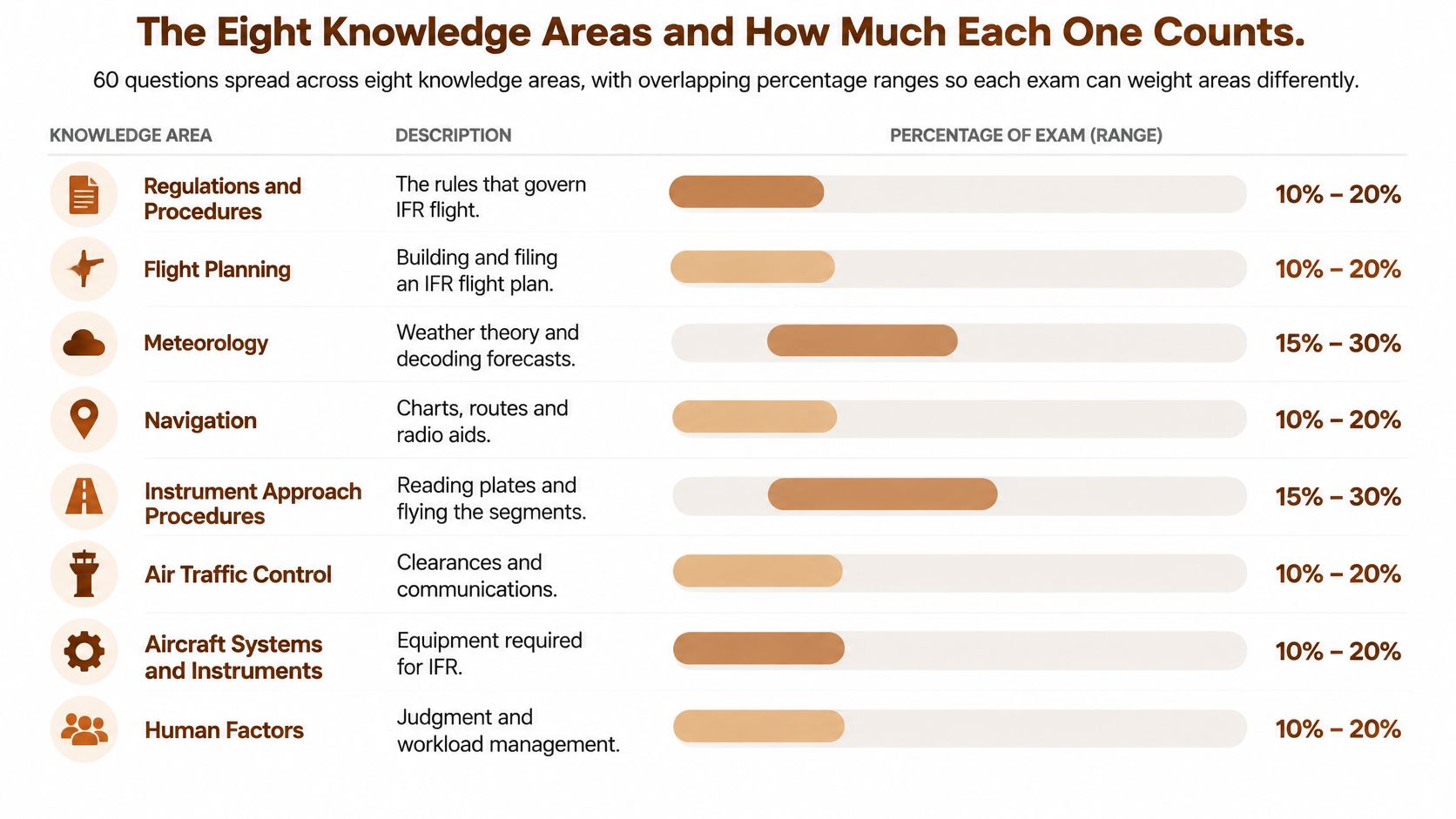
Translating each FAA percentage range into approximate question counts out of 60 makes the weighting concrete when you're deciding where to spend your weeknight study sessions.
| Knowledge area | FAA weight | Approx. questions out of 60 |
|---|---|---|
| Regulations | 5-15% | 3-9 |
| IFR en route and approach procedures | 5-15% | 3-9 |
| Air traffic control and procedures | 5-20% | 3-12 |
| IFR navigation | 5-20% | 3-12 |
| Weather reports, critical weather, wind shear and forecasts | 10-20% | 6-12 |
| Safe and efficient IFR operations | 5-10% | 3-6 |
| Aeronautical decision-making | 5-10% | 3-6 |
| Crew resource management | 5-10% | 3-6 |
Where the Heavy Weight Sits
Three bands can make or break a borderline score. Weather reports, critical weather, wind shear, and forecasts carries the highest floor at 10-20%, meaning you'll face roughly 6 to 12 questions on decoding METARs, TAFs, AIRMETs, SIGMETs, icing conditions, and wind shear hazards. Right behind it, air traffic control and procedures and IFR navigation each account for 5-20%, or 3 to 12 questions apiece. Together, those three domains can easily represent half of your entire exam.
Regulations and IFR en route and approach procedures sit in the middle tier at 5-15% each (3 to 9 questions). Meanwhile, candidates frequently brush past the human-factors group: safe and efficient IFR operations, aeronautical decision-making, and crew resource management each carry 5-10% (3 to 6 questions). Combined, those three areas still contribute anywhere from 9 to 18 questions, which is far too many points to leave on the table.
Why an Overall Practice Score Can Mislead You
A single percentage across a mixed practice quiz hides dangerous blind spots. Say you earn a comfortable overall score because you nailed every regulation and human-factors question, yet you miss most of the items on weather interpretation and IFR navigation. If your real test pulls near the top of the 20% band on weather and navigation, that hidden gap can drag a comfortable practice score dangerously close to failing.
Track your accuracy by ACS knowledge area, not just by overall test score, so a weak high-weight domain can't hide behind your strongest subjects.
Measuring readiness area by area forces repeated competence in the heavier domains and connects every missed question back to its exact ACS task element. That area-level diagnostic becomes the foundation for organizing your study blocks in the right order.
Eligibility, Scoring and What the Pass Rates Show
Before booking a seat, separate test eligibility from checkride readiness. Meeting the minimum age requirement and securing your instructor's endorsement or approved ground-school completion sign-off under 14 CFR Part 61.65 lets you sit for the written early, even while you're still building cross-country instrument time. Many pilots knock out the knowledge test mid-training so their ground study reinforces what they're flying under the hood.
Your exam result is reported immediately as a percentage alongside the specific ACS codes for every question you missed. That printed Airman Knowledge Test Report (AKTR) stays with your training file, and your Designated Pilot Examiner will review those missed codes during the oral portion of your checkride.
What Four Years of FAA Outcomes Reveal
Looking at national test results puts the difficulty of the exam in proper perspective. According to FAA Airman Knowledge Test annual statistics, candidate volume grew substantially between 2021 and 2025 while pass rates and average scores stayed remarkably steady.
| Reporting year | Applicants | Pass rate | Average score |
|---|---|---|---|
| 2021 | 17,537 | 94.54% | 85.73% |
| 2023 | 23,363 | 94.44% | 85.84% |
| 2024 | 25,647 | 94.24% | 85.64% |
| 2025 | 27,143 | 94.38% | 86.15% |
Across those reported years, annual testing volume climbed by about 54.8%, rising from 17,537 applicants in 2021 to 27,143 applicants in 2025. Over that exact same span, the annual pass rate held tightly between 94.24% and 94.54%, and average scores consistently exceeded 85%, reaching 86.15% in 2025.
Reading the Numbers Without Overconfidence
Those numbers are encouraging, but they deserve a careful reading. First, the FAA figures cover all reported test outcomes, not strictly first-time attempts, so retakes sit inside the totals. Second, national pass rates don't prove that any single video course, book, or question bank caused those results.
What the data does show is clear: the instrument rating knowledge test is very passable with disciplined preparation, yet roughly one in eighteen applicants still does not pass in a given year. Candidates who clear the exam also tend to beat the passing threshold by a wide margin rather than squeaking by on the line. Aiming for solid mastery across every subject area gives you the cushion you need if an unfamiliar scenario or tricky weather chart catches you off guard.
How to Build a Study Plan Around the ACS Codes
Studying randomly from a massive pool of questions wastes hours on topics you already understand while leaving subtle weaknesses untouched. A structured workflow anchored to the ACS turns test prep into a measurable routine.
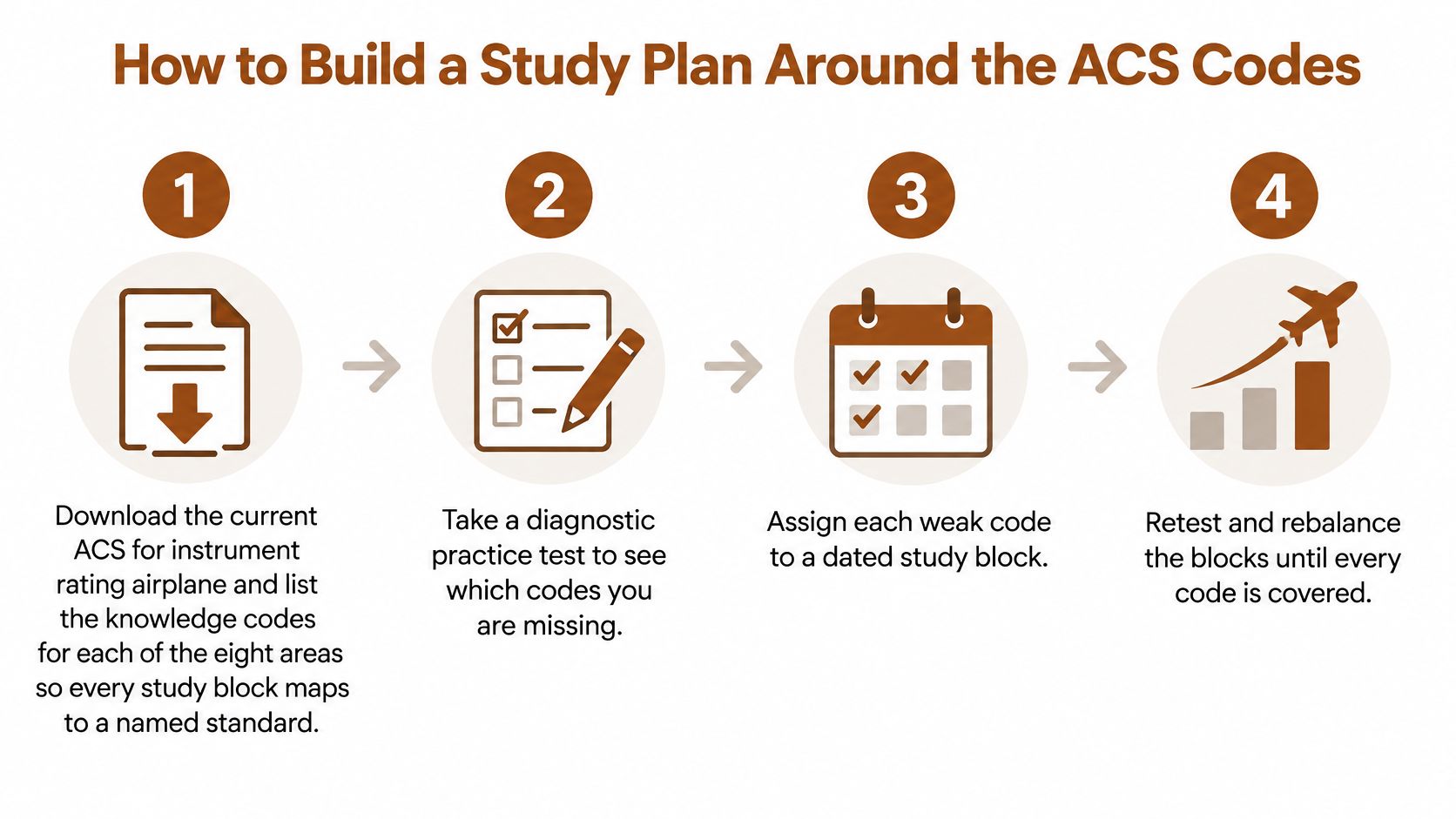
Follow these seven steps in order to build a study schedule that mirrors how the exam evaluates you:
- Pull the official ACS document and map the codes. Download the current Instrument Rating Airplane ACS from the FAA website and list the knowledge codes under each of the eight areas. Knowing how to read FAA knowledge test codes keeps every study block tied to an official standard instead of vague chapter titles. Common slip: skipping straight into practice quizzes without knowing which standard a missed question belongs to.
- Run a baseline diagnostic test. Take one full-length practice exam cold and log your accuracy separately for each of the eight knowledge areas. Don't worry if the score looks ugly; a diagnostic isn't a judgment, it's a map. Pilots who only glance at their overall percentage miss the exact domains dragging them down.
- Prioritize by weight multiplied by error rate. Multiply each area's upper exam weight by the percentage of questions you missed in that area. A high-weight subject like weather forecasts where you missed half the items goes straight to the top of your queue, ahead of a lighter subject where you only missed one item. This prevents you from spending three nights polishing regulations while navigation stays shaky.
- Work in focused 45-minute single-topic blocks. Pick one ACS area per session and read the full explanation for every question, even the ones you guessed correctly. Why? Lucky guesses evaporate when the FAA changes the airport name or weather numbers. Keep sessions tight at 45 minutes so fatigue doesn't turn active reasoning into autopilot clicking.
- Schedule spaced review at 1, 3, and 7 days. Put every missed question and its matching ACS code into a review log. Revisit that concept the next day, three days later, and one week out, explaining out loud why the right answer works and why the other two distractors fail. Cramming the same quiz three times in one evening builds short-term familiarity, not exam-day retention.
- Shift to weekly timed full-length tests in the final month. Once your individual areas are climbing, run one timed 60-question exam every week under strict clock conditions, using only an approved E6B flight computer or basic calculator and scratch paper. Untimed practice hides pacing trouble, especially on wind correction, fuel burn, and approach plate lookups.
- Hold off on booking until you hit consistent high-80s scores. Don't treat a single lucky passing score as a green light. Wait until you're posting consistent scores of 85% or higher across multiple full practice exams with no single knowledge area trailing below passing.
What a Strong Study Week Looks Like
Keep your weekly rhythm simple enough to survive a busy job or flight training schedule. Run one full timed practice exam on a weekend morning when your focus is fresh. Spend your next session doing a deep review of every missed item, sorting each error back to its ACS code rather than rushing into another quiz.
Then use three or four short weekday blocks of 45 minutes to drill your active list of weak codes alongside your 1-, 3-, and 7-day review items. By Friday, you should be able to explain every rule on that short list in plain English without peeking at answer choices.
Reading Unfamiliar Charts on Image-Based Questions
For decades, ground schools taught pilots to recognize numbered figures straight out of the public FAA testing supplement. You'd spot a familiar airport name, remember the answer tied to Figure 24, and click through in ten seconds without reading half the plate. That shortcut no longer holds up.
Beginning October 27, 2026, under the FAA June 2026 testing notice, Instrument Rating Airplane knowledge tests include image-based questions drawn from current instrument approach charts, low-altitude enroute charts, and other chart images that aren't in the traditional printed testing supplement.
Pilots preparing for the exam now need the same visual scanning discipline they use in the cockpit when reviewing current plates on paper or a tablet.

The underlying knowledge standard and passing score aren't changing. What's shifting is transfer: proving you can locate symbols, frequencies, minimum altitudes, approach transitions, fixes, and chart notes on a brand-new visual excerpt while the clock runs. International pilots training for an FAA rating feel this shift even more sharply when adapting from Jeppesen or foreign AIP chart conventions to standard FAA government plates.
Walking Through an Unseen Approach Plate
Say a test question displays a current RNAV (GPS) approach plate for an airport you've never heard of, and asks for the lowest authorized altitude between an intermediate fix and the final approach fix when local altimeter settings aren't available. Memorized figure numbers can't help you here.
Start with a strict four-step scan:
- Find the fix in the plan view first: Locate the named intermediate fix and trace the inbound course arrow to confirm you're looking at the right transition segment, not a feeder route or missed approach track.
- Drop down to the profile view: Read the published crossing altitude for that exact segment and verify whether it's an "at or above" bar or a mandatory altitude.
- Scan the notes and briefing strip: Check the equipment notes box and the minimums section for any footnote raising minimums or altitudes when the local altimeter is out of service.
- Verify against the answer options: Match your computed altitude to the choices only after checking every applicable note.
Knowing the exact meaning of each symbol speeds up that scan dramatically, so keep an IFR chart legend handy while building your visual habits.
Diagnosing Chart-Reading Errors Versus Knowledge Gaps
When you miss an image-based question during practice, don't lump it into a generic "approaches" bucket. A pilot can understand step-down minimums completely and still pick the wrong answer because they overlooked a small footnote or misread a fix triangle. Separate visual scanning mistakes from conceptual IFR gaps using the diagnostic matrix below.
| Error type | What it looks like | Fix |
|---|---|---|
| Symbol misread | Confusing a fix or NAVAID symbol with a similar one | Trace the symbol against the legend on the chart shown |
| Wrong chart edition | Using a figure from an outdated chart | Check the effective date printed on the chart before answering |
| Missed chart note | Ignoring a footnote that changes a minimum altitude | Read every note block before choosing an answer |
| Conceptual gap | Knowing the rule but applying it wrongly to the chart | Return to the matching ACS knowledge code and reread the rule |
If you understand the IFR rule immediately once someone points to a footnote on the plate, your problem isn't aviation knowledge. Your problem is an incomplete chart scan.
Watch how a structured scan pulls frequencies, minimums, fixes, and notes off an unfamiliar instrument approach plate before you ever commit to an answer.
A Ten-Minute Daily Chart Drill
Build transfer skill directly into your study week using current public FAA approach plates and low-altitude enroute charts from airports outside your home area. Pull one unfamiliar plate per session, answer three targeted questions (such as the missed approach holding fix, the highest obstacle on the plan view, and the Category A circling minimums), and point out loud to the exact spot on the chart where each fact lives. Practicing that physical locate-and-verify loop turns unfamiliar test images into routine cockpit work.
Pacing and Habits That Cost Points on Exam Day
Good ground knowledge still leaks points when exam-day execution gets sloppy. Start with the simple pacing math: dividing two and a half hours across sixty questions gives you two and a half minutes per question. That sounds generous until you sink eight minutes wrestling with one convoluted wind-correction or holding-entry problem, borrowing time from three questions further down the test.
Quick recall items on regulations or airspace definitions often take thirty seconds. Bank those extra seconds intentionally for multi-step chart lookups and weather decoding so you never feel forced to guess through the final ten questions.
Five Habits That Quietly Drain Scores
Even well-prepared pilots hand away five to ten percentage points through avoidable test-taking errors:
- Answering from the first few words of the stem: Fix this by reading the final sentence of the question first so you know what decision is requested before scanning the scenario.
- Glossing over qualifier words like always, never, except, or not: Fix this by noting every qualifier on your scratch sheet before evaluating the three choices.
- Changing an answer out of nervous second-guessing: Fix this by switching your choice only when you can state the specific regulation, calculation, or chart note that proves the new option right.
- Forgetting to revisit flagged questions while time stays on the clock: Fix this by flagging any item that takes longer than two minutes, entering your best initial choice, and returning to the flagged list once you finish item 60.
- Walking into the testing center without timed rehearsals: Fix this by completing at least three full timed mock exams beforehand so the clock feels routine instead of stressful.
A Steady Exam-Day Routine
Plan to arrive at the testing center at least twenty minutes early with your valid government photo ID, your instructor endorsement or completion certificate, and an approved non-programmable calculator or manual E6B. Before clicking start on the PSI workstation, verify that the screen displays the IRA test code and confirm the exact time limit shown by the testing center.
Set a single mental checkpoint at question 30. If you've crossed the halfway mark with roughly half your clock remaining, your pace is right on target. Keep moving cleanly, use your scratch paper for every math step and holding diagram, and reserve your final ten to fifteen minutes exclusively for reviewing flagged items.
Confirm Your Readiness and Book the Exam
Schedule your exam based on repeatable evidence, not on a calendar deadline or one lucky practice run. At flyCowboys, we consider a pilot ready to book once you're scoring 85% or higher consistently across full practice exams, with every single knowledge area sitting cleanly above the passing line. Confirm that the weak domains from your first diagnostic now hold steady and that you finished your last two full timed rehearsals comfortably inside the exam clock.
Once your scores meet that bar, reserve your seat at an FAA-approved testing center. Double-check the test code, aircraft category, confirmed appointment duration, required ID, and endorsement paperwork ahead of time using a reliable FAA written test scheduling guide so an administrative mix-up doesn't cancel your morning.
What a Study Platform Can and Cannot Do
A structured study app can map your accuracy by ACS area, serve realistic practice tests, and signal when your scores are consistently in the passing range. Still, you must not rely solely on any app for flight training or test preparation. Software does not replace certified flight instruction from authorized flight instructors (CFIs), official FAA publications, approved Part 61 or Part 141 flight training programs, FAA knowledge tests or practical tests, or aircraft flight manuals and pilot operating handbooks.
Use your practice platform to tighten weak ground concepts and build chart-scanning speed, then bring every tricky weather, clearance, or approach question straight to your CFI during ground sessions. Passing the written clears a major milestone, yet it's a stepping stone toward flying safely in the clouds and earning your rating on checkride day, not the finish line of your instrument training.
If you're ready to organize your Instrument Rating Airplane prep around the FAA ACS instead of static memorization, flyCowboys brings ACS-mapped IFR questions, plain-English explanations, spaced repetition, PSI-style timed mock exams, and a Readiness Score together in one iPhone app. Take a quick placement quiz to spot your weak knowledge areas, build a personalized daily plan, and walk into your testing center knowing your scores are consistently above the mark.