· 15 min read
Instrument Written Test Prep for Steady Readiness
Build instrument written test prep with an ACS-based study plan, timed practice tests, image-question drills, and clear readiness checks.
Stop chasing a high question bank score and calling it readiness. That popular advice fails instrument students because you can recognize answers you've already seen and still freeze on an unfamiliar hold, alternate calculation, or chart image. Good Instrument Written Test Prep proves something harder, that you can retrieve the right knowledge across the full ACS, after a delay, and apply it when the wording or figure changes.
Table of Contents
- Why Readiness Is More Than a Practice Score
- Know What the Instrument Written Test Covers
- Build an ACS-Based Study Routine
- Use Practice Questions to Find Knowledge Gaps
- Prepare for Image-Based Instrument Questions
- Take Practice Tests Under Real Conditions
- Use These Tools Before You Schedule the Test
Why Readiness Is More Than a Practice Score
One strong practice result doesn't prove you're ready. It proves you performed well on that set, on that day, often with questions you'd partly recognized. That's a weak standard for an exam tied to real IFR decisions.
You can score well overall and still be exposed in specific places. Weather decisions, alternate requirements, holds, avionics failures, and clearance interpretation don't always show up evenly in random practice. If your bank keeps feeding you regulation recall you already know, your average climbs while those gaps stay untouched. Strong national results hide the same problem at individual level, since FAA 2023 statistics show a 94.44% pass rate and an 85.84 average score for 23,363 Instrument Rating Airplane tests in the FAA airman knowledge testing matrix. Passing is common. Balanced competence is a different question.
A passing threshold is not a competency guarantee. Treat it as the floor, not your target.
Run This Self Check Before You Study More
Don't ask only what your score is. Ask where the score came from.
- Comfortable areas: Which topics can you explain out loud without looking at answer choices first
- Pattern dependent areas: Which topics you get right only when the question looks familiar
- Slow areas: Which topics eat time because you're reasoning from scratch or guessing between two plausible options
- Delayed recall areas: Which topics felt solid last week but fade when you return after several days away
Write those four lists down. If you can't separate them, you don't have a readiness picture yet, you have a number. Retakers need this distinction most, because familiarity from a prior attempt can inflate confidence fast. CFIs need it too, since a single mock score tells them almost nothing about whether a student will handle a novel weather scenario or a clearance they've never seen phrased that way.
Readiness means balanced ACS mastery, durable recall, and transfer. Build for all three from the start, not after a disappointing result forces you to.
Know What the Instrument Written Test Covers
Start from the actual certification task, not from an undifferentiated pile of questions. The Instrument Rating, Airplane knowledge test is a standardized, objective multiple choice exam you must pass before the practical test, with 60 questions and a 70 percent minimum passing score specified in the Instrument Rating Airplane Airman Certification Standards. You'll also need an authorized instructor endorsement certifying readiness under 14 CFR §61.65, so the written isn't a standalone credential. It's one stage in an integrated process your instructor has to sign for.
That structure should shape how you study. The ACS organizes expectations into operationally relevant areas, including regulations and procedures, weather, flight planning, navigation systems, instrument approaches, and risk management. A bank built only for memorization can leave holes in exactly the areas the practical test will probe again.
Instrument Written Test Study Map
| ACS knowledge area | What to study | Useful practice |
|---|---|---|
| Regulations and procedures | IFR operating rules, clearances, lost communications, alternate rules | State the rule, then apply it to a clearance or diversion scenario |
| Weather | Reports, forecasts, icing, convection, fog, frontal behavior | Brief a route and defend a go, no go, or alternate decision |
| Flight planning | Fuel, alternates, performance, route selection | Plan a full IFR cross country with realistic constraints |
| Navigation systems | VOR, GPS and RNAV, DME arcs, holds, system limitations | Work raw data problems and draw the geometry by hand |
| Instrument approaches | Plate reading, minimums, missed approach, lighting, categories | Brief an unfamiliar plate aloud in segment order |
| Risk management | Human factors, illusions, decision traps, personal minimums | Explain what you'd do when the plan starts breaking down |
Treat weather as a decision subject, not a decoding exercise. If your theory base is thin, work through aviation weather theory for instrument students before grinding more METAR questions, because memorizing abbreviations won't help you judge whether a forecast supports the flight.
Every study block should map to one row in that table and to a reason the knowledge matters in the airplane. If you can't name the operational use, you're collecting trivia. Approach plates connect to briefing discipline. Regulations connect to what ATC expects when communications fail. Risk management connects to why a legal flight can still be a bad one. Study the connections and the recall gets easier, because you're learning a system instead of loose facts.
Build an ACS-Based Study Routine
Begin with a diagnostic, not a chapter. Take a mixed set across all ACS areas, cold, and record accuracy by domain rather than one overall percentage. That baseline tells you where your first weeks belong. Without it, you'll default to studying what you already like.
A useful session has a repeatable shape. Pick one primary domain, study the underlying material until you can explain it, then retrieve it with questions, then apply it to a short scenario. Holds, for example, shouldn't end with picking an entry type. Draw the fix, state the entry, state the wind correction logic, and say what you'd report to ATC. Explanation exposes gaps that recognition hides.
Here's the weekly rhythm to build around that session shape.
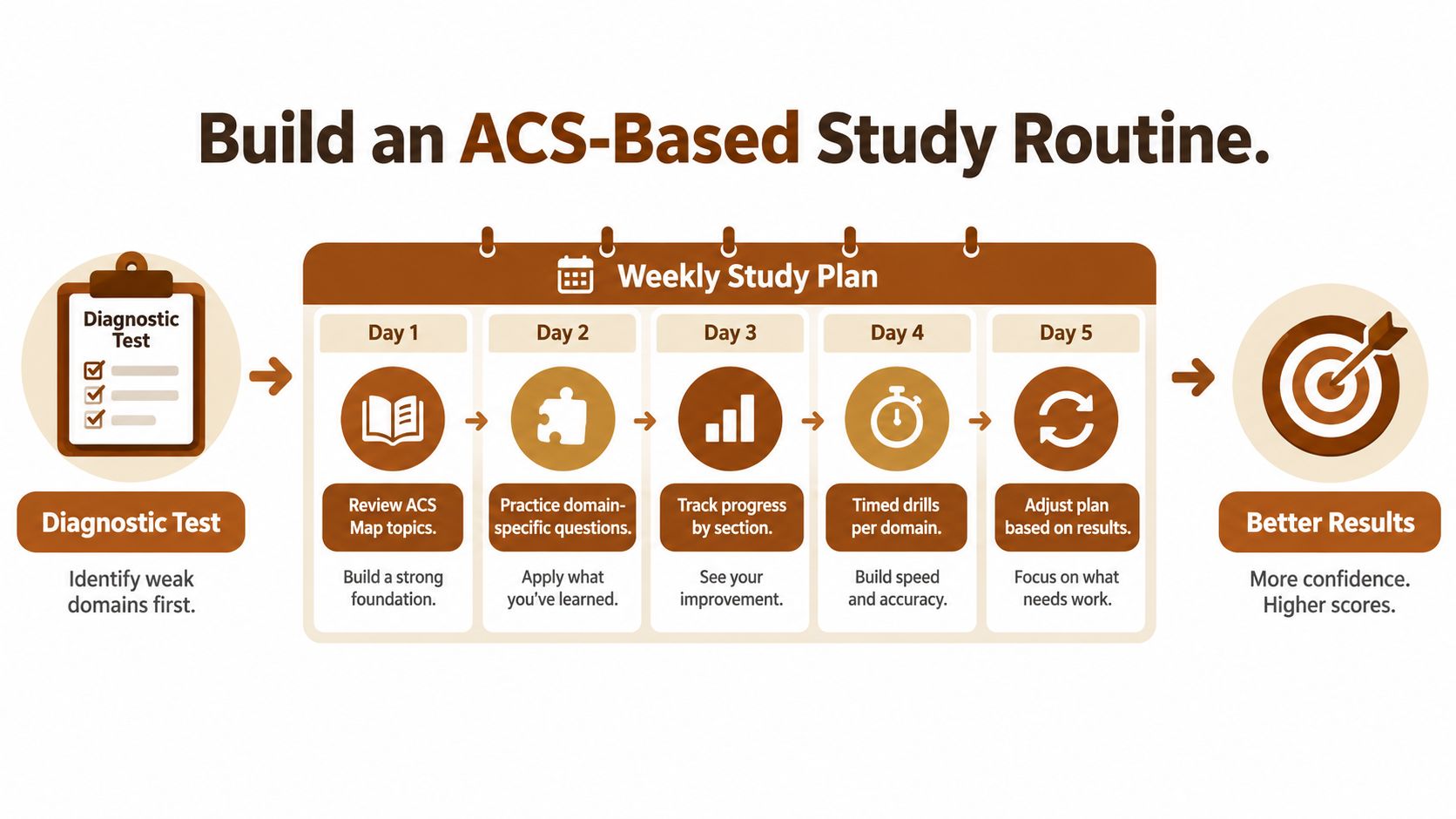
How to Structure the Week
- Focused blocks: Spend most sessions on one weak domain at a time so errors cluster and become diagnosable
- Mixed review: Reserve one session for interleaved questions across domains, because the exam won't announce the topic
- Spaced returns: Revisit earlier material after a gap instead of retesting it the same evening while it's still warm
- Review queue: Keep missed and uncertain concepts in a running list, and clear that list before opening new material
Don't reread everything equally. That's the most expensive habit in Instrument Written Test Prep. Your notes should shrink over time into a short queue of unresolved concepts, each with the correct reasoning in your own words and a date to retest it.
Practical rule: If you can't teach the concept back without the answer choices visible, you haven't finished studying it.
Adjust the Routine to Your Situation
A student pilot starting early can move slowly and pair each domain with flight lessons, which makes the material stick. A candidate with a test date looming should cut new content sooner and shift weight toward weak area drills and mixed sets. A retaker should rebuild from the diagnostic, not from the topics they remember missing, since memory of a failed attempt is unreliable.
CFIs assigning practice should ask for domain level results, not screenshots of overall scores. Give the student a target domain, a retest date, and a requirement to explain two missed concepts aloud at the next lesson. That turns homework into evidence.
Consistency beats marathon sessions. Short, frequent blocks with a maintained review queue will move you further than a single long weekend of rereading, because retrieval after a gap is what converts exposure into knowledge you can use under pressure.
Use Practice Questions to Find Knowledge Gaps
Consider a common pattern. A student cruises through regulations, finishes practice sets quickly, and feels ahead of schedule. Then weather questions stall her, hold entries flip when the inbound course changes, and clearance questions go wrong because she reads the limit but misses the route amendment. Her overall average looks fine. Her readiness isn't.
That gap stays hidden if you treat practice as a score generator. Treat it as an error analysis system instead, using approaches like those in structured FAA knowledge test preparation methods that track performance by topic rather than by total.
Log Every Miss Properly
For each wrong or uncertain answer, record five things in a simple notebook or spreadsheet.
- ACS area: The domain the question tested, not the chapter it came from
- Reason for the miss: Missing knowledge, misread wording, bad calculation, or flawed chart reading
- Confidence level: Whether you knew it, narrowed it to two, or guessed outright
- Correct reasoning: One or two sentences explaining why the right answer wins
- Retest date: When you'll attempt a similar but not identical question
Review your slow correct answers too. A right answer that took three minutes and a coin flip between two options is weak recall wearing a disguise. Mark it, log it, retest it.
Separate Familiarity From Transfer
Repeated questions reward recognition. To test whether you own a concept, change the surface details. Use a different chart region, a different runway layout, a different weather depiction, or a procedure with different fixes and altitudes. If your accuracy collapses when the dressing changes, you'd memorized the item, not the idea.
Ask your instructor to rephrase questions orally for the same reason. If you can answer the bank version but not a spoken version about your home airport, the knowledge won't survive the oral portion of the practical test either.
End every session with one rule. No miss closes until it has produced a future retest. A miss that only gets an explanation read over it will come back. A miss that gets logged, explained, and reattempted days later in altered form becomes progress you can measure.
Prepare for Image-Based Instrument Questions

Text-only question banks leave one skill untrained: reading an unfamiliar figure under time pressure. That gap is about to matter. The FAA has announced that, beginning October 26, 2026, the Instrument Rating Airplane knowledge test will include embedded image questions built on clearer, updated sectional chart and instrument procedure images, some of which may not appear in existing test supplements, as described in the FAA September 2026 special edition testing update. If your test date falls on or after that date, plan for these items. Memorizing the supplement figures you drilled won't cover them.
A fixed reading sequence removes the improvisation. Run it the same way on every figure until the order is automatic.
A Repeatable Sequence for Any Figure
- Identify the chart type: Approach plate, sectional excerpt, en route chart, or weather depiction, before reading any detail
- Orient the procedure: Find the airport, runway, final approach course, and direction of flight so the geometry makes sense
- Extract only what's asked: Go directly to the requested item, whether that's a minimum altitude, frequency, fix, course, or approach lighting detail
- Cross check the source: Confirm the value against the relevant part of the procedure, such as the profile view against the plan view, before selecting an answer
Most chart errors aren't knowledge errors. Students grab the first altitude they see instead of the one for their segment, or read a frequency for the wrong facility. The sequence prevents that by forcing orientation before extraction.
Read the image in layers. Never treat a dense plate as one picture to absorb all at once.
This layered reading pass is what the sequence trains.
A Transfer Drill for Embedded Images
Image items pull from several ACS areas at once, so a single high bank score tells you nothing about them. Train for transfer. Once or twice a week, pull a plate or sectional excerpt for an airport you have never briefed. Vary the runway orientation, the approach type, and the terrain. Set a timer, because untimed chart work flatters you. Run the sequence, write down the requested value, then verify it against the chart.
Afterward, be honest about how you got the answer. If you recognized the figure from earlier practice, the rep doesn't count toward image readiness. Track accuracy on first-seen figures separately from your overall score. That separate number, your unfamiliar visual performance, is the one that predicts how you'll handle embedded images once they go live.
Take Practice Tests Under Real Conditions
A full length practice test is a diagnostic event, not a study session. If you're pausing to check notes, looking up explanations mid test, or stopping the clock, you're measuring something that won't exist on test day.
Set the simulation up properly. Sit at a screen, work without notes, use scratch paper the way you would at the center, and finish in one sitting. Mark questions you're unsure about and move on rather than burning disproportionate time on a single stubborn item.
This overview shows how to frame those timed sessions before you run one.
Manage the Clock in Blocks
Don't fixate on finishing with time to spare. Divide the session into blocks and check your position at each block boundary. If you're behind, the fix is decisiveness on questions you know, not rushing chart work. Flag calculation heavy and figure heavy items, bank the straightforward ones, then return with whatever time remains.
For general expectations on the testing experience, this FAA written exam walkthrough covers the format so the center itself holds no surprises.
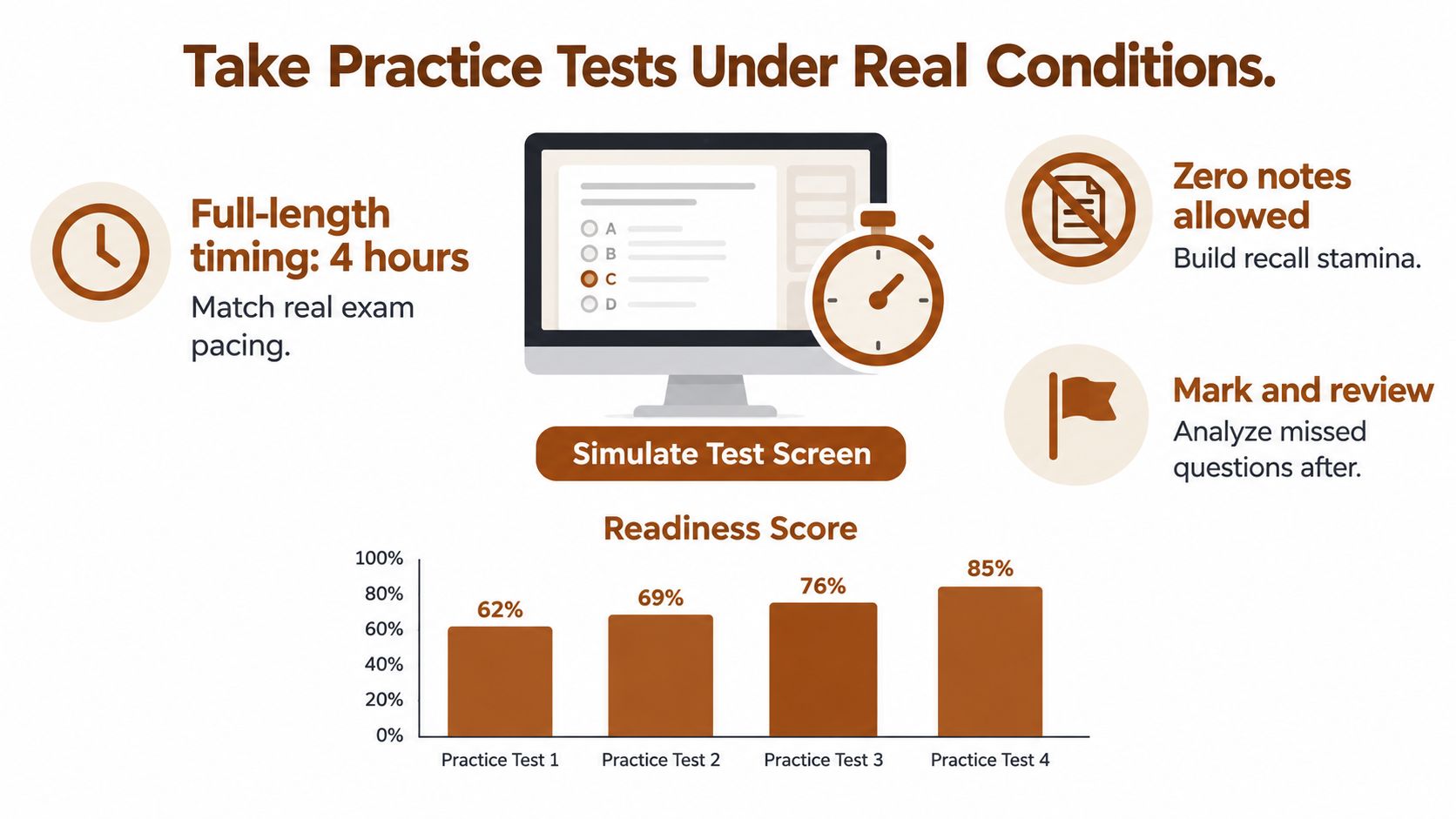
The visual below summarizes how repeated realistic attempts should trend when remediation happens between them.
Debrief by Domain, Not by Total
After each attempt, calculate performance by ACS area. Review incorrect answers and lucky guesses with equal suspicion, then remediate the largest gap before you schedule another full attempt. Retesting the next day mostly measures whether you remember yesterday's explanations. Wait, study the weak domain, then retest so recall has to survive a delay.
Three profiles show up repeatedly. First time candidates often discover pacing problems more than knowledge problems. Retakers often discover their score was propped up by recognition. Students who test well at home but crumble under pressure usually haven't practiced flagging and moving on, so one hard question early poisons the next ten. Each profile needs a different fix, and only honest simulations reveal which one you are.
Don't reduce the outcome to how many questions you can afford to miss. The FAA doesn't publish a topic by topic minimum, so a passing total built on one collapsed domain is a fragile pass and a bad setup for the practical test.
Use These Tools Before You Schedule the Test
Schedule on evidence, not on a feeling or a deadline you invented. Before you book, confirm three things. Every major ACS area has been studied and tested. Your recent scores are stable across fresh material, not inflated by repeats. You can work an unfamiliar chart image with your reading sequence without hunting randomly.
Final Readiness Checklist
- Weak areas remediated: Your review queue is short, current, and retested after delays
- Realistic simulation completed: At least one full length attempt under timed, no notes conditions
- Novel question transfer: Solid accuracy on figures and scenarios you hadn't seen before
- Delayed material retested: Early topics still hold up weeks after you first studied them
- Instructor reviewed: Your results discussed with an instructor who can challenge your reasoning orally
Add radio work if phraseology is a weak point, but keep it in its lane. Confident clearance readbacks help your flying and your practical test. They don't substitute for written knowledge. Tools such as flyCowboys combine ACS mapped question practice with AI based radio drills in one app, which can work if you use the domain reporting rather than chasing the headline score.
The endorsement is the last checkpoint, not a formality. Your instructor is certifying readiness, so bring domain level results, your error log, and your simulation history to that conversation. If the evidence shows a collapsed domain or scores that only hold on repeated material, delay and fix it. A short delay now is cheaper than a failed attempt, a remedial grind, and an examiner who finds the same gaps later.
Book the test when coverage, stability, and transfer all point the same direction. That's steady readiness, and it's the only kind worth trusting.
Build that steady readiness with ACS mapped Instrument Written Test Prep, adaptive drills that target your weak domains, PSI style timed practice exams, and AI radio practice for clearance confidence, all in one iPhone app from flyCowboys. Start your diagnostic today, work your review queue daily, and schedule your exam only when your readiness evidence says you're ready.