· 16 min read
Pilot Instrument Rating: Training and Test Prep
Master your pilot instrument rating with clear FAA requirements, training pathways, and modern test prep strategies to pass the IFR knowledge exam.
The most popular advice about a pilot instrument rating is also the least useful: memorize the question bank, pass the written test, and the rest will come together in the airplane. A strong test result matters, but it doesn't prove that you can manage an unfamiliar clearance, recognize deteriorating weather, or keep flying accurately when the radio, navigation, and aircraft workload arrive at once.
Instrument training should build a pilot who can make sound decisions without outside visual references. The FAA framework supports that broader standard through the Instrument Rating Airplane Airman Certification Standards, or ACS, which evaluates knowledge, risk management, and skills, not knowledge alone. Your preparation should therefore connect every regulation and procedure to a cockpit action, a decision point, and a recovery plan.
Table of Contents
- The Reality of Instrument Flight Proficiency
- Why the Instrument Rating Matters in Modern Aviation
- Navigating FAA Eligibility and Flight Hour Requirements
- Adapting to Modern FAA Knowledge Test Changes
- Choosing the Right Training and Study Pathway
- Maintaining IFR Currency and Operational Readiness
- Your Action Plan for the Instrument Rating Journey
The Reality of Instrument Flight Proficiency
A high written-test score can create false confidence. In 2025, 27,143 applicants took the airplane Instrument Rating knowledge test, with a 94.38% pass rate and an 86.15% average score, according to the FAA Airman Knowledge Test Volume Report. Those results show that many applicants can prepare effectively for predictable knowledge domains. They don't establish that those applicants are ready for ambiguous, high-workload IFR situations.
That distinction is the difference between paper proficiency and operational competence. A pilot may correctly identify a holding entry on a multiple-choice test, then hesitate when ATC assigns an unexpected hold while the weather closes in and the avionics display behaves differently from the training aircraft. Memorizing the rule is useful. Knowing when the rule matters, what information is missing, and which option reduces risk is the actual training outcome.
What the ACS changes
The ACS gives instructors a practical way to connect knowledge with action. A lesson on approaches shouldn't stop at identifying the final approach course. It should also ask:
- What changes: What will you do if the approach clearance differs from the plan?
- What can fail: Which instruments, navigation sources, or communications are essential?
- What triggers a decision: When will you go missed, divert, or discontinue the approach?
- What happens next: How will you communicate the decision and manage the aircraft?
The same method works for weather, alternate planning, holding, and IFR clearances. Study the regulation, then apply it to a scenario with limited time and competing tasks.
Instructor's rule: If you can state the answer but can't explain what you would do in the cockpit, you haven't finished learning the topic.
Train for ambiguity, not just recognition
Real IFR flying rarely presents information in the clean order used by a question bank. You may need to interpret weather, brief an approach, configure the aircraft, monitor fuel, communicate with ATC, and assess your personal margin at the same time. A useful debrief asks not only whether the maneuver met the standard, but also whether the sequence was sensible and whether the pilot recognized risk early enough.
Use missed knowledge-test subjects as prompts for targeted flight or scenario work. If the weak area is holding, practice the entry, then add a radio distraction, a revised clearance, or a navigation change. If the issue is weather, build a departure decision around changing ceilings, visibility, fuel, and escape options.
Passing the written exam should mark the end of passive study, not the end of learning. The checkride tests whether knowledge has become repeatable behavior.
Why the Instrument Rating Matters in Modern Aviation
An instrument rating isn't reserved for pilots planning an airline career. It has become a widely held qualification across U.S. general aviation. FAA airman-certificate data for 2024 listed 342,400 instrument-rated pilots among 495,907 total certificated pilots, or approximately 69 percent, compared with 59 percent in 2004, as reported in the FAA pilot and instrument-rating statistics. The change indicates that pilots increasingly view instrument capability as a core part of advanced flying rather than a niche credential.
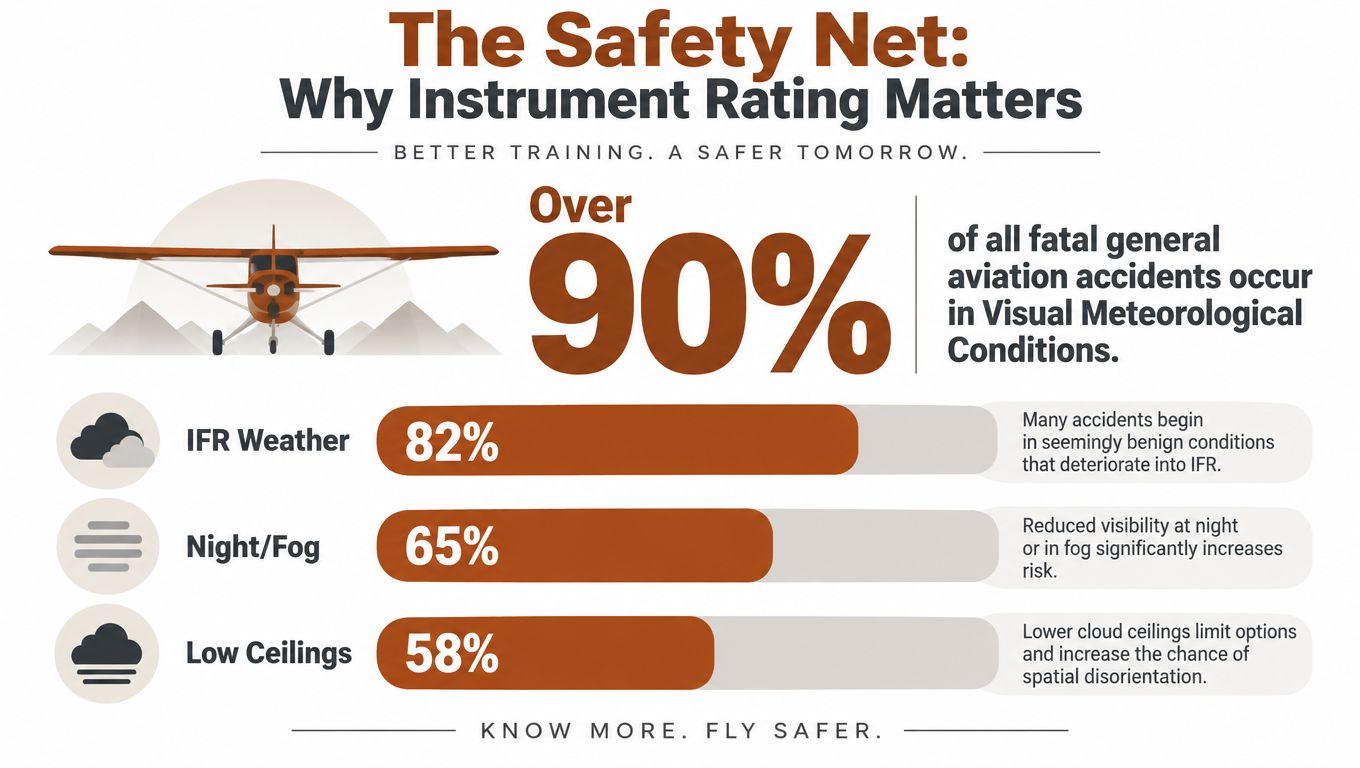
The safety case is equally important. Visual flight into instrument meteorological conditions can overwhelm a pilot who lacks instrument references, disciplined procedures, or a clear escape decision. The same FAA safety summary reports that in 2022, all recorded accidents involving pilots who inadvertently continued visual flight into instrument meteorological conditions were fatal, and one-third involved an instrument-rated pilot. That doesn't mean an instrument rating eliminates weather risk. It means the rating provides tools that must be supported by continuing judgment and proficiency.
The rating's practical value
Instrument training changes how you organize a flight. You learn to:
- Build an instrument scan: Control pitch, bank, altitude, heading, and airspeed from instruments instead of chasing outside references.
- Use procedures systematically: Brief departures, arrivals, approaches, missed approaches, and communications before workload peaks.
- Manage weather actively: Treat forecasts, observations, trends, and escape routes as decision inputs rather than background information.
- Respect clearances: Read back, verify, and execute the clearance you received, not the route you expected.
Those habits improve more than cloud flying. They make planning, cockpit organization, and aircraft control more deliberate on every flight. The rating's value comes from the discipline behind the privileges.
Why the statistics need careful interpretation
The safety figures shouldn't be read as a promise of protection. An instrument-rated pilot can still press into worsening conditions, misunderstand a clearance, lose proficiency, or continue when a diversion is the safer choice. The rating supplies knowledge and procedures, but the pilot still decides whether the flight remains within a manageable risk envelope.
That is why training should include conservative decision-making before the airplane enters IMC. Ask what conditions would cause you to delay, turn around, land short, or request assistance. A pilot who makes those decisions early has more options than one who waits until workload and weather have removed them.
Navigating FAA Eligibility and Flight Hour Requirements
The FAA requirements become easier to manage when you separate them into eligibility, cross-country experience, instrument experience, and recent preparation. Under 14 CFR 61.65, an airplane-rating applicant must hold, or obtain concurrently, an appropriate private pilot certificate. The applicant must also receive an instructor endorsement for the knowledge test and pass the FAA instrument-airplane knowledge examination with at least 70 percent.
The flight-hour rules contain an important distinction that often causes confusion. The regulation requires 40 hours of actual or simulated instrument time, but it doesn't require all 40 hours to be dual instruction. At least 15 of those instrument hours must be received from an authorized instructor who holds the relevant instrument rating.
Experience requirements at a glance
| Requirement Category | Minimum Hours | Specific Conditions |
|---|---|---|
| Pilot-in-command cross-country time | 50 | At least 10 hours must be in airplanes |
| Actual or simulated instrument time | 40 | Includes both instructor-led and other qualifying instrument experience |
| Instrument instruction | 15 | Must be received from an authorized instrument-rated instructor |
| Recent instrument training | 3 | Must occur in an appropriate airplane within the two calendar months before the practical test |
The categories overlap. Your instructor-led instrument time counts toward the total instrument requirement, so you don't add the 15 hours on top of the 40. Review your logbook early, identify what already qualifies, and record the category for every future lesson instead of trying to reconstruct it near the checkride.
Connect hours to operational tasks
Time alone doesn't create proficiency. A lesson should have a purpose that resembles the work of an IFR pilot. That may include planning an IFR cross-country, loading and verifying a route, briefing an approach, flying a hold, managing a missed approach, or responding to a clearance change.
The FAA also requires a qualifying IFR cross-country with an instructor, including a filed IFR flight plan and specified cross-country procedures. Treat that flight as a complete mission, not a box to check. Your planning should account for navigation, weather, fuel, approaches, communications, and alternatives.
The three-hour training requirement within the two calendar months before the practical test is a recency checkpoint. Use it to polish the exact tasks you'll demonstrate, but don't rely on those final hours to repair weaknesses that should have been identified earlier.
Logbook accuracy is part of training. If you can't explain why a flight counts toward a requirement, ask your instructor before you build more time on a faulty assumption.
Adapting to Modern FAA Knowledge Test Changes
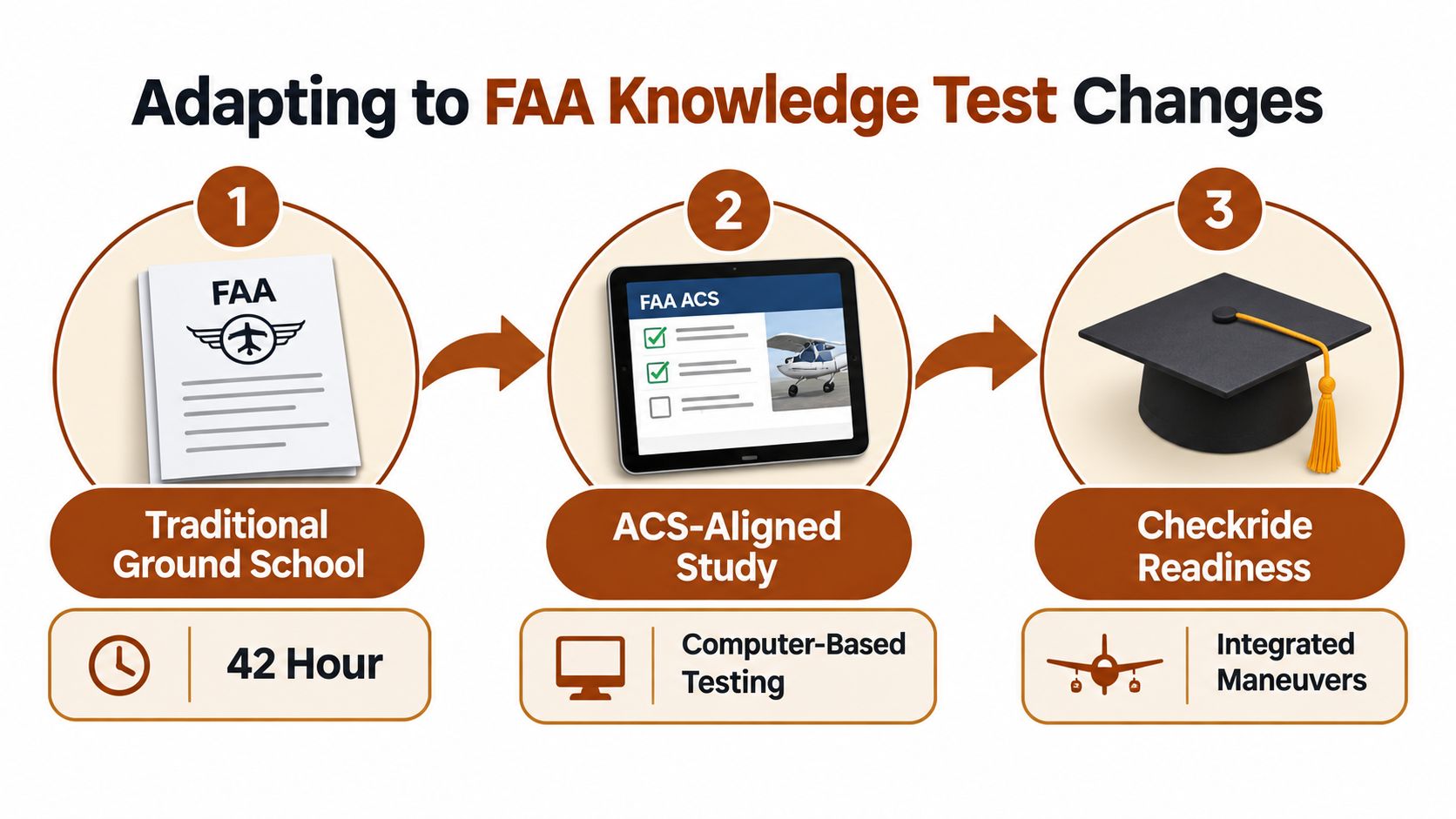
Old study habits can become a liability when they teach you to recognize answer patterns instead of understanding the question. The FAA's 2025 Airman Testing Community Advisory describes several changes in question construction. Negative wording is being removed, questions are shifting from “you” to “the pilot,” and items are being designed to seek one response rather than “both” or “neither.” The advisory also reports that 31 of 89 airman knowledge tests display ACS codes on Airman Knowledge Test Reports, while the Instrument Rating Helicopter exam's allotted time changed from 2.5 hours to 2 hours, as described in the FAA Airman Testing Community Advisory.
These changes point to a better preparation method. You need content mastery, but you also need to read carefully, identify the task being tested, and use the report after the exam as a diagnostic tool.
Study by ACS area
Organize your work around the applicable ACS codes rather than a random sequence of questions. For each weak area, write a short explanation in your own words, then apply it to a flight situation.
For example, a missed approach topic should lead to more than memorizing the published procedure. You should know when to initiate it, how to maintain control while configuring, what clearance you expect next, and how fuel and weather affect the decision to continue or divert.
A current FAA written-test preparation resource can be one part of that process, but verify any resource against current FAA terminology and standards. A recent publication date alone doesn't prove that the material reflects current testing practices.
Treat the test report as a training plan
If your report identifies weak ACS areas, don't just retake broad practice tests. Sort the missed topics into categories:
- Knowledge gap: You don't understand the rule, system, or calculation.
- Application gap: You understand the definition but can't use it in a scenario.
- Reading error: You missed a qualification, limitation, or change in wording.
- Recall weakness: You knew the material previously but couldn't retrieve it under pressure.
Each category needs a different response. Review the source material for a knowledge gap, fly or chair-fly a scenario for an application gap, slow down for reading errors, and use spaced review for recall weaknesses.
The FAA's formal incorporation of ACS and PTS standards into regulation, effective May 31, 2024, reinforces the value of ACS-linked preparation. The exam is a checkpoint within a larger system that continues through the oral and flight portions of the practical test.
Use this video as a supplement for test strategy or instructor-led discussion, not as a replacement for current FAA publications and applied practice.
Choosing the Right Training and Study Pathway
A fragmented study plan usually looks familiar. One resource explains weather, another supplies questions, a paper logbook tracks flight time, and radio practice gets postponed because it feels less urgent than the written exam. That arrangement can work, but it makes you responsible for connecting every piece and finding the gaps.
An integrated pathway begins with the ACS and works outward. The question bank, explanation, radio scenario, logbook category, and flight lesson should reinforce the same operational skill. That structure is especially useful for IFR topics, where knowing a definition without practicing the associated communication or cockpit sequence leaves a significant gap.
Compare the study models
| Traditional fragmented study | ACS-aligned pathway |
|---|---|
| Separate videos and question banks | Topic practice tied to ACS areas |
| Repeated broad quizzes | Adaptive review of weak subjects |
| Radio work left until flight lessons | Deliberate phraseology practice before flying |
| Manual requirement tracking | Logbook categories reviewed with the instructor |
| Test readiness judged by confidence | Readiness judged by coverage and application |
The choice isn't really between technology and traditional instruction. A CFII remains essential for aircraft control, judgment, and flight evaluation. Digital tools can support the ground phase, help you rehearse radio calls, and show where your knowledge needs attention before you use valuable airplane time.
Evaluate tools by their cockpit connection
Ask whether a resource helps you answer three questions:
- What does the rule mean?
- When will I need it?
- What will I say or do next?
Spaced repetition is useful when it schedules difficult concepts for review instead of repeatedly showing what you already know. AI-based radio drills can help you practice timing and phraseology, but your instructor should still correct operational misunderstandings and teach the conventions applicable to your environment.
A mobile platform such as flyCowboys combines adaptive FAA question practice, ACS-linked explanations, AI radio communication drills, and a flight logbook in an iPhone subscription. It's one option to evaluate alongside a structured ground school, instructor guidance, current FAA references, and approved training devices.
The right pathway reduces duplication, but it shouldn't reduce thinking. When a tool gives you an answer, explain the reason, identify the risk, and connect it to a real flight task.
Maintaining IFR Currency and Operational Readiness
Passing the checkride gives you the rating. It doesn't guarantee that the rating remains operationally current. Under the FAA's six-calendar-month currency rule, a pilot intending to act as pilot in command under IFR must have completed, in actual or simulated instrument conditions, six instrument approaches, holding procedures, and intercepting and tracking courses using navigation systems, as explained in this FAA instrument proficiency guidance.
The categories are separate. Flying approaches repeatedly doesn't replace holding practice, and holding doesn't demonstrate that you can intercept and track a course accurately.
A practical currency scenario
Suppose you fly six approaches during a busy training period but don't log a hold or a navigation interception exercise. You may feel sharp because the approaches went well, yet your currency record is incomplete. The missing tasks matter because each tests a different workload:
- Approaches: Transition from en-route navigation to terminal guidance while configuring and monitoring the aircraft.
- Holding procedures: Manage protected airspace, timing, entry, wind correction, and communication.
- Intercepting and tracking: Establish and maintain the intended course using the aircraft's navigation systems.
Track each category independently in your logbook. After every instrument session, record what you practiced rather than labeling the entire flight “IFR currency.” A short review with your instructor can reveal that a flight felt busy but didn't satisfy the skill category you intended to maintain.
Operational habit: Plan currency before the deadline. Don't wait until weather forces an IFR trip to discover that one category is missing.
If you don't complete the required tasks during the following six-calendar-month grace period, you'll need an instrument proficiency check before exercising IFR privileges again. The IPC isn't merely an administrative reset. It should identify the skill that degraded, rebuild it under supervision, and confirm that you can manage the full IFR task sequence safely.
Currency also isn't the same as readiness. A pilot may meet the logging requirements and still need a refresher before a demanding trip. Consider recent workload, aircraft differences, avionics familiarity, weather complexity, and personal comfort. Legal eligibility answers whether you may exercise the privilege. Good judgment answers whether you should do so today.
Your Action Plan for the Instrument Rating Journey
Start with an audit, not a purchase or a test date. Confirm that you hold, or will obtain concurrently, the required private pilot certificate, then review your logbook with an instructor. Separate cross-country PIC time, airplane time, instrument time, instructor-led instrument time, and the recent training requirement so you know exactly what remains.
Build the plan in a useful order
- Choose current references: Use the current Instrument Rating Airplane ACS, applicable regulations, weather material, navigation references, and aircraft manuals. Avoid relying on an old question bank just because you've memorized it.
- Study by task: Pair each knowledge area with a scenario. For holds, brief an entry and correction plan. For approaches, explain the clearance, stable criteria, missed approach, and diversion decision.
- Schedule instructor review: Get the required instructor endorsement only after you can explain the material, not merely after you complete a video course.
- Book the knowledge test deliberately: Select a date after your practice work shows consistent coverage across ACS areas. Use the test as a checkpoint, then study every coded weakness on the report.
- Fly with purpose: Log the required instrument experience while practicing navigation, approaches, holding, clearances, weather decisions, and aircraft control under workload.
- Prepare for the practical test: Organize your logbook, endorsements, aircraft records, flight planning materials, and oral-exam scenarios. Use a resource such as this instrument checkride oral exam guide to structure review, then validate answers with your instructor and current FAA sources.
The written exam and flight training should move together. If you learn alternate planning on the ground, use it during a cross-country briefing. If a practice test exposes a weak approach topic, turn that result into a focused cockpit lesson rather than another round of unfocused quizzes.
Your instructor's endorsement should reflect dependable performance against the ACS, not just minimum logged time. The strongest candidates arrive at the checkride able to explain their decisions, manage workload, recognize changing risk, and recover when the plan no longer fits the conditions.
flyCowboys offers ACS-aligned instrument-rating written-test preparation through adaptive question practice, explanations, AI radio drills, PSI-style practice exams, and IFR logbook tracking in one iPhone platform. Use it to organize your ground study, then connect the results to CFII-led flight lessons and real cockpit decision-making by visiting flyCowboys.