· 21 min read
FAA Knowledge Test Codes: How to Read and Use Them
Understand FAA knowledge test codes: what they mean, how to read your AKTR, decode ACS codes and target missed topics with a focused study plan.
An FAA knowledge test code identifies the standard element or subject area behind a missed question, not the question itself; ACS codes such as CA.I.A.K1 are the current form on tests that display them. The correct decoding document comes from your exact examination and reporting system, not from whichever online code list appears first.
That distinction matters when you sit down with a certificated flight instructor after the test. Your score tells you the outcome, but the coded feedback helps you decide what to study, which references to open, and what understanding you still need to demonstrate.
Treat your report as a set of study instructions. Before trying to translate any letters or numbers, identify what kind of code you're reading.
Table of Contents
- Code Families and What Each One Points To
- Reading Your Airman Knowledge Test Report Line by Line
- Choosing the Right Code Document and Avoiding Misreadings
- Anatomy of an ACS Code, Segment by Segment
- Decoding LSC and PLT Codes on Older Reports
- Turning Missed Codes into a Remediation Log
- Targeting Study by ACS Topic Area
- Retest Decision Rule
Code Families and What Each One Points To
FAA knowledge test codes aren't one universal lookup system. Some point to a precise element in a certification standard. Others name a broader subject, and the examination's own test code serves a different purpose altogether.
The labels can overlap. A PLT code belongs to the pilot learning-statement or subject-matter reporting structure, so it isn't necessarily a separate category from an LSC. The useful distinction is the document you must consult, not whether a website presents the labels as separate families.
FAA knowledge test code families at a glance
| Code family | Example | What it points to | Where it appears |
|---|---|---|---|
| ACS code | CA.I.A.K1 | One knowledge, risk-management, or skill element | Tests with an effective ACS that display ACS codes |
| PLT code | PLT044 | Pilot subject matter in the learning-statement reporting system, not necessarily a numbered PTS element | Applicable reports while a PTS remains effective |
| Learning Statement Code (LSC) | PLT044 | Tested subject and its reference material | Older or applicable knowledge test reports |
| Subject-matter code | PLT044 | A knowledge area identified by the relevant reporting system | Earlier report structure |
| Test code | PPL | The examination itself, not a missed area | Testing matrix and test selection |
The examples show the practical trap. The same printed value can sit in more than one conversation about codes, while the meaning still depends on the reporting system behind your report. That is why a table is only an orientation tool. It helps you classify what you are holding before you assign a study task to it.
A code works like a mailing address. The street address alone doesn't tell you what happens inside the house, and the city name alone doesn't identify the house. In the same way, an ACS code can point to one standard element, a PLT or LSC can point to a tested subject, and a test code can identify the examination itself.
Resolve the family before the subject
For an ACS code, open the ACS for the certificate or rating associated with the report. You're looking for an element within that standard, not merely a handbook chapter with a similar title.
For an LSC or PLT code, use the applicable FAA learning-statement reference. An effective PTS helps establish the certification context, but don't assume a PLT number is a direct address inside the PTS. A subject description and a practical-test task aren't interchangeable.
A subject-matter code also needs its own reference. Older terminology can be less granular than ACS terminology, so resist the temptation to turn a broad subject description into a more precise finding than the report supports.
The test code belongs in your records alongside these deficiency codes. It tells you which examination you took and helps you select the proper testing requirements; it doesn't tell you which concept you missed.
Practical rule: Identify the code family before searching for its meaning. A convincing description from the wrong document is still the wrong answer.
Keep the original code intact, including punctuation and any suffix. Don't shorten it to a topic such as weather or regulations until you've recorded the official description. That exact value is what lets your instructor verify your interpretation later.
Reading Your Airman Knowledge Test Report Line by Line
Read the Airman Knowledge Test Report (AKTR) from the identification fields toward the deficiency codes, rather than jumping straight to the score. The FAA's knowledge-testing questions and answers describes identifying information, examination details, testing site, score, result, attempt information, and codes associated with incorrectly answered questions.
Use the report overview as a checklist, then verify the fields on your own document.
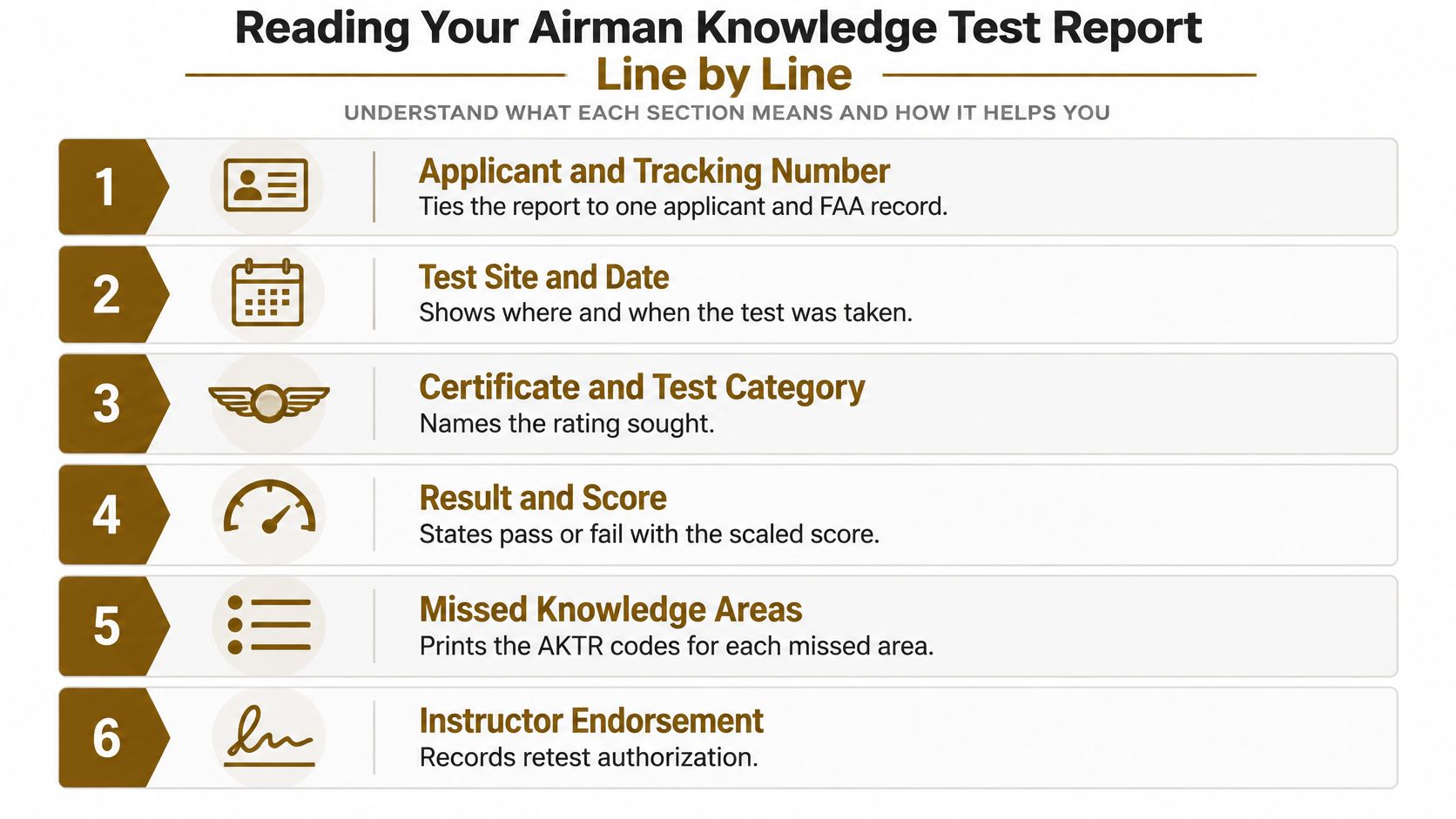
Check what each field actually establishes
Identifying information. Confirm that the report belongs to you and matches your FAA record. Correct identification doesn't establish that you selected the intended examination, so continue to the exam information.
Exam type and date. Check the exact examination and when you took it. These details provide the context for interpreting your codes, but the examination's name alone doesn't identify the document revision used for decoding.
Testing site. Verify where you completed the test. This is administrative information, not evidence that a particular topic needs more study.
Score. Read it as an overall performance result. It doesn't explain whether your errors clustered around one concept or were spread across unrelated subjects.
Pass or fail status. This tells you the examination outcome. Passing doesn't mean every topic is mastered, and failing doesn't mean you need to restart every subject from the beginning.
Attempt number. Keep it attached to the report. When you compare reports, a recurring code deserves investigation because the associated gap may remain unresolved, although the code alone won't explain why.
Missed-area codes. These identify the reported deficiencies. They don't reproduce the original questions, reveal your selected answers, or necessarily show how many questions you missed within each area.
Separate report feedback from study decisions
If no deficiency codes appear, the report flags no missed areas through that coding system. Don't manufacture deficiencies from an empty list, and don't treat the absence of codes as proof of proficiency beyond what the examination assessed.
A PTS-based report may look different from an ACS-based report. Compare their decoded subject descriptions rather than assuming a change in format means your performance changed.
Keep administrative preparation separate from content review. The FAA written exam guide provides broader exam context, while your AKTR supplies the feedback specific to your attempt.
Before leaving the report, copy every code, the attempt number, the test date, and the test type into your study log. Save the original report too, so a transcription error doesn't become a study assignment.
Choosing the Right Code Document and Avoiding Misreadings
Start with the test code, which names the examination, rather than the deficiency code, which identifies the reported missed area. That examination identity determines which reporting system and reference documents you should expect.
The FAA's October 2026 testing advisory gives a reporting-system snapshot in which 33 of 91 available airman knowledge tests display ACS codes, leaving 58 using the older or otherwise different reporting structure. Those counts describe that advisory's inventory, not a permanent rule for every later examination offering.
The practical lesson isn't to memorize the split. It's to stop assuming that an ACS lookup works for every airman examination.
Which document resolves each reporting type
| Reporting situation | Code to resolve | Document to use | Tests affected |
|---|---|---|---|
| Test displays ACS codes | ACS code such as CA.I.A.K1 | Applicable FAA ACS for the certificate or rating, with revision checked | ACS-reporting examinations in the advisory inventory |
| Test uses LSC or PLT codes | LSC or PLT code | Applicable Learning Statement Reference Guide; effective PTS for certification context | Older or differently structured examinations in the advisory inventory |
| Code taken from another certificate | Any | Don't transfer its meaning without verification; use the report's own certificate and date | Not applicable |
An ACS document can help you understand a certification subject even when you're reviewing an older report. That doesn't make it the correct decoder for the older code.
Likewise, the presence of a PTS doesn't mean you should search that document for a PLT number and stop if it isn't there. Use the learning-statement reference to resolve the code, then use the appropriate standards and instructional references to plan the review.
Perform the document identity check
Before accepting a lookup result, match these fields:
- Test code. Confirm the exact examination, not just a broad label such as private pilot or instrument.
- Certificate or rating. Check that the document covers the qualification and category relevant to your report.
- Report date. Establish which reporting structure and standards revision applied when you tested.
- Applicable FAA standard. Record the document title and revision you used, rather than saving only a search-result description.
If you're studying today from a newer standard, keep the distinction clear: one document may explain the historical report, while the current document governs your present preparation. Ask your instructor to reconcile a changed element rather than substituting a new description.
Correct the common misreadings
A code isn't a generic topic label. A description such as navigation is useful for organizing study time, but it may omit the specific concept identified by the official element. Read the complete element before deciding what material to review.
Another certificate's list isn't automatically transferable. Similar-looking strings can sit within different standards. Even when subject matter overlaps, the required scope and task context may differ.
An online decoder may contain an older revision. A polished interface doesn't establish document currency. Look for the supported certificate, source revision, and complete element description; if those aren't available, verify the result directly.
Reports from different attempts may require different references. If the examination changed reporting systems between attempts, decode each report using its own context. Compare the resulting subjects, not just the strings.
A lookup is complete only when you can show which official document supplied the meaning.
For a saved spreadsheet or app export, include the source revision beside the description. That small addition makes it possible to distinguish a genuine learning gap from a mapping error when the standards change.
Anatomy of an ACS Code, Segment by Segment
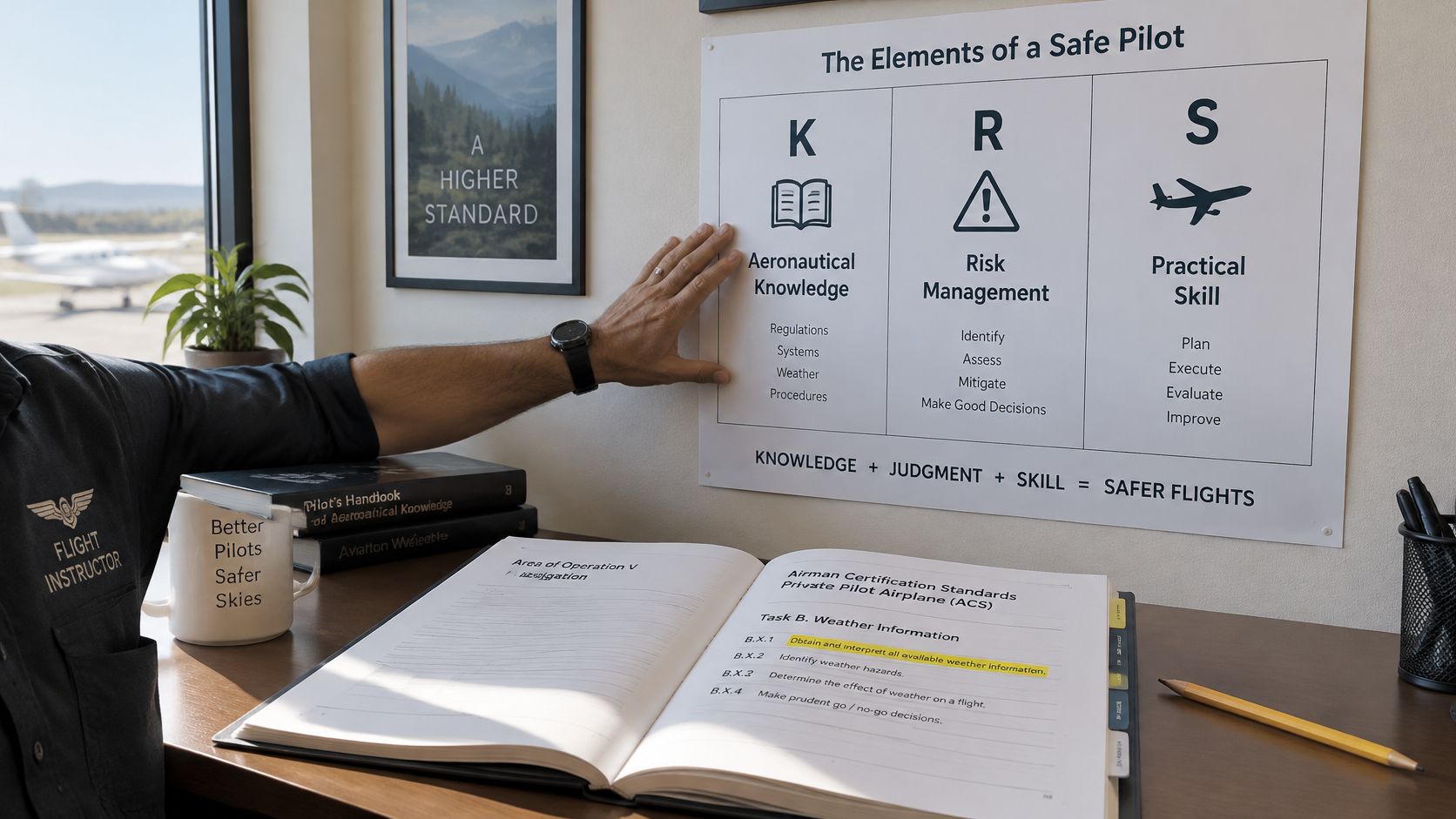
An Airman Certification Standards code is an address within a certification standard. The FAA's advisory circular on knowledge-test guidance describes its four-part structure and the ACS framework connecting aeronautical knowledge, risk management, and practical skill.
The instructional distinction is useful: knowing a rule, deciding how to apply it, and performing a task are related, but they aren't the same demonstration of competence.
Use the illustration as a reminder to consider all of those dimensions during training.
Segments of the ACS code CA.I.A.K1
| Segment | Example in CA.I.A.K1 | What it tells you |
|---|---|---|
| Certificate or rating prefix | CA | Commercial airplane; match it to your own test |
| Area | I | Area heading in the applicable ACS for that certificate |
| Task | A | Task letter under that area |
| Element | K1 | Standard element; K = knowledge, R = risk management, S = skill |
Read from left to right. CA establishes the certificate context, I directs you to an area, and A narrows the location to a task within that area. Only then should you read K1 as the individual knowledge element.
Don't search only for K1. That ending isn't enough to identify a subject because you've discarded the location that gives it meaning.
Let the element type guide the review
For a K element, concentrate on explanation and application. You should be able to state the concept, identify its governing reference, and work through an unfamiliar example without relying on memorized answer wording.
For an R element, practice decisions. Ask what creates the hazard, what information you need, and which action reduces the risk.
For an S element, involve your instructor in the appropriate practical demonstration. Reading about a maneuver or procedure doesn't establish that you can perform it, and the presence of skill elements in the ACS doesn't mean every knowledge-test report evaluates those skills directly.
The video offers an additional format for reviewing the code structure.
Codes that share an area but identify different tasks can require different references and exercises. Don't merge them merely because the area heading matches.
Finally, treat the code as a precise identifier within its document context, not as a guarantee that every future revision preserves the same wording or numbering. Confirm the element text and source revision before building a study assignment around it.
Decoding LSC and PLT Codes on Older Reports
An older-style code needs an older-style lookup path. Learning Statement Codes identify tested subject matter and associated reference material, rather than using the ACS address structure.
For a pilot code such as PLT044, don't infer the subject from the digits. The example establishes the format, not the meaning of that particular entry. Until you've located its official description in the applicable reference, record the meaning as unknown.
Work through the lookup without guessing
Confirm the examination. Copy the report's test code and certificate or rating into your working notes. Don't start from a code copied into a message without its report context.
Check the standards context. Establish whether a PTS remained effective for that examination at the report date. Preserve the document identification rather than assuming the standards currently used also governed the older attempt.
Open the applicable code guide. Look up the complete LSC or PLT code in the Learning Statement Reference Guide or other designated FAA code reference. Use the PTS for relevant practical-test context, not as an assumed substitute for the code guide.
Record the subject and reference. Copy the official description, then note the publication or reference section identified for review. If the guide doesn't provide a sufficiently specific location, mark that detail unresolved.
Attach the result to the attempt. Save the decoded subject with the report date and attempt information so you can compare it with later feedback.
Keep unresolved entries visible
Say you find PLT044 in an unofficial list, but the list doesn't identify its FAA source or revision. Keep the description as a tentative note, not a completed decode.
Your instructor can help verify the reference and choose the correct study material. Don't clear the entry because the unofficial description sounds plausible.
Do not invent a crosswalk. A PLT subject description and an ACS element may overlap, but that doesn't establish a direct equivalence.
If your next report uses ACS codes, retain both original records. You can compare their verified subject matter without pretending the reporting systems use interchangeable identifiers.
Turning Missed Codes into a Remediation Log
A remediation log should show what you did about each reported deficiency, not merely that you copied the codes. Build evidence your instructor can review before a retest or any applicable endorsement.
The FAA's ACS frequently asked questions connects coded feedback with the applicable standard, supporting targeted review of the identified element rather than undirected repetition of an entire subject.
The process graphic provides a useful overview. For non-ACS reports, substitute the applicable learning-statement reference at the decoding stage; the log itself doesn't provide retest authorization.
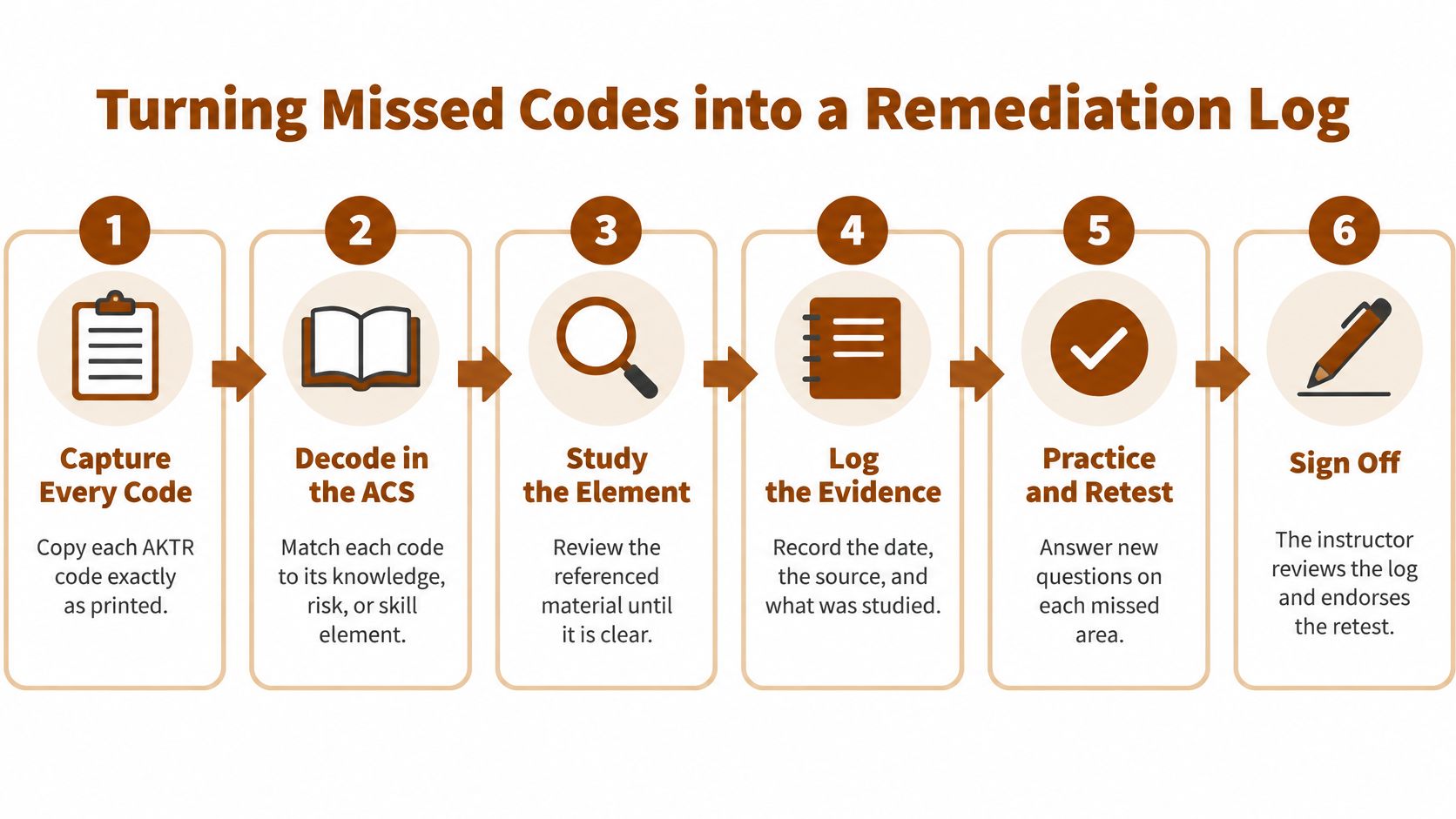
Build an evidence trail
Capture every code from the AKTR with its attempt number and test date. Preserve the exact text. Include the test identity and keep a copy of the report beside the log.
Resolve each code against the applicable FAA ACS or Learning Statement Reference Guide. Record the full element or subject description and the reference revision. When historical decoding and current preparation require different revisions, identify both.
Open the referenced regulation or publication. Use the source named by the standard or guide, then record the chapter or section reviewed. The Pilot's Handbook of Aeronautical Knowledge and relevant operating or certification regulations are possible references, not automatic assignments for every code.
Record remediation evidence. Enter the study date, source reviewed, explanation practiced, and result from a fresh practice set. Note whether an error came from misunderstanding, calculation, chart reading, or misreading the question.
Clear an entry only after confirming the learning, then share the log with your instructor. Use fresh questions and explain your reasoning. A familiar answer choice isn't sufficient evidence that you understand the underlying concept.
A worked entry you can adapt
Consider a hypothetical student whose report includes CA.I.A.K1. The entry below shows a recording format, not a claimed definition of that element or an FAA-required practice quantity.
| Log field | Hypothetical entry |
|---|---|
| Exact code | CA.I.A.K1 |
| Attempt | Initial attempt, copied from the report |
| Resolved description | Full element text copied from the applicable commercial airplane ACS |
| Source revision | Document title and revision used for the lookup |
| Material reviewed | The regulation or publication identified during the verified review, with exact section recorded |
| Study evidence | Explanation of the element and a worked application example |
| Practice evidence | All questions correct on a fresh targeted set, with reasoning reviewed |
| Status | Ready for instructor review |
Don't invent a regulation citation to make the row look complete. If the reference hasn't been verified, leave that field unresolved and finish the lookup.
A recurring code should remain open until a separate practice result demonstrates improvement. Keep the earlier result rather than overwriting it, so your instructor can see whether your understanding improved or you repeated the same exercise.
The finished log should preserve the exact code, its verified meaning, the source revision, and the evidence of learning. That record makes your preparation reviewable instead of relying on a general feeling that you've studied enough.
Targeting Study by ACS Topic Area
Group verified deficiencies into study blocks, then rank those blocks by recurrence and demonstrated difficulty. Start with subjects that keep appearing across attempts, rather than the subjects you enjoy reviewing.
Use test weighting only when you have an applicable official basis for it. A list of missed codes doesn't establish how heavily each topic is represented, and the number of codes in a cluster isn't necessarily the number of questions missed.
Missed-code clusters mapped to study topics
These are practical study groupings, not substitute code definitions. The exact element and its listed references should control the assignment.
| Missed-code cluster | Study topic | Primary reference |
|---|---|---|
| Airspace and charts | Airspace classes and sectional charts | Pilot's Handbook of Aeronautical Knowledge; Aeronautical Information Manual |
| Weather theory, METARs and TAFs | Weather theory and weather reports | Pilot's Handbook of Aeronautical Knowledge; Aeronautical Information Manual |
| Regulations | Operating rules and certificate requirements | Applicable sections of the certification and operating regulations |
| Performance and weight and balance | Takeoff, climb, and loading | Pilot Operating Handbook of the training aircraft |
| Navigation and IFR procedures | Navigation, clearances, and approach plates | Pilot's Handbook of Aeronautical Knowledge; Instrument Procedures Handbook |
| Human factors and emergencies | Risk management, decision-making, and emergencies | Pilot's Handbook of Aeronautical Knowledge; Aeronautical Information Manual |
Within a cluster, keep the individual elements visible. A correct answer about airspace entry requirements doesn't necessarily resolve a separate deficiency in chart interpretation.
For private-pilot preparation, use the Private Pilot ACS guide to connect the broader study organization with the standard's areas and tasks. Continue recording results at the element level so a strong subject average doesn't hide a narrow gap.
Match practice to the actual examination
The FAA Airman Knowledge Testing Matrix identifies examination-specific requirements, including question count, minimum age, allotted time, reporting type, and a 70 percent passing score for the examinations described. Question counts and time limits differ, so use the entry for your exact test rather than borrowing another applicant's pacing plan.
Separate targeted learning from exam simulation. During targeted learning, pause to consult references and explain mistakes; during simulation, use the applicable examination length and time allowance without stopping the clock.
Suppose a student has recurring airspace and performance deficiencies. Start with an airspace review using actual chart examples, then assign fresh interpretation questions; follow with performance calculations using the aircraft handbook and different loading conditions.
After those targeted exercises, use a full-length timed practice examination to check whether the student can apply the material under exam constraints. A short performance-only drill can test calculation speed, but it doesn't reproduce the content distribution of the full examination.
Track readiness on separate lines: understanding by element and completion within the examination's time allowance.
Treat a cluster as complete only when fresh practice supports clearing its individual codes and timed work confirms usable pacing. If the student answers correctly only with unlimited reference checks, keep the cluster active for further practice.
Retest Decision Rule
Retest when every code on the latest AKTR has a verified meaning, recurring deficiencies have cleared in fresh timed practice, and passing performance holds across separate sessions. Use that as a preparation rule, not as a substitute for FAA eligibility requirements or your instructor's endorsement judgment.
A useful personal standard is to require passing results in separate sessions rather than relying on a single strong attempt. The point is consistency: you should be able to reproduce the result without remembering the previous question order.
Confirm the records before booking
Every code has a completed log entry. Check that each entry includes its official meaning, reviewed reference, and evidence of improvement. An unexplained code is still an unfinished assignment, even if your overall practice score is strong.
Practice performance holds across sessions. Review both the overall result and the targeted results for recurring deficiencies. Don't let strong performance in familiar subjects conceal the same unresolved element.
Your instructor has reviewed the work before any required endorsement. Bring the AKTR, remediation log, and practice results together. The log supports the instructor's assessment; it doesn't authorize the retest by itself.
Make the scheduling decision from evidence
Use the readiness review as a final preparation check, not a reason to postpone decoding unresolved feedback. If the evidence is incomplete, assign a specific review task and another practice check instead of scheduling on confidence alone.
At flyCowboys, we offer a rating-based placement quiz and personalized weak-area study plan, plus a question bank covering every topic on the FAA Private Pilot Knowledge Test; topic practice can support your code-based assignments. Our app doesn't replace certified flight instruction, required instructor endorsements, official FAA publications, approved training programs, FAA tests, or aircraft manuals.
Before deciding, use the code-families table to confirm what you're reading, the document-matching table to verify your reference, and the topic-mapping table to organize any remaining work. Book when the evidence is complete and your instructor confirms the applicable requirements are satisfied.
Bring your AKTR codes and verified topic descriptions to your next study session. Visit flyCowboys to take a rating-based placement quiz and build a personalized study plan around weak areas, then use targeted practice alongside your instructor-reviewed remediation log.