· 15 min read
FAA Instrument Rating Knowledge Test Study Plan
Pass the FAA instrument rating knowledge test with a focused study plan, ACS mapping, practice test tips, and clear readiness checkpoints for IRA exam day.

You're sitting in a quiet PSI room, headset off, scratch paper blank, watching the clock eat questions you thought you knew at home. That's the moment most instrument students discover the FAA Instrument Rating Knowledge Test isn't a harder Private Pilot written. It's a different kind of test. This plan treats it that way, tying every study block to a cockpit job you'll do: briefing a plate, choosing an alternate, or copying an amended clearance.
Table of Contents
- Why the IRA Exam Trips Up Otherwise Good Pilots
- Mapping the Six ACS Knowledge Areas You Will Be Tested On
- Your 23-Day Study Schedule Built Around the ACS
- Choosing the Right Prep Tool for Your Learning Style
- Running Realistic Practice Tests and Reading the Results
- Readiness Checkpoints Before You Schedule the Exam
- Exam Day Logistics and What Comes After You Pass
Why the IRA Exam Trips Up Otherwise Good Pilots
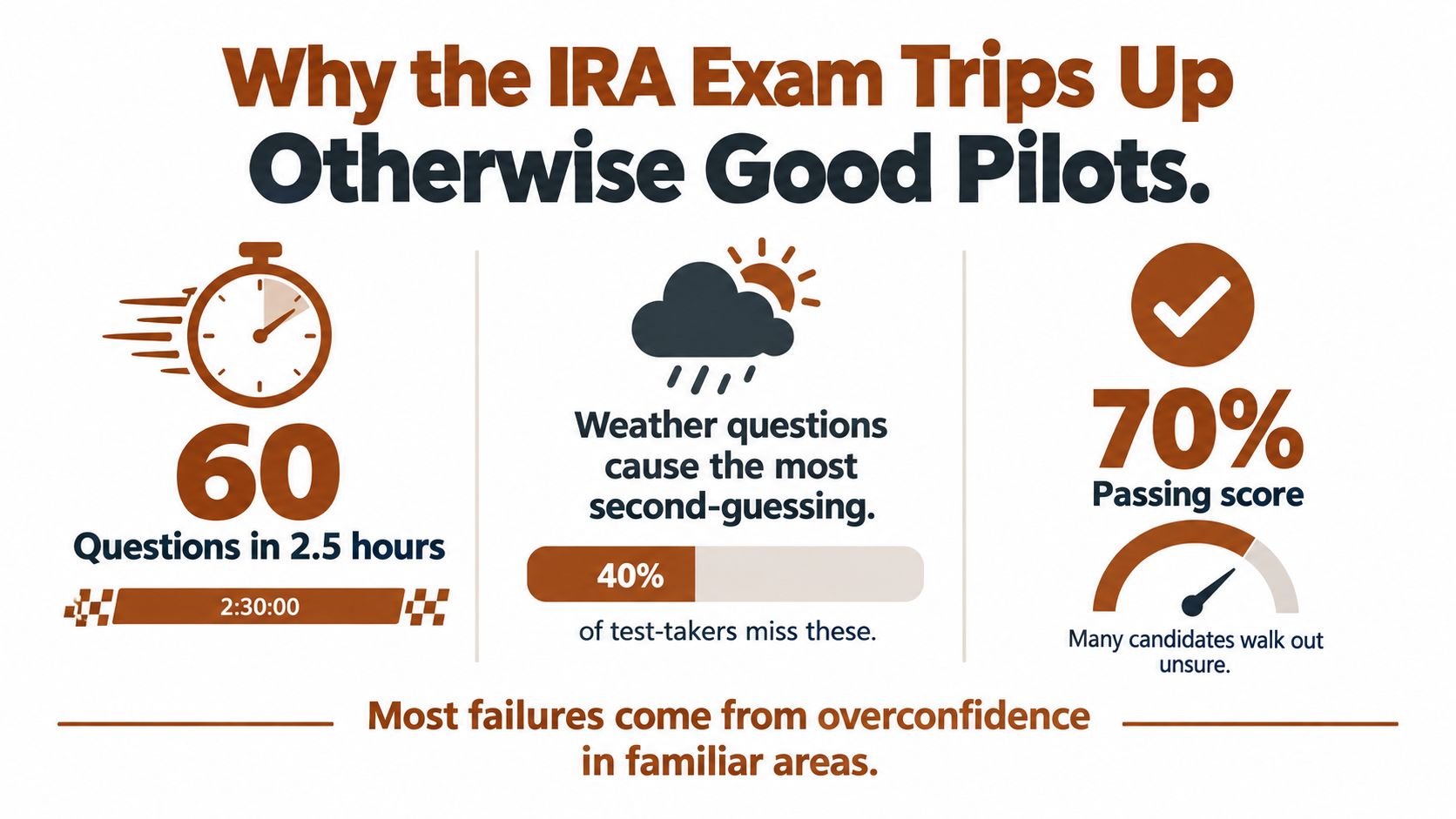
Good stick skills don't protect you here. The FAA Instrument Rating Knowledge Test, test code IRA, presents 60 questions with a 2-hour limit and a 70 percent minimum passing score, as listed in the FAA testing matrix for the IRA exam. That works out to roughly two minutes per question if you average it, and you won't average it. A regulation recall takes seconds. A holding entry, a low-altitude enroute chart, or a TAF time window takes real work.
That's why solid Private Pilots stumble. They prep for recognition. The IRA rewards interpretation. You have to read a chart excerpt cold, apply a regulatory distinction that sounds almost identical to another one, and pick the FAA-standard answer over the answer that merely sounds operationally reasonable.
Passing Is Not the Same as Being Ready
A passing score proves you cleared a floor on one day. It doesn't prove you can transfer that knowledge to a clearance, a plate briefing, or an alternate decision when the weather briefing contradicts your plan. FAA reporting shows 27,143 Instrument Rating Airplane tests in 2025 with a 94.38% pass rate and an 86.15% average score, according to the FAA CY2025 airman knowledge testing volume report. High pass rates hide weak understanding if you only chase a number.
If you can recognize the right answer but can't explain what you'd do differently in the airplane, you haven't learned the item yet.
Every recommendation in this plan maps back to FAA-S-ACS-8C, the current Instrument Rating, Airplane Airman Certification Standards, effective May 31, 2024. Study by ACS task, not by random question volume. You'll also need screen-native chart skill going forward, because the interface is moving toward embedded imagery instead of a memorized supplement figure. Prep for the test you'll sit for, and for the flying right after it.
Mapping the Six ACS Knowledge Areas You Will Be Tested On
Stop organizing your notes by chapter in someone's textbook. The FAA organizes this rating by ACS knowledge areas, and your studying should match that structure so you can spot a hole before PSI does.
Regulations and ATC Procedures
Regulations questions test close distinctions, recency, equipment, clearances, and what a rule requires versus what a controller can approve. ATC and procedures questions put you inside the system, copying clearances, understanding departure and arrival procedures, and knowing what to do when instructions change. In the cockpit, this is the difference between reading back words and understanding the route, altitude, and restriction you just accepted.
Candidates often memorize a phrase without the condition attached to it. When the stem changes one condition, the memorized answer collapses.
Navigation and Weather
IFR navigation covers navigation systems, enroute charts, holds, and approach construction. Expect multi-step items where you identify a fix, an altitude, a course, and then an entry or procedure. Brief every practice plate out loud, minimums, missed approach, step-down fixes, and required equipment, because that's the operational task hiding inside the question.
Weather reports and forecasts punish sloppy reading. METAR and TAF questions hinge on valid times, prevailing conditions, and forecast change groups. The cockpit link is direct, you're deciding whether a destination works, whether an alternate is legally and practically usable, and whether waiting changes anything.
Operations, Decision-Making, and CRM
Safe and efficient IFR operations connects systems, performance, icing, and procedural discipline to real risk. Aeronautical decision-making and crew resource management sounds soft until a question asks you to prioritize tasks while workload spikes on an approach. The FAA frames the test around these knowledge areas in the Instrument Rating Airplane ACS change document, and that framing should drive your error tracking.
ACS Knowledge Areas and Their Common Failure Modes
| ACS Area | Question Style | Typical Mistake |
|---|---|---|
| Regulations | Rule distinctions and eligibility | Choosing a plausible rule that applies to a different operation |
| ATC and Procedures | Clearances, departures, arrivals | Accepting words without checking route or altitude logic |
| IFR Navigation | Charts, holds, approaches | Correct fix, wrong minimum altitude or entry |
| Weather | METAR, TAF, charts, alternate logic | Ignoring valid time or a temporary condition |
| Safe IFR Operations | Systems, icing, efficiency scenarios | Treating a limitation as a suggestion |
| ADM and CRM | Workload and risk decisions | Fixating on one task and losing prioritization |
Your 23-Day Study Schedule Built Around the ACS
You don't need marathon sessions. You need daily contact, heavy topics early, and proof at the end. This 23-day structure assumes short focused weekday work and one longer weekend session, which fits pilots juggling jobs and flight lessons far better than a heroic weekend cram.
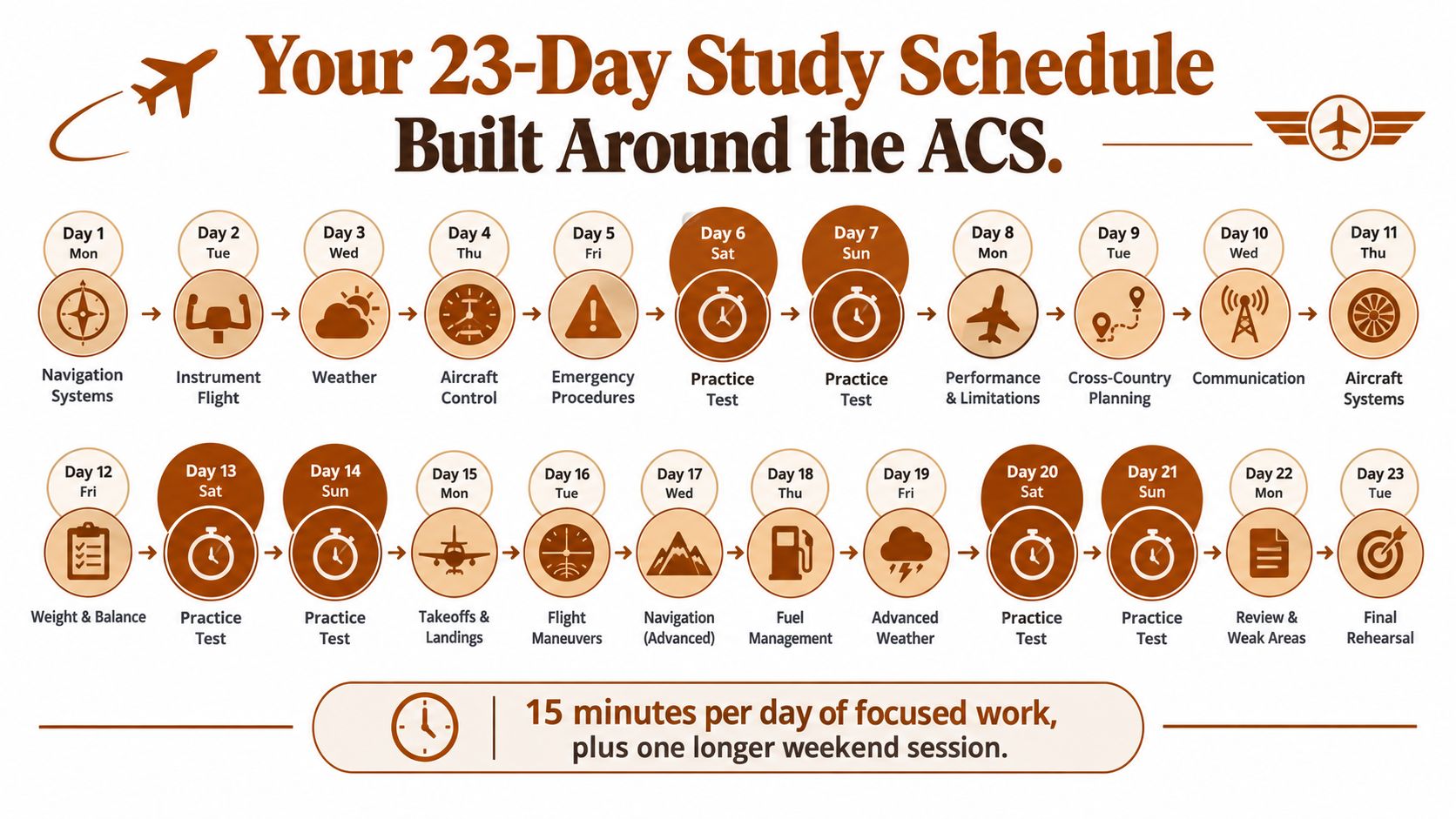
Days 1 to 7 Build the Heavy Foundation
Start where the test creates the most friction.
- Day 1, Navigation systems: End by explaining how each system gives you course guidance and what failure looks like.
- Day 2, Enroute charts: Pull altitudes, fixes, and route information from unfamiliar excerpts without hunting for a familiar figure.
- Day 3, Weather products: Read METARs and TAFs aloud, translating every group into plain language.
- Day 4, Regulations: Write the condition that makes each rule apply, not just the rule itself.
- Day 5, Approach plates: Brief plates cold, top to bottom, missed approach included.
- Weekend, Cumulative quiz: Mix all five areas so you catch early decay while it's cheap to fix.
Don't move on because the calendar says so. Move on when you can teach the day's idea without looking.
Days 8 to 18 Rotate, Retrieve, Repair
Each morning, redo yesterday's misses before touching new material. That's your spaced repetition, and it matters more than adding fresh questions. Rotate through holds, alternate decisions, ATC procedures, icing and systems, and ADM scenarios, but keep returning to weather and plates every few days because those skills fade fastest when they're only read, not used.
Daily success signal: You should finish each session able to state the governing rule, chart reference, or calculation in one sentence.
Use the second weekend for a timed mixed set, then spend the following weekdays only on categories you missed. If a topic keeps producing different mistakes, stop drilling questions and reread the source material. Volume won't repair a broken mental model.
Days 19 to 23 Prove It Under Time
Reserve the final block for full simulations and error-log review. No new textbook chapters. Sit, score, dissect, retest the weak areas, and repeat. By day 23 you want boring consistency, not one lucky high score. Boring is what survives a strange stem at PSI.
Choosing the Right Prep Tool for Your Learning Style
Pick a tool for the weakness you actually have. Most candidates buy for comfort, then discover comfort doesn't diagnose anything.
The image below shows the usual mix candidates juggle, classroom notes, a laptop course, and phone-based practice.

Ground School and Video Courses
In-person ground school gives you accountability and a human who notices when you're nodding without understanding. It costs you schedule flexibility, and a class pace may not match your weak areas. Choose it if you know you won't study alone.
Video ground school lets you pause, rewind, and move at your speed. It's strong for first exposure to difficult ideas like holds and approach categories. Its blind spot is diagnosis. Watching a clear lecture feels like mastery until a timed question asks you to produce the answer without the instructor's voice guiding you.
Question Banks Versus Adaptive Practice
A static question bank gives you volume and familiarity with FAA wording. Used badly, it trains figure recognition and letter memory. Used well, with every explanation read and every miss logged by ACS area, it's useful raw material. A comparison of prep formats and tradeoffs is laid out in this guide to FAA written test prep options, which is worth reading before you pay for overlapping tools.
An adaptive app such as flyCowboys takes a different approach, combining ACS-mapped question practice, spaced repetition on weak topics, PSI-style mock exams, and "Talk to Tower" radio practice in one subscription. That consolidation matters if your problem isn't access to questions, it's knowing which questions you need next and whether you're ready to schedule. It won't replace reading a chart carefully, and no tool will.
Watch the walkthrough below with a specific question in mind, does this format force retrieval, or does it just present information?
My blunt recommendation is simple. Use one source to learn, one system to retrieve and diagnose, and full timed exams to prove it. Buying three question banks is not a strategy. It's procrastination with receipts.
Running Realistic Practice Tests and Reading the Results
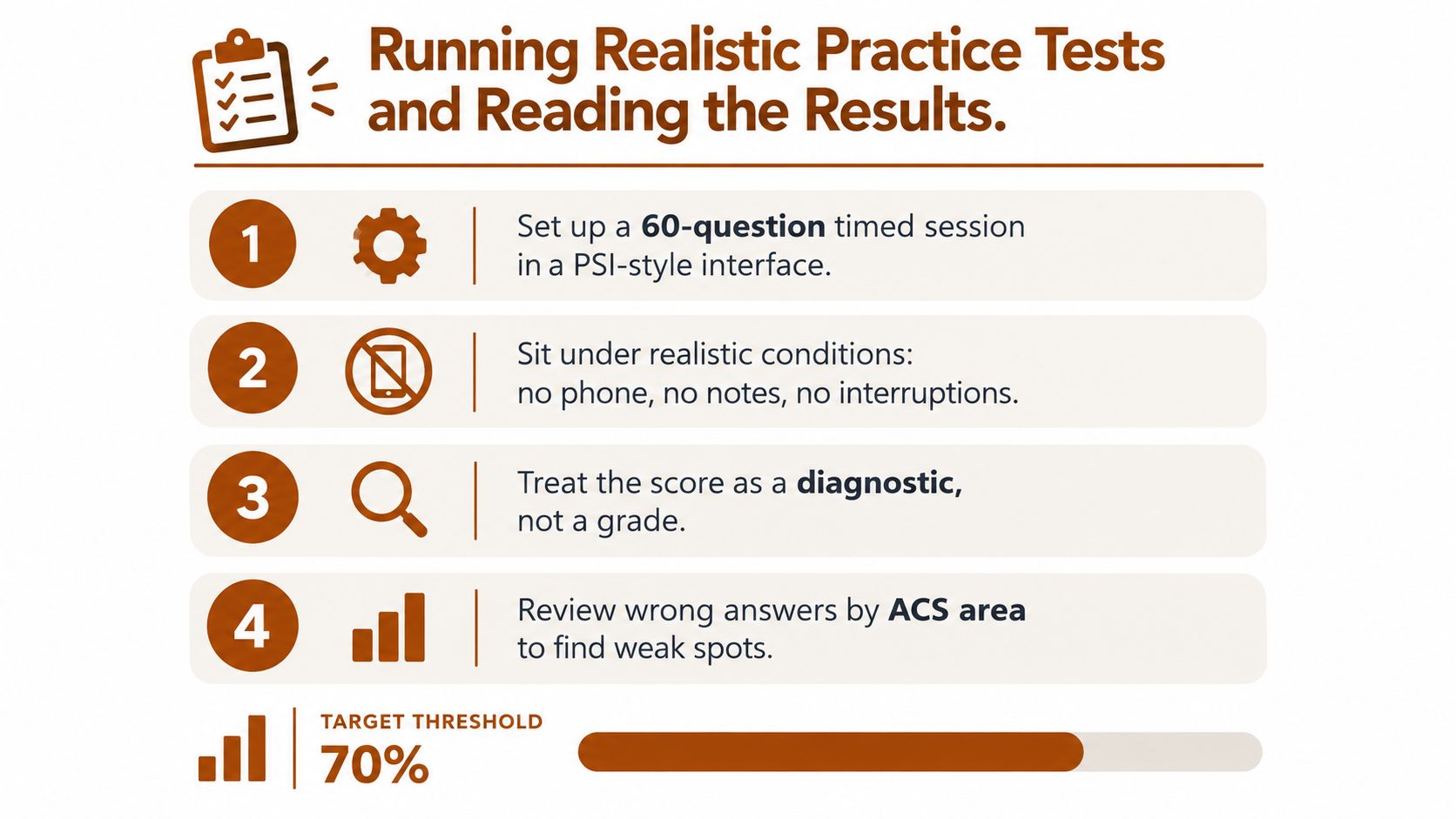
A practice test is a diagnostic, not a verdict and not entertainment. Run it like the actual event or don't trust the score.
Set the Conditions
Build a 60-question timed session, sit in one block, phone in another room, no notes, no pausing to look something up mid-test. Flag calculation-heavy navigation, holding, and plate questions, answer the fast knowledge items, then return with the time you banked. That pacing habit is a skill, and test day is a bad place to learn it.
When you finish, score it twice. First pass, raw result. Second pass, performance by ACS area. A strong overall score can hide a dangerous pocket, for example solid regulations covering repeated weather misses. That second pass is where the value lives, a point reinforced throughout this FAA knowledge test prep guidance.
Build an Error Log That Teaches
For every miss, and every lucky guess, record four things.
- Prompt type: Name the task, such as TAF valid period or holding entry.
- Mistaken assumption: Write what you believed that made the wrong answer attractive.
- Applicable source: Identify the rule, chart element, or procedure that governs it.
- Corrected procedure: State what you'll check first next time.
Don't log the correct letter. Log the thinking error. Letters change. Thinking errors repeat.
Watch for specific patterns. Misreading METAR and TAF time windows is common. So is picking the operationally plausible answer that isn't the FAA-standard response, and confusing related terms that differ by one condition. FAA statistics for 2023 list 23,363 Instrument Rating, Airplane tests with a 94.44% pass rate and an 85.84% average score in the FAA 2023 annual test statistics report. Use population data as context, not comfort. Your error log is the only data that predicts your result.
Turn each log entry into a spaced-repetition prompt. Review it the next day, then again after a gap. Stop taking full tests when repetition starts masking weak concepts with familiarity, and go repair the concept instead.
Readiness Checkpoints Before You Schedule the Exam
Seventy percent is a regulatory floor, not a readiness signal. Schedule only when you clear three tougher checkpoints.
Checkpoint One, Margin With No Soft Area
Require repeated timed scores in the 85–90% range, with no single ACS area collapsing underneath a good total. That margin protects you against unfamiliar wording and one bad chart. Historical FAA data show the average score sits well above the minimum, and the 2024 report lists 25,647 tests, a 94.24 percent pass rate, and an 85.64 percent average score in FAA annual testing statistics. If you're hovering near the floor in practice, you're volunteering for a coin flip.
Checkpoint Two, Explanation Quality
For any missed or guessed item, explain the underlying rule, calculation, or chart interpretation out loud without looking at the answer choices. If your explanation is "I've seen this one before," you're not ready. That answer won't help when ATC amends your route or the plate in front of you isn't the one from your question bank.
Checkpoint Three, Screen-Native Chart Skill
Beginning October 26, 2026, Instrument Rating Airplane tests will include image-based questions using current chart imagery that may not appear in printed test supplements, while content remains aligned to applicable ACS codes, according to the FAA September 2026 special edition testing notice. You don't mainly need new material. You need a new retrieval habit. Practice zooming in, finding symbols, checking legends and scale, and extracting altitudes from excerpts you've never seen.
Scheduling rule: Book the exam when a bad day still lands you comfortably above passing, not when a good day barely does.
An external readiness measure can help you sanity-check self-assessment, since students are notoriously generous graders of their own work. But the final call is yours. If one ACS area still surprises you, delay, fix it, and walk in calm.
Exam Day Logistics and What Comes After You Pass
Make test day boring. Pre-register, confirm your appointment details, and arrive with the identification and authorization your situation requires, checked in advance rather than debated at the desk. If you're under 18, verify your ID requirements before you travel. The applicants who lose time almost always lose it on paperwork, not questions.
At the Center
Expect a controlled check-in, secured personal items, and only the materials the center permits at your workstation. Use scratch paper deliberately. Draw the hold. Write the TAF timeline. Note the minimums before you look at the choices. Externalizing the problem frees working memory and stops careless slips.
- Before you leave home: Confirm ID, appointment, and endorsement or authorization requirements.
- During the test: Flag slow items, protect easy points, and return with fresh eyes.
- If you're unsure: Eliminate the answer that violates a rule or chart value first.
Practical sequencing advice for the written and what follows it is covered in this overview of the FAA written exam process.
After the Score Prints
Read your Airman Knowledge Test Report carefully and keep it safe. The coded areas show where you missed questions, and your instructor will care about those areas as training continues toward the practical test. If you score below passing, don't immediately rebook in frustration. Rebuild from the reported weak areas, re-earn your margin in timed practice, then schedule.
A passing result isn't a verdict on you as a pilot. It's a data point saying your knowledge base is ready to be tested in an airplane, on a real approach, with weather moving. That's the point of all this work.
Start your 23 days with ACS-mapped adaptive drills, PSI-style timed mock exams, and a clear readiness signal that tells you when to schedule your FAA Instrument Rating Knowledge Test instead of guessing. You can put the error log, spaced repetition, and "Talk to Tower" radio practice in one place with flyCowboys, then spend your energy learning to brief plates and make alternate decisions like an instrument pilot.