· 14 min read
How Many Questions Are on the Knowledge Test: PPL and IFR
Learn how many questions are on the knowledge test for each FAA rating, including 60 for PPL and IFR, the passing score and how to plan practice.
How many questions are on the FAA knowledge test? According to the FAA testing matrix, the Private Pilot Airplane (PAR) and Instrument Rating Airplane (IRA) knowledge tests each contain 60 questions; confirm the Commercial Pilot Airplane (CAX) count in the same matrix before relying on a commercial-test figure.
But if you know the question count, do you know what you're ready to answer? A student who recognizes familiar practice questions can feel prepared while still struggling to apply the same knowledge to an unfamiliar chart, weather report, or flight scenario.
When students ask how many questions are on the knowledge test, they're usually trying to judge how much studying lies ahead. The raw total works like the length of a runway: it tells you the distance, not whether your airplane is ready to fly it. Readiness depends on how those 60 questions are divided among knowledge areas, and on how closely your practice sessions reproduce the actual exam's format, timing, and mix of topics. A useful planning approach combines the exam's length with its subject coverage, scoring standard, and current testing instructions.
Table of Contents
- Question Counts for Each FAA Knowledge Test
- Passing Score and How Many Correct Answers You Need
- How Questions Are Split Across Knowledge Areas
- Why a Large Question Bank Is Not the Same as the Exam
- How to Plan Practice for a 60-Question Session
- Confirm Readiness Before You Book the Exam
Question Counts for Each FAA Knowledge Test
Which FAA knowledge test are you preparing to take? Start with your test code, not just your certificate name. PAR identifies the Private Pilot Airplane knowledge test, while IRA identifies the Instrument Rating Airplane knowledge test. That code gives you a precise way to match study materials, practice sessions, and booking instructions to your examination.
For PAR, the FAA Private Pilot Airplane Airman Certification Standards lists 60 multiple-choice questions, a 70% passing score, and an allotted testing time of 2.5 hours. The question count establishes the length of a full practice session, but the timing requires a separate check before booking.
FAA knowledge test question counts by certificate
The private and instrument airplane tests have the same question count and passing standard:
| Certificate or Rating | Test Code | Questions | Passing Score |
|---|---|---|---|
| Private Pilot Airplane | PAR | 60 | 70% |
| Instrument Rating Airplane | IRA | 60 | 70% |
Matching totals do not make these examinations interchangeable. Your preparation still needs to cover the knowledge areas for the rating you are seeking.
A test code works like an aircraft identification on a checklist: it helps you select the instructions that apply. A guide labeled “private pilot written” may address a different aircraft category. Check that its subject emphasis, practice format, and timing apply to your examination before using it to organize your study.
For commercial, helicopter, glider, sport, or flight instructor examinations, identify the exact code in the current FAA testing matrix before choosing an exam-length practice format.
Resolve the published timing discrepancy
The published PAR timing figures differ. The Private Pilot ACS allowance stated above is longer than the allowance in the FAA testing matrix. An older handbook or a practice-app timer cannot resolve that difference.
Check the current matrix entry and confirm the appointment instructions with the testing provider. Resolve any disagreement about the allotted time before test day.
Planning rule: Match your preparation to the exact test code, then verify the current administrative details before you reserve an appointment.
Use complete exam-length sessions alongside shorter quizzes. The total measures the session's size; coverage across the applicable knowledge areas makes that session useful. A familiar practice format alone does not establish readiness for the full examination.
Passing Score and How Many Correct Answers You Need
The FAA testing matrix specifies 60 questions and a 70% passing score for PAR. Converted into correct answers, that standard corresponds to 42 correct answers if every question carries equal weight. Think of the percentage as the gauge and the correct-answer count as the fuel mark: one tells you the rule, the other tells you what it looks like on test day.
The arithmetic is simple. Multiply the question total by the passing proportion to find the minimum correct-answer count. Subtract that result from the total to find the maximum misses under the same equal-weight assumption.
Work through the scoring arithmetic
| Hypothetical practice result | Calculation | Meaning |
|---|---|---|
| Minimum passing result | 60 × 0.70 = 42 correct | Meets the threshold under equal weighting |
| Maximum misses at that threshold | 60 − 42 = 18 missed | Leaves no additional margin |
| Student answers 50 correctly | 50 − 42 = 8 | An 8-question margin above the threshold |
| Student answers 40 correctly | 42 − 40 = 2 | Falls 2 questions short |
These are worked practice examples, not promises about the result of a particular official test session. They show the difference between scraping across the line and having room for a misread chart, a missed qualifier, or a weak topic.
The same method applies to an instrument practice test using the question count and passing standard in the Instrument Rating ACS. The key preparation question is whether you can repeat that performance with unfamiliar questions, not whether you can do the multiplication.
Keep scoring assumptions separate from your study target. A testing screen may show items that are not scored in the same way, so use the provider's current instructions instead of borrowing rules from another licensing examination.
A legal passing standard is still a floor. A result just above it leaves little margin, like landing with only enough runway and no reserve. Aim for a repeatable cushion, explain why each answer works, and complete full sessions without relying on familiar wording or answer order.
How Questions Are Split Across Knowledge Areas
The exam samples different kinds of knowledge, not a single undifferentiated subject. That's why an overall practice percentage can hide an important weakness: strong performance in regulations may obscure poor performance interpreting weather or choosing an IFR procedure.
The FAA Instrument Rating Airman Certification Standards specifies 60 questions, a 70% passing score, and the knowledge-area percentage ranges shown below. The approximate question counts are calculated by applying those published ranges to the exam total.
IRA question ranges by knowledge area
| Knowledge Area | FAA Range | Approximate Questions of 60 |
|---|---|---|
| Regulations | 5–15% | 3–9 |
| IFR en-route or approach procedures | 5–15% | 3–9 |
| Air traffic control procedures | 5–20% | 3–12 |
| IFR navigation | 5–20% | 3–12 |
| Weather reports, forecasts, and critical weather, including windshear | 10–20% | 6–12 |
| Safe and efficient operations, aeronautical decision-making, and crew resource management | 5–10% for each listed area | 3–6 for each listed area |
The last row groups related areas for readability. It doesn't mean they share a single combined allocation.
These ranges are not a fixed question-by-question itinerary. You shouldn't add all the upper endpoints together and expect that total to describe an examination. Instead, use the ranges to understand why equal-length test forms can present different topic mixes.
Turn topic ranges into a study decision
Suppose you're comfortable with regulations but hesitate whenever a practice question asks you to interpret an approach plate. Repeating regulation quizzes may improve your overall average without fixing the skill that needs attention.
A more useful review asks what went wrong. Did you misidentify a fix, confuse a published restriction, or fail to connect the chart with the clearance? Those are different problems and require different practice.
Record results with enough detail to guide the next session:
- Knowledge area: Identify whether the miss concerned weather, navigation, procedures, or another ACS domain.
- Task involved: Note whether you needed recall, chart interpretation, a calculation, or a decision.
- Reason for the miss: Separate a knowledge gap from a reading error or an unsupported guess.
If you're unsure which examination applies to your training path, use the FAA knowledge test code guide to distinguish the codes before choosing study material.
Track performance by knowledge area, not only by overall score. Your study plan should respond to what you can't yet explain or apply, rather than just rewarding the topics you already enjoy practicing.
Why a Large Question Bank Is Not the Same as the Exam
A large practice bank is useful, but its size doesn't prove that you're ready. You can work through many questions and still rely on visual recognition: the familiar diagram, the familiar sentence, or the answer that was correct last time.
Use question practice as a way to test understanding, not as a contest to finish the largest collection.

The FAA testing advisory signals broader question coverage, efforts to avoid multiple questions from the same subject area, and fewer lookup-and-explain items in favor of practical application. That direction supports preparing to use aviation knowledge, rather than expecting a practice bank to reproduce your particular examination.
Recognizing an answer versus applying a rule
Consider a student who has memorized answers to airspace questions. When the diagram and wording look familiar, the student selects the expected answer quickly.
Now change the task. Give the student a proposed route, a weather report, and an airspace boundary, then ask whether the planned operation is appropriate. The student must connect the information instead of retrieving an isolated answer.
That's the distinction to test during review:
- Explain the correct choice: State the applicable rule, chart detail, or operating principle without looking at the explanation.
- Reject the alternatives: Explain what makes each distractor wrong under the stated conditions.
- Change the scenario: Ask whether a different altitude, weather condition, or clearance would change the answer.
A useful self-check: If the answer choices disappeared, could you still describe what the pilot should do and why?
Judge the preparation method
When comparing study tools, examine the explanations, topic mapping, and exam-simulation format rather than the advertised question total alone. The FAA test prep app guide can help you assess those features against your study needs.
Practice-bank familiarity and exam readiness aren't interchangeable. A useful simulation tests your ability to interpret unfamiliar wording, manage the allotted time, and make sound choices across the applicable knowledge areas.
How to Plan Practice for a 60-Question Session
Build a routine that alternates diagnosis, focused review, and complete simulations. Short drills help you repair specific weaknesses; full sessions help you evaluate whether those repairs hold when subjects are mixed together.
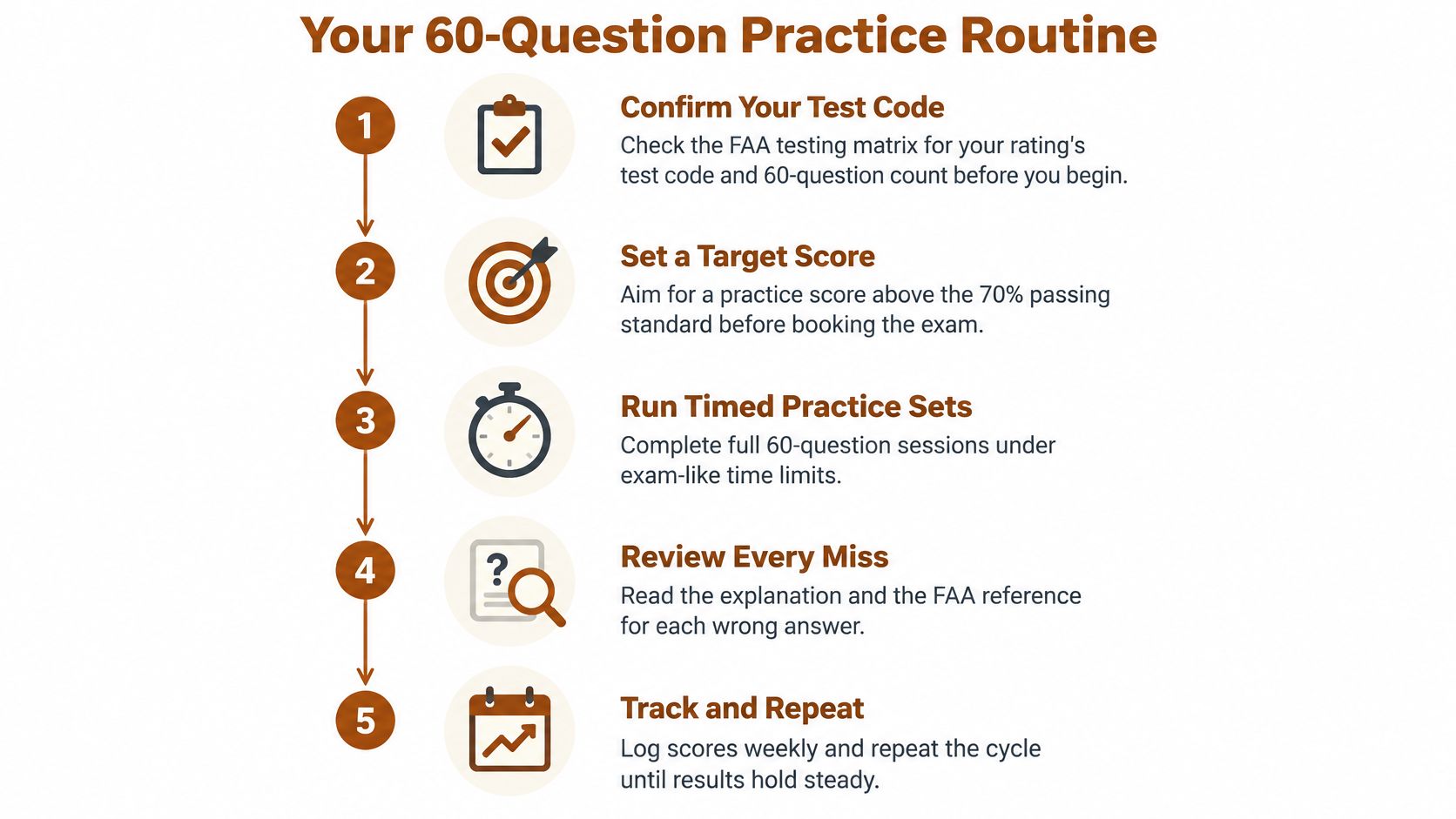
Use this process as a repeatable study cycle rather than a checklist you complete once.
Build your study cycle
Confirm the examination before selecting practice mode. Match the code in your training plan to the current FAA testing matrix, then check the appointment instructions for timing. The common mistake is selecting a generic private-pilot or instrument quiz without confirming which examination it prepares you for.
Choose a practice goal above bare passing. Treat the official threshold as a floor and set a personal goal that leaves room for unfamiliar wording and ordinary mistakes. Don't lower that goal just because a familiar question set produces reassuring results.
Take an honest baseline session. Use the full exam format, the applicable time allowance, and only the references or tools permitted for that session. Don't pause to look up answers, because an assisted result won't tell you where your unaided understanding needs work.
Rank your weaknesses before drilling. Review the missed questions by ACS area and give extra attention to the subjects where your reasoning breaks down. Keep sampling stronger areas too, rather than abandoning them or spending the whole session on favorite topics.
Review the reason, not the answer letter. For a missed weather question, identify the report detail you misunderstood; for a performance problem, trace the chart inputs and units. Then solve a related question without copying the previous solution.
Repeat simulations with fresh combinations. Leave enough time between full sessions to study the underlying material, and compare how you handle different topic mixes. Don't treat an immediate retake of the same questions as independent evidence of readiness.
Shift from expansion to consolidation. When performance is stable and weak areas no longer require guessing, concentrate on maintaining recall, checking procedures, and arriving rested. Avoid an endless search for new question collections, but investigate any unresolved concept before deciding you're finished.
Keep a review log you can act on
A useful log records the topic, your mistaken reasoning, the correct principle, and what you'll practice next. “Missed navigation” is too broad; “used the wrong reference when interpreting the course indication” gives you a specific repair task.
You can also note whether you changed a correct answer without evidence or rushed past a limiting word. Those habits call for a different response than missing subject knowledge.
Use the accompanying video as another study resource, then return to active practice rather than treating viewing time as proof of mastery.
Keep the routine manageable alongside flight training. A focused session with a clear purpose is more useful than repeatedly opening a question bank without deciding what you're trying to improve.
Confirm Readiness Before You Book the Exam
Book when complete practice results stay comfortably above the passing standard and your weaker knowledge areas no longer depend on guesses. A strong result should reflect understanding you can reproduce, not a lucky topic mix or a set of answers you remember.
Before reserving an appointment, explain a selection of recently missed questions aloud to your instructor. If you can identify the governing principle, work through the relevant chart or report, and explain why the alternatives are wrong, you have more meaningful evidence than a score alone.
Make the booking decision deliberately
- Check consistency: Look for stable performance across separate sessions with unfamiliar combinations of questions.
- Check understanding: Review unresolved errors and distinguish knowledge gaps from avoidable reading mistakes.
- Check administration: Confirm the current question count, time allowance, and appointment requirements before booking.
At flyCowboys, we provide a question bank covering every topic on the FAA Private Pilot Knowledge Test. Use our readiness review guide to organize your final preparation and identify anything that still needs attention.
The app doesn't replace certified flight instruction, approved training programs, or official FAA publications. Keep your instructor involved, and don't rely solely on an app for training or test preparation.
At flyCowboys, we offer FAA knowledge-test practice with plain-English explanations and realistic exam simulations. Visit us to build a study routine around your weak knowledge areas and practice applying what you know before booking your written exam.