· 13 min read
Practice Knowledge Test MN: FAA Prep That Works
Use a practice knowledge test MN student pilots trust. The FAA PAR exam is national: 60 questions, 2.5 hours, and 70% to pass.
Practice for a Minnesota-based pilot means the national FAA Private Pilot Airplane knowledge test, not a state driver's quiz: 60 questions, 2.5 hours of testing time, and 70 percent to pass. Those numbers follow you to every testing center in the country, including the PSI sites in Minnesota.
The most popular advice about this topic is to grind free practice questions from whatever page ranks first until the answers start to feel familiar. In Minnesota that advice wastes a week, and not because of effort. Most pages ranking for practice knowledge test MN sell driver-license prep: road signs, parallel parking, the permit age rules. Useful if you're sixteen and heading to DVS. Useless if you're training for a private pilot certificate.
What follows separates the two searches, then rebuilds practice around what the FAA scores. The exam is national, the blueprint is public, and readiness has a definition you can test: a passing score held across every knowledge area under a clock, not a high score on the questions you've already seen.
Table of Contents
- Minnesota Is a Location, Not a Different FAA Exam
- The FAA Scorecard Every Practice Session Must Match
- How to Find and Use Practice That Tracks the ACS
- Two Weak Areas and How Practice Should Fix Them
- Myths That Send Minnesota Pilots to the Wrong Test
- Book the Written After Every Area Holds
Minnesota Is a Location, Not a Different FAA Exam
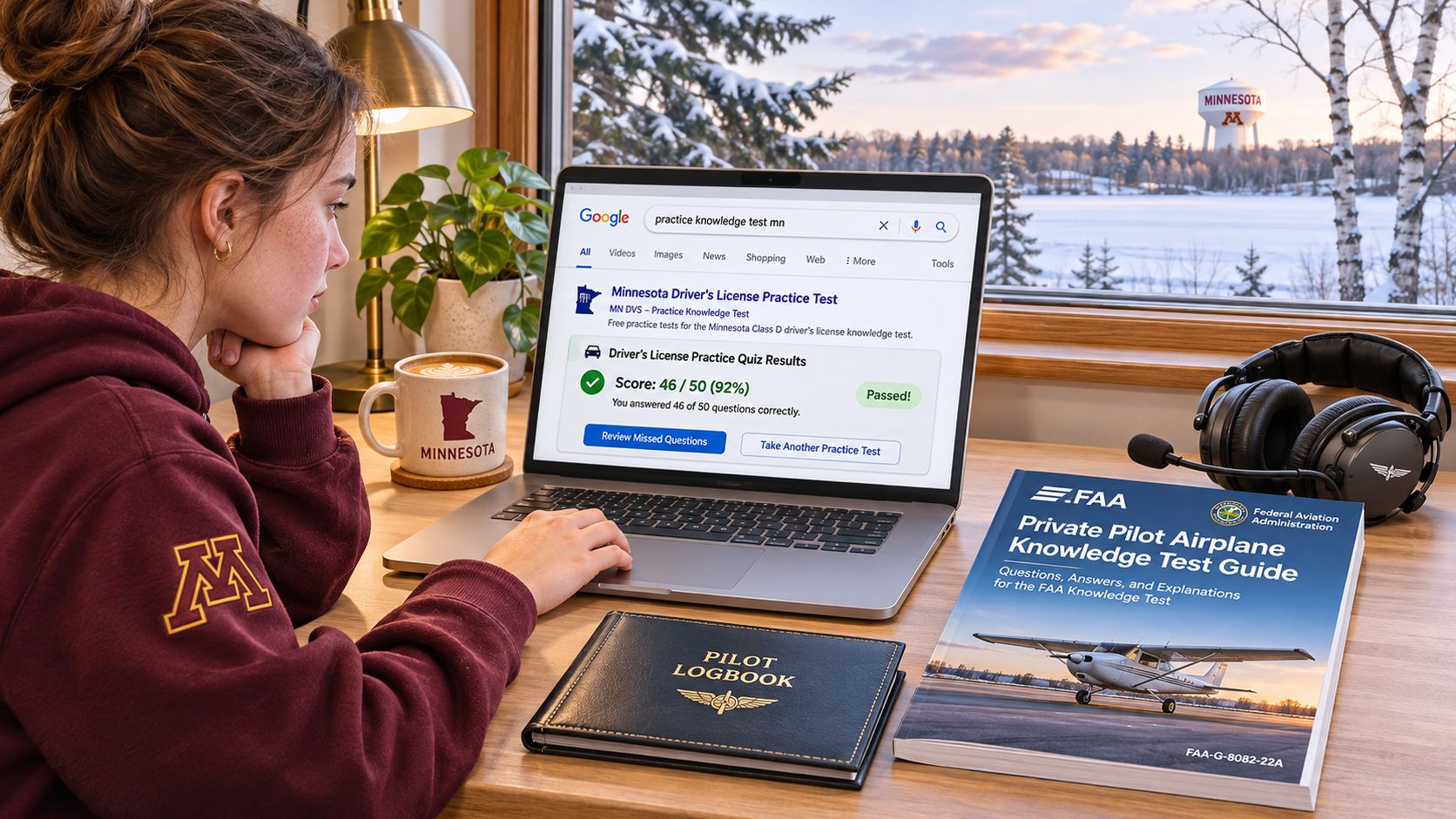
Searching practice knowledge test MN can lead to the wrong kind of test. A Minnesota driver knowledge exam covers road rules and signs; a pilot knowledge test follows a federal FAA standard. The words overlap, but the exams do not.
Two exams share one search phrase
The Minnesota DVS written knowledge exam tests traffic laws, road signs, and moving-violation penalties. It is for drivers, as are the state tests connected with commercial learner's permits. These materials help with a Minnesota driving test, not an FAA pilot exam.
For a private pilot certificate or instrument rating, identify the FAA test you need before choosing study material. Your location determines where you take the exam, not which state's questions you answer.
Minnesota changes where you sit for the exam. The FAA sets the pilot test content and scoring standard.
Why a St. Paul address doesn't move the standard
The Airman Certification Standards (ACS) describe the knowledge and skills expected of pilot applicants. They also connect knowledge topics with risk management and practical flight performance. The same federal standards apply whether you train in Minnesota or another state.
Your training program may shape how you prepare. A Part 61 student and a Part 141 student can use different study routines, but their FAA knowledge tests follow the same national standard.
The code you should search instead
Before choosing an app or book, confirm your test code with your instructor. The code helps you match your practice to the correct certificate and exam.
| Code | Exam | Scored questions | Unscored items |
|---|---|---|---|
| PAR | Private Pilot Airplane | 60 | None listed |
| IRA | Instrument Rating Airplane | Total not published | Includes unscored validation questions that do not affect the score |
The IRA exam includes validation questions used to evaluate new items. They do not count toward the score, so an unfamiliar question does not necessarily mean your practice material is aimed at the wrong test.
The FAA Scorecard Every Practice Session Must Match
A practice score means little unless the session matches the test's basic conditions. The FAA Private Pilot Airplane Airman Certification Standards lists 60 questions, 2.5 hours of testing time, and a 70 percent passing score. Confirm the current time limit on the FAA's site before setting a practice timer.
| Figure | PAR airplane knowledge test | How to use it in practice |
|---|---|---|
| Question count | 60 scored questions | Run full-length sets of 60, not only short quizzes |
| Testing time | 2.5 hours | Time the set, then confirm the current limit on the FAA's site |
| Passing score | 70 percent | Treat about 42 of 60 as the floor, not the goal |
| Blueprint | Private Pilot Airplane ACS | Tag every miss to an ACS area before moving on |
The 42-question floor
If every item counts equally, 70 percent of 60 works out to 42 correct. That is the passing threshold, not a study target. A score just above it can hide a weak area, such as performance charts, even if regulations questions feel easy. Aim to build understanding across the ACS areas rather than relying on a strong overall score.
Use timed, full-length practice to build familiarity with pacing. For the written exam's place in the broader training sequence, the FAA written exam guide explains how it fits alongside flight training and the checkride.
What a question bank has to prove
A large question bank is useful only if it helps you identify what you know and what needs work. Sort practice by ACS area, such as regulations, airspace, weather, navigation, performance, and risk management. If airspace answers are steady but weather questions keep tripping you up, spend the next study session on weather instead of repeating material you already know.
The scorecard stays the same in Minnesota. Use it to judge your practice, not your address.
How to Find and Use Practice That Tracks the ACS
Seven steps, in this order. Skip one and the ones after it get weaker.
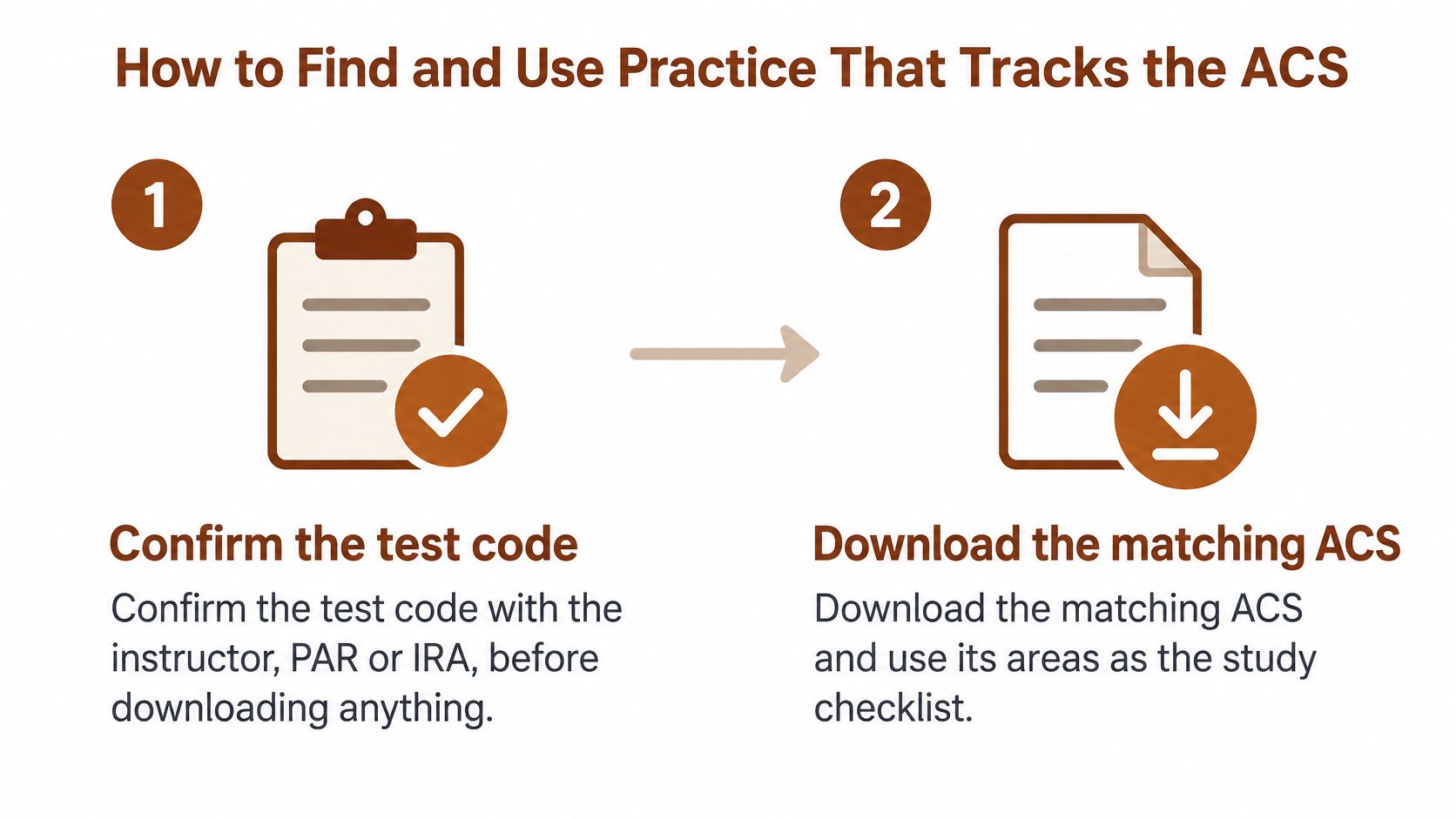
- Confirm the test code first. Ask your CFI whether you're sitting PAR or IRA before you download anything. Reason: every later filter depends on that answer. Slip to avoid: buying an instrument bank for a private pilot written.
- Use the ACS as the checklist, not a quiz menu. Download the matching ACS PDF and treat its areas as your syllabus. Reason: it's the document the questions are built from. Slip: letting an app's topic list decide what you study.
- Read the source before the drill. For a weak area, read the matching FAA handbook chapter or the Aeronautical Information Manual section, then answer questions on it. Reason: the book is the authority and the bank is the drill. Slip: learning a topic from answer explanations alone.
- Sort every miss the same day. Tag each wrong answer to an ACS area and schedule that area again this week. Reason: repeating one missed item tests your memory of that item, not the concept. Slip: retaking the same twenty questions until the letters feel right.
- Mirror the PSI screen. Run timed full-length sets with the same flag-and-review flow you'll use at the center. Reason: an unfamiliar interface eats minutes you need for chart questions. Slip: practicing only in a format with instant feedback and no clock.
- Explain the distractors. For each miss, say out loud why the other options are unsafe or technically wrong. Reason: rewording the stem is how the FAA defeats pattern recall. Slip: marking an answer correct because you remembered the letter.
- Leave flight training alone. Keep lessons with your instructor exactly as scheduled. Reason: written prep and dual instruction do different jobs, and neither substitutes for the other. Slip: canceling a lesson to cram a bank.
Here's the walkthrough in video form if you prefer to see the sequence before you start.
If you're retaking, don't reread a whole ground-school course. Rebuild from the Airman Knowledge Test Report the FAA issues, which lists the knowledge areas marked deficient, and work those areas against the Private Pilot ACS until the codes stop appearing. The signal to move on is consistent timed scores comfortably above the passing mark in every major area, and the examples below show what that looks like in practice.
Two Weak Areas and How Practice Should Fix Them
Say you're departing a small Minnesota field on a 90 °F afternoon with a short runway and a full load. You miss a density-altitude question. The miss isn't a memory failure. You skipped the performance chart and the aircraft-specific assumptions behind it.
The fix is procedural, not more flashcards. Recompute pressure altitude from field elevation and altimeter setting, apply the temperature correction, then read takeoff distance and climb rate from the chart for that airplane. Then say why the tempting answer, the one with the shorter runway and no wind correction, is unsafe. That explanation is what the ACS is testing: knowledge wired to a decision.
A METAR that never becomes a decision
Second scenario: a fall cross-country with a warm front forecast to arrive mid-afternoon. You read the METAR correctly and still pick the wrong answer, because you never turned ceiling, visibility, wind, and the forecast change into a go or no-go call. Recognizing the numbers isn't the same skill as deciding with them.
The fix connects the report to the regulation and to your own personal minimums. Read the METAR, read the TAF, state the trend, then state the decision and the condition that would change it. Do that five times with five real briefing packages pulled from a week of Minnesota weather and the weather questions stop being trivia.
Fix the cause, not the item: a missed density-altitude question means the chart work is thin. It doesn't mean the question was unfair.
The FAA's ACS change document assigns many knowledge domains an indicative 5 to 15 percent share of test questions, so one neglected domain can move a result even when the rest of the bank feels easy. That's why adaptive study should diagnose errors by ACS code or knowledge area, then schedule targeted work: repeated density-altitude misses trigger performance-chart practice, weather misses trigger METAR and TAF interpretation tied to go/no-go calls.
The same pattern applies in one line each to radio communications, where the miss is usually a readback you never rehearsed aloud, and weight and balance, where the miss is usually loading to maximum without recomputing the envelope. Both reward a stated reason over a recognized letter.
And that's the contrast worth keeping. Recognizing a letter you saw last week collapses the moment the FAA rewords the stem. Explaining why three options fail survives the rewording.
Myths That Send Minnesota Pilots to the Wrong Test
Minnesota has no separate pilot knowledge test. The FAA written is the same national exam wherever you take it. Searches for a “Minnesota knowledge test” can also lead to the state driver exam, which has separate questions, language options, and scoring. The Minnesota bill on plain-language standards concerns that state exam, not FAA pilot testing.
Myth: A fixed question bank is the FAA standard. The FAA tests knowledge areas, not just familiarity with a particular set of questions. Anyone who passes with less than 100 percent must receive training to proficiency in each area identified as deficient on the Airman Knowledge Test Report before certification for the practical test, according to FAA testing guidance. A passing score opens the door to the practical test, while the report points to knowledge that still needs work.
Myth: Memorized answer patterns are enough. They can fail when a question is phrased differently. Learn why the correct answer fits and why the alternatives do not; that reasoning transfers better than recognizing a familiar stem.
Myth: Extra instrument-test questions are a trap. Some items are unscored validation questions, so they do not affect the result. Treat each question seriously, but don't assume an unfamiliar item means your score is at risk.
Myth: A weekend cram session changes what the FAA tests. The FAA publishes the standards, and they define the knowledge and skills candidates are expected to demonstrate. The state driver exam and the FAA pilot written test follow different standards; studying for one does not prepare you for the other.
Readiness rule: Review every weak area identified in practice. A single overall score can hide a gap that still needs attention.
Book the Written After Every Area Holds
Book the knowledge test when timed practice holds in the passing range across every area on the scorecard, not after one lucky set. We use 85 percent or higher, held consistently, as the practical booking signal, which gives a buffer over the FAA minimum and covers a bad morning on one domain.
Most flyCowboys users are ready to take the written exam after 4 to 6 weeks of daily study, and the app builds a plan from a PPL or IFR placement quiz, then tracks whether your scores sit in the passing range by ACS area so a weak domain shows up before test day. Flight training with your CFI stays exactly as it is, and the written is where the app does its work. When you're picking a location, our guide to the FAA knowledge test center covers what to expect at a PSI site.
Set the limit clearly, because it matters. The app doesn't replace certified flight instruction from authorized instructors, official FAA publications, approved Part 61 or Part 141 training programs, FAA knowledge or practical tests, or aircraft flight manuals and pilot operating handbooks.
If you're still weighing a Minnesota driver exam against a pilot written, stop here and use DVS materials for the driver license. For a pilot certificate, the action is narrow: confirm PAR or IRA with your instructor, keep every lesson on the calendar, and schedule the written only after the weak areas on your last timed set are closed.
flyCowboys is an iPhone study app built for exactly this split: 3,500+ exam-style questions with plain-English explanations, ACS-mapped drills that resurface weak areas right before you'd forget them, and full-length practice exams that use the same layout as the PSI screen you'll see on test day. If you're training in Minnesota and tired of sorting pilot prep from driver prep, start with the PPL or IFR placement quiz and let the plan target your weak domains week by week. Visit flyCowboys to see how the readiness score tracks your progress toward a booking decision.