· 17 min read
FAA Test Prep App Compared: Features, Pricing, Accuracy
Compare every FAA test prep app on ACS coverage, mock exam realism, pricing and claim accuracy, then pick the right one for your certificate.
Store ratings and headline pass rates are a weak way to pick an FAA test prep app. Most candidates pass the same standardized written exams, and a typical score sits comfortably above the minimum without being perfect. A product can look successful on a store page while still leaving weak topics untouched. Judge an app by evidence it can show: exam-spec fidelity, ACS-level diagnostics, content currency, pricing structure, and whether a score report becomes a study plan. Treat every vendor figure as a claim until the sample, exam type, time window, and method are disclosed.
Table of Contents
- Why Your FAA Test Prep App Choice Matters
- Quick Picks by App Type for PPL and IFR
- Exam Specs a Credible App Must Reproduce
- Feature Criteria That Separate Strong Apps
- Pricing Models and the Real Cost of Each
- Checking Content Accuracy and Vendor Claims
- Turn a Failed or Narrow Pass Into a Study Plan
- Pick the App That Fits Your Situation
Why Your FAA Test Prep App Choice Matters
In 2024, candidates took 46,132 Private Pilot Airplane knowledge tests, with an 89.52% pass rate and an 82.89% average score, according to FAA knowledge-test volume data. That is a large, active market, not a niche requirement. Many apps compete for the same exam.
The 70% passing line is a floor, not a readiness target. The typical result sits in the low 80s. That is well above the minimum and nowhere near a near-perfect paper. An app that only asks whether users pass misses the useful question. Structured practice should lift scores, shrink weak-topic gaps, and produce steady performance across the published subject areas. With tens of thousands of sittings, small changes in preparation outcomes can be measured. A serious product should be measurable too.
This comparison uses five app types, not a short list of brands.
- ACS-mapped question banks can show topic coverage and timed full tests.
- Video ground school add-ons can show instruction before practice.
- Free question banks can show cheap drills, rarely currency.
- Radio trainers can show phraseology, not written-test coverage.
- All-in-one platforms can show study plus hour tracking only if you check each module on its own.
Practical rule: The first decision is the certificate and the timeline, not the app brand.
Choose Private Pilot or Instrument Rating, and how many weeks you have, before you compare logos.
Quick Picks by App Type for PPL and IFR
Categories, not named products, are the right first sort. Feature sets change often, so confirm the current listing before you pay.
| App type | Typical strength | Typical gap | Best fit |
|---|---|---|---|
| ACS-mapped question bank with mock exams | Weak-area tracking by ACS topic and timed full tests | Little or no radio practice | Self-study PPL or IFR candidates with a set test date |
| Video ground school with question bank add-on | Structured lessons and instructor explanations | Slower review; bank may be a secondary feature | Learners who need instruction before practice |
| Free flashcard or open question bank | Zero cost and quick drills | Unverified currency and no exam-spec simulation | Supplementing another resource only |
| Radio and ATC phraseology trainer | Practice with timing and read-back for clearances | No written-test coverage | Pairing with a question bank for IFR candidates |
| All-in-one app with logbook | One place for study, readiness, and hour tracking | Depth varies by module; check each module separately | Students tracking PPL and IFR minimums together |
Read the gap column before the strength column. A self-study Private Pilot candidate with a fixed test date usually needs the first row, because the job is weak-area tracking plus a full timed test. An Instrument Rating candidate who already holds a private certificate still needs that bank, and also needs the radio row. Clearances and read-backs are not a substitute for the written test, and a written bank is not a substitute for phraseology under time pressure.
Most candidates should pair two categories. A question bank plus a radio trainer is the common IFR pair. A learner who stalls on self-paced reading should start with video instruction, then add a bank once the lessons have a shape. An all-in-one app with a logbook fits students who are tracking Private Pilot and Instrument Rating hour minimums in one place, but only if the study module is as serious as the logbook. Situation-by-situation verdicts come later. The matching rule here is simple: one category rarely covers both the written exam and the skill the other category exists to train.
Exam Specs a Credible App Must Reproduce
The FAA lists 60 questions and a 70% passing score for both the Private Pilot Airplane (PAR) and Instrument Rating Airplane (IRA) knowledge tests. A credible app should match the published exam format and make clear which FAA source it follows.
| Exam | Questions | Time limit | Passing score | FAA source |
|---|---|---|---|---|
| Private Pilot Airplane (PAR) | 60 | 2 hours | 70% (42 correct) | FAA knowledge-test table |
| Instrument Rating Airplane (IRA) | 60 | 2 hours on the FAA knowledge-test table; the Instrument Rating Airplane ACS specifies 2.5 hours | 70% (42 correct) | FAA knowledge-test table and Instrument Rating Airplane ACS |
The sources agree on question count and passing score, but give different IRA time limits. For PAR, the knowledge-test table specifies two hours. For IRA, that table specifies two hours, while the Instrument Rating Airplane ACS specifies two and a half hours. Confirm the current limit on the FAA knowledge-test table before using an app's timer to assess exam readiness. Do not treat either IRA duration as settled without checking the current table. The FAA written exam format is easier to evaluate once the applicable time limit is clear.
What a faithful simulator includes
A passing score shows that a candidate met the threshold. It does not show whether knowledge is consistent across ACS topics or whether the result depends on recalled answers. Compare apps by the evidence their reports provide: topic-level performance, exam-format fidelity, and a score report that points to missed material for review.
- Timed full-length mode: 60 questions, the time limit confirmed on the current FAA table, and a testing-center-style layout.
- Mixed-domain mode: questions without topic labels, so the subject heading cannot cue the answer.
- Pass-margin report: show the number correct and the margin above the 42-answer passing threshold, rather than reporting only pass or fail.
For example, 43 correct answers out of 60 meet the stated threshold, but leave little margin. An app can document that result; it cannot prove readiness from one score alone. Look for repeated timed results and reporting that identifies weak areas, then use those findings to guide review. A timer is credible only when it follows the current FAA specification for the exam being practiced.
Feature Criteria That Separate Strong Apps
Apply this checklist in a trial, before a subscription renews. A demo that only shows a pretty home screen has not earned the fee.
This short walkthrough shows how a mapped bank should feel in daily use, separate from the checklist below.
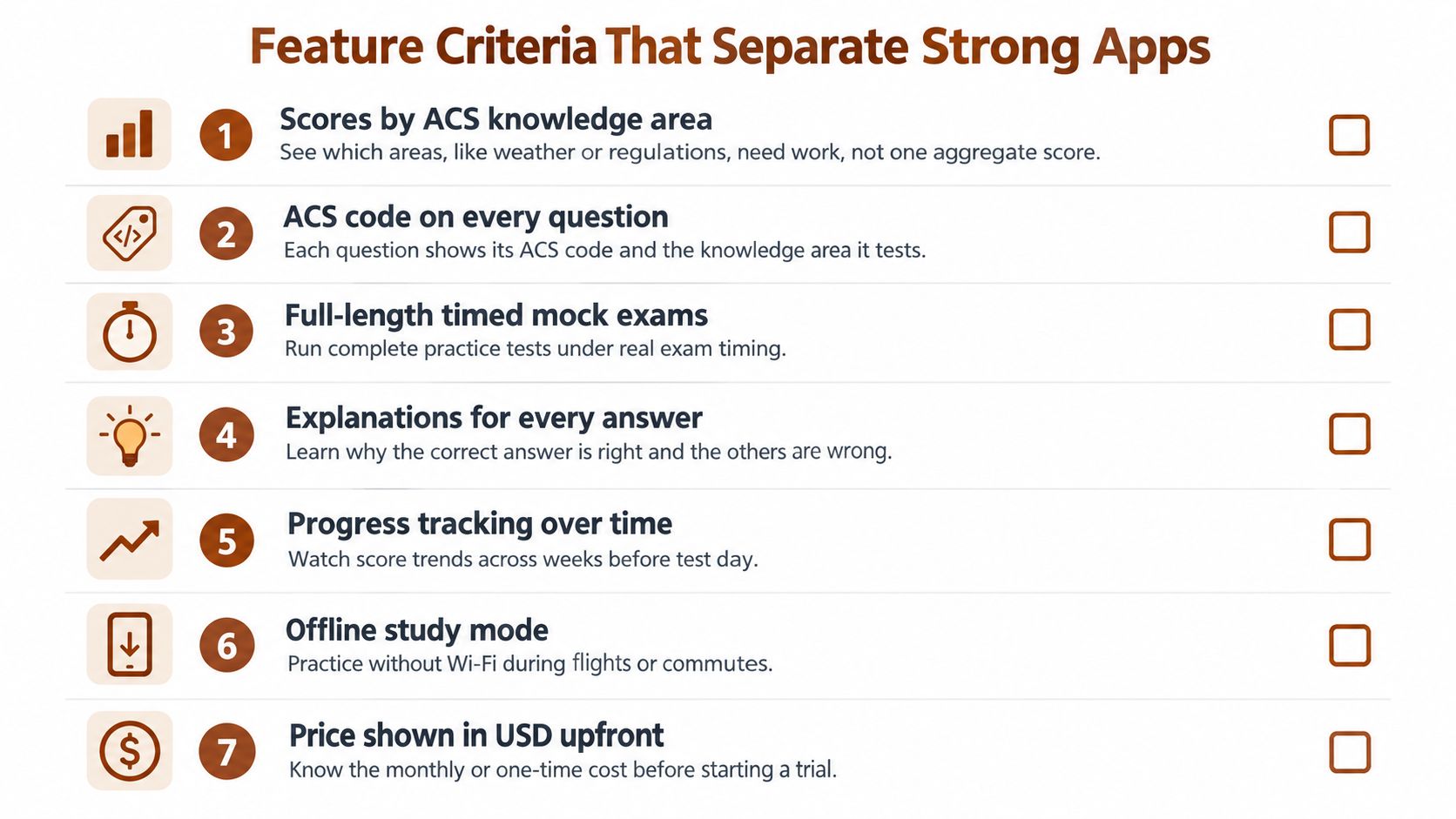
- Performance by ACS knowledge area. One aggregate score hides a weak area behind a strong one. You should see uncovered tasks, not only a single percent.
- ACS code and revision on the question. The label should name the code and the edition in use, so an explanation is tied to the active standard rather than a generic subject tag.
- Timed full-length mocks. Mirror the 60-question format and keep a pass-margin record across attempts. Use the clock you confirmed above, 2 hours or 2.5 hours for IRA, and do not treat 150 minutes as settled.
- A separate mixed-domain mode. Retrieval on test day is not cued by a topic header. Practice that always sorts by weather, regulations, or approaches trains a different skill.
- Spaced repetition on recurring errors. Weather, regulations, navigation, and approaches should return on a schedule when you miss them, not only when you choose that chapter.
- Radio or clearance practice for IFR. Timing and phraseology feedback matter for instrument candidates. They do not replace the written bank.
- A visible content change log. It should name the ACS edition, note which questions changed, and give an instructor enough history to verify that recommendations are still current.
The same ACS alignment makes that change log more than a marketing badge. Explanations and review scheduling should reflect the active standard, and a monthly review is only credible if the edition and the edit history are visible.
A score just above 70% is a weak readiness signal. It leaves little margin for ordinary test-day variance. A stronger app requires repeated timed attempts above the threshold and stops a high score in one topic from masking a deficiency in another.
Exportable study records are a practical plus for a CFI or a flight school. Timed mocks, missed-question categories, and a completion file give someone else something to audit. A readiness badge with no export does not.
Pricing Models and the Real Cost of Each
Sticker price is not the cost. Run one check on every model: total dollars divided by the study days you will really use. A cheap monthly plan that runs for four idle months can cost more than an annual plan you finish in six weeks.
| Model | How you pay | What it often omits | Break-even check |
|---|---|---|---|
| One-time purchase | Single payment for lifetime or fixed access | Updates after a set period; ACS revisions may need a new purchase | Confirm update policy for the next ACS edition |
| Monthly subscription | Recurring monthly charge | Nothing required, but cost keeps running if study stalls | Monthly price times months you will actually study |
| Annual subscription | One yearly charge | Refunds or pauses if you pass early | Worth it only if you finish inside the year |
| Course bundle covering PPL and IFR | One price for both certificates | Logbook or radio features may be sold separately | Compare against two separate single-certificate purchases |
| Free tier with paid upgrade | No cost to start | Full mock exams and readiness reports may be locked | Check which exam-simulation features sit behind the paywall |
Hidden costs that change the math
A free tier often locks the full mock and the area report, which are the features that tell you whether you are ready. You can drill for weeks and still not know your pass margin. A radio trainer or a logbook sold as a second app is another bill, even when the question bank looked complete. A second subscription for Instrument Rating after Private Pilot is the same trap on a longer timeline.
A single price for both certificates beats two purchases only if you need both. If you are a year away from instrument training, paying now for IFR content is a discount you may never use.
One vendor example, labeled as a claim
flyCowboys sells a single iPhone subscription covering Private Pilot and Instrument Rating, with cancel-anytime terms and no separate upsell for the second certificate, and it says its cost position is typically about $800 less than in-person ground school plus separate apps. That savings figure is vendor-reported. It is not an audited comparison. Add your own ground-school quote, your bank, and your radio app, then run the break-even check on those totals before you accept any savings number.
Checking Content Accuracy and Vendor Claims
The FAA's published pass rates provide a benchmark, not proof that a particular app prepares candidates well. A claim is comparable only when it identifies its sample size, exam type, time window, and validation method. Without those details, readers cannot compare an app's percentage with another product or the national candidate pool.
FAA testing guidance says applicants must pass the knowledge test before the practical test, and most knowledge-test reports remain valid for up to 24 calendar months for completing it. Vendor claims need comparable scrutiny. A claimed 94% readiness accuracy or 92% first-attempt pass rate cannot be generalized until the vendor explains how it measured the result.
| Claim type | Evidence to request | Red flag |
|---|---|---|
| First-try pass rate (example: 92%) | Sample size, exam type, date window | No denominator or mixed exam types |
| Average score (example: 89%) | Cohort size and whether scores are self-reported | Practice-test scores presented as exam results |
| Readiness prediction accuracy (example: 94%) | Validation method and how pass outcome was measured | No definition of ready or no outcome data |
| Content currency (example: monthly updates) | Named ACS edition and dated change log | No ACS edition named |
| Time to readiness (example: 23 days) | Sample size, study schedule, starting skill level, and readiness definition | Average reported without a cohort or method |
The table separates claims that are often blurred together. A 92% first-attempt pass rate without a denominator could mix Private Pilot and Instrument Rating candidates, or count only people who completed a course. An 89% average drawn from self-reported practice tests does not establish exam performance. A 94% readiness prediction requires a stated readiness threshold and measured exam outcomes. “Updated monthly” is meaningful only when the vendor names the ACS edition and provides a dated change log.
Treat time-to-readiness figures the same way. A statement such as 23 days at about 15 minutes a day needs a disclosed sample, starting skill level, and definition of readiness to support comparison. Without those details, it is an example, not evidence of a typical result.
A ten-question check you can run today
Choose ten app questions and compare each explanation with the current FAR/AIM and the ACS task it claims to cover. Record explanations that conflict with the source, codes that do not match the task, and figures the handbook does not support. This small spot check cannot certify an entire question bank, but it can reveal weak explanations or labeling.
Use the Private Pilot ACS task checklist to check whether the app's labels match the published task elements. Then examine the 70%-margin blockquote from the feature criteria: a high practice score alone does not validate a readiness model. An instrument timer is credible only if it matches the exam clock.
Turn a Failed or Narrow Pass Into a Study Plan
Start with the official Airman Knowledge Test Report. It identifies deficient areas, but the level of detail varies. When ACS codes appear, use them to locate the relevant tasks. When they do not, map each missed topic to the appropriate ACS area yourself. The report is a starting point, not a complete diagnosis.
A passing score does not establish durable understanding. Treat a narrow pass as a reason to review weak areas, and use the report to guide what you study next.
- Record every deficient area or code, along with any section you passed by only a question or two.
- Identify the concepts behind each gap. Distinguish knowledge, risk management, and skill. Name the weather product or regulation involved, rather than relying on the answer choice.
- Verify the concepts against authoritative references. Use the FAR/AIM, the relevant ACS task, and a reference text. Check your reasoning against those sources, not only an app's answer key.
- Practice with mixed-domain sets, then take a full timed mock exam. Mixing topics removes the label as a clue and tests whether you can retrieve the concept in exam conditions.
- Set a readiness threshold above the minimum. Schedule the retake only after weak areas produce repeated timed scores with a clear margin above 70%, not after a single strong result.
Turn the diagnostic into a remediation plan: connect each missed area to a source, a focused review, and a later timed check. If an app reports performance by ACS area, use that breakdown to track whether the specific gaps are closing. A total score alone can conceal weaknesses, so keep reviewing any area that remains inconsistent.
Study the concepts identified by the report, rather than trying to recreate or memorize live FAA questions. If you already passed and are preparing for the practical test, check the validity period that applies to the passed knowledge-test report. That requirement concerns the practical test, not when to retake a failed exam.
Pick the App That Fits Your Situation
Match the category to the constraint you really have. The report-to-plan path for retakers is already laid out above. Use it, and do not restart from a fresh question bank as if the official report did not exist.

A first-time Private Pilot candidate with a test date in four to eight weeks needs an ACS-mapped question bank, full timed mocks, and area-level reporting. Video is optional if the concepts are already in place. The clock is not.
An Instrument Rating candidate who already holds a private certificate needs that bank plus radio and clearance practice. One app is better than two subscriptions when both modules are real. If the radio tool is a thin add-on, buy the trainer separately and skip the bundle story.
A CFI or flight school recommending a resource should require exportable completion evidence and a visible change log. A student screenshot of one high score is not a training record. A budget-limited self-studier should start on a free tier to test explanation quality, then pay only when mock exams and area reports become available. If those stay inaccessible, the free tier is a demo, not a course. A learner who needs live instruction should choose video ground school first, then add a question bank. Lessons before drills beat drills before lessons when the material is still unfamiliar. A structured private pilot ground school path is the right complement when an app's explanations are not enough on their own.
For flyCowboys, the fit is strongest for Private Pilot and Instrument Rating candidates who want one price, a logbook, and radio practice in the same subscription. It is a weaker fit if you need live instructor lessons, or if a school bundle already covers the written prep and the logbook. That is a scope match, not a ranking.
Run one full timed mock. Check the report against the feature criteria, area by area. Schedule the exam when those area scores stay above the threshold on repeated attempts, not after one high score.
flyCowboys is an iPhone study subscription for the Private Pilot and Instrument Rating written exams, with ACS-mapped practice, radio drills, and a logbook in one plan. If you are comparing an FAA test prep app on exam-spec fidelity and area-level reporting rather than on a headline pass rate, review what is included and run your own break-even check. Visit flyCowboys to see the current subscription and decide whether that single-app scope matches your certificate and timeline.