· 16 min read
PPL Written Test Prep: A Real Study Plan That Works
Practical PPL written test prep built around the FAA ACS — study strategy, practice question drills, common traps, and exam day checklist to help you pass.
Most students obsess over getting to 70%, and that's exactly the wrong target. The FAA's own 2024 data shows a 91.90% pass rate with an 82.89% average score on 46,132 Private Pilot Airplane knowledge tests, which means the test is not some impossible gatekeeper, but it also isn't a formality either FAA 2024 testing data. A passing score clears the minimum. A ready student walks in with margin.
Table of Contents
- What the PPL Written Test Really Tests
- Mapping the ACS Knowledge Areas Before You Study
- A Four-Week Study Plan You Can Actually Follow
- Practice Question Strategy That Builds Real Judgment
- Common Question Traps and How to Spot Them
- The Exam-Day Checklist That Prevents Stupid Mistakes
- Retake Planning and Measuring True Readiness
What the PPL Written Test Really Tests
The FAA Private Pilot Airplane knowledge test is a 60-question, objective multiple-choice exam with a 70% passing standard and a 2.5-hour time limit. If every question is scored, you need at least 42 correct answers to pass FAA ACS private airplane material. That is the floor, not the goal. Anyone who studies to barely clear that line is preparing to survive the test, not to fly well.
The high pass rate is the trap
The gap between the pass rate and the average score is what matters. In 2024, most applicants passed, yet the average score was still 82.89%, not anything close to perfect [FAA 2024 testing data]. That means the exam is very passable, but plenty of candidates still leave with weak margins.
Practical rule: If your practice score only barely clears 70%, you are not ready. You are gambling.
The FAA also requires the written test before the practical test, so this is not a box to check later [FAA ACS private airplane material]. Treat written-test prep as a required step, not a casual question-bank session. Build real understanding first, then prove it under time pressure.
Readiness is a feedback loop, not a memory game
The ACS organizes the exam around knowledge areas like regulations, accident reporting, performance charts, radio communications, weather, density-altitude performance, weight and balance, aerodynamics and aircraft systems, stalls and spins, aeronautical decision-making, and preflight actions [FAA ACS private airplane material]. Historical ACS material also assigns each area a stated percentage range, generally 5–15%, so one or two favorite topics will never cover the whole test [FAA ACS private airplane material]. Students who study only what feels comfortable get exposed fast.
Use each missed question as a diagnostic. If you cannot explain the rule, read the chart, apply the formula, and make the operational decision without help from the answer choices, you do not own that topic yet. The written exam rewards retrieval, comparison, and application. It does not reward blind recall of one memorized wording.
Bottom line: PPL written test prep works when every missed question becomes a diagnosis, not an embarrassment.
Validation questions can appear on some tests. They are used for statistical analysis, they are not scored, and they are not included in the posted question count, although they still take time inside the allotted window [FAA ACS private airplane material]. That matters because pacing has to reflect actual test behavior, not just the visible question count. Train for 60 questions, a 70% threshold, broad ACS coverage, and timed simulations that feel real.
Mapping the ACS Knowledge Areas Before You Study
Start with the ACS, not with your favorite topic. The FAA's Private Pilot ACS lays out the exact knowledge areas the written test draws from, including regulations, weather, airspace, navigation, performance, weight and balance, aerodynamics, radio communications, and human factors. That structure should drive your study order, because the exam rewards broad coverage, not comfort.
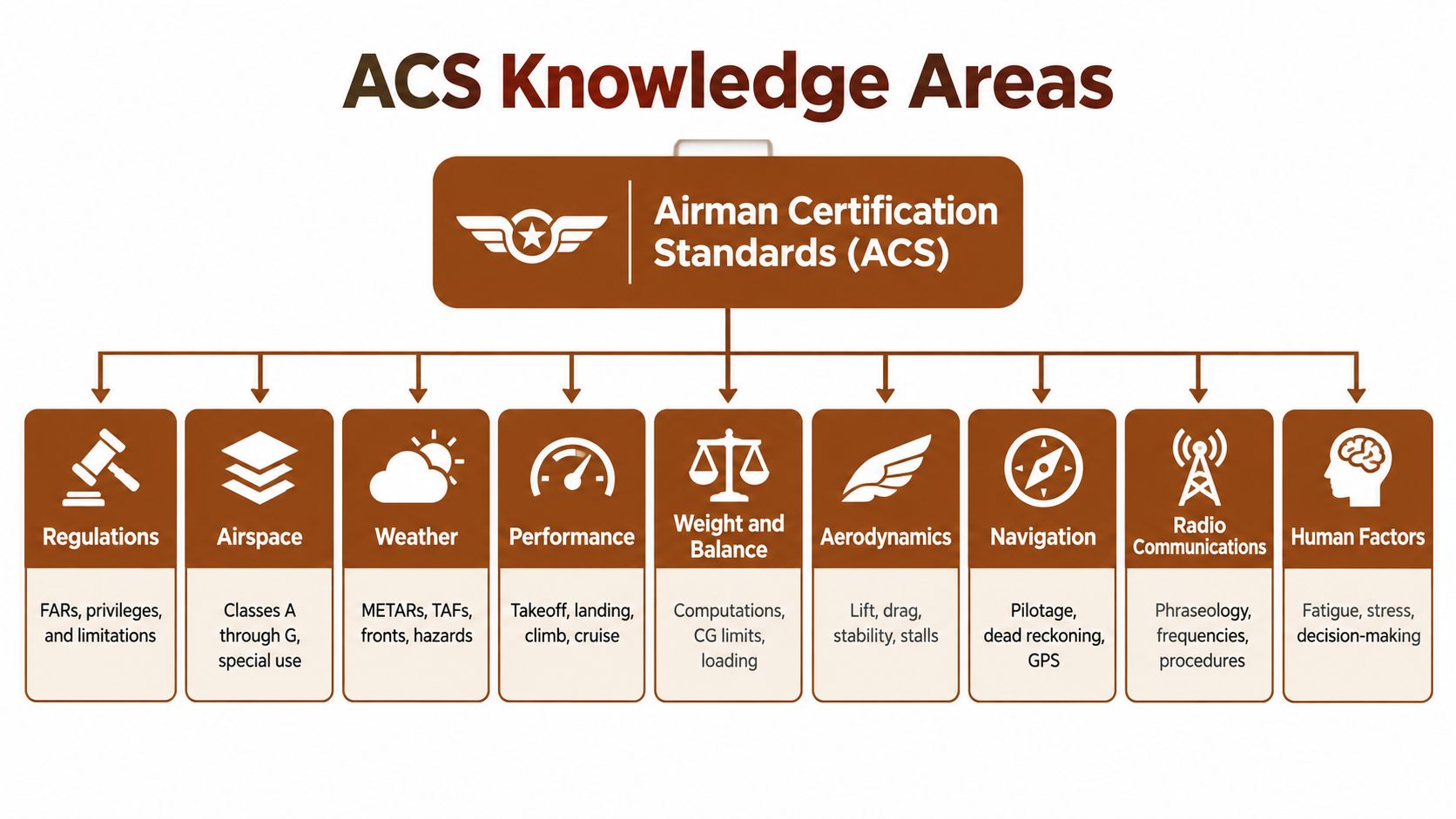
Use the ACS as your map, not your reward
Question banks train pattern recognition. The ACS trains judgment. If you begin with random practice questions, you often learn the bank's wording instead of the FAA's logic. Start with the ACS reference guide, then work the questions that match each code and task. For a clean overview of the same structure, use the ACS reference guide while you study.
Historical ACS material assigns each major area a general weight range of 5–15%, so no single subject can carry your score. That range is historical, but the lesson is current. A weak area can still sink an otherwise decent test. If you keep missing one domain, stop calling it a small issue. It is the part of the test that can cost you points fastest.
Use this filter instead of guessing what to study next:
| Major ACS knowledge area | Approx. weight range | Sample ACS focus or task | Common mistake |
|---|---|---|---|
| Regulations | Historical 5–15% | PA.I.A.K1, currency, limitations, and required equipment | Memorizing limits without knowing when they apply |
| Airspace | Historical 5–15% | PA.IV.A.S1, class boundaries, weather minimums, and entry requirements | Missing the class, floor, or equipment requirement |
| Weather | Historical 5–15% | PA.II.B.K1, METARs, forecasts, and frontal trends | Reading the product but not the trend |
| Performance | Historical 5–15% | PA.IV.A.K1, runway length, density altitude, and climb performance | Ignoring density altitude or runway conditions |
| Weight and Balance | Historical 5–15% | PA.IV.B.K1, loading, CG limits, and fuel placement | Doing the math but missing the loading logic |
| Aerodynamics | Historical 5–15% | PA.I.C.K1, stall behavior, load factor, and critical angle of attack | Knowing definitions, not stall behavior |
| Navigation | Historical 5–15% | PA.III.A.K1, chart symbols, checkpoints, and course selection | Recognizing symbols without chart context |
| Radio Communications | Historical 5–15% | PA.IV.C.K1, CTAF calls, tower phraseology, and readback | Knowing phraseology but freezing under pressure |
| Human Factors | Historical 5–15% | PA.I.B.K1, fatigue, hypoxia, IMSAFE, and risk decisions | Treating judgment as theory instead of risk management |
The table is a diagnostic tool, not a trivia list. If one row feels shaky, that is where your first serious study block goes. Stop ranking subjects by what feels easy. Rank them by what would hurt you most on test day.
Missed questions should point to a knowledge gap, not just a score total. If you cannot explain the rule, interpret the chart, and apply the decision without the answer choices helping you, you do not own that topic yet. That is the difference between scraping past 70% and being ready. A passing score shows you crossed the line. Real readiness shows you can explain why the wrong answers are wrong and change your answer when the scenario changes.
The test also includes unscored validation questions on some forms. They still eat time inside the testing window, so pacing has to reflect real exam behavior, not the visible question count. Train for the full test pace, broad ACS coverage, and timed review sessions that expose weak codes before the exam does.
A Four-Week Study Plan You Can Actually Follow
The best prep is plain and repetitive. Skip heroic cram sessions. Use a loop that mixes new material, retrieval practice, and timed review until the ACS codes stop feeling like separate islands. A student studying 10 minutes a day can use the same structure in smaller blocks. A student with 45 minutes can push deeper on the same cycle.
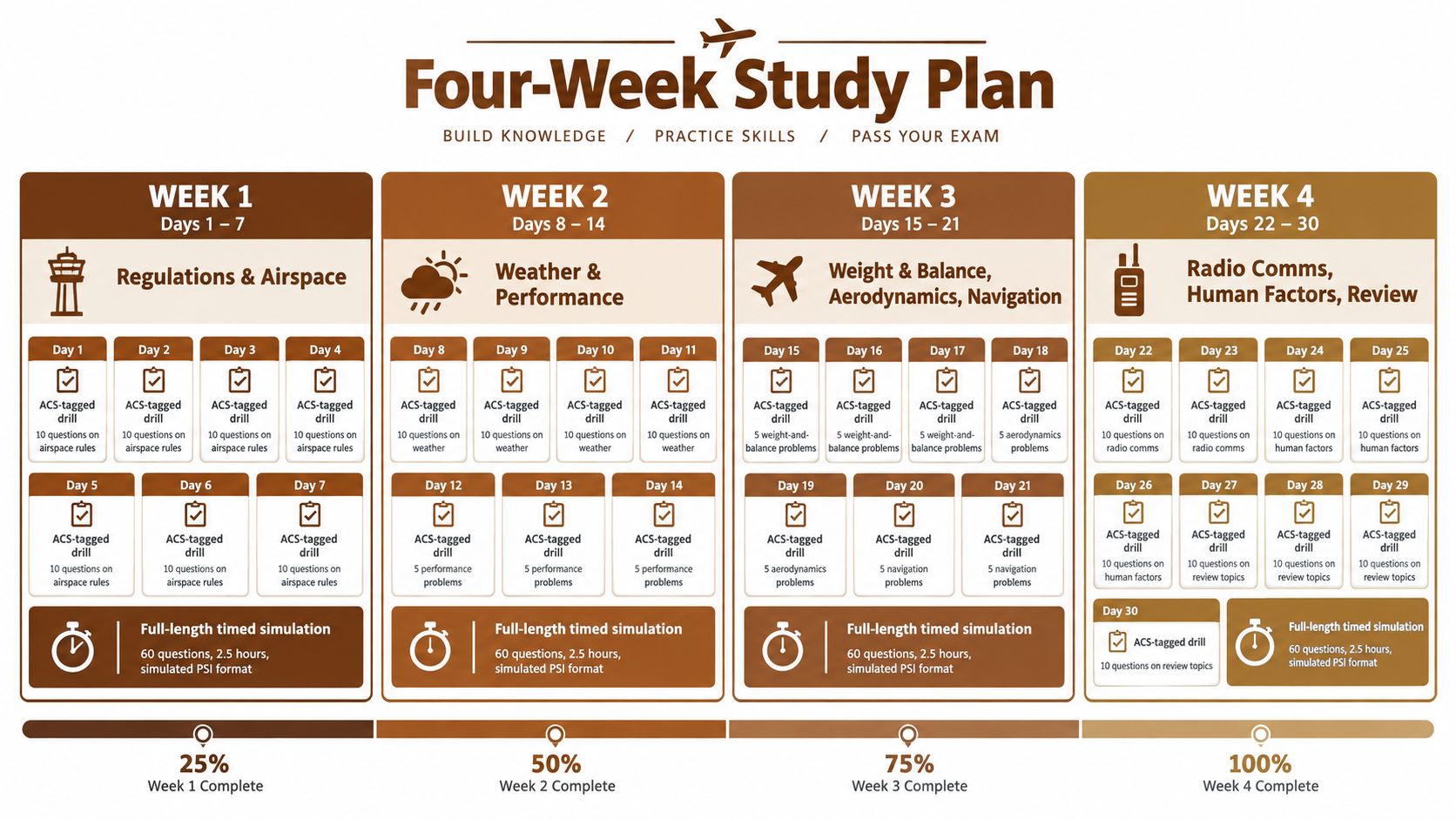
Week-by-week cadence that actually holds together
Start each week with new learning while your attention is fresh. Use the middle of the week for mixed drills, not long runs on one topic. Finish each week with a timed simulation, because anyone who never practices the clock is not practicing the test.
- Week 1, Regulations and airspace: Read one ACS sub-area, then do a small question set tied to that code. Build confidence in the material that affects almost everything else.
- Week 2, Weather and performance: Add a second layer of mixed review. These subjects expose whether you understand the reason behind the answer or just recognize the wording.
- Week 3, Weight and balance, aerodynamics, navigation: Weak math and chart reading show up here. Slow down, sketch the problem, and work it through instead of tapping answers.
- Week 4, Radio communications, human factors, review: Shift from learning mode to test mode. Your job is to stabilize scores, not chase brand-new rabbit holes.
A full-length simulation should feel like the actual exam. The FAA Private Pilot test allows 2.5 hours and requires at least 70% for passing per the ACS guidance cited earlier. Use timed sets that force pacing, not comfort. If you keep finishing early but still miss scenario questions, you are moving too fast.
Study rule: New material belongs earlier in the week. The last three days before the exam should be review, recall, and confidence building.
The calendar matters less than the sequence. Learn the ACS element first. Then answer a few targeted questions. Then revisit the misses after a delay. Finish the week with a mixed, timed set that combines domains the way the FAA does.
Keep your written prep tied to the same training flow you would use for the rest of ground instruction, not as a random cram project. A practical ground school guide helps keep that rhythm organized. The schedule is not fancy. It works because it forces repetition, spacing, and pressure testing in the right order.
A real weekly rhythm, not a motivational poster
Monday through Thursday should carry most of the learning load. Friday should be a short mixed review, not a new topic dump. Saturday is for the timed simulation and weak-code review. Sunday is for cleanup, not guilt.
That rhythm matters because the FAA data shows students are passing, but not by a huge margin that excuses sloppy prep. In 2024, the average score was 82.89% per the FAA data cited earlier, which is enough to pass but not enough to call the knowledge deep by default. Train to leave room for error.
Practice Question Strategy That Builds Real Judgment
Most students use practice questions like flashcards. That's lazy. A practice question is a diagnostic event, not entertainment. Every miss should tell you whether you misunderstood the rule, misread the stem, guessed from memory, or failed to apply the ACS code to a changing scenario.
Stop treating explanations as the finish line
Reading the explanation once and moving on feels efficient. It isn't. If you don't tag the miss to an ACS element, you haven't really reviewed it. You've just nodded at it.
A better loop looks like this:
- Tag the miss to the ACS code so you know the exact knowledge area.
- Label the failure as a knowledge gap, a reading mistake, or a scenario error.
- Rework the question until you can explain the governing rule out loud.
- Re-test that same code later, not immediately, so you're checking retention, not short-term recognition.
- Mix it back into a new set so the wording changes and the answer stem doesn't rescue you.
That last step matters more than people admit. If you only drill one bank in one format, you learn the bank's habits. You don't learn the FAA's judgment model. The written exam rewards students who can answer a new question using an old rule, not students who remember the right letter.
CFI rule: If a student can't explain why the wrong answers are wrong, the review isn't done yet.
Use fewer questions, review harder
You do not need to grind endless sets. You need a clean loop with enough volume to expose patterns. A short daily drill is enough if the review is real. A real review means you can name the chart symbol, formula, regulation, or operational decision that produced the answer.
That's also where an adaptive platform can help, if it maps misses to ACS elements and spaces the repeats instead of just throwing more random trivia at you. One example is flyCowboys, which organizes PPL study around ACS domains, adaptive drills, timed simulations, and weak-area tracking, so the next session targets what you missed rather than what you already know. The important point isn't the brand. It's the method.
What a useful log looks like
Your notes should be ugly but precise. Don't write “weather mistake.” Write “missed frontal passage rule in ACS weather code.” Don't write “performance problem.” Write “ignored density altitude effect on takeoff distance.” If your notes are vague, your next session will be vague.
A good question session ends with a decision, not a score. Either you've mastered the code, or you've found the next code to drill. That's how the question bank becomes a feedback loop instead of a slot machine.
Common Question Traps and How to Spot Them
The FAA doesn't need trick questions to catch weak prep. Simple distractors do the job well enough. The test leans on wording, assumptions, and scenario shifts that look small until they change the answer completely. If you know the trap type, you can slow down before the wrong choice feels safe.

The four traps worth drilling
- Distractor wording: One answer adds a qualifier like “generally,” “only,” or “except.” Those words matter. Before you click, ask whether the stem asked for the rule or the exception.
- Chart misreads: Two symbols can look similar on a sectional or weather product, but they don't mean the same thing. If a question references a chart, confirm the product first, then the symbol.
- Sign and unit errors: Performance and weight-and-balance questions can punish sloppy arithmetic. Check whether the numbers are feet, knots, pounds, gallons, or a rate change before you do anything else.
- Scenario assumptions: A question can change because of airspace, runway direction, or time of day. If you answer from memory before checking the setting, you'll miss the actual problem.
The reason these traps work is simple. They exploit students who answer from recognition instead of analysis. You see a familiar stem, your brain jumps to a memorized response, and the details you skipped were the ones that controlled the answer.
Read the question twice, once for the topic and once for the condition that changes the topic.
That's the habit to practice during drills. Force yourself to underline the changing variable in your head before you answer. If the question is about a runway, ask what changed. If it's about airspace, ask where you are and what class you're in. If it's about weather, ask what product you're reading and whether the trend matches the decision.
The smartest prep is boring in the right way. It teaches you to slow down on qualifiers, confirm the chart, check the units, and challenge the scenario before the answer choice gets the better of you.
The Exam-Day Checklist That Prevents Stupid Mistakes
The last 48 hours before the test should feel calmer than the week before it. Stop cramming. Confirm the appointment, pack your ID, and review the codes you keep missing. The goal is not to learn something new the night before. The goal is to protect the score you've already built.
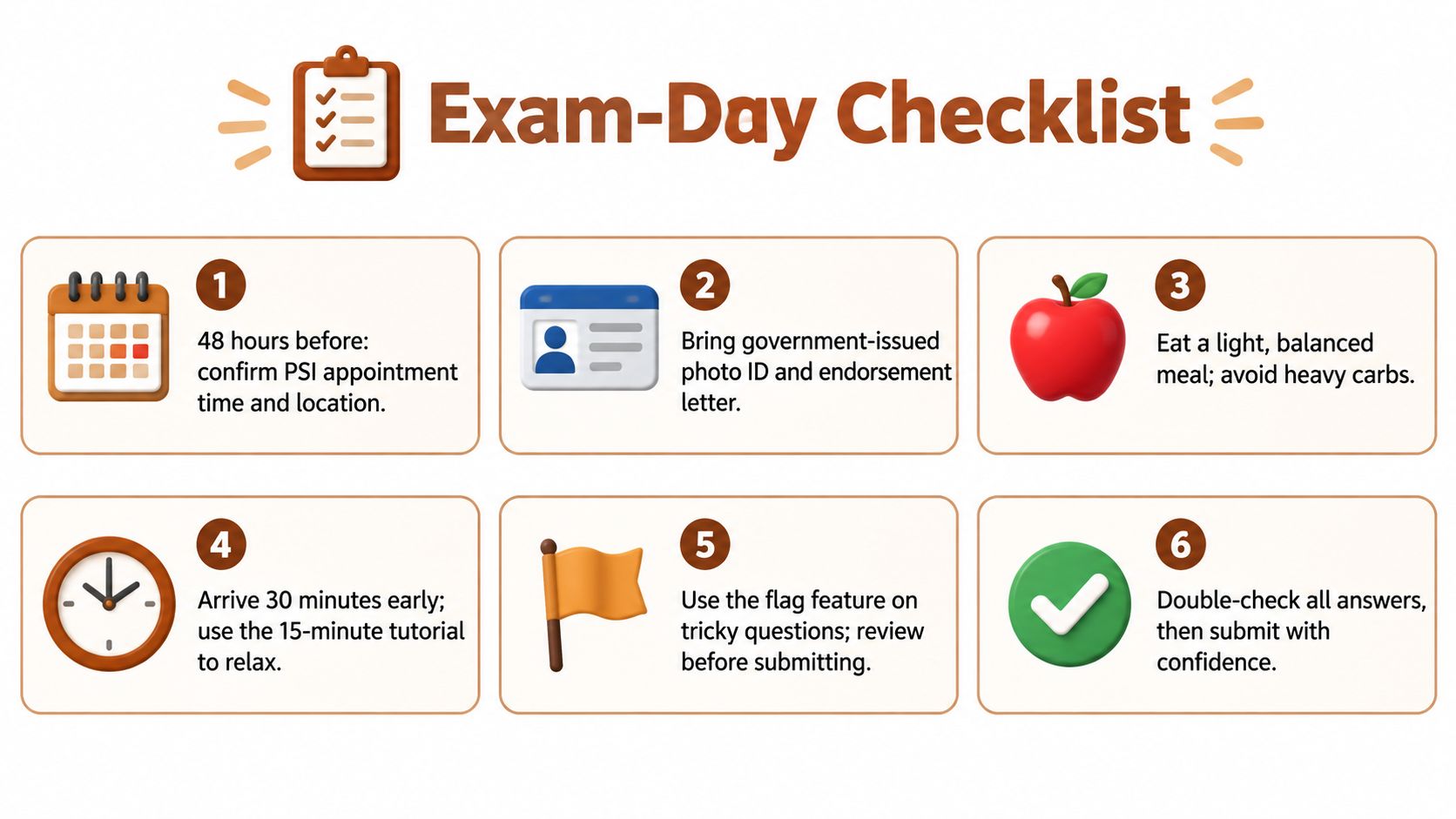
Keep the morning simple
- 48 hours before: Confirm your PSI appointment time and location.
- Bring the right documents: Government-issued photo ID and your endorsement letter.
- Eat normally: Pick a light, balanced meal so you're not distracted by hunger or sluggishness.
- Arrive early: Use the tutorial time to settle down instead of rushing.
- Flag uncertain questions: Don't burn the clock on one item.
- Review with intent: Use your final pass to check flagged answers, not to panic-read everything.
The first minute at the desk matters more than most students think. Don't click fast because the screen is in front of you. Skim the interface, breathe, and get your pacing straight before you start. Once you're in motion, treat the clock as a guide, not a threat.
If a question feels expensive, flag it and move on. You're not being asked to solve every problem in sequence. You're being asked to manage the whole test well enough to cross the finish line with margin.
For a clean overview of written-exam logistics and what the testing flow tends to look like, keep a practical guide handy such as the FAA written exam overview linked here FAA written exam guide. Use it for the boring parts, not the studying. Boring is good on test day.
Retake Planning and Measuring True Readiness
Schedule the retake only after two separate 80%+ mixed simulations, with no single ACS code accounting for more than 30% of your misses. Then spend the next 10 to 14 days on those codes. That is how you turn a near-pass into a real pass.
A retake plan should be narrow. Work the weak codes from your report, rebuild them with targeted drills, then fold them back into timed mixed practice so you are checking transfer, not recall. If the same codes keep failing, the problem is not test volume. The problem is that those knowledge areas are still unstable.
Readiness shows up when your misses spread out and your score stops wobbling on new question sets. The FAA's own 2024 data cited earlier shows plenty of applicants pass, but the average score still leaves room for sharper prep. Do not trust a bank score that only holds when the wording feels familiar.
If you failed once, stop rebuilding everything. Fix the weak ACS codes, retest under fresh wording, and watch the pattern. Improvement that survives a new mix of questions is real readiness. Anything else is just temporary comfort.