· 14 min read
Readiness Review for FAA Written Exams: A Pilot's Guide
A readiness review shows whether you are ready for the FAA knowledge test. Check topic mastery, practice scores and gaps before you book.
The most common advice for the FAA written is to keep taking quizzes until you clear the passing line, then book a seat. That advice sends people to the testing center with a hole still in the syllabus.
A single practice score can look fine while one area stays blocked. You recognize a question you saw yesterday, the average climbs, and the weak topic never gets a full look. On test day the wording changes. A forecast, a clearance, or a broken radio call asks you to use the idea, not spot it. The score never measured that.
A readiness review is the set of checks you pass before you schedule, not one number on one quiz. It asks whether every syllabus area has been practiced, whether the weak area sits close to the rest, whether the score holds after a few days away, and whether you can explain a miss and repair a messy radio call. Passing once is common. Being steady is the standard worth booking on.
Table of Contents
- Readiness Checks and Benchmarks at a Glance
- What Pass Rates Reveal About Your Baseline
- How to Run a Readiness Review in Seven Steps
- Reading Your Results by ACS Area
- Testing Application and Communication Beyond Recall
- Choosing Practice Sources and Tracking Scores
- Deciding When to Book Your FAA Knowledge Test
Readiness Checks and Benchmarks at a Glance
A readiness review is a set of checks you pass before booking, not one score. ACS here means the Airman Certification Standards areas on your test.
| Readiness check | Suggested benchmark | What passing tells you |
|---|---|---|
| Practice score | 85% or higher on several full-length tests | Overall knowledge is at exam level |
| ACS area coverage | Every ACS area practiced at least once | No blind spots in the syllabus |
| Weakest area | No single area far below the rest | The average is not hiding a gap |
| Retest after delay | Score holds after several days away | Recall, not short-term memory |
| Timed simulation | Completed within exam time limits | Pace and focus hold under test conditions |
| Explanation check | Can explain why each missed question was wrong | Understanding, not recognition |
| Scenario and radio check | Handles judgment and radio scenarios correctly | Knowledge carries into real decisions |
These rows are practical starting standards, not FAA rules. Clearing the published passing mark on one sitting is not the same thing as meeting every row.
How to read the rows
Read left to right. The middle column is the bar. The right column is what that bar proves. One failed row means more study in that specific area, even when the overall average looks fine. A strong practice score next to a weak-area miss is the trap. The average is doing the hiding.
Practical rule: One red row keeps the booking on hold, no matter how green the other rows look.
Score your current results against every row today. Mark each row red, yellow, or green before you change the plan. Red means the check failed. Yellow means it is close but not stable. Green means it meets the benchmark on more than one sitting.
What Pass Rates Reveal About Your Baseline
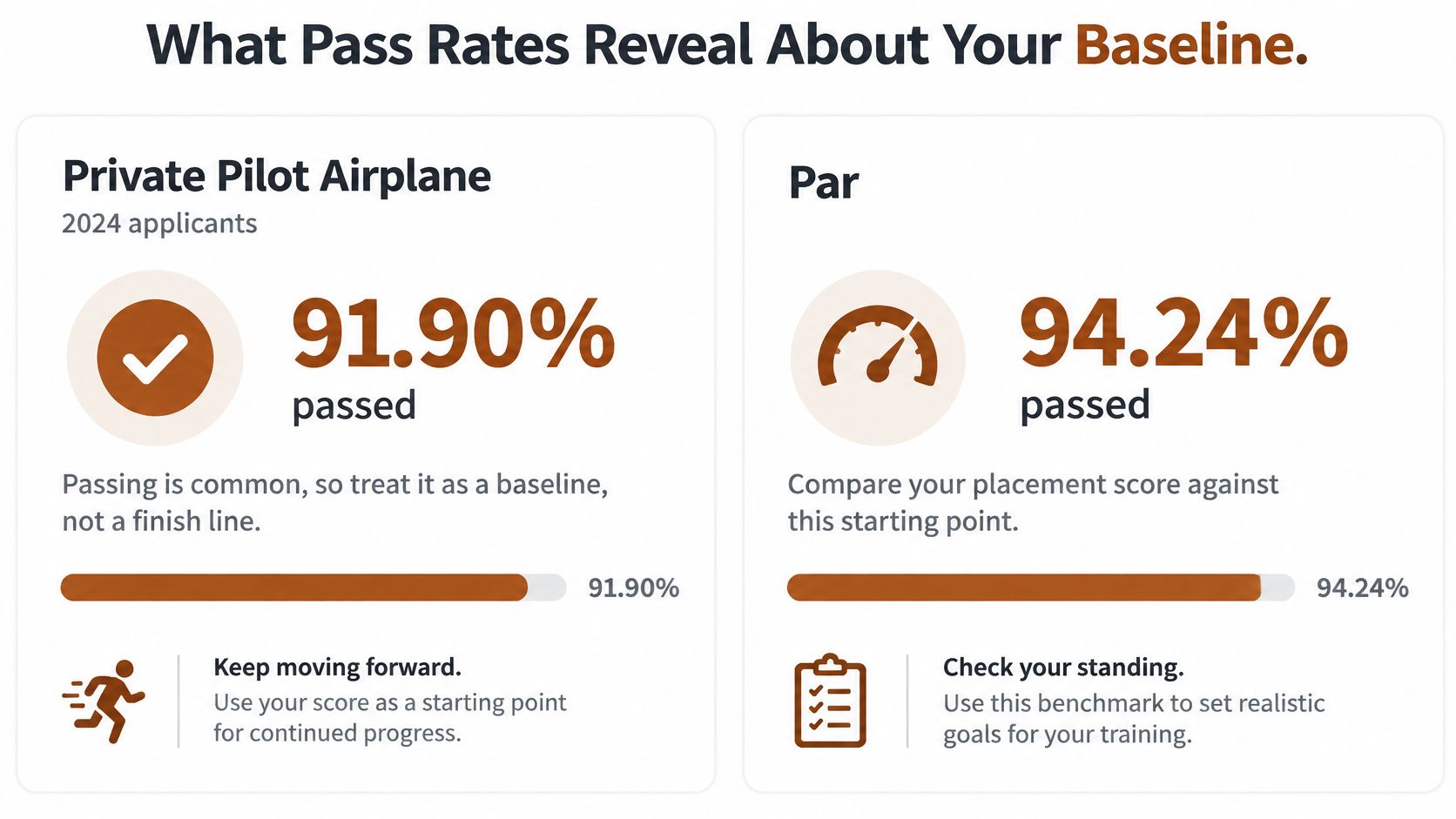
A class average can look healthy while one required task stays broken. National knowledge-test results work the same way. The 2024 FAA airman knowledge test volume report shows 46,132 Private Pilot Airplane tests with a 91.90% pass rate and an 82.89% average score, and 25,647 Instrument Rating Airplane tests with a 94.24% pass rate and an 85.64% average score. That is a pass-rate gap of 2.34 percentage points and an average-score gap of 2.75 points.
| Test | Tests administered | Pass rate | Average score |
|---|---|---|---|
| Private Pilot Airplane | 46,132 | 91.90% | 82.89% |
| Instrument Rating Airplane | 25,647 | 94.24% | 85.64% |
Those figures are a baseline, not your finish line. Most applicants passed. Averages still sat in the low-to-mid 80s. Instrument applicants posted both the higher pass rate and the higher average on procedures, clearances, navigation, and instrument approaches. Private-pilot topics are a different task list.
What a national pass rate cannot see
The FAA figure is a crowd. It cannot see one blocked ACS area under a high practice average, the way a tidy traffic pattern can hide a go-around you cannot talk through. A readiness review has to show application on a fresh scenario and clear communication: say why the answer is right, not only select it.
These are testing outcomes, not proof that a study method causes a pass. Set the score you want beside 82.89% and 85.64%, then judge how much practice that gap still needs.
How to Run a Readiness Review in Seven Steps
A high practice average can hide a blocked ACS area. The review has to show that you can apply the rule and say it clearly, not just post a passing score. One green overall number works like a preflight that never looks at the red gauge.
Run the review as a loop across several cycles. Tell FlyCowboys your rating, PPL or IFR, and take the short placement quiz. The study plan that comes back is built around your weak areas. Progress tracking shows when you are ready to test. The average student is exam-ready in 23 days.
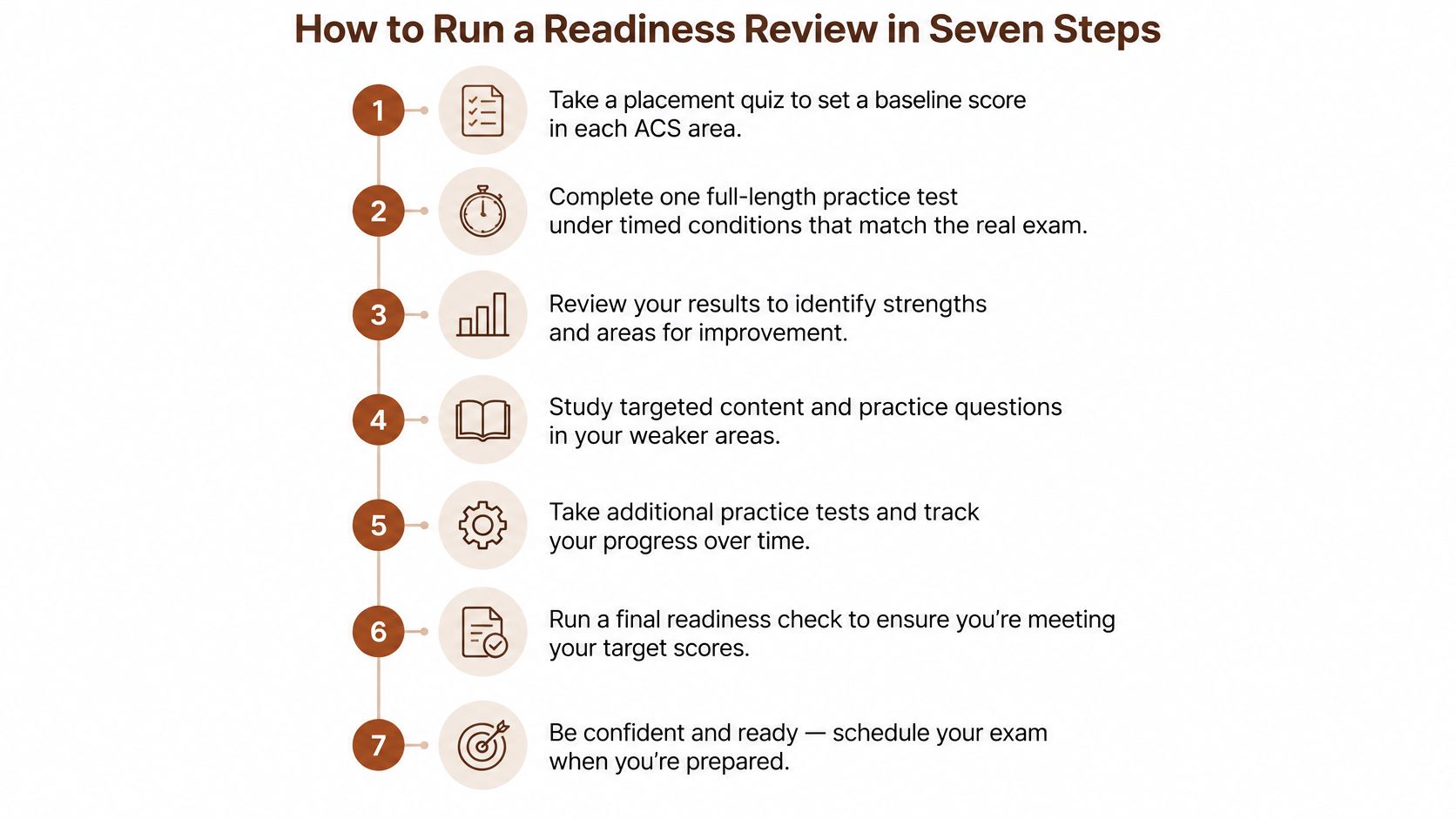
- Take a placement quiz and record a score in each ACS area. You need area-level numbers before you drill, or the week goes to topics you already know.
- Sit one full-length practice test on a timer that matches the exam. Pace and focus show up under real timing. The practice exams use the same layout as the PSI screen, the official system at every FAA testing center, so the clock and the screen feel familiar.
- Sort every miss by ACS code and rank areas from weakest to strongest. In the FAA frequently missed ACS codes report covering July 1, 2024, through June 30, 2025, code PA.IX.A.K3 accounted for 73.33% of recorded misses on the Private Pilot Airplane test, which shows where misses cluster rather than an overall failure rate. Sorting shows whether your misses pile up the same way, on one blocked area instead of a thin spread.
- Study the explanation for every miss in the weakest area first, and state the rule in your own words. Diagnosis comes before more questions. If you cannot say the rule without the answer choices, apply it to a new scenario, and explain it the way you would on a radio call, you are not done with that item.
- Re-test those areas after several days. Spaced repetition brings a question back right before you would forget it, so the re-test measures recall instead of this morning's memory.
- Run a mixed-domain simulation that covers every area in one sitting. Switching from weather to regulations to a clearance is a different skill from drilling one chapter. A strong score on single-topic sets can still fall apart when the subject changes mid-test.
- Record the scores and decide. A user is ready to schedule the test when scoring 85% or higher consistently, and when the Readiness Score goes green the student is ready and books the exam. If any area is still blocked, go back to step 3 and sort the new misses.
Stop the loop only when the weak area has caught up and the delayed re-test still holds.
Reading Your Results by ACS Area
The FAA Private Pilot Airplane ACS is the single source that connects knowledge-test expectations with practical-test knowledge, risk management, and skills. A readiness review that only tracks one quiz percentage misses that structure. Task-level items include radio-frequency selection, ATC phraseology, and communication procedures, along with weather, regulations, and navigation.
Say your overall average is 90 percent and weather is 40 percent. You are not ready for weather questions, however strong airspace and aerodynamics look. The high average hid a safety-critical gap. The same pattern shows up in regulations, navigation, and communications. A pilot who can recite cloud types but cannot read a forecast against a route is not done.

How to score coverage
Count the questions you attempted in each ACS area, then divide correct by attempted for that area alone. Flag any task you miss more than once. Do not call yourself ready until that task has been remediated and re-tested. A second miss on the same task is a pattern, not a slip.
Live FAA knowledge-test questions are not publicly released. Build the review from the applicable regulations, the testing matrix, and current references, and map each area the way a private pilot ACS study plan lays out the tasks. Memorized recognition of a bank item is not competence.
Make a list of every ACS area with its percentage. Mark any area below your target as a blocker, and do not move that mark until a later sitting clears it.
Testing Application and Communication Beyond Recall
A clean overall average can still leave one ACS area blocked. Picking the right letter on a practice item is a quieter skill than using the rule when the scenario changes, and quieter still than saying the right thing on a messy frequency. A readiness review has to show application and clear communication, or that average is only a costume for a gap.
Applicants can post a solid written score and still stumble on the practical test, because a knowledge item can miss the judgment safe piloting needs. Some subjects you understand never show up on the exam at all. Older test references could be broad, complex, trivial, outdated, or ambiguous. A 70% written-test threshold, which FAA certification materials treat as the pass line, is not proof you can use the material once the workload rises.
Two questions, two skills
A recall question asks which weather minimum applies. An application question hands you a forecast and a route and asks whether the flight should go. The first works like a flashcard in a quiet room. The second works like standing on the ramp with a sky that does not match the card.
You are at application level when three things are true. You can explain each answer in your own words. You can apply the rule to a scenario you have not seen. You can name the ACS task the question belongs to.
A high score can still hide weak weather decisions, risk management, navigation judgment, or clearance interpretation, for private and instrument students alike. Knowledge, risk management, and skill travel as one set. Scoring well on one of them does not clear the other two, which is how a blocked area stays hidden behind the overall number.
Radios under a bad signal
A memorized script falls apart once the frequency gets noisy. Garbled readbacks, blocked transmissions, and heavy controller workload all erode situation awareness on a live frequency.
A stronger check tests listening when part of a call is lost, choosing which of two calls matters, recovering after a blocked transmission, asking for clarification, and correcting a bad readback. Congestion, weak signals, accents, and task saturation show up on ordinary training days, not only in the worst stories.
If you are not sure what the controller said, ask for a repeat. Guessing is the failure.
Write one scenario question for your weakest area. Then run one interrupted-transmission drill and write down whether you asked for a repeat or filled in the blank yourself.
Choosing Practice Sources and Tracking Scores
A practice question is useful only when it maps to a current ACS area and you can check it against a current reference. The FAA publishes the ACS, the testing matrix, and the references. Live test items stay unpublished, so every practice item should trace to one area and to the book or regulation it cites. Drop any bank that rewards a memorized letter with no explanation of why the other choices fail. A FAA test prep app is worth using only when the items stay tied to those areas and the explanations are in plain language.
The score log
Keep one row per full-length test. Use these columns:
- Date: the day you sat the test, not the day you reviewed it.
- Test source: which bank or simulation, so a soft quiz is not mixed with a full exam.
- Overall score: one number, recorded before you look at explanations.
- Score for each ACS area: the split that shows a hidden gap.
- Missed ACS codes: the specific tasks, not just the chapter name.
- Explanations completed: yes only if you stated every miss in your own words.
- Planned re-test date: several days out, written down before you close the log.
Compare the trend across several full-length tests before you decide anything. Say one sitting is 88 and the next is 74. The average can still look acceptable, and the review is not stable. Check coverage every cycle so each ACS area is attempted at least once. An area you skipped is not an area you passed.
Set up the log with those columns and enter your last three practice results before the next study block.
Deciding When to Book Your FAA Knowledge Test
Book the exam when every check in the opening table is green and practice scores hold at 85% or higher across several full-length tests. That is the standard we use for scheduling. The Readiness Score predicts exam score with 94% accuracy from practice across every ACS area, and when that score goes green you book. The published passing mark is the minimum to pass. 85% is the margin you want before you spend the testing fee. A date on the calendar is not a reason to sit.
| Situation | Rule | Next action |
|---|---|---|
| Every check green | Scores at 85% or higher across several full-length tests | Book the exam |
| One yellow ACS area, rest green | The weakest area is the only gap | Spend one more cycle on that area, then re-test |
| Any red row or unstable scores | A check fails or scores swing between tests | Return to step 3 of the seven-step review |
Three situations, one decision
If every row is green, schedule. You have coverage, a stable score, explanations, and a scenario check, not a lucky quiz.
If one ACS area is yellow and the rest are green, spend one more cycle on that area. Re-test it after several days, then decide again. Do not let a single soft area ride along because the overall number looks polite.
If any row is red, or the scores swing from test to test, go back to step 3 and re-sort the misses by ACS code. Volatility means the knowledge is not yours yet. Our realistic exam simulations use timed conditions that match the exam, so use one of those before you trust a green mark. The FAA written test scheduling steps come after the log says you are ready, not before.
Check each row against your score log today. Book only when the decision is green.
flyCowboys is an iPhone study app for the private pilot and instrument knowledge tests, with adaptive ACS drills, plain-English explanations, PSI-style practice exams, and radio practice that matches the checks in a readiness review. When your scores hold and the weak areas are closed, the Readiness Score is the signal to schedule. Start with a placement quiz at flyCowboys and see which rows are still red.