· 17 min read
IFR Flight Requirements for Pilots: A Complete Guide
IFR Flight Requirements explained: 14 CFR 61.65 eligibility, 40 instrument hours, endorsements, tests and six-month currency rules for pilots.
The advice to “get the hours, pass the written, and stay current” leaves out the most important distinction in instrument flying: legal qualification and operational readiness aren't the same thing. A pilot can satisfy a logbook requirement yet struggle when the outside horizon disappears, an instrument fails, and ATC changes the clearance.
Treat IFR flight requirements as separate checks: eligibility for the rating, readiness for the tests, authorization for the flight, and proficiency for the conditions. Some are hard legal gates. Others require an honest judgment about what you can do in the airplane you'll fly.
Table of Contents
- Eligibility Requirements for an Instrument Rating
- Instrument Experience Hours Required by 14 CFR 61.65
- How the Knowledge and Practical Test Path Works
- ACS Areas of Operation the Practical Test Covers
- IFR Currency Rules and When an IPC Is Required
- Filing Flight Plans and Getting ATC Clearances
- Why Legal Currency Does Not Guarantee Safe IMC Flying
- Confirm Your Eligibility Before You Book the Test
Eligibility Requirements for an Instrument Rating
| Condition | What the rule requires | Source |
|---|---|---|
| Pilot certificate | Private pilot certificate held, or private and instrument ratings applied for together, with the appropriate category and class | Instrument-rating eligibility regulation |
| English language | Read, speak, write, and understand English, subject to FAA safety limitations | Instrument-rating eligibility regulation |
| Ground training | Instructor-provided training or an approved home-study course, completed and logged | Instrument-rating eligibility regulation |
| Instrument flight training | Logged training in an appropriate aircraft, full-flight simulator, or flight-training device | Instrument-rating eligibility regulation |
These are distinct eligibility conditions under 14 CFR § 61.65, which also requires the applicable instructor endorsements and successful knowledge and practical tests. They aren't interchangeable: passing an exam doesn't erase missing training or an unsigned endorsement.
Your certificate establishes the privileges you're building on. Check the category and class rather than assuming that holding any pilot certificate settles the issue. An instrument-airplane training plan must match the rating you're seeking.
The English-language requirement concerns reading, speaking, writing, and understanding. In practice, you need to interpret charts and weather information, understand clearances, and communicate accurately when you're busy. If a medical condition affects this eligibility requirement, the FAA's safety limitations matter, not an informal judgment from a study provider.
Ground preparation and flight preparation have different gates
Ground training establishes your preparation for the knowledge test. Complete the course, preserve the training record, and obtain the readiness endorsement before presenting yourself for that test.
Instrument flight training establishes a different part of your qualification. Your records must document the training, and an authorized instructor must endorse your readiness for the practical test. A course-completion screen isn't a substitute for that endorsement.
For example, a student can finish an approved home-study course and obtain the knowledge-test endorsement before accumulating instrument flight experience. That student can pursue the written exam while continuing flight training, but can't treat a passing score as permission to take an otherwise unsupported checkride.
Practical rule: Match every eligibility claim to a certificate, training record, test result, or instructor endorsement.
Mark each condition met, in progress, or missing with your instructor. Don't use a single “ready” checkbox for the entire process. Separate records make it easier to identify whether your next action is studying, flying, correcting documentation, or obtaining an endorsement.
Instrument Experience Hours Required by 14 CFR 61.65
For an airplane instrument rating under 14 CFR 61.65, the required experience includes 40 hours of actual or simulated instrument time, with at least 15 hours provided by an authorized instructor. The cross-country and approach requirements are separate checks within that experience.
| Requirement | Required amount | Notes |
|---|---|---|
| Total instrument experience | 40 hours | Includes actual or simulated instrument time. |
| Instrument training from an authorized instructor | At least 15 hours | The instructor must be authorized to provide instrument training. |
| Simulator and training-device credit | Up to 20 hours | Credit depends on the approved device and applicable training pathway. |
| Instrument cross-country flight time | One qualifying flight | Must meet the route, airport, and approach requirements in § 61.65. |
| Instrument approaches before the practical test | Six approaches | The required approaches must meet the rule's conditions, including use of different kinds of approaches. |
A logbook total alone does not establish eligibility. Keep aircraft instrument time, instructor training, device credit, cross-country details, and approaches identifiable so each requirement can be checked on its own. A single entry may count toward more than one category, but the categories are not interchangeable.
Don't confuse cross-country training, recent training, and currency
A qualifying instrument cross-country flight has specific route and approach conditions. Recent practical-test preparation concerns readiness for the checkride. Instrument currency, by contrast, determines whether a rated pilot may exercise instrument privileges.
An approach count does not replace required instructor training. A local flight with several approaches also does not satisfy the cross-country requirement unless it meets the rule's route and airport conditions.
Plan the qualifying flight with your instructor. Before departure, agree on the route and approaches, and confirm how weather, equipment outages, or an amended clearance could affect whether the flight meets the requirement.
Audit the entries, not just the arithmetic
A combined aircraft and device total may look sufficient while hiding a shortfall. For example, some time may be in a device that does not qualify for the credit claimed, or an entry may lack the details needed to show what training occurred.
A flight logbook with requirement tracking can help organize entries, but your instructor must still determine whether each one qualifies.
- Aircraft entries: Identify actual or simulated instrument conditions and the training performed.
- Instructor entries: Record the instruction provided and the instructor's details.
- Device entries: Identify the device and confirm that the claimed credit is permitted.
- Cross-country entries: Keep the route and approach details needed to show the flight qualifies.
- Approach entries: Record enough detail to verify each approach against the rule.
A device that resembles your airplane does not automatically qualify. Its approval and permitted use determine whether its time can count.
How the Knowledge and Practical Test Path Works
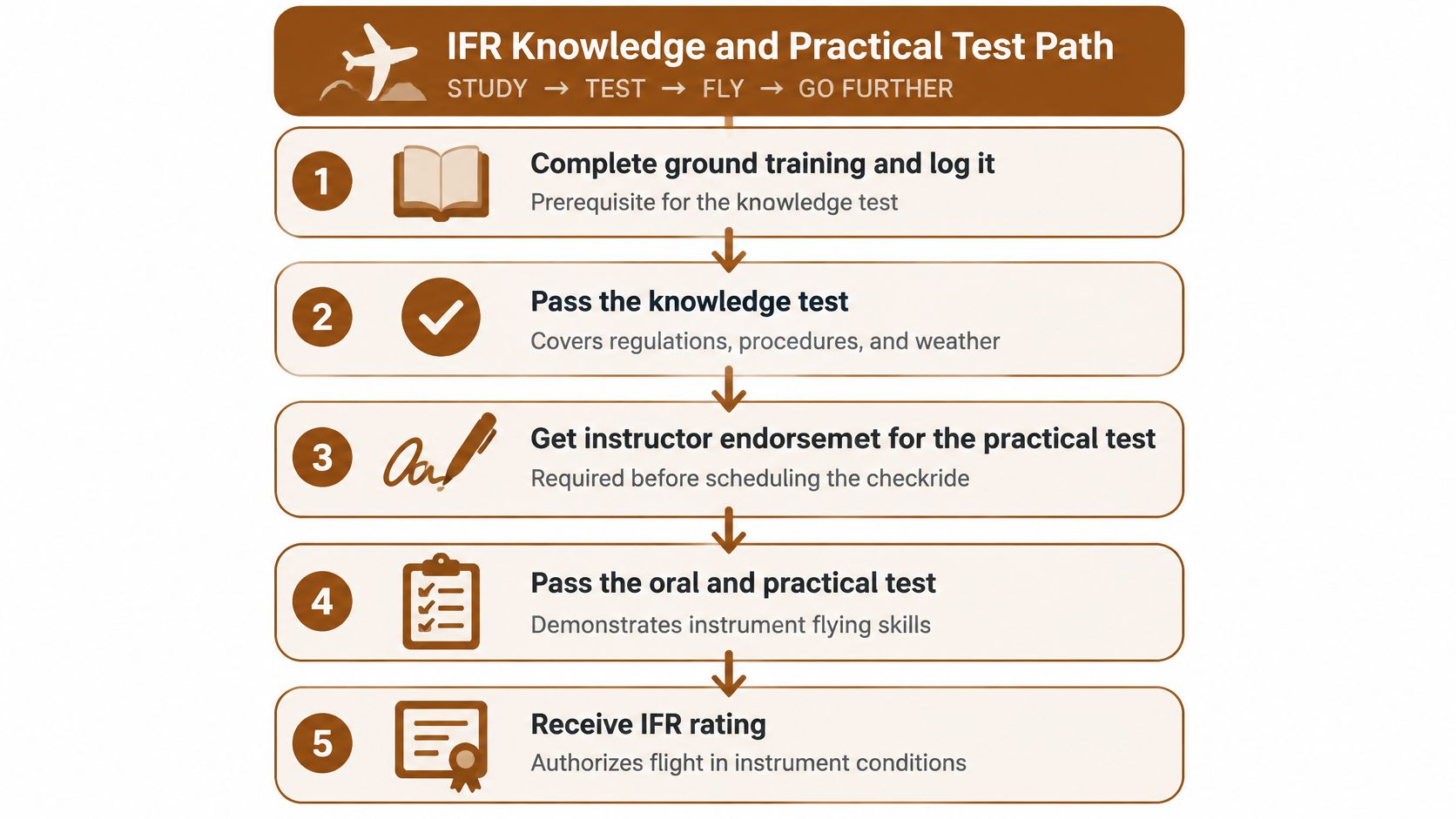
The knowledge test and practical test are separate gates. Study and flight lessons can happen at the same time, but each requirement needs its own documentation.
Complete and log ground training. Use instructor-provided training or an approved home-study pathway. Keep the completion documentation so your instructor can verify what you covered.
Obtain the knowledge-test endorsement. Confirm that the required endorsement is in place before taking the test. Confidence with practice questions does not replace authorization.
Pass the knowledge test before the practical test. Use missed questions to find gaps in your understanding, rather than memorizing answers. An IFR study guide can help explain weather, procedures, and regulations in plain language.
Complete and document the required instrument training. Ground study and flight training may overlap. Keep records that show each training requirement has been met.
Obtain the practical-test endorsement. Your instructor evaluates your knowledge and flying performance, not just your logged totals, before recommending you for the test.
Pass the practical test in an appropriate aircraft or eligible device. Approval for training credit does not automatically mean a device is approved for every practical-test task. Confirm its suitability before making arrangements.
What study software cannot authorize
flyCowboys supports FAA knowledge-test preparation, but it does not replace certified flight instruction from an authorized flight instructor (CFI), official FAA publications, approved Part 61 or Part 141 flight training programs, FAA knowledge or practical tests, or aircraft flight manuals and pilot operating handbooks.
Software can help you study. It cannot confirm that your instructor has reviewed your training record or endorsed you for a test.
A test appointment is a scheduling decision. An endorsement is an instructor's documented determination of readiness.
Before booking, check your records. Confirm that the training is documented, the required endorsement is available, and you are scheduling the next test you are eligible to take.
ACS Areas of Operation the Practical Test Covers
| Area of operation | What it covers | Checkride focus |
|---|---|---|
| I. Preflight Preparation | Qualifications, weather, cross-country planning | Defensible flight-planning decisions |
| II. Preflight Procedures | Instrument and navigation equipment checks, cockpit checks | Aircraft readiness and organized setup |
| III. ATC Clearances and Procedures | Clearances, compliance, and holding procedures | Understanding and executing authorization |
| IV. Flight by Reference to Instruments | Instrument control and unusual-attitude recovery | Aircraft control without outside references |
| V. Navigation Systems | Navigation-system use and related services | Correct setup, identification, and tracking |
| VI. Instrument Approach Procedures | Approaches, missed approaches, circling, and landing | Procedural accuracy and aircraft control |
| VII. Emergency Operations | Communications and equipment failures | Prioritization and safe decisions |
| VIII. Postflight Procedures | Instrument and equipment discrepancy checks | Identifying and documenting discrepancies |
The FAA Instrument Rating–Airplane Airman Certification Standards organizes practical-test expectations into eight Areas of Operation and integrates knowledge, risk management, and skills. It also requires the applicable knowledge test to be passed before the practical test.
That organization is more useful than a loose list of IFR topics. Knowing the definition of a missed approach isn't the same as recognizing when to execute one, configuring the airplane, navigating correctly, and managing the associated workload.
Study the decision and the demonstration
For each weak task, ask what you must explain, what risk you must recognize, and what action you must perform. Weather study, for example, should produce a departure or diversion decision, not merely accurate decoding of an airport report.
Use lost communications as a connected scenario. Review the clearance you accepted, then introduce a radio failure and explain what changes. The clearance context belongs in your procedural preparation; the failure response belongs in emergency practice.
Don't assign a task to an area solely because the topic sounds related. Use the ACS task itself to identify the examiner's expectations.
- Knowledge: Explain the procedure without depending on a memorized answer choice.
- Risk management: Identify what could make the procedure unsafe or inappropriate.
- Skill: Demonstrate it while maintaining aircraft control and situational awareness.
Use the applicable edition
The FAA ACS publication page identifies the Instrument Rating–Airplane ACS published in April 2024, effective May 31, 2024. Check the FAA's publication listing when preparing rather than assuming a downloaded copy is still the applicable edition.
Maintain a study sheet with the task name, your weak point, and the exercise you'll use to address it. Keep eligibility auditing alongside that preparation: a strong task demonstration doesn't resolve an experience-credit shortfall, and an immaculate logbook doesn't demonstrate task mastery.
IFR Currency Rules and When an IPC Is Required
| Item | Rule | If it lapses |
|---|---|---|
| Recent instrument experience | Qualifying approaches, holding, and intercepting/tracking within the applicable calendar-month window | You can't act as PIC under IFR or below VFR weather minimums |
| Instrument proficiency check | Required when the permitted opportunity to regain currency through experience has expired | Complete the required proficiency check before exercising those privileges |
| Simulator or training-device experience | Must qualify for the intended currency use | Unsupported device entries can't establish currency |
The FAA's currency and proficiency-check guidance explains the six-calendar-month instrument-experience framework and the ACS-based scope of an instrument proficiency check. Don't confuse the period used to establish current experience with the separate provisions for regaining currency after it expires.
Losing currency doesn't automatically mean an IPC is immediately mandatory. There can be an opportunity to regain the required experience without an IPC, but that opportunity isn't permission to act as PIC under IFR while noncurrent.
Calculate the window from the full record
Check the qualifying set of events, not just the date of your most recent approach. A recent approach doesn't establish currency if other required experience is missing.
Avoid using a remembered month as a shortcut. Calendar-month rules aren't the same as counting a fixed number of days, and an isolated logbook entry doesn't tell you whether the complete requirement was satisfied.
Have your instructor review the applicable dates and identify the lawful route back to currency. That might involve appropriately conducted simulated-instrument practice, qualifying device use, or an IPC, depending on your record.
Make currency provable
Your logbook should let another qualified person reconstruct what you did without guessing.
- Approaches: Record the date, approach type, and identifying details.
- Holding: Identify the holding work rather than assuming it's implied by an approach entry.
- Intercepting and tracking: Document the relevant navigation practice.
- Conditions: Distinguish actual instrument conditions, simulated instrument conditions, and approved-device use.
- Device identity: Preserve the information needed to establish eligibility for the credit claimed.
An IPC isn't a convenient way to collect approach entries. It evaluates the applicable instrument tasks and proficiency, and additional training may be necessary before satisfactory completion.
Currency check: Can you show the qualifying events and explain why they count, without relying on a summary total?
Schedule recurrent practice before your privileges become a question. Even when the record establishes currency, choose training that reflects the airplane, avionics, and conditions you intend to use.
Filing Flight Plans and Getting ATC Clearances
An instrument rating doesn't authorize every IFR operation by itself. Under 14 CFR § 91.173, IFR operation in controlled airspace requires both a filed IFR flight plan and an ATC clearance.
Filing tells the system what you propose. The clearance tells you what you're authorized to do. Don't depart on your requested routing merely because you submitted it successfully.
Before takeoff
Copy the clearance, compare it with your proposed route, and resolve uncertainty before moving into a high-workload phase. Work through an IFR clearance example until you can distinguish the clearance limit, route, altitude instructions, and departure details.
Determine which takeoff rules apply to your operation. Don't treat published takeoff minimums as universally binding on every general-aviation departure, and don't treat the absence of an applicable legal minimum as a sound reason to launch into conditions you can't manage.
A departure still needs a plan for obstacle clearance, equipment failure, and where you'll go if you can't continue.
If communications fail
For an IFR lost-communications situation, work through the route hierarchy in context:
- Assigned route: Follow the route assigned in the last clearance.
- Radar vectors: If being vectored, proceed directly to the fix, route, or airway specified in the vector clearance.
- Expected route: Use the route ATC advised you to expect when applicable.
- Filed route: Use the filed route when the preceding alternatives don't apply.
Route selection is only part of lost-communications planning. Weather conditions, altitude, clearance limits, and approach timing also need consideration; don't reduce the procedure to a mnemonic.
For example, a clearance involving a holding fix doesn't permit you to improvise a preferred route after radio failure. Work from the clearance and applicable procedures, then address the clearance-limit problem explicitly.
Before departure, confirm:
- Flight plan: The intended IFR plan has been filed.
- Clearance: You've received, understood, and accepted the authorization.
- Departure: Applicable minimums and a workable obstacle-clearance plan are addressed.
At the destination, verify cancellation or closure with ATC or Flight Service as appropriate. Don't assume landing at an airport without an operating tower automatically closes the plan.
Why Legal Currency Does Not Guarantee Safe IMC Flying
Logged experience doesn't prove that you can manage a sudden loss of visual references. The first challenge may be resisting an apparently convincing sensation that the instruments are wrong.
The cockpit, not an outside horizon, becomes your reference in cloud.
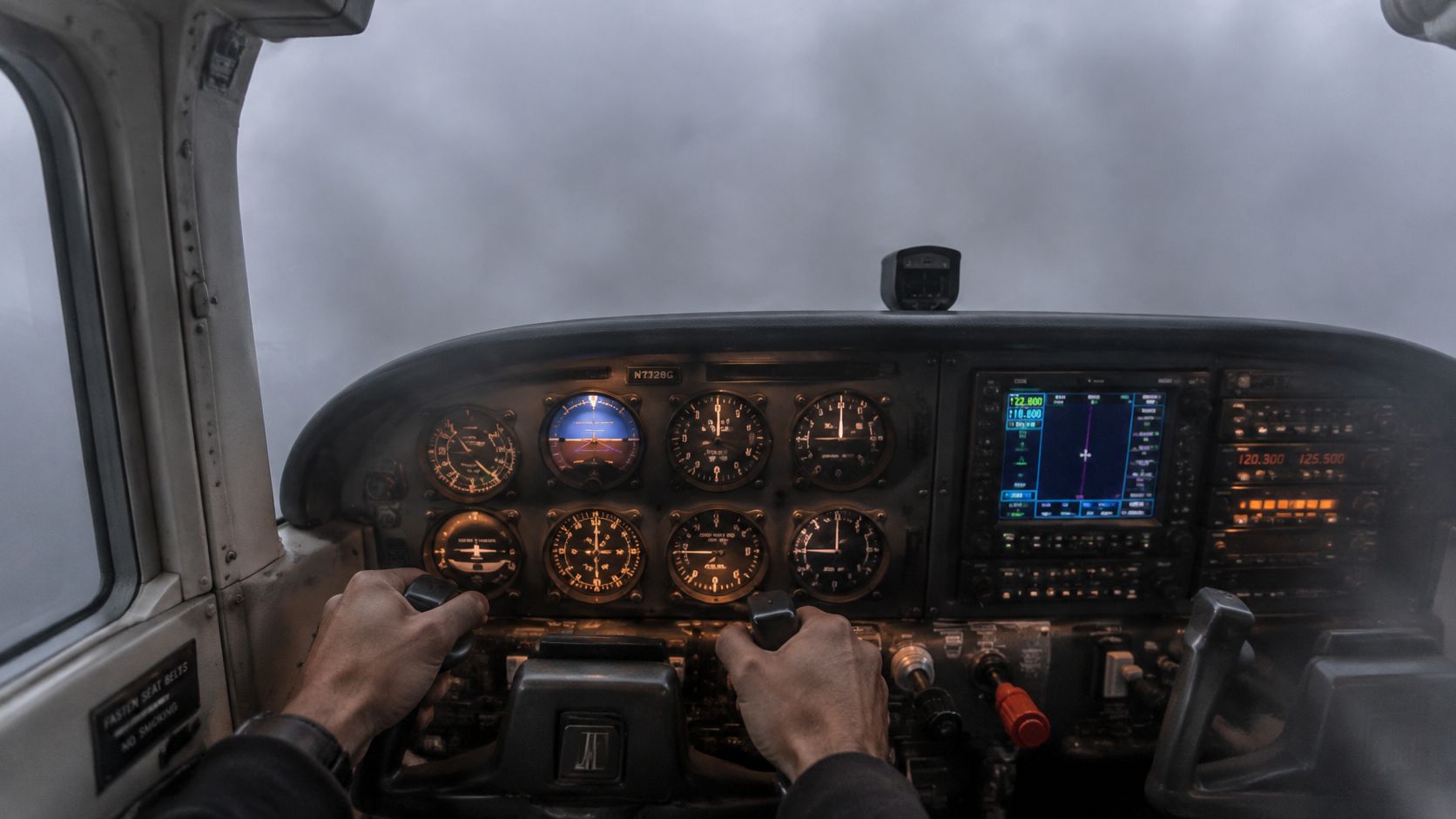
The FAA's spatial-disorientation analysis reports a 94% fatality rate for the general-aviation spatial-disorientation accidents it examined. That finding supports treating disorientation recognition and instrument control as operational survival skills, not checkride-only exercises.
A practiced approach in familiar conditions may not reveal what happens when you're startled, fatigued, uncertain about the automation, or trying to interpret conflicting indications. Currency establishes compliance with an experience rule; proficiency means your performance remains dependable under the workload you'll encounter.
Train observable responses
Ask yourself: Does my simulator practice prepare me for the transition when visual references disappear? Can I explain why a legally current pilot might still be unprepared for unexpected IMC?
A simulator can rehearse procedures and workload, but don't assume it reproduces every physical sensation or stressor of flight.
- Instrument control: Maintain attitude and flight path before reaching for a checklist or changing navigation settings.
- Partial-panel flying: Identify the failed indication and use the remaining reliable information.
- Illusion recognition: Recognize when a bodily sensation conflicts with valid instrument indications.
- Autopilot use: Know the active modes, limitations, disconnect procedure, and failure indications.
- Escape planning: Brief a workable response to deteriorating weather rather than inventing one after entering it.
Use video as a discussion aid, then practice the relevant skills with an appropriately qualified instructor.
Your personal minimums should reflect demonstrated performance, not confidence alone. If routine avionics programming disrupts your scan during training, adding cloud, turbulence, and an amended clearance won't simplify the task.
The self-test is concrete: Can you recover from an unusual attitude using instruments alone, without the horizon? Demonstrate it in a controlled training setting. Don't use an actual weather encounter to discover the answer.
Confirm Your Eligibility Before You Book the Test
Book the test you're eligible for, not the test you hope your remaining training will justify. You don't need completed instrument-flight experience or operational instrument currency merely to take the knowledge test. You do need the applicable preparation and endorsement.
Start with an authorized instructor and separate your written-test readiness from practical-test readiness.
- For the knowledge test: Verify your eligibility, completed ground preparation, and required endorsement.
- For the practical test: Verify the knowledge-test result, applicable experience categories, recent preparation, and instructor recommendation.
- For later IFR operations: Verify current pilot privileges, qualifying recent experience, aircraft suitability, and the authorization for that flight.
Bring your underlying entries, not just totals. Ask the instructor to identify any unsupported device credit, incomplete cross-country documentation, or missing training endorsement before you commit to a checkride date.
Build your remaining study around ACS tasks you can't yet explain or demonstrate. If the written exam is your next eligible milestone, take it while continuing flight training. If your practical-test gap is experience or performance, schedule the appropriate instruction rather than treating a test booking as motivation to catch up.
Your final decision needs both answers: Am I legally eligible, and can I perform the required tasks reliably? Neither answer substitutes for the other.
Visit flyCowboys to select your rating, take a placement quiz, and build a personalized written-study plan around your weak areas. You can also log flights in seconds and track PPL and IFR experience categories, including night, cross-country, hood time, and solo, then review the records with your instructor before booking.