· 8 min read
FAA Private Pilot Written Test Practice That Actually Works
Build a 30-day FAA private pilot written test practice plan with spaced repetition, PSI-style drills, and ACS-mapped review that turns weak areas into a passing

You're at the kitchen table with a notebook open, a practice bank on your phone, and a PSI appointment circled on the calendar. The questions look familiar, the score looks decent, and still there's that uneasy feeling that you're recognizing stems more than you're understanding the FAA's logic. That's the gap good faa private pilot written test practice has to close, because the exam rewards people who can justify the answer under time pressure, not just spot it.
Table of Contents
- Why Most Private Pilot Written Practice Falls Short
- Running Your First Diagnostic Block by ACS Area
- The Daily Drill Loop Using Spaced Repetition
- Why a Single PSI-Style Practice Test Is Not Enough
- Retrieval After Delay and the 24-Month Knowledge Expiry
- Targeted Fix-Ups for the Three Weak Areas That Cause Most Fails
- Your Final Week and the Readiness Checklist
Why Most Private Pilot Written Practice Falls Short
A student sitting at the PSI center often knows the answer choices and still can't explain why one is correct. That's the classic trap, repeated exposure to the same wording makes the bank feel easy, but it doesn't prove the pilot can defend the answer with the governing regulation, chart, or calculation.
The FAA Private Pilot Airplane test, PAR, has 60 multiple-choice questions, a 2-hour limit, and a 70 percent passing score, with the test built across broad knowledge domains rather than one narrow topic (FAA ACS, FAA testing matrix). That means a pile of “familiar” questions can hide weak spots in weather, airspace, performance, or human factors.
Practical rule: If you can't explain the rule behind a missed question in plain English, you don't own the topic yet.
The better habit is simple. Practice should measure the ACS area, force timed retrieval, and make you write down why each miss happened. That turns practice from a score chase into real diagnosis.
Running Your First Diagnostic Block by ACS Area
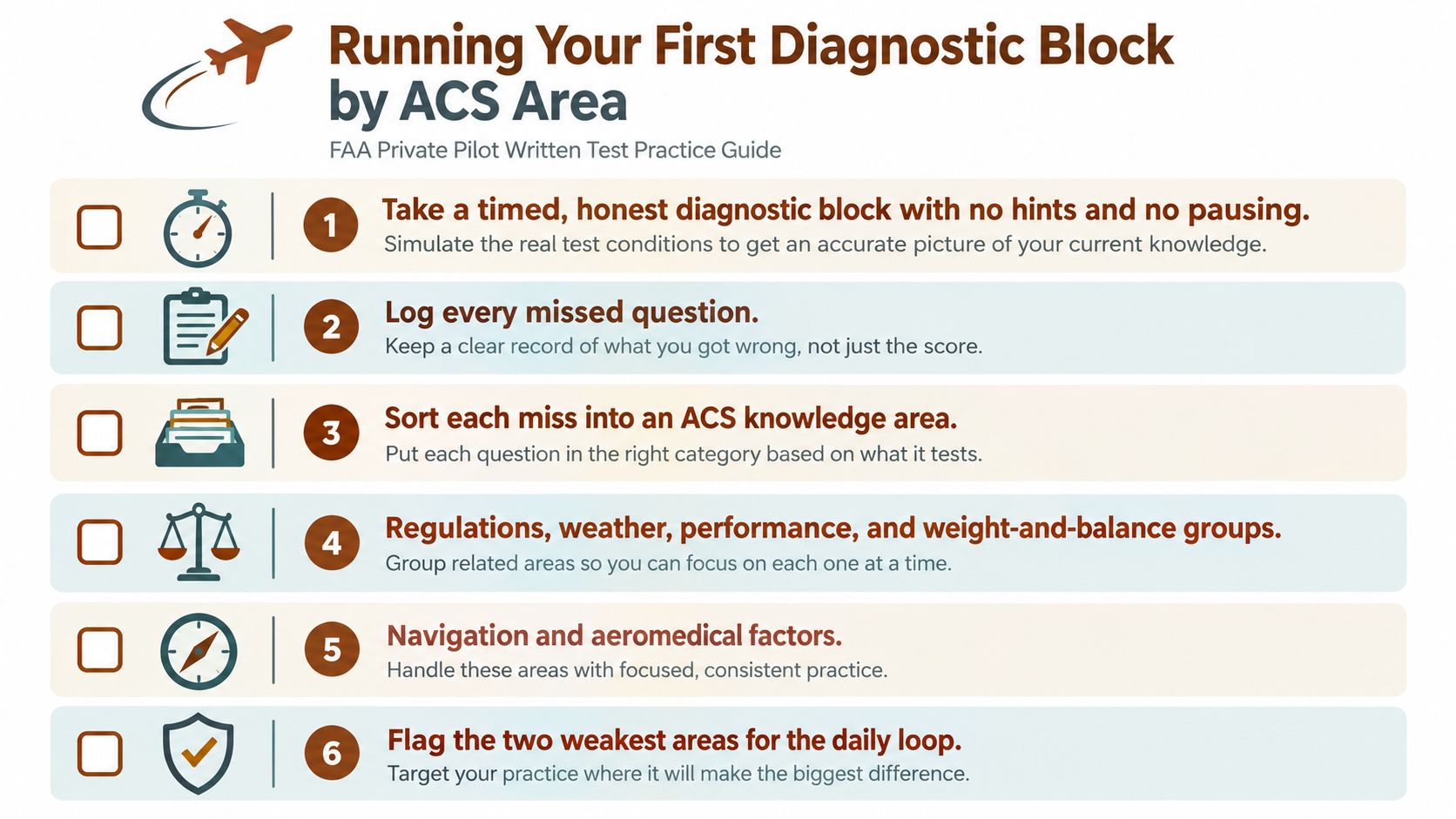
Start with one honest block. No hints, no pausing, no looking anything up, just the clock, the questions, and your best answer. Then tag every miss by ACS area, not by vibe.
The FAA's private pilot ACS includes areas such as regulations, accident reporting, performance charts, radio communications, weather, safe and efficient operations, density-altitude performance, weight and balance, aerodynamics and aircraft systems, stalls and spins, aeronautical decision-making, and preflight actions (FAA ACS). On a real student profile, a weather-heavy miss pattern usually means decoding problems, while a performance-heavy pattern usually means chart reading or math is the bottleneck.
Simple score sheet to use after every block
- Question number:
- ACS area:
- Why I missed it:
- Rule, chart, or regulation that controlled the answer:
- What I'll do next time:
A strong next step is to sort your misses into two or three areas only, then attack those first. If you try to fix everything at once, nothing gets fixed.
For deeper ACS organization, the private pilot ACS overview at flyCowboys' ACS guide fits well beside this kind of review. It helps keep the study process tied to the standard instead of to random question memorization.
The Daily Drill Loop Using Spaced Repetition
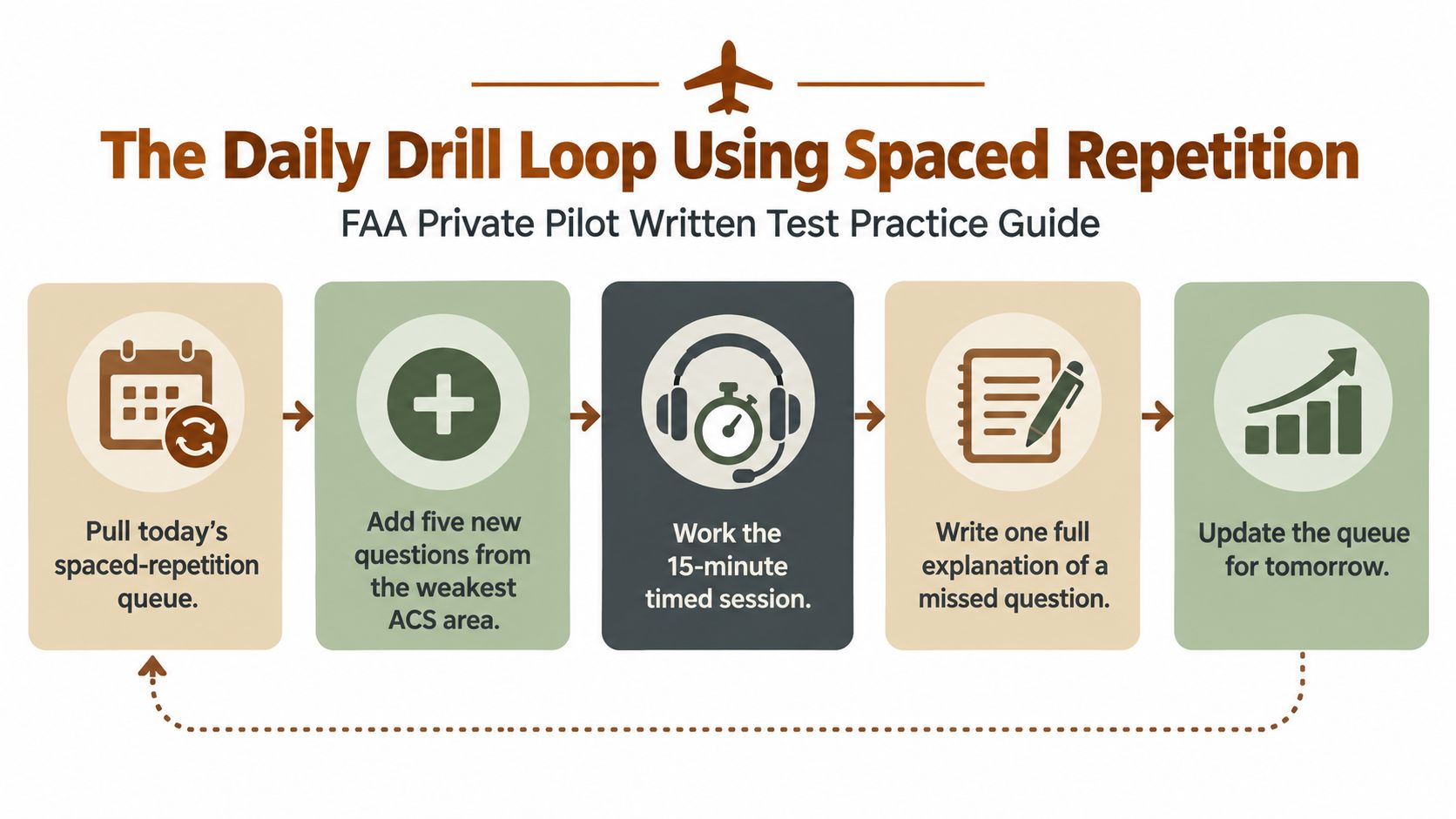
A short daily loop beats a long weekend binge. Pull the items due today, mix in a few questions from your weakest ACS area, then finish by writing one explanation in your own words. That last step matters because it forces you to convert recognition into recall.
A realistic 20-minute session looks like this:
- 5 minutes, review today's due items.
- 7 minutes, answer five fresh questions from the weakest area.
- 5 minutes, write one full explanation for a missed rule.
- 3 minutes, update your queue for tomorrow.
A mixed session trains the brain to switch among weather, regulations, and performance the way the real test does.
If you want a practical tool mix, flyCowboys is one option that combines adaptive question practice, spaced repetition, PSI-style exams, and ACS-mapped explanations in one app. That matters because the daily loop works best when weak items come back on schedule, not whenever you happen to remember them.
For a short study break, this embedded lesson can help with the mindset around repetition and consistency:
Why a Single PSI-Style Practice Test Is Not Enough
One full practice test tells you where you are that day. A string of full simulations tells you whether you can hold that score under fatigue, chart interpretation, and pacing pressure. That's a very different signal.
The FAA reported 46,132 Private Pilot Airplane knowledge test takers in 2024, with a 91.90 percent pass rate and an 82.89 percent average score (FAA 2024 test statistics). The 2023 report showed 45,820 tests, a 90.30 percent pass rate, and an 82.05 percent average score (FAA 2023 test statistics). Those averages suggest that consistent scores in the low-to-mid 80s are a better readiness signal than one lucky run.
A short quiz can flatter you. A full 60-question session exposes whether your reading speed holds up when every question is on the clock and every chart feels slightly more annoying than it did at home. After each simulation, log the misses by ACS area, the time you felt rushed, and the questions you only got right by memory.
For another structured prep path, flyCowboys' written test prep guide is worth comparing against your current routine. The useful standard is not “did I pass one quiz,” it's “can I repeat the result in the actual format?”
Retrieval After Delay and the 24-Month Knowledge Expiry
A question you answer correctly today can still vanish by next month. That's why the FAA's 24 calendar month validity window matters, because retention has to last long enough to carry you to the practical test (FAA testing matrix).
Use retrieval after delay. Review a missed item at 1 day, 3 days, 7 days, and 21 days. Only mark it learned when you can answer it cleanly at every interval without a hint.
A density-altitude problem should survive the delay with the full logic intact, not just the final number. A METAR or TAF question should survive with the decoding order intact, too. If the answer falls apart at day 7, it was recognized, not learned.
Targeted Fix-Ups for the Three Weak Areas That Cause Most Fails
Weather, performance, and airspace are where a lot of students bleed points, mostly because those topics demand interpretation, not recall. The fix is not more random questions, it's tighter drilling.
Weather
Spend two weeks on METARs, TAFs, and the “why” behind the report. Read one weather product aloud every day, then answer a few decoding questions without notes. The rule to memorize is simple, if you can't translate the report into flight conditions, you're not ready.
Performance and weight and balance
Work chart reading and density-altitude problems together. Build a habit of identifying the controlling line on the chart before you calculate anything. If you miss these, it's usually because the chart wasn't read in the right order.
Airspace and radio communications
Learn the airspace picture first, then the phraseology. The goal is to stop guessing based on word association and start matching the situation to the correct rule set. One useful companion here is flyCowboys' ground school overview, especially if your study stack needs more structure than a raw question bank.
| Topic | Most-Tested Rule | Common Trap | Drill Frequency |
|---|---|---|---|
| Weather | Decode the report before interpreting it | Skipping wind, visibility, or ceilings | Daily |
| Performance | Read the chart line that applies | Jumping straight to the math | Daily |
| Airspace | Match class and equipment requirements | Mixing up similar-looking rules | Every other day |
Your Final Week and the Readiness Checklist
In the final week, run two full PSI-style simulations, keep a light review queue, and don't add new topics. Then check the ACS-area scorecard and be honest about the weak spots you still can't explain cleanly.
- Schedule when you can score in the low-to-mid 80s consistently.
- Don't book if any ACS area is still below your target.
- Make METAR and TAF decoding feel routine.
- Be able to explain why every wrong answer was wrong.
- Use the test report to refine the oral prep later, not to rescue a bad study plan.
If that checklist feels solid, you're ready to stop grinding and book the seat. The right move is to trust the prep when the prep has been measured.
If you want a tighter routine for FAA private pilot written test practice, flyCowboys combines ACS-mapped questions, adaptive review, PSI-style simulations, and radio drills in one app. Visit flyCowboys and use it to turn weak ACS areas into a clean, repeatable study plan before you walk into the testing center.