· 14 min read
IFR 123 Rule: When an Alternate Is Required
The IFR 123 rule explained: the 2,000-foot ceiling and 3-mile visibility test, the two-hour window, and when you must file an alternate airport.

A ceiling of at least 2,000 feet above airport elevation and visibility of at least 3 statute miles, both held from 1 hour before to 1 hour after your estimated time of arrival, plus a published instrument approach at the destination, generally let you file without an alternate under the IFR 123 rule. But if the forecast only just qualifies, have you proved that you don't need a backup, or only that you're allowed to leave the alternate box blank?
That distinction matters. A student can memorize the numbers and still make a weak flight-planning decision by overlooking a weather trend, an unavailable approach, or the fuel needed for a practical diversion.
Table of Contents
- What the IFR 123 Rule Tests
- How to Check a Destination Forecast Against 1-2-3
- Destination and Alternate Standards Compared
- Judging a Forecast That Barely Clears 1-2-3
- Using GPS and WAAS Approaches as Alternates
- Common Misreadings of the 1-2-3 Rule
- Filing Decision by Scenario
What the IFR 123 Rule Tests
The IFR 123 rule is a destination-weather test used to decide whether an alternate must be listed on an IFR flight plan. For aircraft other than helicopters, 14 CFR § 91.169 establishes the familiar thresholds: 1 hour before and after ETA, a ceiling of at least 2,000 feet above airport elevation, and visibility of at least 3 statute miles.
Think of the alternate as the normal planning requirement, with an exception available when the destination qualifies. That framing is more useful than assuming you don't need an alternate until the weather looks particularly bad.
Read the conditions together
The ceiling and visibility requirements are connected by and, not or. A generous ceiling doesn't compensate for inadequate visibility, and excellent visibility doesn't compensate for a low ceiling.
The time element matters just as much. You're evaluating the applicable weather across the arrival window, not selecting the most favorable forecast line or checking only the estimated touchdown time.
There's also a condition that the mnemonic doesn't spell out: the destination must have a qualifying published instrument approach procedure. Good forecast weather alone isn't the complete exemption.
Planning distinction: Permission to omit an alternate is not a prediction that you'll land successfully at the destination.
What the test leaves unanswered
Passing the filing test doesn't settle whether the runway will remain available, whether your equipment supports the approach, or whether deteriorating weather will make continuing sensible. Those questions require an operational review.
Keep the decision narrow when you're learning it: first establish whether an alternate is required. Then decide whether filing and preparing one is prudent anyway. Separating those questions prevents a legal minimum from becoming your entire weather strategy.
How to Check a Destination Forecast Against 1-2-3
Start with the arrival time you expect to use, not an old estimate left in your planning app. Under the current destination-exemption provision in § 91.169, the published approach condition and weather showing at least a 2,000-foot ceiling and 3 statute miles visibility from 1 hour before through 1 hour after ETA must support the exemption.
Use the forecast as a timeline rather than a snapshot.
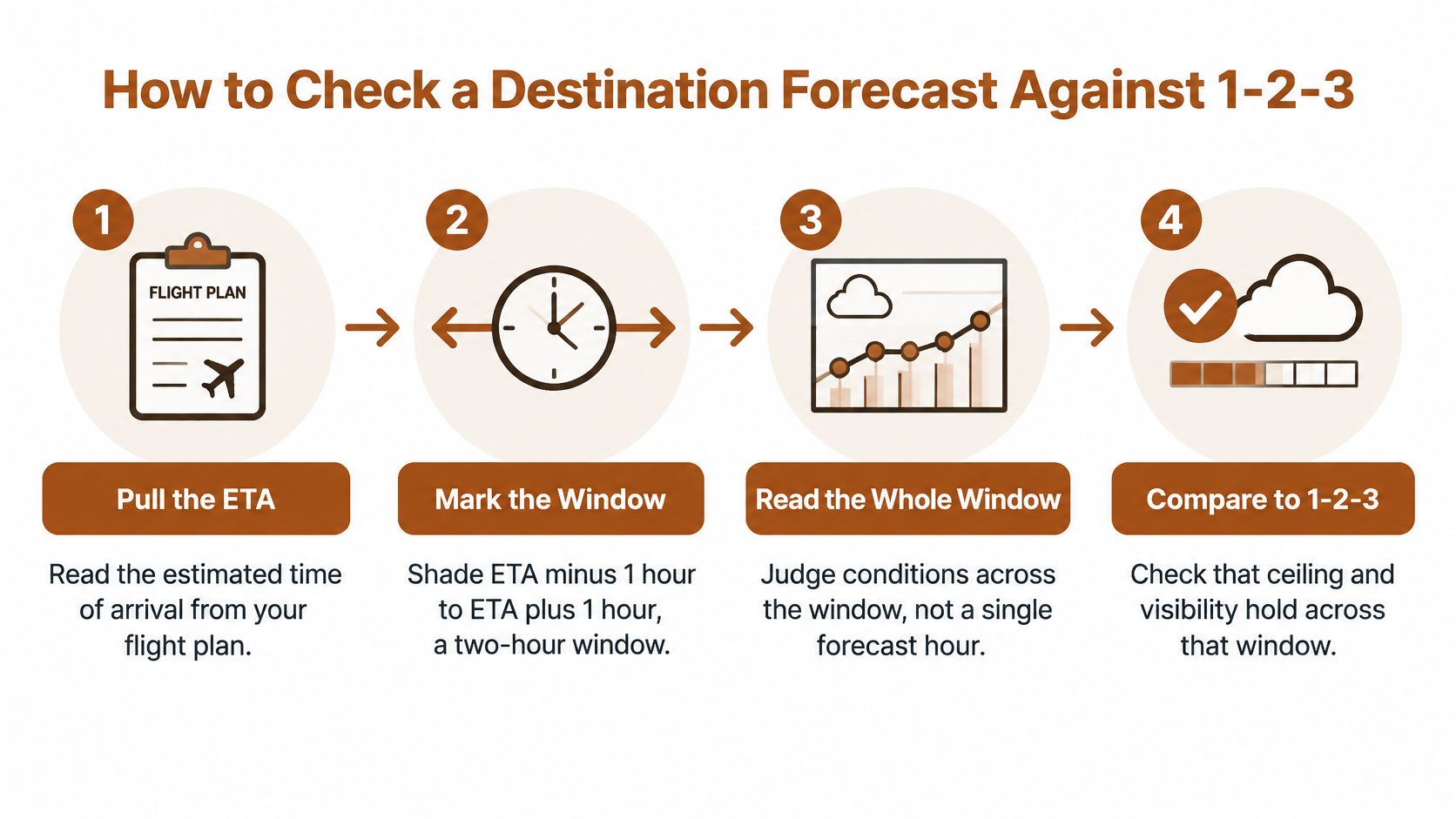
Mark the arrival window. Put your ETA on the flight-planning timeline and mark the required period on either side. The common slip is treating the arrival time itself as the whole test.
Obtain weather covering that period. Use an appropriate aviation forecast, such as the destination TAF, together with applicable reports and briefing information. A current observation helps establish context, but don't assume it establishes future conditions throughout an uncovered forecast period.
Check the ceiling throughout. Read every applicable forecast segment and identify the ceiling, not merely the lowest cloud mentioned. TAF cloud heights are above the aerodrome, so don't add airport elevation to an already above-ground forecast ceiling; convert references only when comparing against an altitude expressed above mean sea level.
Check visibility separately. Evaluate visibility throughout the same period rather than stopping after the ceiling passes. Keep statute miles distinct from the nautical miles used elsewhere in navigation.
Confirm the published approach. Open the destination's procedures and verify that a qualifying instrument approach exists. Then check availability and equipment compatibility as operational questions rather than assuming an airport identifier proves everything you need.
Record the outcome. If a required condition fails, list an alternate and evaluate that airport separately. Save the forecast issue time, arrival window, controlling weather, and approach checked in your planning notes so you can reconstruct the decision.
Make the forecast readable before deciding
If the weather code slows you down, practice reading METARs and TAFs before making the filing decision. Pay particular attention to change groups that overlap your arrival period.
Use this video alongside an actual forecast, pausing to identify which conditions apply to your planned arrival.
Recalculate the window when your ETA changes materially. A correct check against an obsolete arrival estimate isn't a useful basis for the flight you're now planning.
Destination and Alternate Standards Compared
Do I need an alternate? and Does this airport qualify as my alternate? are different questions. The destination exemption answers the first; alternate planning requirements answer the second.
The FAA Instrument Procedures Handbook treats alternate selection as a separate planning task, not a guarantee that either airport will remain usable.
The destination exemption and alternate forecast standards belong side by side, but they must not be treated as interchangeable.
| Test | Ceiling | Visibility | Time Window |
|---|---|---|---|
| Destination exemption, the mnemonic test | Must meet the destination exemption threshold | Must meet the destination exemption threshold | Throughout the required period surrounding destination ETA |
| Alternate forecast, non-helicopter | Apply published alternate minima or the applicable regulatory standard | Apply published alternate minima or the applicable regulatory standard | At the alternate's ETA |
An important correction: A blanket formula of an airport-height floor or an increment above approach minimums is not the general Part 91 alternate standard. Don't use that shortcut to qualify an airport. Consult the current regulation and the airport's published alternate-minimums information.
Why the clocks differ
The destination test evaluates whether you qualify for an exception to carrying a filed backup. The alternate evaluation asks whether your backup has suitable forecast conditions when you would reach it.
That means the alternate needs its own arrival estimate. Using the destination ETA for a distant alternate can place your weather check in the wrong forecast period, particularly when a front is moving through.
It also means you shouldn't copy destination weather into the alternate assessment. A nearby airport might share the same weather problem; a more distant airport might offer better conditions but require more fuel.
Keep the labels separate: Alternate planning minima determine whether you can list the airport. Published approach minima govern the approach you actually conduct, subject to the applicable operating rules.
Evaluate the complete backup
Before accepting an alternate, inspect its approach restrictions, navigation requirements, runway suitability, and weather information. A forecast that looks favorable doesn't remove an alternate-use restriction on the procedure you intend to rely on.
Helicopter provisions require separate treatment and aren't represented by this comparison. For an airplane student, the essential habit is to finish the destination exemption decision before beginning the alternate-qualification decision.
Judging a Forecast That Barely Clears 1-2-3
A destination can satisfy the filing exemption while leaving you with an unattractive flight. Legal compliance doesn't establish a comfortable operating margin.
Boldmethod's IFR alternate-planning discussion highlights the need to distinguish the regulatory trigger from the broader decision about weather, approaches, and diversion options. For a marginal forecast, the useful question isn't whether the numbers pass. It's what would happen if the forecast proves optimistic.
Keep a compact review alongside your weather briefing.
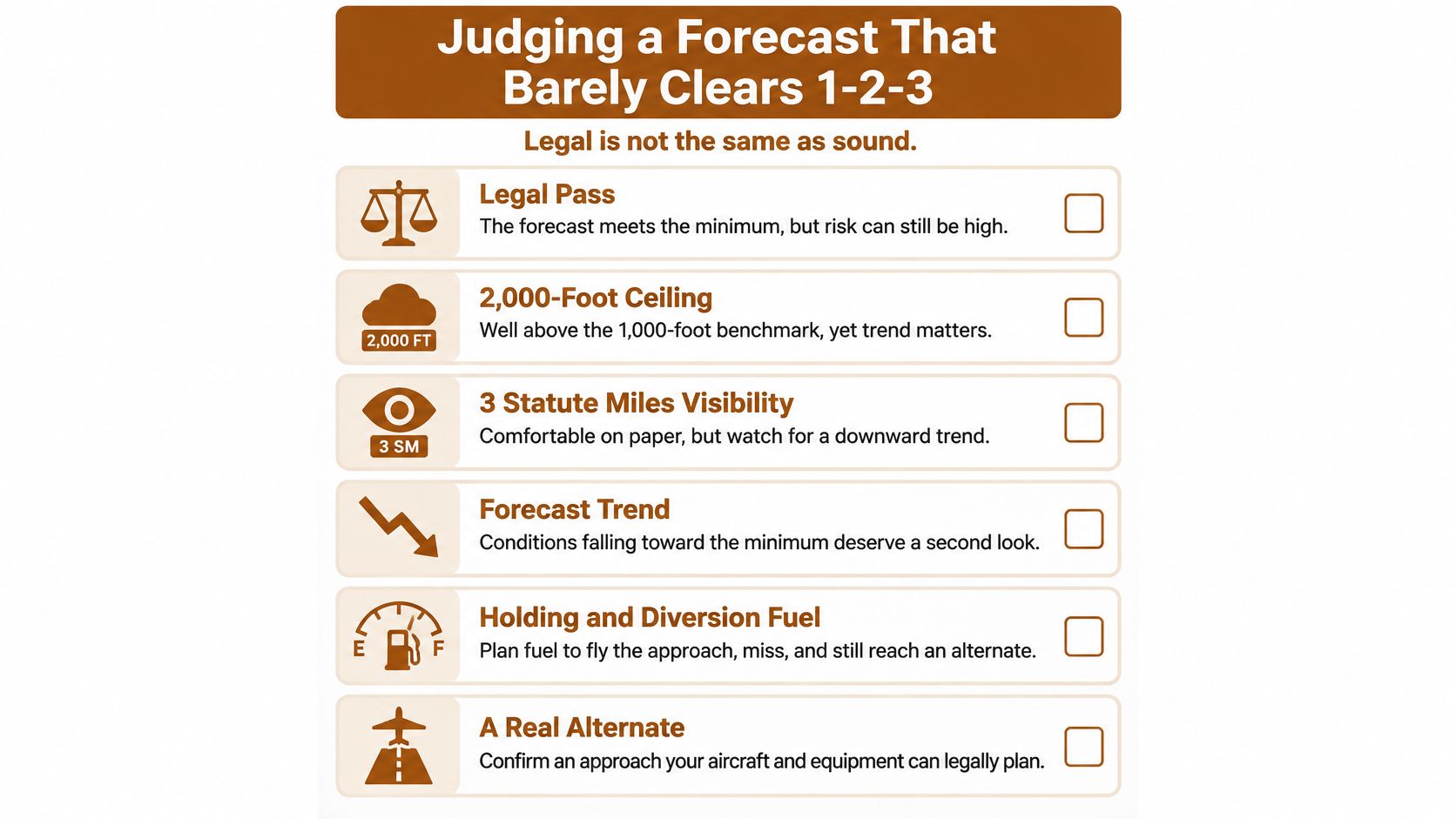
Check the consequences of being wrong
- Forecast confidence and trend. Compare the forecast with current observations and surrounding weather. A downward trend deserves more attention than a stable forecast with the same nominal conditions.
- Approaches and NOTAMs. Check navigation outages, approach restrictions, lighting issues, and runway closures. Identify what remains usable if your preferred approach disappears.
- Runway and airport suitability. Review wind, aircraft performance, surface conditions, and operating hours. An available approach isn't enough if the landing or airport service you need is unsuitable.
- Fuel and diversion options. Account for a missed approach, climb, possible delay, and diversion. Don't make your backup depend on an immediate clearance and an uninterrupted direct route.
- Terrain and hazardous weather. Consider mountain obscuration, icing exposure, and convection along both the destination route and the escape route.
Say the forecast meets the exemption throughout the window, but a convective line is approaching soon afterward. That may satisfy the numerical test while making an arrival delay consequential. If the line is forecast to reduce conditions below the thresholds inside the window, however, you no longer have a passing exemption.
Choose a response before departure
You can file an alternate voluntarily, choose an airport with more useful runway and approach options, carry additional fuel within aircraft limitations, or change the departure time or route. Sometimes postponing is the more defensible choice.
Write the reasoning in your briefing notes: approaching convection, limited destination approaches, alternate selected outside the expected weather. That record helps you establish an in-flight decision point rather than improvising after the destination deteriorates.
Using GPS and WAAS Approaches as Alternates
An airport can have an RNAV approach and still be unsuitable as the alternate for your particular airplane. Procedure availability, avionics approval, and alternate-planning permission are separate checks.
The FAA's advisory circular on suitable RNAV systems addresses the use of approved RNAV equipment, including substitution for conventional navigation facilities. That distinction matters whenever your plan depends on GPS doing a job originally assigned to a ground-based aid.
The cockpit display is only the starting point for that assessment.

Separate unaugmented GPS from WAAS
With unaugmented GPS, review the installation's approval and the requirement for an alternate approved and operational navigation method suitable for the route. Don't infer alternate capability from the receiver's ability to display and load an approach.
With WAAS, additional RNAV alternate-planning options may be available, but that doesn't make every published minima line acceptable for planning. Generally, you must use LNAV or another specifically permitted minima line, rather than assuming you can plan on LPV.
An approach offering only LPV minima doesn't, by itself, establish alternate capability. The attractive vertical-guidance presentation on your display isn't a substitute for checking the planning authorization.
Work through the actual approach chart
Suppose your proposed alternate has only an RNAV approach. Open the chart, locate the minima lines, and establish which one your aircraft may use for alternate planning before deciding whether the forecast qualifies.
Then answer these questions:
- Aircraft approval. Does the flight manual supplement authorize the intended operation with this installation?
- Database status. Is the procedure available in the required database, and does its status meet the equipment's operating requirements?
- Procedure restrictions. Do chart notes or alternate-minimums information prevent the planned use?
- Service availability. Do relevant NOTAMs affect navigation service, the approach, or the runway?
- Substitution. Does any segment depend on GPS replacing a conventional navigation facility, and is that substitution permitted?
Practice reading an approach plate with those questions beside you. Read the notes and restrictions as carefully as the plan view.
A GPS-only alternate is an aircraft-specific planning question, not a yes-or-no property of the airport.
For training, have your instructor walk through the check using the airplane you fly. A correct answer for another aircraft's avionics installation may not apply to yours.
Common Misreadings of the 1-2-3 Rule
Most filing errors come from shortening a conditional rule until an important condition disappears. Listen for the version you say aloud during a briefing, because that wording often reveals which check you're skipping.
These common misreadings produce different mistakes, even though they can all lead to an unjustified decision to omit an alternate.
| Misreading | What It Gets Wrong | Correct Reading |
|---|---|---|
| Passing the mnemonic means no alternate is ever needed | Ignores the published approach requirement and operational judgment | Establish the complete exemption, then assess whether a backup is prudent |
| Meeting either ceiling or visibility is enough | Discards a required weather condition | Evaluate ceiling and visibility together throughout the applicable period |
| The destination test checks alternate minima | Mixes separate filing decisions | Determine whether a backup is required before checking which airport qualifies |
| The window is only the ETA hour | Treats a period as a single observation | Read all forecast segments applicable to the required arrival window |
| A passing forecast guarantees the approach will be usable | Ignores forecast changes and operational restrictions | Continue checking current weather, NOTAMs, equipment, and runway availability |
Diagnose the skipped check
If you normally say “the weather looks good,” replace that phrase with the evidence you used. Name the forecast period, controlling ceiling and visibility, and destination approach rather than relying on an overall impression.
If you normally say “the alternate has GPS,” identify the equipment approval and planning minima line instead. That turns a vague assertion into something you and your instructor can verify.
A failed required condition anywhere in the applicable window is enough to defeat the destination exemption. Don't average favorable and unfavorable forecast segments, and don't let a strong ceiling distract you from a visibility problem.
For your next practice flight plan, explain the decision aloud before filling in the alternate field. If your explanation matches a misreading in the table, repeat the forecast check and the separate alternate evaluation before filing.
Filing Decision by Scenario
Before filing, put the ETA, applicable weather period, destination approach, and alternate evaluation on the same planning page. Use the broader IFR flight requirements review to keep this decision connected to equipment, fuel, and the rest of your preflight preparation.
| Scenario | Destination-test result | Alternate required? | Next step |
|---|---|---|---|
| Forecast clears both thresholds throughout the window and an approach exists | Passes | Not under this test | Confirm operational margins before omitting the alternate |
| Forecast barely clears, or a front approaches | Passes only if all applicable conditions remain qualifying | Discretionary if it passes; required if it fails | Evaluate the trend and prepare a practical diversion |
| No qualifying published instrument approach at destination | Exemption unavailable | Yes | Select an eligible alternate and check its forecast |
| Proposed alternate relies on GPS only | Doesn't determine the destination result | Determined by the destination test | Verify avionics approval, permitted minima, restrictions, and NOTAMs |
| Mountainous destination with passing weather | Passes numerically | Not under the numerical test alone | Consider terrain, obscuration, and a conservative alternate |
The regulatory test sets the floor; your judgment determines the plan you're willing to fly. A voluntarily planned alternate should be as thoroughly checked as a required one.
For exam preparation, use scenarios that change the forecast timing, approach availability, or avionics rather than merely repeating the mnemonic. When our Readiness Score goes green, the student is ready and books the exam.
At flyCowboys, we offer Instrument Rating knowledge-test preparation with adaptive question practice and plain-English explanations. Practice weather and alternate-filing scenarios, then use the explanations to check whether you understand both the legal trigger and the operational decision.