· 15 min read
FAA Private Pilot Written Exam Study Guide: 2026 Plan
Use this FAA Private Pilot Written Exam Study Guide to learn the 60-question format, the 70% passing score, high-risk ACS topics and a practical study plan.
73.33 percent of applicants missed ACS item PA.IX.A.K3, according to the FAA's frequently-missed finding accompanying its 2025 knowledge-test statistics. That's a reason to question a study method built around recognizing familiar answers. You need to identify the concept behind a question, understand its conditions, and apply it when the wording changes.
A useful FAA private pilot written exam study guide should help you decide what to study next, not give you more questions. Start with the test requirements, use official missed-topic findings to flag potential weaknesses, and practice explaining how each answer affects an actual flight.
Table of Contents
- The FAA Private Pilot Exam at a Glance
- Topics That Carry the Most Exam Risk
- How to Build a Study Plan That Finishes in Time
- Density Altitude Explained Through Cause and Effect
- Common Study Mistakes That Lead to Failed Exams
- Readiness Benchmarks and Booking Decision
The FAA Private Pilot Exam at a Glance
The passing score is 70 percent, or at least 42 correct answers out of 60, and the FAA Private Pilot–Airplane Airman Certification Standards identify the applicable test requirements summarized below. Treat that threshold as the minimum acceptable result, not your preparation goal. A passing total can still conceal gaps in weather, aircraft performance, or operating rules.
FAA Private Pilot–Airplane knowledge test key facts
| Item | Requirement | What It Means for Study |
|---|---|---|
| Test code | PAR | Use this exact code when checking study material |
| Questions | 60 | Cover every ACS area, not only favorite topics |
| Time limit | 2 hours (120 minutes) | About two minutes per question |
| Passing score | 70 percent | At least 42 correct answers out of 60 |
| Minimum age | 15 years old | Confirm eligibility before scheduling |
| ACS standard | FAA-S-ACS-6C, effective May 31, 2024 | Check study material against this version |
| Practical test link | Knowledge test must be passed first, unless an applicable regulatory exception applies | Finish the written before final checkride preparation |
Use the ACS as your checklist
The Airman Certification Standards, usually shortened to ACS, organize the knowledge and skills associated with certification. Use them to check whether your study materials cover the applicable subjects, rather than assuming a large question bank guarantees complete preparation.
For each topic, connect the explanation to its ACS knowledge element. That gives you somewhere useful to return when you miss a question.
Budget time by task
The average pace in the table isn't a deadline for every question. A straightforward regulation question may take little time, while a performance chart requires careful reading, calculation, and a reasonableness check.
Practice moving efficiently through familiar material without rushing the chart problems. Before committing to a study schedule, confirm your test code, your available time, and a practice-score target comfortably above the minimum. Check the ACS version on any materials you buy, especially older books or downloaded outlines.
Topics That Carry the Most Exam Risk
The frequently-missed ACS item in the opening deserves investigation, but it doesn't establish a ranking for every subject on the exam. The FAA's broader results recorded 44,657 Private Pilot Airplane test attempts in 2025, an 89.56 percent pass rate, and an 81.64 percent average score. Most candidates passed, but passing and thorough understanding aren't the same thing.
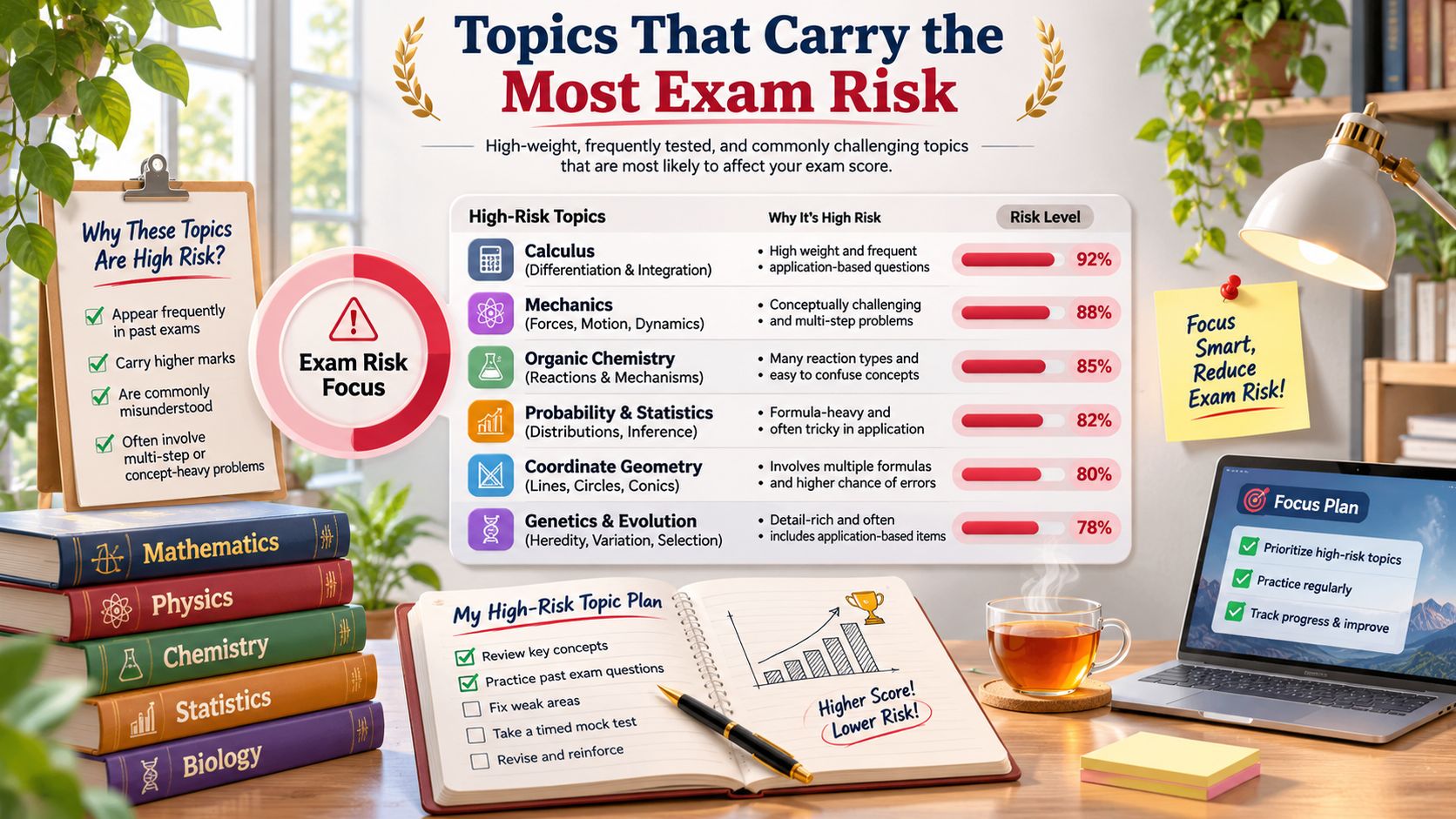
Use this topic map to organize your own error review. Risk here means the chance that a topic will cost you points because you missed the exact condition, calculation step, or reasoning path the question tested.
Turn a missed code into a study priority
Look up PA.IX.A.K3 in the current ACS and read the exact wording. Don't guess its meaning from the code or assume it belongs to a subject you already find difficult. The private pilot ACS guide can help you understand how the standard is organized.
Then ask your instructor to turn that knowledge element into an unfamiliar scenario. Can you explain what information matters and what action follows? That question exposes the difference between recognizing an answer and understanding why the answer works.
Use this priority order:
- Officially flagged knowledge elements: Check these early because the FAA has identified difficulty with them.
- Your repeated errors: Give recurring misses more attention than isolated slips.
- Unpracticed subjects: Test these before declaring them strengths.
A single miss may be a reading slip. Three misses in the same area usually mean the topic needs a cleaner mental model. Treat your log as a map of causes, not a list of bad scores.
Separate the mistake from the subject
The following areas deserve applied practice, but this isn't an official FAA miss-rate ranking of those subjects.
High-risk exam areas and the mistake behind each
| Area | Typical Mistake | Fix in Practice |
|---|---|---|
| Performance charts and weight-and-balance | Reading the wrong chart column | Redo chart problems until you can identify each input reliably |
| Weather interpretation | Memorizing a rule without knowing when it applies | Tag each weather miss by the condition it tested |
| Airspace requirements | Knowing the limit but missing the exception | Review every airspace miss against its applicable conditions |
| Regulations | Choosing an answer that is true but not the best | Compare the wrong choice with the best choice |
| Navigation with charts | Misreading a chart symbol or scale | Include recurring chart problems in your weekly practice |
A memory error calls for recall practice. A chart-reading error calls for another worked problem. A judgment error requires explaining why a plausible answer doesn't fit the scenario.
That last category causes confusion because two answers can sound reasonable. The better answer is the one that matches the conditions in the question. Read the question as a small flight scenario: aircraft position, weather, equipment, clearance, or operating limit. Then trace the cause to the required action.
Use the accompanying video as a discussion prompt, then explain the reasoning without replaying it.
How to Build a Study Plan That Finishes in Time
Build your calendar around demonstrated progress, not an assumed completion date. At flyCowboys, most users are ready after four to six weeks of daily study, but that isn't a promise about your individual timeline. Prior knowledge, available study time, and unresolved topics affect when you should book.
The schedule below is a suggested planning template, not an FAA requirement or a measured timeline for all students.
Work backward from a provisional test date
- Take a broad baseline quiz. Include unfamiliar questions across the ACS areas. Don't study the answers immediately beforehand, because you want an honest starting point.
- Sort misses by knowledge area. Record the ACS element, the reason you missed it, and the reference that resolves it. Question numbers alone won't reveal a pattern.
- Set a provisional date. Reserve space for review and instructor questions before making the booking decision.
- Build foundations early. Study regulations, airspace, weather, and navigation before expecting complex flight-planning problems to feel straightforward.
- Return repeatedly to calculations. Alternate performance charts, weight-and-balance problems, and conceptual explanations instead of completing a calculation chapter once.
- Finish with realistic rehearsals. Take full-length exams under the published time limit without notes, then review incorrect answers and uncertain guesses.
- Keep daily work manageable. Choose a session length you can maintain, and end with a specific unresolved question rather than an exhausted attempt to finish everything.
Weekly study time budget for a four-to-six-week plan
| Stage | Timing | Main Focus |
|---|---|---|
| Baseline | Days 1–3 | Diagnostic quiz across all ACS areas |
| Foundations | Weeks 1–2 | Regulations, airspace, weather, navigation |
| Performance and judgment | Weeks 3–4 | Density altitude, weight-and-balance, aerodynamics, risk decisions |
| Timed practice | Final 1–2 weeks | Full-length exams under the published time limit |
Make each session produce evidence
A productive session should leave something you can check: a completed calculation, an annotated chart, or an explanation spoken without notes. For performance study, use a concept map to connect the conditions in a problem with the result you expect before calculating.
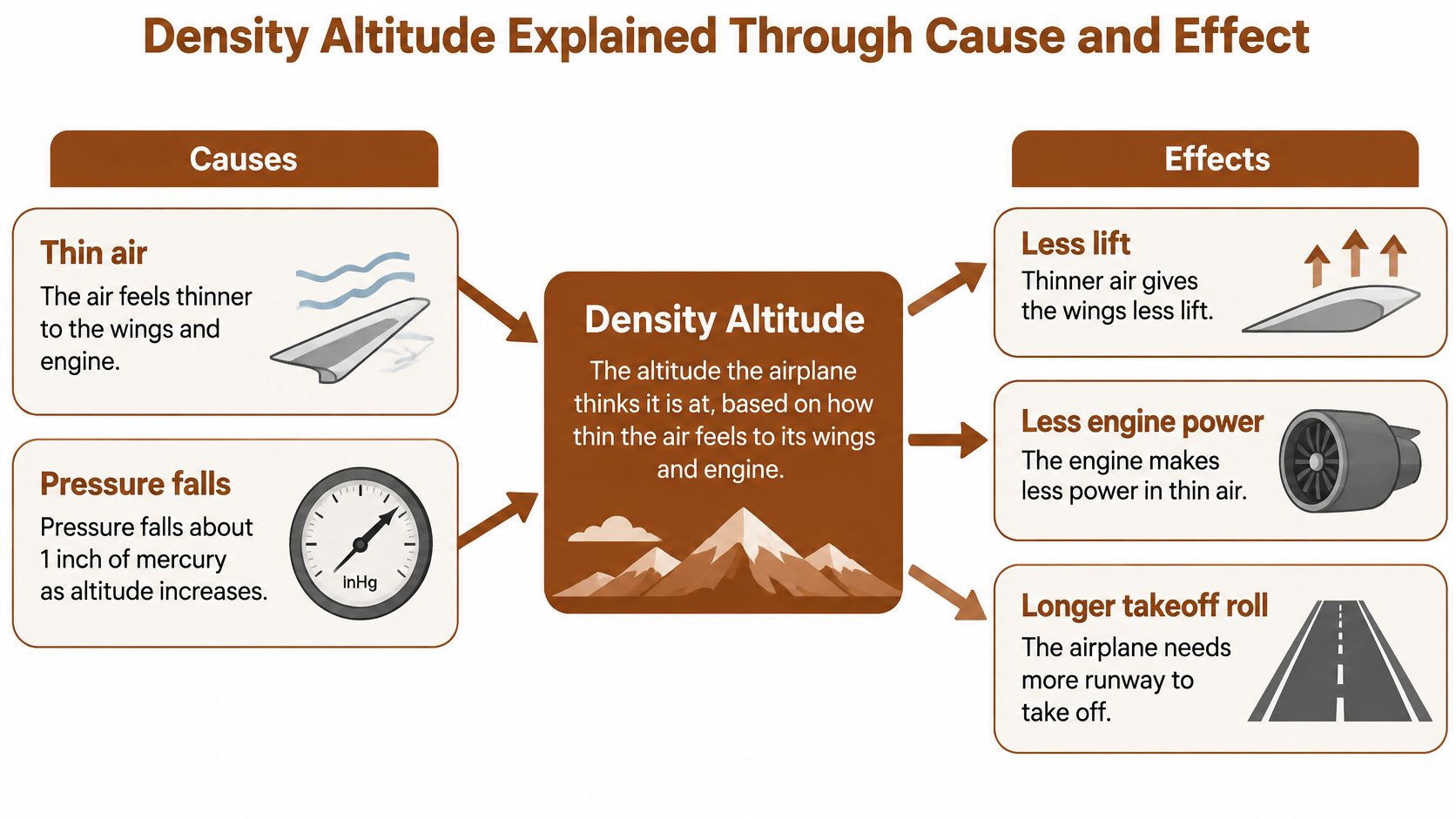
Read simplified diagrams alongside the FAA handbook and the aircraft's performance information. They're memory aids, not substitutes for chart inputs or operating limitations.
Progress rule: Move forward when you can solve a fresh problem and explain your method, not merely when you've finished the assigned pages.
If the same error returns, change the practice method before adding more questions.
Density Altitude Explained Through Cause and Effect
Think of density altitude as the altitude the airplane effectively performs at because of the surrounding air density. The familiar phrase “the altitude the airplane thinks it is at” is a memory aid, not a separate instrument reading. Field elevation alone doesn't tell you how the airplane will perform.
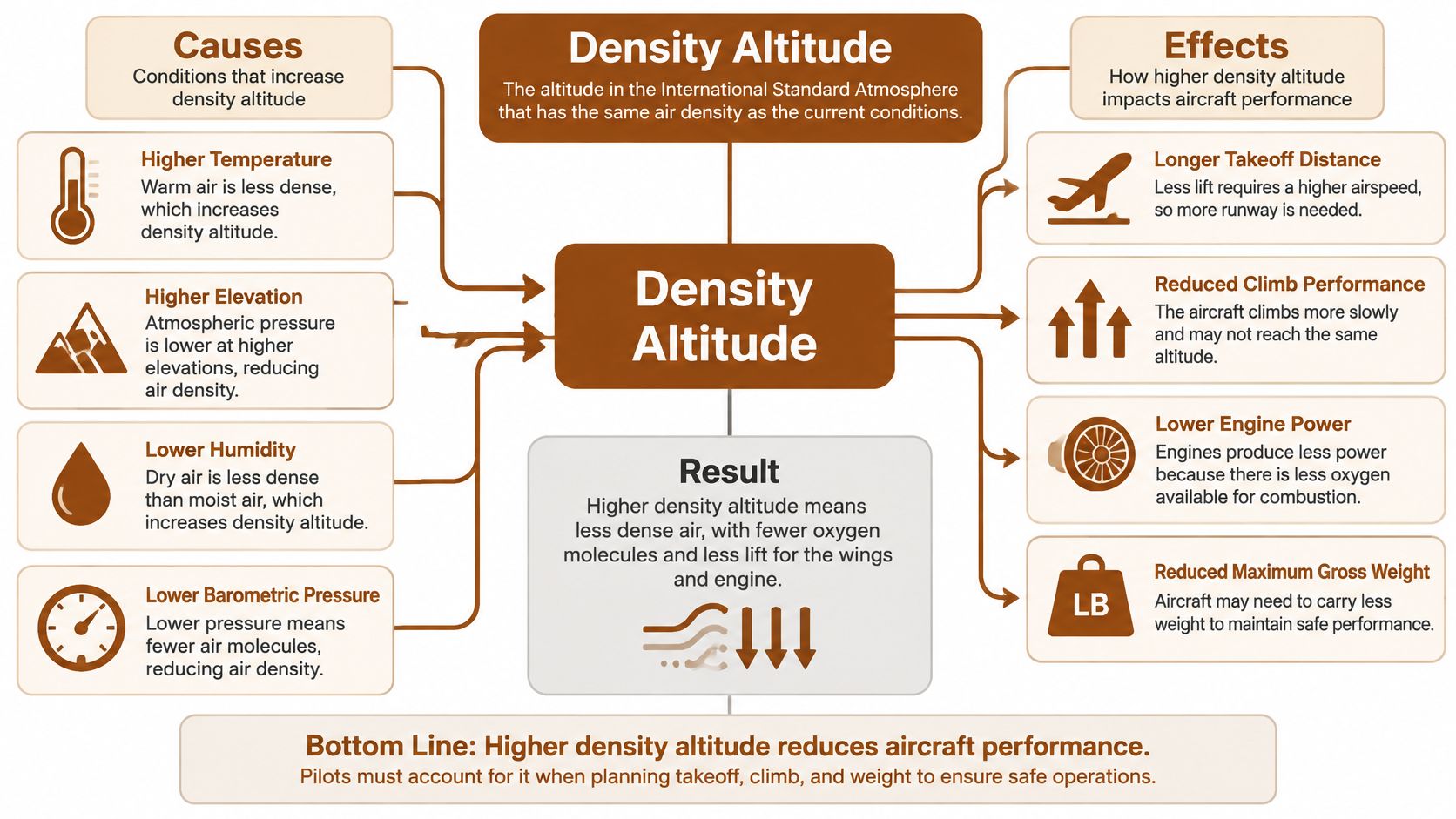
The FAA Pilot's Handbook of Aeronautical Knowledge explains that atmospheric pressure decreases approximately 1 inch of mercury per 1,000 feet on average, while increased temperature also reduces air density. Reduced density affects engine power, propeller efficiency, and lift, which increases takeoff distance and reduces climb performance.
Predict the direction before calculating
Say you're preparing a heavily loaded airplane for departure from a high-elevation airport on a hot afternoon. Before opening the chart, predict the result: a longer takeoff roll and weaker climb performance than under cooler, otherwise comparable conditions.
Build the reasoning carefully:
- Higher elevation: Lower atmospheric pressure contributes to less-dense air.
- Higher temperature: Warmer air further reduces density.
- Humidity: Moisture can also contribute to reduced density.
- Aircraft response: Reduced performance leaves less margin for runway length and obstacle clearance.
The airplane's weight is an additional performance burden. It doesn't raise atmospheric density altitude, even though it can make the departure more demanding. Keeping those causes separate helps you avoid a common conceptual mix-up.
Let the aircraft chart determine the answer
Identify pressure altitude and outside-air temperature together, then follow the aircraft's chart instructions. If you're confusing pressure altitude with field elevation or density altitude, review how to define pressure altitude before continuing.
Check the chart's weight, wind, runway, and configuration assumptions. Don't add an improvised correction or assume that calculating density altitude alone supplies every required chart input.
Predict whether performance should improve or deteriorate, then use that prediction to catch an implausible calculation.
Finally, connect the result to a decision. A longer suitable runway, reduced load, cooler departure time, or cancellation may be appropriate. Getting the arithmetic right matters, but the operational question is whether the departure leaves a conservative margin.
Common Study Mistakes That Lead to Failed Exams
Recognizing an answer isn't the same as retrieving the knowledge behind it. Repeatedly selecting the same option can look like progress even when you can't explain the rule. Test that distinction by covering the choices and answering the question in your own words.
Change the habit behind the miss
- Memorizing answer positions. If you remember the option rather than the explanation, unfamiliar wording can expose the gap. State why the correct answer fits and why each distractor doesn't.
- Avoiding slow chart work. Reading explanations feels easier than tracing chart lines or calculating moments. Work the problem on scratch paper, label units, and compare your method with the solution.
- Accepting a strong overall score. Familiar topics can conceal weak ones. Keep separate records for knowledge areas and investigate subjects with little practice exposure.
- Using an unchecked outline. An old resource may still teach useful fundamentals, but you shouldn't assume its organization or test details remain current. Verify its ACS reference and updates before relying on it.
- Practicing without a clock. Unlimited time conceals hesitation and repeated recalculation. Use realistic timing for full exam rehearsals, while keeping learning sessions slow enough to understand the method.
- Saving everything for the weekend. A long session can become passive reading. Use regular review sessions that require recall, calculation, or explanation.
Review guesses as well as wrong answers
A correct guess belongs in your error log until you can defend it. Otherwise, your score credits knowledge you haven't demonstrated.
Write a short correction that identifies the actual mistake. “Used field elevation instead of the required chart input” gives you something to fix; “careless error” doesn't.
Better review: Record what you'll do differently on the next problem, not just which answer you should have selected.
More study time won't automatically solve a faulty method. A better annotation habit, a clearer reference, or an instructor's explanation may make the next session more useful than another round of familiar questions.
Readiness Benchmarks and Booking Decision
A score just above the passing threshold isn't a comfortable preparation margin. You're ready to consider booking when you can reproduce strong results on unfamiliar questions, explain your decisions, and complete realistic rehearsals without outside help.
The following ladder is a suggested study benchmark, not an FAA rule. Its purpose is to prevent a single encouraging result from becoming your only reason to schedule.
Suggested practice score benchmarks before booking the exam
| Practice Score | Readiness Signal | Next Action |
|---|---|---|
| Below 60% | Not ready | Return to core learning and reread explanations |
| 80% or higher on three consecutive full exams | Ready to consider scheduling | Confirm no single ACS area is below your target before booking |
Inspect what the score leaves out
An overall result doesn't tell you whether every subject received meaningful coverage. Review the distribution of questions and distinguish a demonstrated strength from an area that barely appeared.
For each weak area, try an unfamiliar application problem. Explain the relevant rule or chart procedure without opening the answer explanation. If you can only solve the problem after recognizing the choices, keep reviewing.
Use these booking checks:
- Consistent performance: Meet your chosen benchmark across consecutive full-length rehearsals.
- Acceptable topic coverage: No ACS area remains below your personal target or effectively untested.
- Current materials: Verify the applicable standard and resolve conflicting instructions or test details.
- Confirmed eligibility: Check your test code, required authorization, identification, and testing-center instructions with your instructor and the booking service.
Make a specific booking decision
If those checks are satisfied, choose an appointment at an FAA-approved testing center. Use the FAA knowledge test center guide to prepare for the logistics, and confirm the center's current instructions before traveling.
If a check is missing, don't repeat another full exam. Assign the gap a concrete task: review the relevant handbook passage, complete a fresh chart problem, or discuss the scenario with your CFI. Set another readiness review after that work is complete.
Keep the knowledge test connected to your flight-training schedule. Your instructor can help you choose timing that leaves room to address knowledge weaknesses before the practical examination.
Keep study tools in their proper role
Our question bank covers every topic on the FAA Private Pilot Knowledge Test, but topic coverage alone doesn't establish individual readiness. You still need to show that you can apply the material.
The app doesn't replace certified flight instruction from authorized CFIs, official FAA publications, approved Part 61 or Part 141 flight training programs, FAA knowledge or practical tests, or aircraft flight manuals and pilot operating handbooks. Use those references and your instructor whenever an explanation affects an actual aircraft or flight decision.
Visit flyCowboys for a Private Pilot question bank covering every knowledge-test topic, with explanations and exam practice to support your study. Start by identifying your weak areas, then use your practice results and CFI's guidance to make a deliberate booking decision.