· 15 min read
FAA Knowledge Test Prep That Actually Works
Practical FAA knowledge test prep guide with study plans, question bank strategy, PSI practice test tips, and readiness metrics for PPL and IFR.

You're getting decent practice scores, your instructor is asking when you'll take the written, and the PSI appointment suddenly feels more real than the lessons in your study app. Then you open an unfamiliar performance chart and hesitate. Are you ready, or have you just learned to recognize the questions?
FAA knowledge test prep should answer that question before you book the exam. Don't measure preparation by videos watched or questions completed. Measure whether you can explain the rule, use the chart, and solve an unfamiliar version without help.
Table of Contents
- What the FAA Knowledge Test Actually Is
- The Numbers Behind First-Time Pass Rates
- Building Your Six-Week Adaptive Study Plan
- Using a Question Bank Like a Diagnostic Tool
- Practicing on the PSI Testing Interface Before Exam Day
- Preparing for Embedded Figures and Visual Reasoning
- Readiness Metrics and When to Schedule the Exam
What the FAA Knowledge Test Actually Is
The written isn't a flying test, and it isn't an aviation trivia contest. It's a structured knowledge assessment that you must complete before the corresponding practical test. Treat it as part of your pilot training, not a separate obstacle to get past.
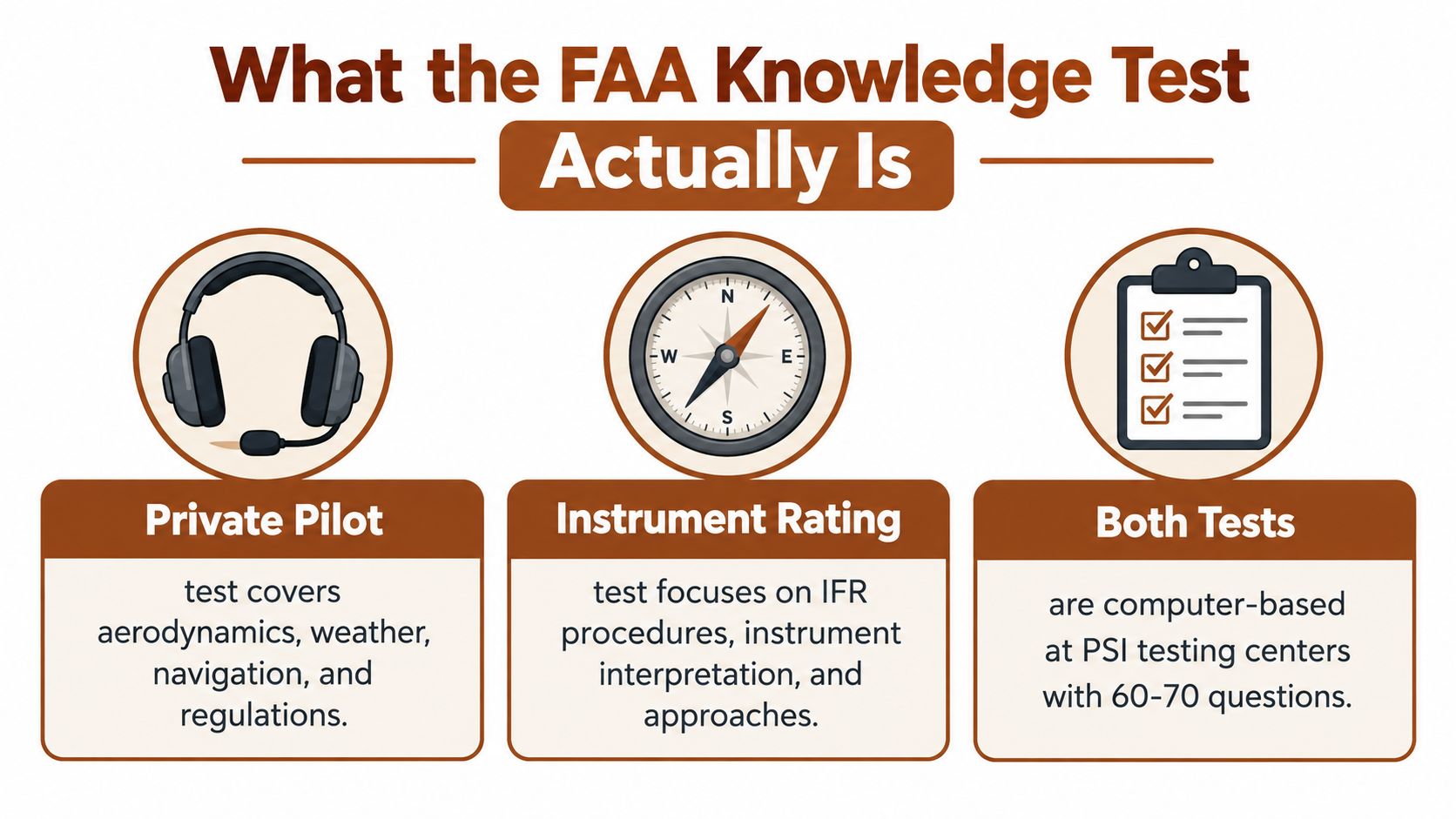
For Private Pilot Airplane and Instrument Rating Airplane, the FAA specifies 60 multiple-choice questions and a minimum passing score of 70 percent, with one correct answer per question, as described in the FAA's Private Pilot Airplane certification standards and knowledge-test requirements. Your preparation needs to match the certificate or rating you're pursuing.
Use this visual as a broad orientation, but follow the exam-specific question count above rather than any broader range shown in the graphic.
Know the standard behind the questions
The Airman Certification Standards, or ACS, connect knowledge with risk management and practical skills. They give you a coverage map, not permission to study only the subjects you enjoy.
Organize your preparation around these distinctions:
- Knowledge means understanding the applicable rule, principle, procedure, or calculation.
- Application means using that knowledge when the question changes the situation.
- Test execution means doing the work independently under a time limit.
Private pilot preparation spans subjects such as weather, airspace, navigation, regulations, and aircraft performance. Instrument preparation demands attention to procedures and chart-based application rather than carrying your private pilot quiz habits forward.
Make the appointment predictable
Confirm the current time allowance for your exact exam when arranging the appointment. Don't rely on an old prep page or assume every airplane knowledge test uses the same limit.
Before exam day, understand the testing-center instructions, authorization requirements, permitted materials, and result-report process. You should arrive thinking about aviation, not wondering whether you brought the correct paperwork.
Preparation standard: Know what you're taking, what it covers, and how you'll demonstrate understanding before you start chasing a practice score.
The Numbers Behind First-Time Pass Rates
The FAA's published results don't support the idea that passing is automatic. They also don't support scare stories about collapsing private pilot pass rates.
The supplied graphic below conflicts with the official results. Don't use its declining bars as a study benchmark, and don't treat the reported attempt-level statistics as a clean first-time-only comparison.
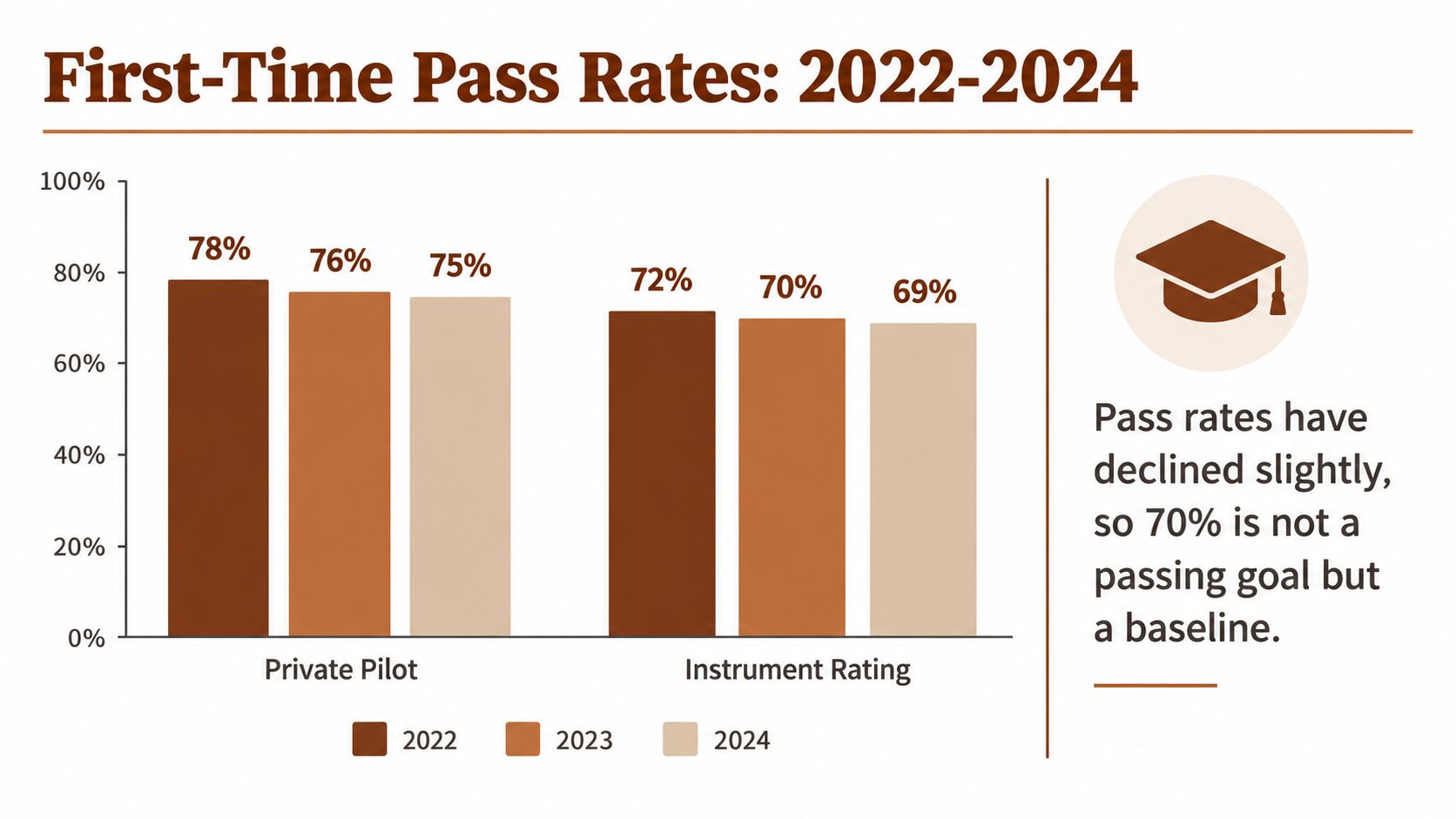
For Private Pilot Airplane, the FAA reported 39,893 tests, an 89.83 percent pass rate, and an 82.86 percent average score in 2022; 45,820 tests, a 90.30 percent pass rate, and an 82.05 percent average score in 2023; and 46,132 tests, a 91.90 percent pass rate, and an 82.89 percent average score in 2024, according to the FAA's published knowledge-test volume and performance data. Those results show increasing participation and improving pass rates, not the decline depicted above.
What those results mean for you
Most applicants passed, but the average score remained well below complete command of the material. That distinction matters because a passing result doesn't establish that every subject is understood equally well.
An overall average can hide a serious weakness. You might answer regulations confidently while guessing through performance questions, or handle familiar weather reports while struggling with a different presentation.
Use the national results as context, not a prediction:
- Population performance isn't personal readiness. The FAA results don't tell you whether you understand your weakest ACS domain.
- A familiar bank can inflate confidence. Recognizing an answer isn't evidence that you can reconstruct the reasoning.
- Passing and mastery are different targets. Build enough margin that an unfamiliar chart or awkwardly worded question doesn't derail you.
For an additional perspective on preparation, keep your own missed-topic notes beside you while watching.
My recommendation is blunt: don't prepare to scrape through. Aim for consistently strong performance across domains, with no subject depending on lucky guesses. A slightly lower score on unseen material tells you more than a polished score on a quiz you've memorized.
Building Your Six-Week Adaptive Study Plan
Use a six-week calendar as a planning template, not a promise about how quickly you'll become ready. Your schedule should change when the evidence changes. If a weak domain needs more work, give it more work instead of advancing because the calendar says so.
Start by listing the applicable ACS areas and recording your current confidence in each. For a broader foundation before targeted practice, use this private pilot ground school guide to organize your learning.
Sample Six-Week FAA Knowledge Test Prep Plan
The schedule below is a proposed study framework, not an FAA requirement or a measured completion-time claim.
| Week | Daily Time | Primary Activity |
|---|---|---|
| First | A short, protected session | Map ACS coverage and complete an initial diagnostic |
| Second | A focused session, longer when needed | Repair the weakest concepts using authoritative references |
| Third | Focused study plus brief delayed reviews | Continue remediation and check retained understanding |
| Fourth | Regular drills with a longer uninterrupted session | Introduce mixed-topic practice and a timed rehearsal if coverage supports it |
| Fifth | Brief maintenance plus full-exam blocks | Run realistic simulations and investigate remaining errors |
| Sixth | Targeted review and final uninterrupted rehearsals | Confirm readiness and resolve testing logistics |
Protect a daily study window you can keep. Use a longer session on a day without competing demands for chart work, calculations, or a full rehearsal. Don't squeeze those tasks into a distracted gap between errands.
Let the diagnostic change the calendar
An adaptive plan assigns the next session according to the previous session's evidence. If you miss a weather question because you misunderstood the underlying process, studying more weather abbreviations won't repair the problem.
Write a session objective before opening the app:
- Target code identifies the ACS element you're working on.
- Repair task names the concept, chart method, or regulatory distinction you need to learn.
- Evidence of understanding describes what you must explain or solve without hints.
- Return date gives that material another check after a delay.
Keep these notes short enough to use every day. “Review weather” is too broad; “explain why this weather interpretation changes the decision” gives the session a purpose.
Don't spend the whole study session proving you're good at your favorite topic. Spend it fixing the topic you'd rather avoid.
If you're preparing alongside flight lessons, connect the study objective to something you're doing in the airplane. Bring an unresolved performance question to your instructor, or discuss the reasoning behind a weather decision before the next lesson.
Don't compress the plan by deleting diagnostics and review. Compress it only when you can already demonstrate the required understanding.
Using a Question Bank Like a Diagnostic Tool
A question bank should tell you where your understanding breaks down. Its size matters less than its ability to identify weak ACS elements, explain mistakes, and present variations you haven't memorized.
The technically sound workflow is ACS mapping, diagnosis, reference-based remediation, delayed retesting, and then mixed timed practice, consistent with the knowledge, risk-management, and skill framework in the FAA's Instrument Rating Airplane ACS. Use that sequence whether your practice tool is adaptive or you're maintaining the record yourself.
Set up your study space for explanation, not just answer selection.

Record the failure, not just the answer
Begin with an untimed topic diagnostic without hints or reference material. Include correct guesses in your review queue. They're unresolved knowledge gaps even when the software marks them green.
A useful error log captures the difference between a wrong answer and a repairable problem:
| Record | What to write |
|---|---|
| ACS element | The knowledge area the question actually tests |
| Error mechanism | What you misunderstood or did incorrectly |
| Governing reference | The handbook passage, regulation, chart, or formula |
| Repair evidence | Your explanation or completed calculation |
| Delayed check | Whether you can solve a changed version later |
Use the private pilot ACS guide if you need help turning a topic label into a usable standards-based study target. Don't let the app's broad category replace the specific element you need to repair.
Augment each miss with the governing material
Suppose you miss a performance-chart question. Don't merely reread the answer explanation until it sounds familiar. Reconstruct the work with the chart in front of you, identifying the relevant inputs, labels, units, and requested output.
Then change an input and reason through what should happen. If you can only reproduce the original answer, you've repaired recognition, not application.
For a regulation question, locate the governing provision and distinguish the general rule from the exception. For weather, identify whether the problem was decoding the product or interpreting what it meant.
This is diagnostic-by-ACS, augmented with authoritative references. The bank measures the gap; the reference work repairs it.
Close the explanation before retesting. State your reasoning out loud and explain why the alternatives don't fit. If you can't do that, leave the code open in your error log regardless of how many correct answers you've accumulated.
Practicing on the PSI Testing Interface Before Exam Day
Knowing the material and operating comfortably on a testing screen are separate skills. You can understand a calculation and still waste attention navigating, finding the relevant figure, or deciding how to handle an unfinished question.
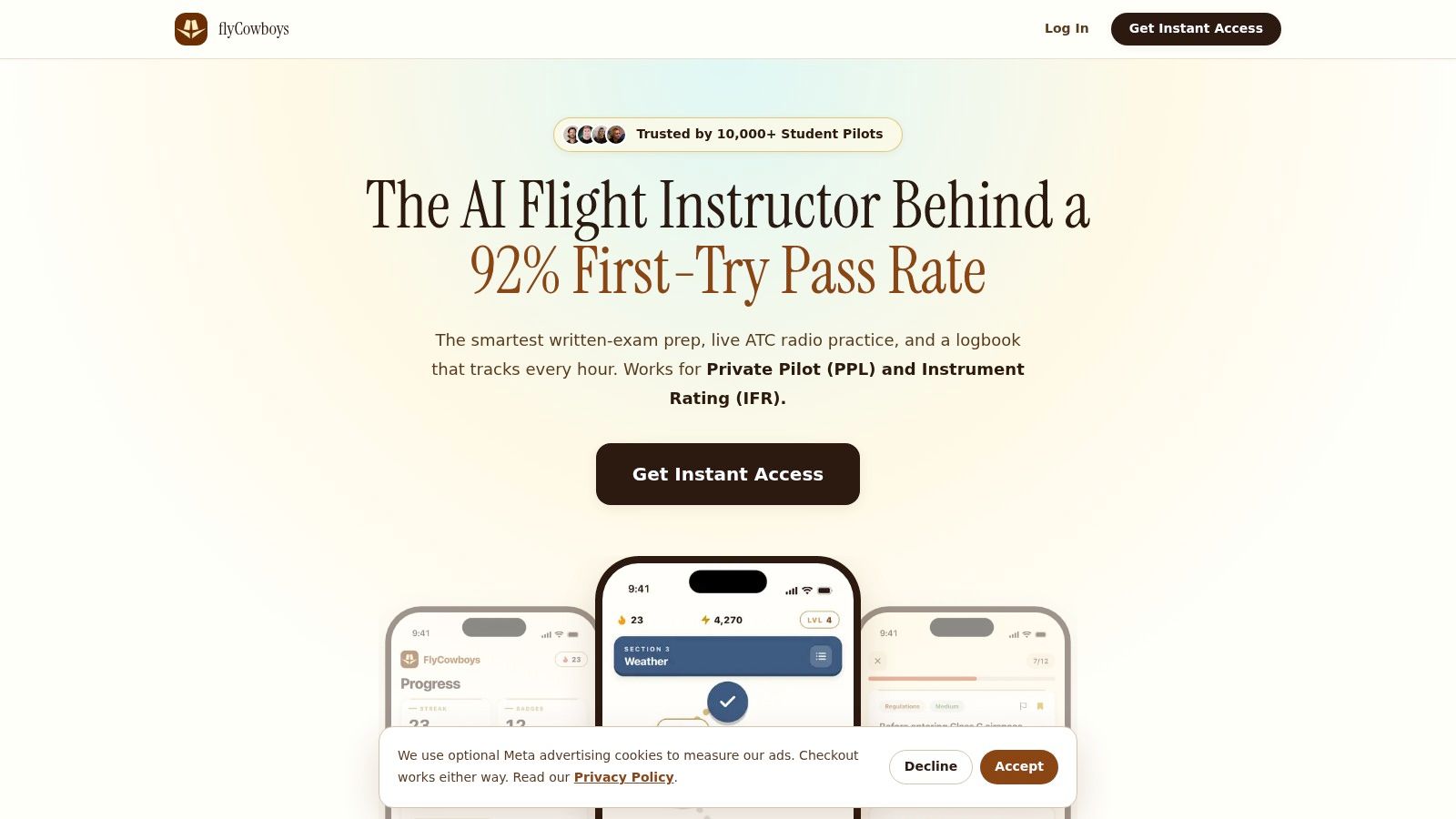
A prep-app screenshot can help you recognize the difference between casual study and screen-based rehearsal. It isn't proof that every control matches your actual testing-center screen.
Compare learning mode with exam mode
During learning, pausing for a reference is productive. During a simulation, it prevents you from measuring independent performance. Keep those modes separate so you know what your results mean.
| Learning practice | Exam rehearsal |
|---|---|
| Pause to investigate a concept | Keep working within the selected time limit |
| Read an explanation immediately | Save explanations for the debrief |
| Concentrate on a weak domain | Work through mixed subjects |
| Ask for help when stuck | Make and review your own decisions |
| Repeat a familiar problem | Favor unseen variations |
Introduce full-length rehearsal when you've established broad coverage. Starting too early can leave you repeatedly measuring gaps you already know exist, instead of repairing them.
When rehearsing, use the current allowance confirmed for your exam. Complete the session without your phone, explanatory notes, or an instructor standing by to rescue a calculation.
Practice the decisions you'll make on screen
Use current official sample content to learn the available navigation and figure presentation. If flagging, review controls, or calculator tools are available, practice them rather than assuming they work like your favorite app.
Build a deliberate screen routine:
- Orient before starting. Identify how to move between questions, view figures, and monitor the session.
- Read the entire stem. Notice whether the question asks for a correct statement, an exception, or a calculated result.
- Inspect every choice. Don't stop reading because an early option looks familiar.
- Manage unresolved work. Use the available review process rather than repeatedly restarting the same difficult calculation.
After the rehearsal, separate content errors from execution errors. Misreading a unit requires a different correction from not understanding the formula.
Before your appointment, confirm identification, authorization, permitted materials, and check-in instructions directly with the testing provider. Don't assume a prep app's checklist reflects every current requirement.
If a technical problem occurs, notify the proctor immediately rather than improvising a workaround. After the exam, retain the result paperwork and bring it back into your training discussions. The written should inform your next lessons, not disappear into a drawer.
Preparing for Embedded Figures and Visual Reasoning
Stop treating aviation figures as pictures attached to questions you've already memorized. The useful skill is interpreting an unfamiliar representation accurately.
The FAA and PSI have been moving toward figures embedded directly within knowledge-test questions; Private Pilot exams already include embedded figures, and the FAA encourages applicants to use PSI sample content to become familiar with the format, according to the FAA's December knowledge-testing update. That doesn't justify assuming every instrument question or every supplement has changed in the same way.
Train transfer instead of pattern matching
An embedded figure doesn't necessarily make the underlying concept harder. It can expose whether you understand the concept independently of the page layout you practiced.
Start by orienting yourself to the figure, then read the stem and return to the relevant detail. The first glance establishes what kind of information you're seeing; it shouldn't become a lengthy inspection of details the question never asks about.
Use a visual-reasoning sequence:
- Identify the representation. Decide whether you're looking at a sectional excerpt, weather depiction, performance chart, or procedure diagram.
- Locate the decisive information. Find the labels, units, symbols, reference points, and constraints relevant to the stem.
- Describe the task in plain English. State what you need to determine before reaching for an answer choice.
- Check the alternatives against the figure. Reject choices using evidence, not familiarity.
For a sectional excerpt, practice locating the relevant symbol and explaining its significance without depending on a remembered screenshot. For a performance chart, describe the route through the chart before making the calculation.
Instrument candidates should apply the same discipline to procedure diagrams. Work from the depicted information and the question's conditions rather than the shape you remember from a previous quiz.
Change the representation
Ask your instructor to vary a chart exercise or select an unseen version. Change an altitude, weather condition, runway input, or route variable and explain how that changes the reasoning.
If a different picture makes you lose the concept, you haven't finished learning the concept.
Don't assume embedded graphics eliminate every need to practice with testing supplements. Prepare for the materials and presentation applicable to your exam, and use unfamiliar visuals to check whether your understanding transfers.
Readiness Metrics and When to Schedule the Exam
Book when your evidence agrees, not when you're tired of studying. A readiness score can summarize progress, but an estimate of pass likelihood isn't a substitute for inspecting unresolved errors.
Use this advisory benchmark: an error rate below 10 percent by ACS domain and at least three full-length simulations without a recurring error category, alongside the FAA's published performance context and requirement to retain the printed Airman Knowledge Test Report described in the FAA's annual knowledge-test statistics and preparation guidance. These are preparation targets, not additional FAA passing requirements.
Make the booking decision
- Coverage is complete. No ACS domain remains untouched or supported mainly by guesses.
- Errors are understood. Classify misses as computation, chart interpretation, weather decoding, regulation recall, or question wording.
- Retention is visible. Your evidence includes delayed checks and unfamiliar variations.
- Logistics are confirmed. Verify the exam, appointment instructions, authorization, and report-handling process.
Instrument applicants can use the IFR study guide to keep preparation aligned with their rating rather than repeating a private pilot routine.
Review the timing with your instructor and your broader training record. If a failure category keeps returning, repair it before booking. A green dashboard doesn't override a recurring misunderstanding.
flyCowboys offers ACS-aligned adaptive question practice, explanations, and PSI-style practice exams for Private Pilot and Instrument Rating preparation. Visit it as one study option, start with a diagnostic, and use the results to decide what you need to repair before scheduling your written.