· 12 min read
Private Pilot Ground School: In-Person vs App vs Video
Compare private pilot ground school options for the FAA written exam. Analyze in-person, app, and video formats, costs, outcomes, and which fits your schedule.
The national first-try pass rate for the Private Pilot Knowledge Test is roughly 89 to 92 percent, so most students pass on the first attempt no matter which ground school format they choose. The main difference is how efficiently you get there, how well the format fits your schedule, and how much friction you create for yourself along the way.
You're probably staring at a pile of weather notes, regulations, airspace rules, and performance charts, wondering why a simple written test suddenly feels like a second job. That feeling is normal. What matters is picking a private pilot ground school format that matches the FAA's testing structure instead of fighting it.
| Format | Best for | Weak point | Best use case |
|---|---|---|---|
| In-person classes | Students who want direct instructor feedback and group momentum | Fixed schedule | You need accountability and quick clarification |
| Video courses | Students who want to study anywhere, anytime | Easy to drift or cram | You work odd hours or learn well by watching |
| App-based study | Students who want flexible, targeted practice | Less live human interaction | You want repeatable practice and fast review |
Table of Contents
- Why Your Ground School Choice Matters
- Understanding FAA Requirements and Knowledge Testing
- Comparing In-Person, Video, and App-Based Ground Schools
- Cost Analysis of Different Ground School Formats
- Choosing the Right Format for Your Goals and Lifestyle
- Enhancing Your Ground School with flyCowboys
- Final Checklist for Selecting Your Ground School
Why Your Ground School Choice Matters
A new student often starts with enthusiasm, then hits the same wall: too many topics and too little structure. Weather, airspace, aircraft systems, radio calls, and regulations all start to blur together, and the problem isn't laziness, it's mismatch. If the format doesn't fit how you live and learn, you end up spending more time fighting the process than learning the material.
The FAA doesn't care whether you prefer classrooms, videos, or apps. It cares that you can answer the test's questions correctly and show the required knowledge before the practical test. That's why the format matters, because some setups build retention, while others only create the illusion of progress.
Practical rule: choose the format that keeps you studying on ordinary weekdays, not the one that only feels good on a quiet Sunday afternoon.
A student with fixed work hours and family obligations usually needs flexibility more than social pressure. A student who procrastinates benefits from live structure even if it costs more. A student who learns fast from repetition and feedback may do better with a system that keeps resurfacing weak areas until they stick.
The wrong choice doesn't always fail loudly. It fails under the surface, by stretching a two-month task into a six-month drag. By the time that happens, the written test isn't the main problem anymore, momentum is gone.
Understanding FAA Requirements and Knowledge Testing
The FAA ties private pilot ground school directly to the aeronautical knowledge required by 14 CFR §61.105. An applicant for a private pilot certificate must either receive and log ground training from an authorized instructor or complete an approved home-study course covering the knowledge areas for the category and class sought. That makes ground school part of the certification path, not optional warm-up. FAA private pilot requirements and knowledge testing rules
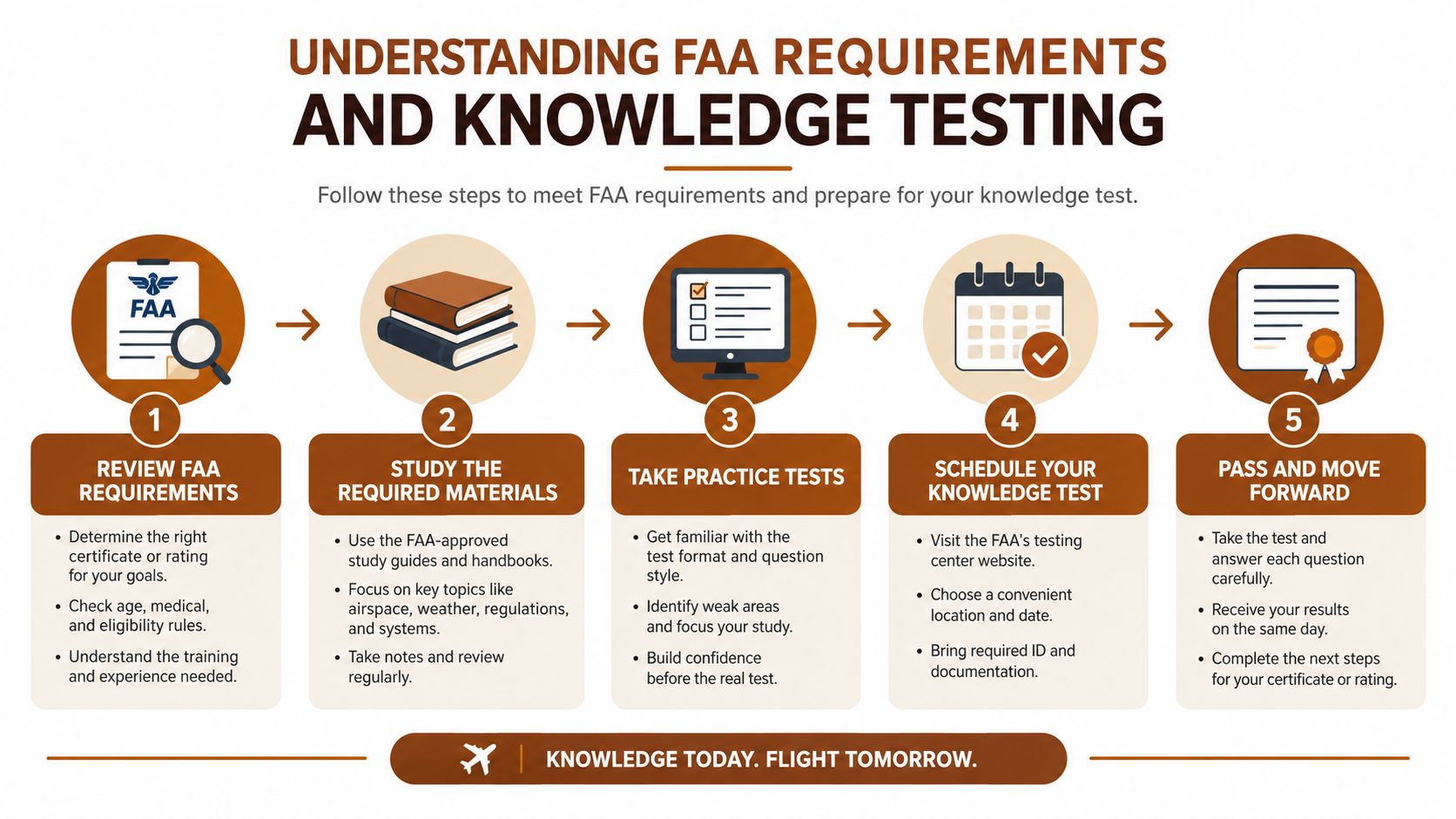
The current Private Pilot, Airplane Airman Certification Standards became effective May 31, 2024, and that matters because it connects knowledge, risk management, and practical performance in one framework. If you study as if the written is just a trivia bank, you're missing the point. The ACS is the map, and the written exam is one checkpoint along that route. FAA Private Pilot, Airplane ACS change 1
Before the knowledge test, the FAA requires evidence that you're prepared. Acceptable documentation can include an FAA-approved pilot school certificate, an authorized instructor's endorsement or logbook entry, or proof of completing an eligible home-study course. Applicants must also pass the knowledge test before the practical test, and the test uses objective multiple-choice questions with one correct response per question. FAA private pilot knowledge test standards
If you want a clean study target, organize everything around ACS knowledge areas, not around random flashcards. That's exactly why a platform should track topic coverage and readiness together. If you can't see what you know, what you miss, and what still needs work, you're guessing.
For a simple study structure that matches FAA expectations, use a topic map like the one in this private pilot written prep guide.
Comparing In-Person, Video, and App-Based Ground Schools
In-person classes
In-person ground school still has one real advantage, a good instructor can catch confusion before it hardens into bad habits. If you ask a question about weather, performance, or radio phraseology, you get a live answer and usually a follow-up example. That's valuable for students who freeze when they study alone or who need someone to force clarification.
The downside is simple. You're tied to the class calendar, and if your life doesn't match it, you'll miss sessions or rush the material. In-person works best for students who value structure more than convenience.
Video courses
Video courses give you control over timing and repetition. If you've got a weird work schedule, childcare, or travel, this format can keep you moving when a fixed class would stall out. It also lets you pause and replay the parts that matter most, which is useful for subjects like weather and navigation.
But passive watching creates a trap. Students feel productive while the material stays fuzzy, especially when they're not forced to retrieve answers from memory. Video is strong for explanation, weaker for accountability.
App-based platforms
App-based study is the most efficient format for students who want tight feedback loops. You answer questions, get corrected quickly, and revisit weak topics before they fade. That lines up well with FAA testing, because the written rewards broad recall, not vague familiarity.
For comparison, use this format guide to weigh interaction, pace, and study control against your real schedule.
If your calendar changes every week, a self-paced format usually beats a scheduled class.
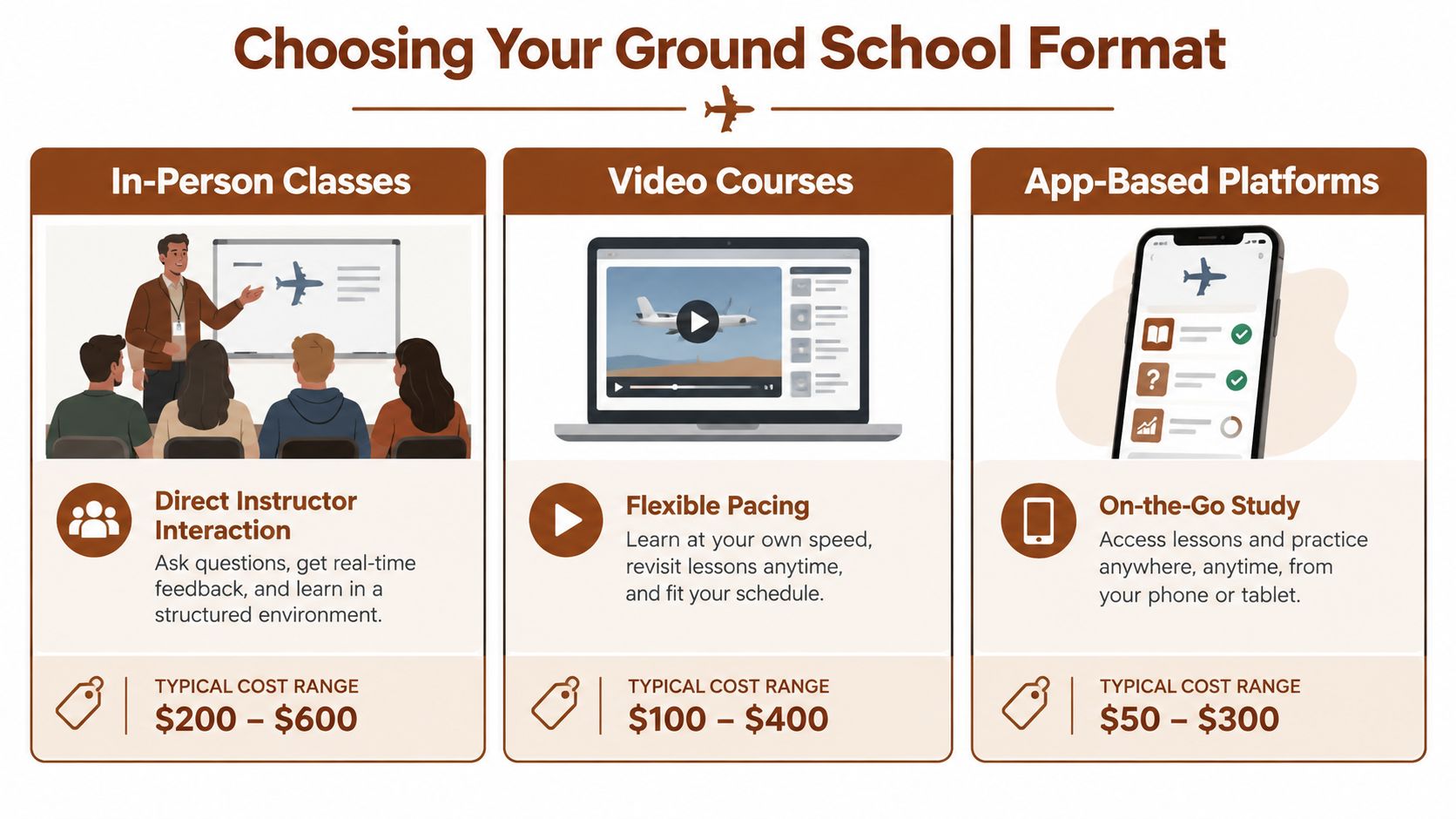
The right choice depends on the problem you're trying to solve. If you need accountability, pick people. If you need flexibility, pick video. If you need repetition, correction, and measurable progress, pick an app or build one into your routine.
Cost Analysis of Different Ground School Formats
A cheap course can become the costly one if it leaves you unready for the FAA knowledge test. Compare the full bill, money, time, and the rework you buy when the first study method does not stick.
In-person training usually has the highest direct cost because you are paying for live instruction and facility overhead. Video courses often look cheaper at checkout, but many students still add separate practice material, so the “budget” option turns into a patchwork. App-based study often folds more of the workflow into one subscription, which can cut the number of tools you need.
The hidden expense is repeating the same material because it never stayed in memory. Retaking the same material because the first pass did not stick is a system failure, not a software failure. If the format does not force correction, you pay later in extra study time and second-guessing.
According to flyCowboys' own pricing comparison, its subscription typically costs about $800 less than in-person ground school plus separate apps, while organizing study around the FAA ACS domains. That matters only if the format matches how you work through weak areas. For a student watching every dollar, a cheaper option that tracks readiness is stronger value than a bigger package that only gives more content.
Budget rule: compare the total cost of getting to a passing score, not the price tag on the first checkout screen.
A good value course should cut wasted review, expose weak areas early, and give you enough practice to walk into the test calm instead of guessing. If a format does not do that, the lower price is an illusion.
Choosing the Right Format for Your Goals and Lifestyle
A student with a fixed weekly routine should think differently from a student with an unpredictable calendar. If you can show up to class consistently and you learn best from live correction, in-person training is still a strong choice. If your schedule changes every few days, a recorded course or app-based path will keep you moving when a classroom cannot.
The decision hinges on three questions. Do you need someone to hold you accountable? Do you need freedom to study in short bursts? Or do you need a system that keeps drilling weak areas until they stop being weak?
- Choose in-person if you learn best by asking questions in real time and you won't reliably self-manage at home.
- Choose video if you need to study after work, on the road, or in broken time blocks.
- Choose app-based study if you want repetition, progress tracking, and quick feedback without waiting for the next class session.
A student who likes structure but hates commute time usually lands in the middle. That person often does well with recorded instruction plus a practice tool that tests knowledge daily. A student who already has strong discipline can skip the classroom entirely and still prepare well.
The wrong question is “Which format is best?” The right question is “Which format will I use on a tired Tuesday night?” If the answer is obvious, you've got your choice.
Enhancing Your Ground School with flyCowboys
A solid primary course can still leave gaps, especially in question practice and radio work. That's where a supplemental tool earns its place. The goal is not to collect more study resources, it's to close the exact holes that cost students points on the written.
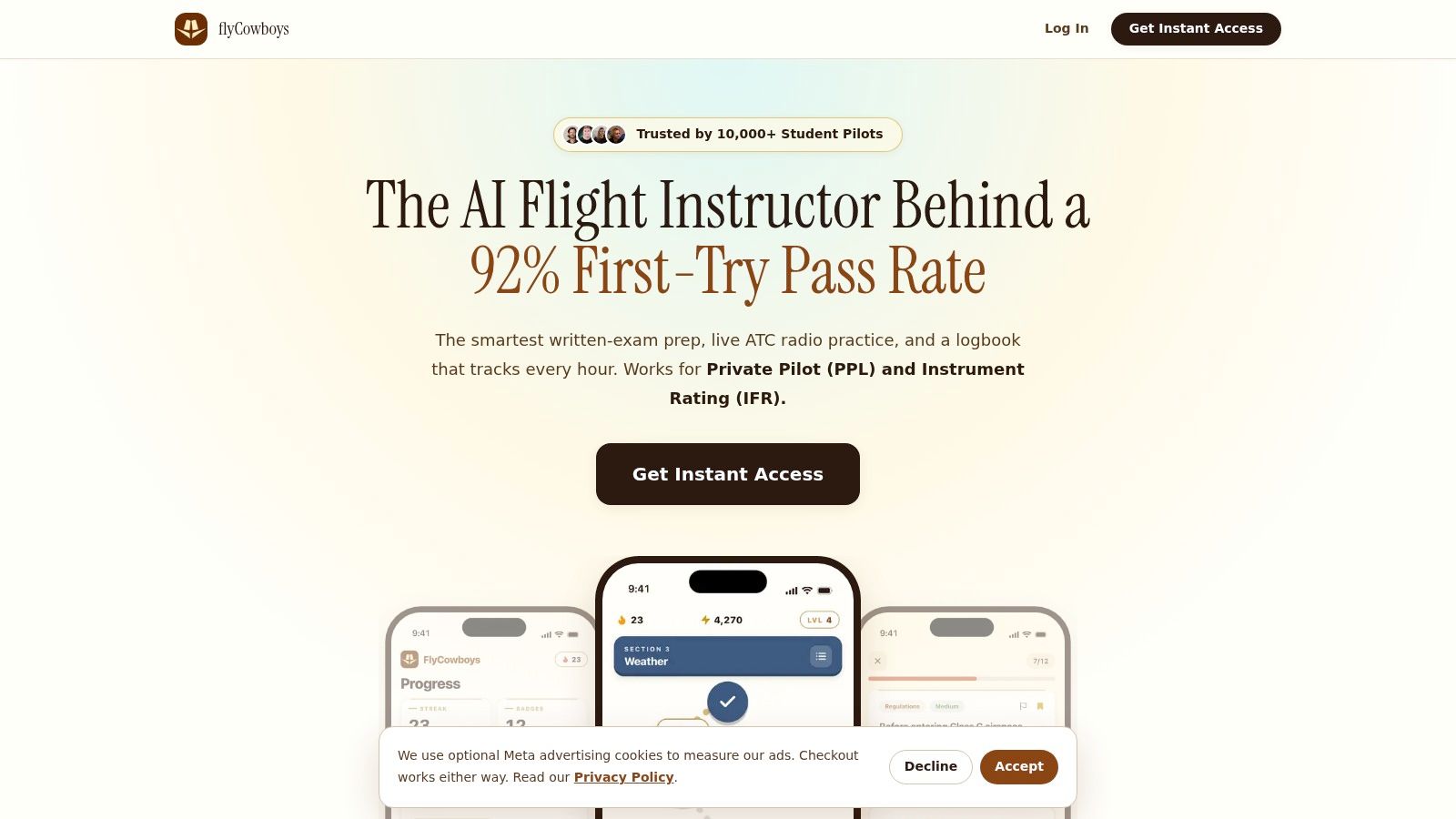
flyCowboys is a mobile study platform that combines adaptive question practice, AI-based radio communication drills, and a flight logbook inside one iPhone app subscription. Its study content is aligned to the FAA Airman Certification Standards, and its full-length practice tests mirror the PSI testing interface used at FAA centers. If you struggle with test-day nerves, interface familiarity matters more than people admit. flyCowboys private pilot study guide
Use a tool like this in a narrow, disciplined way. First, take a full practice test to expose weak ACS areas. Second, spend your daily study time on those weak areas instead of rereading the parts you already know. Third, use the radio practice feature if phraseology still feels stiff or unnatural.
The point of a supplement is consistency. If you can keep your study loop short, repeatable, and tied to feedback, you'll waste less time pretending that passive reading is progress. That's the difference between a study stack and a study plan.
Final Checklist for Selecting Your Ground School
Start with your schedule. If you can't reliably attend a live class, don't pretend you will. Choose the format that survives your normal week, not the one that looks good on paper.
Then check your learning style. If you need immediate feedback and accountability, classroom instruction is hard to beat. If you prefer to absorb material in short bursts or late at night, recorded lessons or app-based study will serve you better.
Next, inspect the curriculum. The course should cover the FAA ACS knowledge areas, not just the obvious topics everyone talks about. Weather, regulations, navigation, performance, airspace, and radio work all belong in the same system, because the test does too.
A clean checklist looks like this:
- Schedule fit means you can study without rearranging your life every week.
- Feedback access means you can correct mistakes before they become habits.
- Practice quality means the questions and explanations match FAA-style testing.
- Coverage depth means the course hits every major knowledge area, not just the popular ones.
- Total cost means you've counted the course, the extras, and the time you'll lose if you pick badly.
Finally, ask whether the format helps you move from preparation to readiness. That distinction matters. You don't want to feel busy, you want to be test-ready and calm enough to prove it.
Choose the system that makes repetition easy, weakness visible, and progress measurable. That's how you get to the written with less stress and fewer detours.
If you want a study setup that pairs ACS-based practice with adaptive drills, radio communication practice, and PSI-style tests in one place, visit flyCowboys and see how it fits your ground school plan. It's built for students who want a tighter path from preparation to test readiness, especially when the clock and the schedule are both working against them.