· 13 min read
FAA Knowledge Test Center: How to Find and Book One
Find an FAA knowledge test center, schedule your exam through PSI, and prepare for test day with the steps, documents and benchmarks you need.

You've finished the ground school modules, your instructor has signed off the last lesson, and someone says the words every student hears eventually: go book the written. So you open the testing site, type your postal code, and get a tidy list of centers. Then you click one, look for a morning slot, and find nothing for three weeks. The closest center is twenty minutes away and useless to you this month.
That gap between "there are centers near me" and "I have a confirmed seat on a date I can make" is where most of the frustration lives. Booking an FAA knowledge test is two jobs, done in a fixed order: work out where you're allowed to sit the exam, then secure a time you can keep. This walkthrough follows that order and stops at each point where students typically lose a week.
Table of Contents
- Find a Test Center and Get a Seat
- Schedule Your Seat and Bring the Right Documents
- Reading Your Readiness Against National Pass Rates
- Retests and Failed Attempts
- Book Your Seat This Week
Find a Test Center and Get a Seat
The number of centers near your home tells you almost nothing about whether you can sit an exam in the next three weeks. One center can be twelve minutes away and booked solid through the end of the month. Another can be fifty minutes away with a confirmed Saturday morning seat. Measure access by time to a confirmed appointment, not by how many pins appear on a map.
FAA knowledge tests are delivered through a commercial center network rather than at FAA offices. PSI Services LLC became the FAA's Airman Certificate Testing Service contractor in 2018, and by 2022 its network included more than 750 testing centers, with third-party providers administering a significant majority of the approximately 207,000 FAA knowledge tests completed in the United States that year, as the FAA's knowledge testing pages describe. PSI's account setup involves identity and verification steps that can take a little time, so create and confirm your account on a calm evening, not the night before your exam.
Two items belong in your hand before you open the search. Your FAA Tracking Number (FTN) from the FAA registry, and the test code for the certificate or rating you're chasing. Searching without either produces a slow, confusing session where you can't tell whether a center is missing your exam or you're missing the right code.
| Search by | What it returns | Check before you book |
|---|---|---|
| Postal code | Centers nearest your home | Drive time on the day you would test |
| Country | Centers in the country you select | Whether the exam you need is offered there |
| Distance | Centers within the radius you set | Round-trip travel plus a possible retake trip |
| Exam | Centers offering your specific test | That the test code matches your certificate or rating |
The search fields are the easy part. The harder truth is that a listed location doesn't guarantee near-term capacity. You search by postal code, country, distance and exam, and you separately confirm identification, eligibility, authorization and any retest requirements before the booking sticks. When no center or seat shows up, PSI runs a separate process for requesting additional availability. That detail matters: an empty search is a situation with a procedure attached, not a dead end.
Practical rule: pick the center you could reach twice. A retake or a rescheduled slot means the same drive again, and a two-hour haul is fine once and miserable the second time.
Confirm listed operating hours with the center directly before you build a day around them. Centers change room availability and front-desk hours, and the person answering the phone knows about next Tuesday in a way the website doesn't.
When the search comes back empty, work through this order: request additional availability through PSI's process, widen the radius to a second center you'd drive to, read the cancellation and reschedule terms before you pay, and move a shaky booking early rather than the day before. Always have that second center in mind from the start. A booking you cancel with notice is a minor annoyance. A booking you abandon on the morning of the exam is a lost seat and often a lost fee.
Schedule Your Seat and Bring the Right Documents
Booking takes about twenty minutes when you do the steps in order. Done out of order, the same booking costs you a seat, a fee and a week of momentum. The deliverable is a confirmed seat on a date you can hold, and every step below exists to protect that date.
If you'd rather watch the flow once before reading it, this walkthrough covers the booking and test-day sequence.
The six steps in order
- Get your FAA Tracking Number first. The scheduling form depends on it, and there's no useful workaround. The slip: reaching the payment screen without one and hunting for the registration page mid-flow, which is where people abandon the session and lose an evening.
- Confirm eligibility and whether an endorsement is required. Under 14 CFR 61.35, an applicant must satisfy specified prerequisites before taking a knowledge test, including holding the required eligibility status and, when applicable, presenting an authorized instructor's endorsement confirming completion of the appropriate ground-training or home-study course and preparation for the test, per the FAA's November 2024 testing advisory, which lists the airman knowledge tests currently on offer. The slip: assuming no endorsement applies to you and finding out two days before the exam.
- Match your certificate or rating to the exact test code. Private Pilot Airplane, Instrument Rating Airplane and Commercial each carry their own code, and the seat you book is tied to it. The slip: booking a code that doesn't match the rating you're training for, then discovering it at check-in.
- Search PSI with the four inputs from the previous section, starting with the exam rather than the postcode when you're short on time.
- Book, then save the confirmation with the date, the start time and the full street address in one place you'll find again. Write down the second center you'd take if this slot disappears, so a cancellation becomes a phone call rather than a fresh search.
- Recheck three to five days out. Confirm the time and location still hold. Centers move rooms and adjust schedules, and a five-minute call beats a wasted morning.
| Input | Where it comes from | When you need it | Common mistake |
|---|---|---|---|
| FAA Tracking Number (FTN) | FAA registration before booking | Before searching for seats | Booking without an FTN |
| Certificate or rating and test code | Your target rating, matched to the exam code in PSI's portal | When you select the exam | Booking a test that does not match your rating |
| Instructor endorsement | Authorized instructor, when 14 CFR 61.35 requires it | Before you book | Assuming an endorsement is never needed |
If you're mapping the final weeks before the exam, our guide to sitting the FAA written exam walks the same sequence from a student's side of the desk.
The documents that decide the day
The most common operational pitfall isn't a hard exam. It's arriving without the correct identification or authorization, which is exactly why you verify document requirements with the testing provider and your instructor before you book rather than the week of.
The FAA's testing matrix for knowledge tests sets the workflow plainly: obtain an FTN, confirm eligibility and required authorization, schedule through PSI, bring acceptable identification and documentation, complete the exam in the center's desk-or-cubicle environment, and retain the Airman Knowledge Test Report. The pass mark is at least 70%, and the knowledge test has to be passed before the practical test.
Confirm two things before you pay for a seat: the identification your chosen center accepts, and the specific authorization your certificate requires. Neither is guessable.
What authorization looks like depends on your certificate and your training path. An endorsement may come from ground training or home study, and your instructor is the person who signs it, so ask the direct question: what exactly should I carry into that room? Study apps support this preparation, and flyCowboys takes the same line: the app does not replace certified flight instruction from an authorized instructor, official FAA publications, an approved Part 61 or Part 141 flight training program, or the aircraft flight manual.
Test day and what you keep
Here's the shape of the day so nothing surprises you.
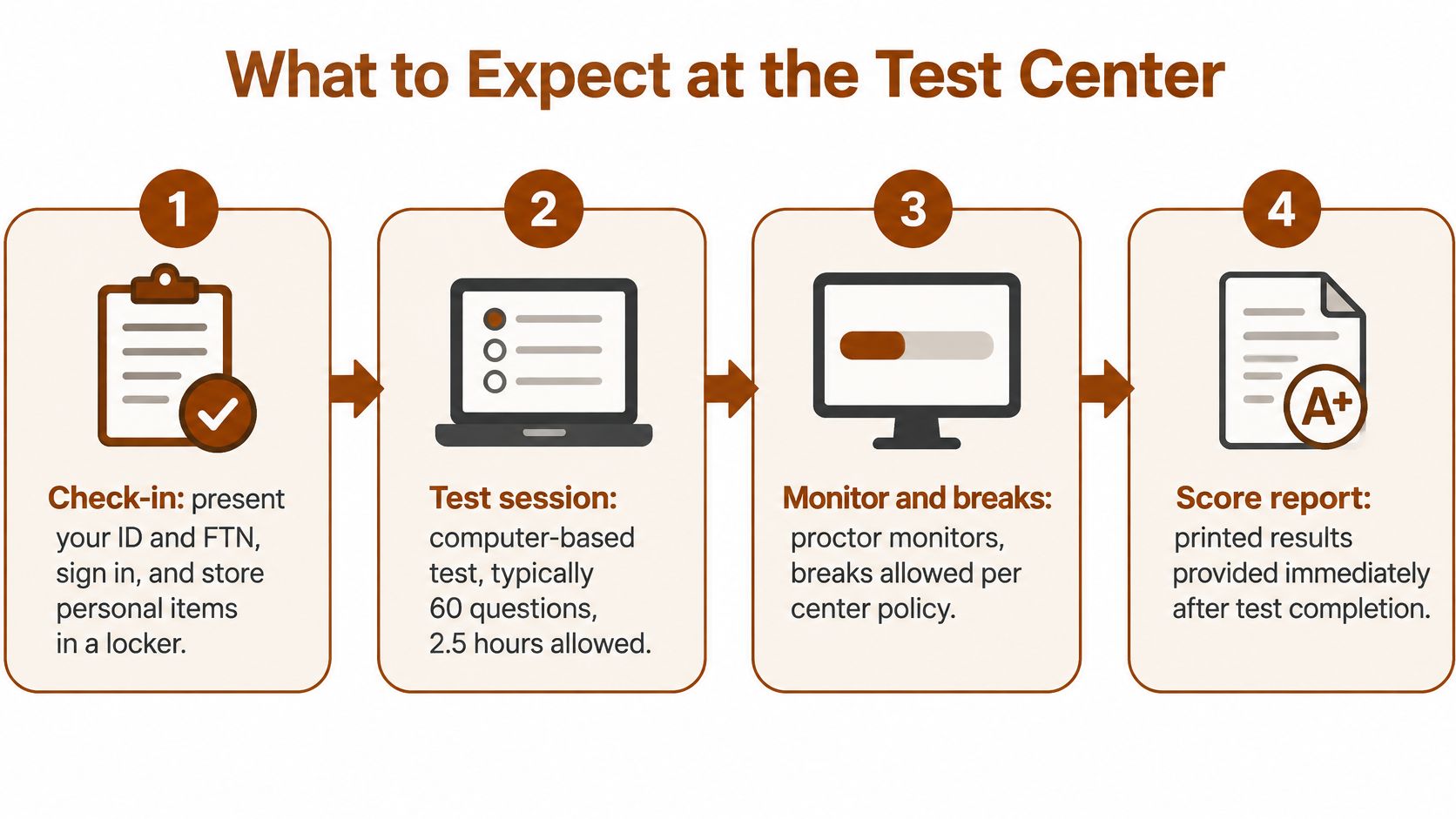
Arrive early enough to sign in without rushing, expect a desk or cubicle rather than a classroom, and follow the center's rules for phones, bags and personal items. Proctors enforce those rules for a reason, and arguing about a watch costs you minutes you'd rather spend on question forty.
Keep your Airman Knowledge Test Report. It's the document that proves the result, and if it goes missing after a test you took recently, the replacement is a duplicate request through PSI rather than a second exam. Repeating a valid test you already passed is pure waste.
Reading Your Readiness Against National Pass Rates
| Category | Tests recorded | Pass rate | Average score |
|---|---|---|---|
| Private Pilot Airplane | 46,132 | 91.90% | 82.89% |
| Instrument Rating Airplane | 27,143 | 94.38% | 86.15% |
The FAA publishes these figures in its airman knowledge test volume report, covering the 2025 testing year for the two airplane categories most readers book. Read them as a picture of what the field scores. They say nothing about your own odds.
The pass mark is 70%. The national averages sit roughly thirteen to sixteen points above it, and that gap is the useful number. A candidate who scrapes past the threshold on a practice test has no cushion against a bad night's sleep, a noisy testing room or two questions from a topic they skimmed. A candidate who lands consistently in the low-to-mid 80s is protected by margin, and margin is what you're building in the last two weeks of study.
That changes how you practise. Rotate across ACS domains instead of re-running the questions you already answer correctly: weather, regulations, navigation, performance and chart interpretation are the ones that punish narrow preparation. Ten questions on weight and balance teach you less than ten questions spread across four domains you avoid.
A practice test is a map of the topics that will cost you points in a room where you can't look anything up.
After the exam, run a short audit. Compare your result and its margin against the national benchmark for your certificate type, and use first-attempt outcomes as a check on whether your study routine is working. If you're on the Private Pilot track, pair that audit with a private pilot study guide so the weak domains get a plan rather than a resolution.
One honest caveat before you book: a 91.90% category pass rate looks like reassurance, and treating it that way is how people book early and sit the exam underprepared. Your own scores are the signal. flyCowboys marks you ready to schedule once your practice exams hold at 85% or higher across sittings and domains, and until that signal arrives, the seat calendar is a distraction. When it does arrive, a confirmed date at your nearest center is worth more than any national statistic.
Retests and Failed Attempts
A failed attempt is a scheduling problem with a study problem attached, in that order. Work through it methodically and the second seat is easier to secure than the first.
- Check the retest requirements before you rebook. FAA guidance treats retest requirements as a separate item from identification and authorization, so confirm the specifics with PSI and your instructor rather than assuming the first booking covers it.
- Run the same search again, with the same four inputs, and keep a second center inside your acceptable drive. Retake seats cluster at awkward times, and one center alone will strand you.
- Read the test report against the ACS domains and study the areas that show up, rather than starting the question bank from the beginning again.
- Protect your record. The report from a passed attempt is what proves the result. If it goes missing, request a duplicate rather than sitting the exam twice.
- Ignore category pass rates as a prediction. They describe the field, not your next attempt. Rebook once your practice scores stay strong across several sittings.
If you want a structured run at the second attempt, an FAA knowledge test prep plan helps you rebuild around weak domains instead of re-reading everything.
Book Your Seat This Week
Do one thing today: message your instructor to confirm eligibility and endorsement status, register for your FTN, then search PSI by exam code rather than by town. Searching by exam first answers the only question that matters, which is whether the test you need is offered anywhere you can reach.
Before you pay, have these ready:
- FTN issued and saved somewhere you'll find it again.
- Endorsement status confirmed, or the signature arranged if one applies to your certificate.
- Test code written down next to your target rating.
- Second center chosen within a distance you'd drive twice.
- Confirmation saved with date, time and full address, not a screenshot of a half-finished booking.
Then answer the readiness question. Are your practice scores holding in the passing range across several sittings and several ACS domains, or do they swing twenty points depending on the topic? If they swing, you're not ready and the seat can wait a fortnight.
flyCowboys practice exams use the same layout as the PSI screen, the official system at every FAA testing center, so the interface isn't a surprise on the day. You tell us your rating, take a short placement quiz, and get a study plan built around your weak areas, with most users ready to sit the written after 4 to 6 weeks of daily study. That's the readiness check to run before you spend a seat.
flyCowboys is an iPhone study app for the Private Pilot and Instrument Rating knowledge tests, with a question bank mapped to the ACS, full-length practice exams in the same layout as the PSI screen, and a readiness score that tells you when your scores have settled in the passing range. If a test center visit is on your calendar for the next month or two, flyCowboys gives you a way to confirm readiness before you pay for a seat. Take the placement quiz, work the weak domains, and book the exam once the practice results hold across several sittings.