· 17 min read
IFR Study Guide: ACS Topics, Schedule, and Readiness
Complete IFR study guide aligned to the FAA ACS. Covers topic breakdown, study schedule, practice question strategy, and readiness signals
If you've ever sat down with a stack of FAA references, a question bank, and a calendar full of other commitments, you already know the feeling. The material looks familiar, the topics seem manageable on their own, and then the pages start blurring together because the challenge isn't learning one rule, it's learning how weather, clearances, systems, and procedures fit together under IFR pressure.
An effective IFR study guide has to do more than help you recognize answer choices. It has to help you think like a pilot who's building a clearance, brief, and approach in real time, because the knowledge test sits inside a larger certification framework that measures more than memorized facts. The FAA's current Instrument Rating-Airplane ACS is FAA-S-ACS-8C, effective May 31, 2024, and it organizes performance around knowledge, risk management, and skills in one competency-based structure FAA Instrument Rating Airplane ACS.

Table of Contents
- Why an IFR Study Guide Has to Start With the ACS
- How the Instrument Rating ACS Shapes Your Study Plan
- The High-Yield IFR Written Topics Grouped for Studying
- A Realistic IFR Study Schedule for a Working Pilot Candidate
- Using Practice Questions as a Diagnostic Tool
- Why a High Score Is Not the Same as Readiness
- Readiness Signals That Tell You to Schedule the Test
- Your Pre-Test Week and What Comes After the Written
Why an IFR Study Guide Has to Start With the ACS
A lot of instrument candidates start in the wrong place. They open a question bank, miss a few weather items, get frustrated with holds, then jump to regulations and approach plates. An hour later, they have touched everything and understood very little. That feels busy, but it does not build the mental model you need when ATC changes the plan in flight.
The ACS gives you the map. It tells you what the FAA expects you to know, what you need to manage, and what you need to do. For the instrument rating, the FAA's current standard connects written-test preparation with practical-test performance in one document.
That matters because instrument flying is not a trivia contest. A weather question on the written test is really about judgment before launch, during an en route deviation, or while choosing an alternate. The same is true for navigation systems, instrument procedures, regulations, and human factors. If your notes do not tie each topic back to an ACS area, you are collecting disconnected facts instead of building operational judgment.
A good IFR study guide should do four things:
- Organize topics by ACS area, so related material stays together.
- Explain why each topic matters, not just which answer is correct.
- Use practice questions as diagnosis, so misses reveal a real gap.
- Track readiness, so a passing score does not hide weak cockpit judgment.
If you already understand the FAA's rating structure, the private pilot ACS framework gives a useful comparison point. The instrument rating follows the same logic, only with more workload and more cross-checking. Keep that structure in view while you study. It saves time, reduces random guessing, and gives every review session a purpose.
How the Instrument Rating ACS Shapes Your Study Plan
Because the ACS groups the rating into knowledge areas, risk management, and skill, your study plan should follow the same three lanes. That structure matters more than the document label. It tells you what the FAA expects you to know, how you should judge a situation, and what you need to do in the cockpit.
A written test prep plan that ignores that structure turns into random review. A plan built around it starts to feel like a checklist a CFI would use in the airplane. That is the right standard.
Know what each element is asking for
Knowledge is the easiest piece to spot. It covers weather interpretation, navigation systems, procedures, regulations, aircraft systems, and human factors. If you can repeat a rule but cannot explain how it changes a decision, you are only halfway there.
Risk management is where many candidates lose ground. The ACS wants you to see consequences, alternatives, and threats before they become problems. In IFR work, that means noticing when a clearance amendment changes fuel planning, when weather makes an alternate more than a backup option, or when an approach briefing needs the missed approach talked through because the setup feels unstable.
Skill may sound like something saved for the practical test, but it still belongs in written prep. If you do not understand what the task looks like in the cockpit, the test questions feel abstract and easy to forget. The instrument rating ACS guide makes the same point from a training angle.
Practical rule: if you cannot connect a topic to a cockpit decision, you do not know it well enough yet.
Use the ACS as a master checklist
A study plan built around the ACS keeps your notes organized around how the FAA evaluates performance. A question on approach minimums belongs with missed approaches, alternate planning, and setup discipline. A question on pitot-static systems belongs with instrument indications, not a generic systems pile. That grouping helps you build useful links instead of isolated flashcards.
The diagram below shows the structure clearly, with knowledge areas, flight tasks, and appendices working together as one framework.
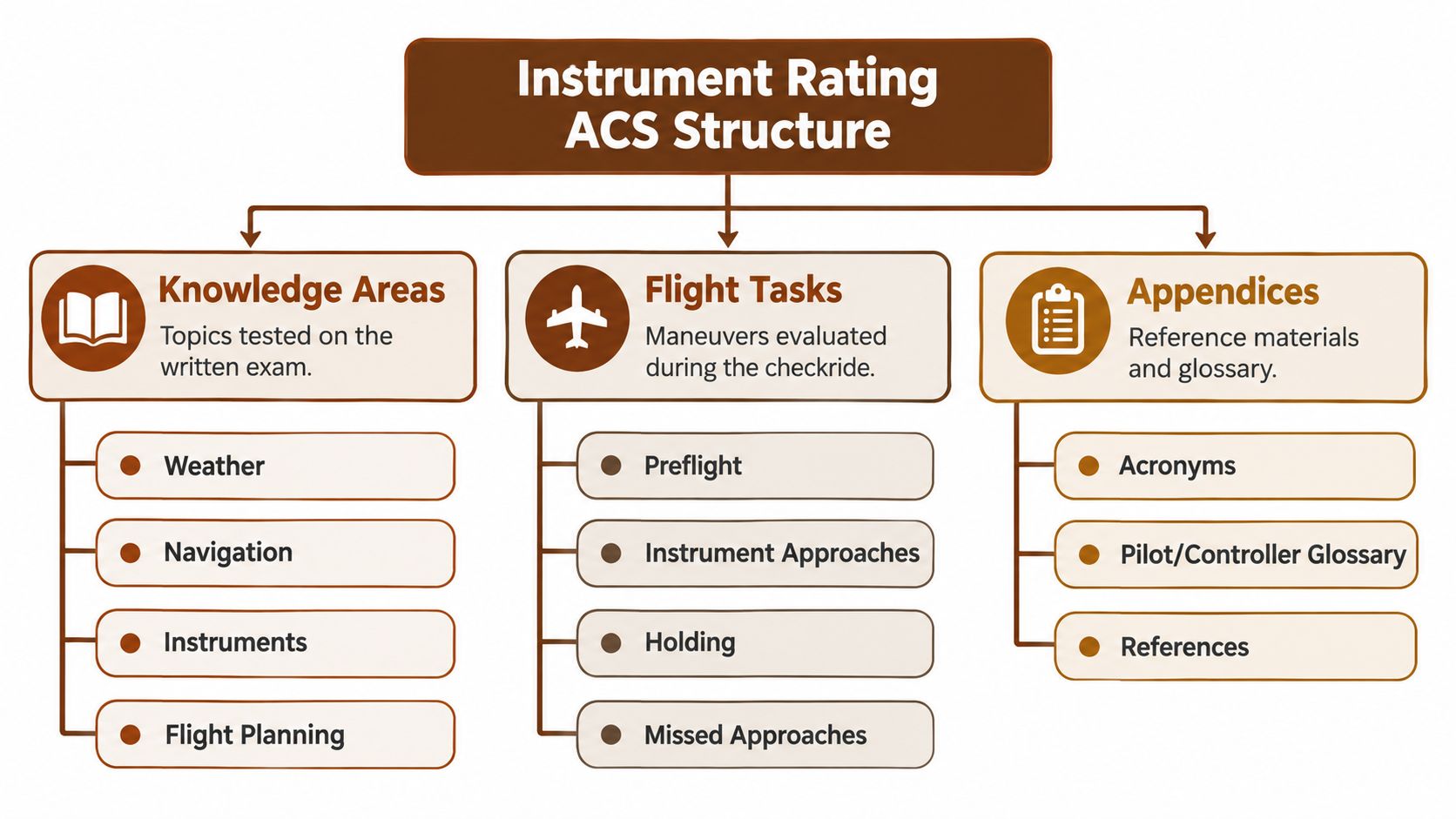
Keep that structure in view while you study. It saves time, reduces guessing, and makes every review session point toward actual instrument competence.
The High-Yield IFR Written Topics Grouped for Studying
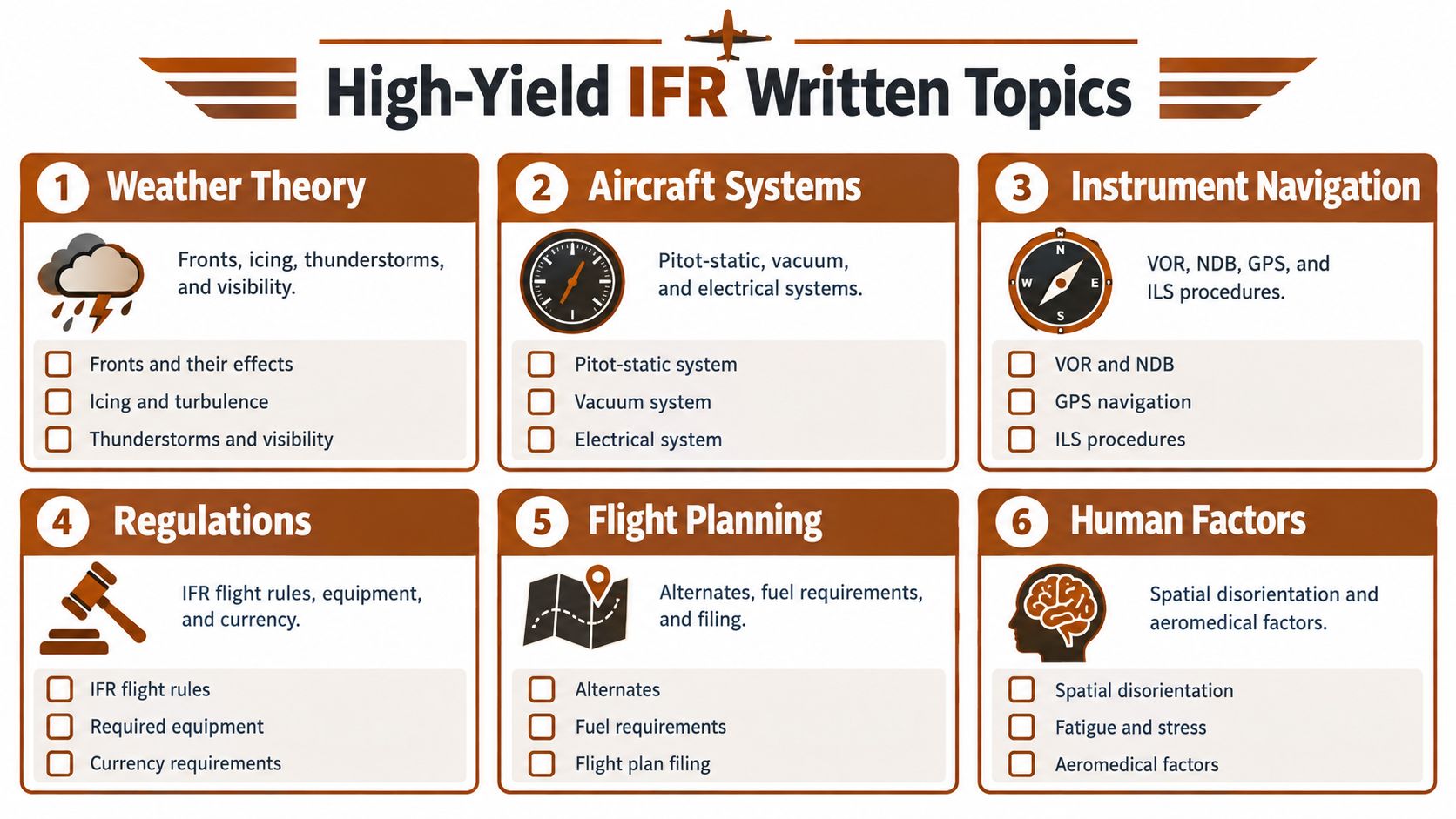
Candidates usually don't fail because one subject is impossible. They lose points because they treat each subject like a separate island. IFR rewards people who can see relationships, so the smartest way to study is to group topics by what they test, then drill the parts that tend to collide in real flying.
Weather, planning, and the picture outside the windshield
Weather is the first place many students feel the weight of instrument training. Not because the material is mystical, but because IFR weather questions often ask you to translate symbols and reports into decisions. METARs, TAFs, icing, turbulence, alternate weather, and visibility all matter because they affect whether the flight should launch, continue, or divert.
Regulations, airspace, and equipment
IFR regulations look dry until you need them. Then they become the spine of the flight. This area covers flight rules, equipment requirements, and the limits that shape legal dispatch. Students often miss points here when they memorize a rule without learning when it applies. That's a problem because a rule you can't apply in context is just noise.
Navigation and procedures
Navigation is where the test gets practical. VOR, GPS, ILS, approach setup, departures, arrivals, holds, and missed approaches all belong together because they're part of one workflow. The common mistake is learning each system as if it lives alone. In the cockpit, it doesn't. The airplane, the chart, the clearance, and the automation all interact.
A candidate who knows how to identify the right aid but can't brief the procedure is still exposed. A candidate who can fly the approach conceptually but can't explain the missed approach is also exposed.
Systems, performance, and human factors
Aircraft systems matter because instrument work depends on accurate indications. Pitot-static issues, vacuum or electrical problems, and related equipment failures change how the panel behaves. Performance and weight-and-balance questions matter because IFR planning depends on margins, not hope. Human factors matter because spatial disorientation, workload, fatigue, and poor prioritization can ruin a technically legal flight.
Watch for this: if you keep missing questions because two topics sound similar, don't memorize harder. Rebuild the comparison from the start.
A practical way to budget study time
Some domains are heavy on rules, some are heavy on interpretation, and some are heavy on scenario thinking. Weather and procedures deserve repeated review because they show up everywhere. Regulations need careful reading. Human factors need honest self-checking because the wrong answer often feels plausible.
A Realistic IFR Study Schedule for a Working Pilot Candidate
A working pilot candidate does better with short, repeated sessions than with heroic weekend marathons. A fifteen-minute daily habit sounds modest, but it's easier to protect, easier to repeat, and easier to keep honest when life gets busy. That kind of cadence also gives spaced repetition a chance to work, because weak topics keep coming back instead of disappearing after one long review.
Build the week around repetition, not exhaustion
Start with the basics first. In the opening phase, read the ACS sections you'll be tested on and pair them with one topic at a time, such as weather, navigation, or regulations. The point is to create context before you start chasing speed.
Then move into deeper review. Spend one block on weather interpretation, another on procedures, then return to the earlier material with fresh questions. The repetition is what turns recognition into retention.
A schedule that fits real life
A simple rhythm looks like this:
- Week 1, Foundation: read the ACS and your core instrument references, then build a clean topic list.
- Week 2, Weather: focus on reports, icing, turbulence, and alternate planning.
- Week 3, Navigation systems: work through VOR, GPS, and ILS logic until the workflow feels familiar.
- Week 4, Regulations and planning: review IFR legality, equipment, and flight planning.
- Week 5, Practice exams: take full-length exams and review every miss carefully.
- Week 6, Weak areas: return to the topics that still feel slippery.
- Week 7, Final review: run a full exam simulation and tighten your notes.
- Week 8, Test week: lighten the load and protect your sleep.
If you're retaking the exam, shift more time into the areas that caused trouble last time and spend less time on topics you already know cold. If you already have a Private Pilot written behind you, you may move faster through airspace, weather basics, and performance, but don't assume those topics transfer automatically to IFR decision-making.
Keep the daily session short enough to survive
The mistake I see most often is overplanning. A candidate writes a perfect calendar, then skips day three because the session is too long. Fifteen focused minutes, followed by a few practice questions and a quick review of misses, beats a two-hour block you can't repeat.
The schedule works because it respects attention span and fatigue. It also leaves room for the kind of review that matters most, the return visit to what you didn't understand the first time.
Good study is repeatable study. If the schedule can't survive a normal week, it isn't a schedule.
Using Practice Questions as a Diagnostic Tool
Practice questions help most when they tell you what to fix. Used badly, they become a score chase. Used well, they act like a mirror, showing which ACS areas are solid, which ones are shaky, and which ones only look familiar because the answer choices gave you a nudge.
Three ways to use practice questions
| Mode | Purpose | How to Score It | Post-Answer Action |
|---|---|---|---|
| Warm-up questions | Activate memory while learning a new topic | Don't obsess over the percentage | Read the explanation and mark the ACS area |
| Untimed study sets | Build understanding one topic at a time | Track accuracy by subject, not just overall score | Rewrite the concept in plain language |
| Timed full exams | Simulate test pressure and pacing | Compare results across domains, not only the final total | Review every miss and every lucky guess |
Warm-up questions are for learning. If you're working weather or regulations, a short set can expose gaps before they harden into bad habits. Untimed sets are where you slow down enough to understand why the wrong answer is wrong. Full exams are for pressure testing your readiness, not for bragging rights.
What to do after every answer
The post-answer step matters more than the question itself. Read the explanation, identify the underlying ACS area, and write down why you missed it if you missed it. If the error came from a term you didn't understand, fix the definition. If the error came from rushed interpretation, slow the next set down.
A lot of candidates skip this part because they want momentum. That feels efficient, but it only works if you're already strong. If you're still building the base, every miss is free data. Use it.
How to read the pattern
A high score with scattered gaps is not the same as a balanced score. One says you're good at recognizing familiar material. The other says you're building coverage you can trust under pressure. When you review your results, look for the domains that keep repeating in the wrong column. Those are your study priorities, even if the overall number still looks decent.
If you want a tool that combines adaptive practice with PSI-style test simulation, flyCowboys includes IFR question practice, weak-topic drills, and full-length exams. The tool matters less than the habit, though. Use any system that forces you to explain why an answer is right, not just whether you guessed right.
Why a High Score Is Not the Same as Readiness
A clean score report can feel reassuring. It can also hide gaps that show up fast in the cockpit. The FAA's 2024 statistics show that 25,647 applicants took the Instrument Rating-Airplane test, the pass rate was 94.24%, and the average score was 85.64% FAA 2024 airman knowledge test statistics. Those numbers matter, but they do not mean the material is simple. They often show that the exam rewards candidates who learned how to prepare for the exam.
The danger of false confidence
A passing score can cover weak understanding in the exact areas that matter in flight. You may remember enough weather and regulation details to answer individual questions, then stumble when several constraints arrive together. That gap is the difference between test performance and cockpit performance.
The written exam only samples the larger ACS framework. It can show that you studied, but it cannot fully measure risk management, adaptation to changing conditions, or steady judgment under pressure. A candidate can pass the knowledge test and still need more work before the practical test.
Measure what actually transfers
Use ACS coverage as the baseline, then ask whether you can handle integrated scenarios without losing the thread. Can you brief an unfamiliar approach, respond to an amended clearance, think through alternates, and explain a missed approach in one connected chain? Can your radio phraseology stay controlled when the pace picks up?
Passing the written proves you cleared one gate. It does not prove your IFR thinking will hold up in a busy cockpit.
For how test prep connects to practical performance, see the FAA written exam guide. The check is whether you can move between weather, procedures, and planning without confusion, because IFR work rarely arrives as isolated questions. It arrives as a sequence of decisions.
Readiness Signals That Tell You to Schedule the Test
Readiness should feel specific, not emotional. If you're relying on gut feel alone, you'll either book too early or delay too long. Better to look for signals that are tied to the ACS and to the kinds of mistakes that show up under light pressure.
Three layers of readiness
First, your scores should be consistent across the major ACS areas, not just high in one or two categories. If weather is solid but procedures are shaky, you're not ready yet. If you can answer regulations but still stumble on navigation logic, you still have work to do.
Second, you should be comfortable with cross-domain scenarios. That means amended clearances, alternate decisions, unstable approaches, and fuel-related judgment don't feel like traps anymore. You don't need perfection, but you do need a steady process.
Third, your radio phraseology should stay controlled when the pace picks up. If you can't say the clearance cleanly, you'll feel the strain later in training when workload rises.
A simple self-check
Use these questions before you schedule:
- Can I explain why the correct answer is correct, without looking at the explanation?
- Can I handle a mixed scenario that combines weather, planning, and procedures?
- Can I keep my radio calls clear when I'm slightly behind?
- Do my weak areas stay weak, or have they stopped repeating?
If the answer to most of those is yes, your study has probably matured enough to justify the exam fee and the seat at the testing center. If not, one more focused week can save you from a shallow pass.
Trust the pattern, not the mood
A lot of candidates feel ready on a good day and unprepared on a tired day. That's normal. The better signal is whether your performance stays stable across several sessions. When the pattern holds, book the test. When it doesn't, keep working the weak areas and resist the urge to guess your way forward.
Your Pre-Test Week and What Comes After the Written
The last week before the exam should be calm and narrow. Don't start new material. Review notes, run one full practice exam, and then stop cramming. Get your logistics set early so test day isn't wasted on avoidable stress, and protect the night before like it matters, because it does.
Passing the written is a gate, not a finish line. It shows that your preparation reached the standard for the knowledge test, but the ACS framework still matters when you move into sims, oral review, and the practical test. Keep studying the same way you trained, with topic grouping, scenario work, and honest review of misses, and the written becomes a useful foundation instead of a hollow milestone.
If you want a structured way to turn IFR study into actual readiness, visit flyCowboys and use its IFR question practice, weak-topic drills, PSI-style exams, and radio practice to keep your prep tied to the ACS. It's built for pilots who want their study time to survive in the cockpit, not just on a score report.