· 13 min read
How to Calculate Weight and Balance for Pilots
Learn how to calculate weight and balance for your aircraft. Master FAA formulas, review worked examples, and use our preflight checklist to fly safely.
You're halfway through a preflight when the loading plan changes. A passenger brings extra baggage, someone moves from the front seat to the rear, and the fuel quantity no longer matches the original plan. The airplane may still look normal on the ramp, but its weight and balance have changed. Knowing how to calculate weight and balance lets you judge that change before it becomes a takeoff or landing problem.
The arithmetic is simple. The important skill is understanding what the arithmetic represents physically. Every pound acts at a location, and moving that pound changes how the airplane balances, handles, and responds to control inputs.
Table of Contents
- Why Aircraft Weight and Balance Matters
- Core Terminology and the Moment Formula
- Working Through a Realistic Loading Problem
- Common Calculation Mistakes to Avoid
- Your Preflight Weight and Balance Checklist
- Mastering Performance for the FAA Written Exam
Why Aircraft Weight and Balance Matters
A four-seat trainer can look ready for a weekend flight while exceeding an approved limit. Full fuel, several occupants, and baggage may fit physically inside the cabin, yet the airplane can still be too heavy or have its center of gravity in the wrong place. A packed baggage compartment doesn't tell you whether the aircraft is safe to fly.

Weight affects performance. A heavier airplane needs more runway, accelerates less readily, climbs more slowly, and may require more energy to stop. The aircraft's approved maximum weight reflects structural and performance limits, not a suggestion about how much can fit inside.
Balance affects control forces and stability. The center of gravity, or CG, is the point where the aircraft would balance if it could be supported at that location. The aircraft must remain within the CG envelope published in its approved documentation.
Why an aft CG deserves attention
A load placed toward the tail moves the CG aft. An aft CG can reduce the stabilizing moment of the horizontal tail and change the amount of elevator force needed in flight. The airplane may feel lighter in pitch, but that lighter feel isn't automatically a benefit. An aft loading can reduce the margin available for stall recovery and make pitch changes more sensitive.
A forward CG creates a different problem. The tail may need to produce more downward force to balance the airplane, which increases the lift required from the wing. That can raise stall speed and increase the control force needed during rotation or flare. A forward-loaded airplane may feel stable and heavy in pitch, yet still demand more runway and stronger elevator input.
Practical rule: An airplane that's within the weight limit can still be unsafe if its CG is outside the approved envelope.
The key decision isn't whether the airplane appears full or empty. It's whether the takeoff and landing conditions remain within both the weight limit and CG envelope. Fuel burn, passenger movement, and baggage placement can all change the answer during the flight.
Core Terminology and the Moment Formula
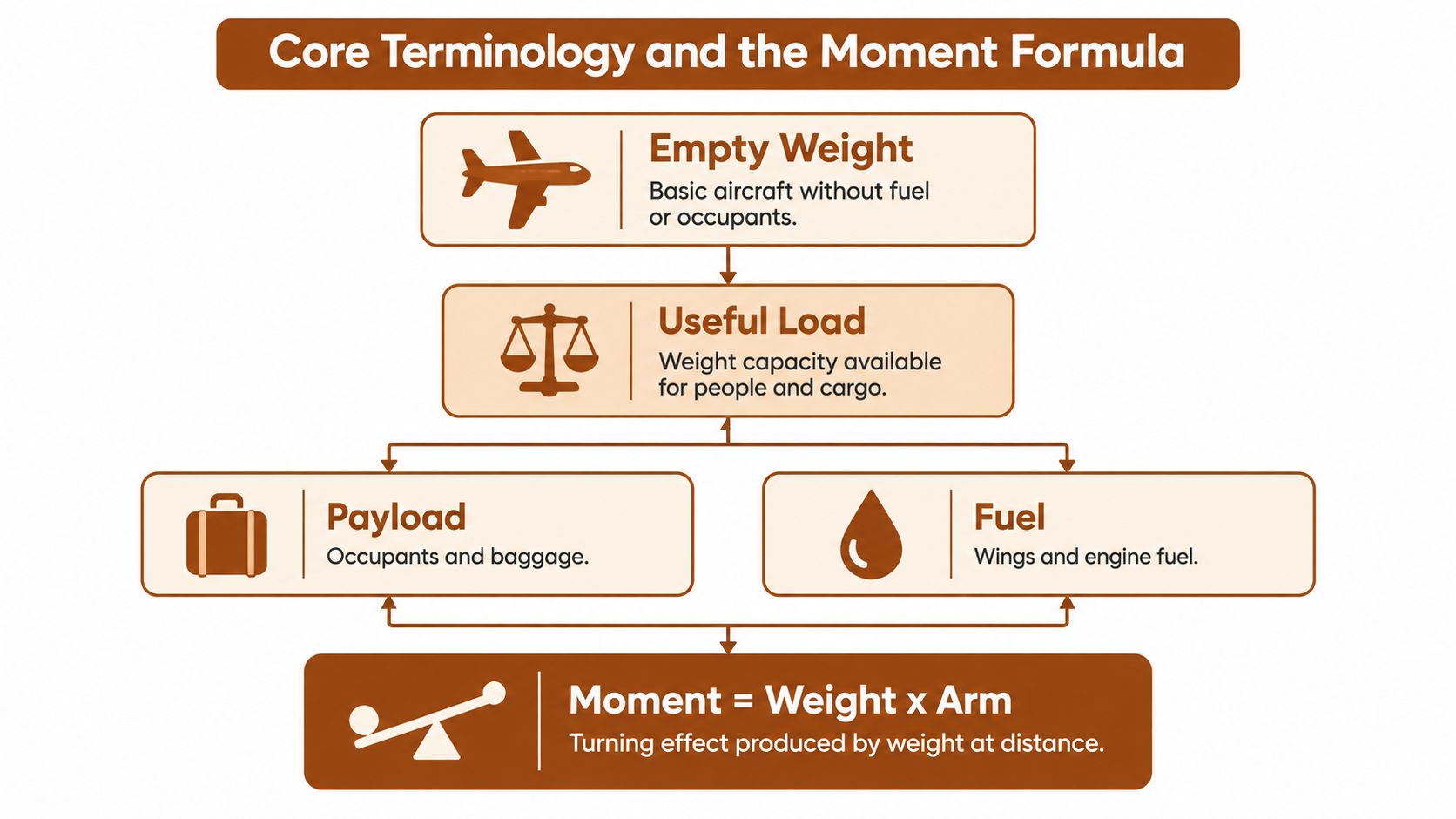
Weight and balance becomes much easier when each term has a physical meaning. Start with the aircraft's documented baseline, then add the items that will be carried on the flight.
- Empty weight is the aircraft's recorded weight in its defined empty configuration. Use the current weight and balance record, not a remembered figure from another airplane.
- Useful load is the weight available for occupants, baggage, usable fuel, and other permitted additions.
- Payload generally means the occupants and baggage carried by the aircraft.
- Datum is the reference plane from which arms are measured. It can be ahead of, behind, or near a physical part of the airplane.
- Arm is the distance from the datum to the point where a weight acts.
- Moment is the turning effect created by a weight acting through an arm.
Think like a seesaw
A playground seesaw gives you the right intuition. A heavy child sitting close to the pivot can balance a lighter child sitting farther away. The lighter child gains advantage because the distance from the pivot is greater.
An airplane works the same way around its datum. A modest baggage load at a long aft arm can create more moment than a heavier item located close to the datum. This is why moving a bag can affect CG more than its weight alone suggests.
The basic equation is:
Moment = Weight × Arm
If a load weighs 20 pounds and acts at an arm of 40 inches, its moment is 800 pound-inches. The units matter because the moment combines both the amount of weight and its distance from the reference.
To find the aircraft's final CG, add all moments, add all weights, and divide:
CG arm = Total moment ÷ Total weight
The final CG is a weighted average location. It isn't the simple average of the arms, because heavier items contribute more strongly than lighter ones.
Use the aircraft's approved documentation and the relevant aviation glossary when an unfamiliar term appears. The glossary can help with vocabulary, but the Pilot's Operating Handbook and current weight and balance records control the actual calculation.
Working Through a Realistic Loading Problem
A flight can begin within limits and become unsafe as fuel burns. That is why a weight and balance calculation must describe the aircraft's loading throughout the flight, not just its appearance on the ramp. Working through a realistic example helps connect the arithmetic to the airplane's physical behavior.
Set up the loading grid
Use one row for the empty airplane and one row for every variable load. Each station arm must come from the aircraft's current documentation. An arm from another model, serial number, or generic worksheet can place the calculated CG in the wrong location.
The following values are illustrative only. They are not approved data for a particular aircraft. For an actual flight, use the aircraft's weight and balance records, station arms, fuel information, and approved CG envelope.
| Station | Weight (lbs) | Arm (in) | Moment (lb-in) |
|---|---|---|---|
| Empty aircraft | 1,650 | 40 | 66,000 |
| Pilot and front passenger | 340 | 37 | 12,580 |
| Rear passengers | 180 | 73 | 13,140 |
| Fuel | 240 | 48 | 11,520 |
| Baggage | 50 | 95 | 4,750 |
| Total | 2,460 | 107,990 |
The total moment is the sum of the individual moments: 66,000 + 12,580 + 13,140 + 11,520 + 4,750 = 107,990 lb-in. The total weight is the sum of every weight entry. Do not multiply the total weight by one station arm, because the airplane's load is distributed across several locations.
The grid also shows why position matters. The baggage weighs less than the occupants, yet its long aft arm gives it a meaningful moment. Moving a load farther from the datum is like moving weight farther from a seesaw's pivot. The same item has a greater effect on balance when its distance increases.
Find the loaded CG
Apply the CG equation:
CG = 107,990 ÷ 2,460
The result is approximately 43.9 inches aft of the datum. This is the location where the loaded aircraft would balance for this specific loading condition.
The arithmetic is only one part of the decision. Compare the total weight with the aircraft's maximum approved weight. Then compare the calculated CG with the approved envelope at that weight. The envelope may permit different CG ranges at different weights, so a single limit cannot replace the approved graph or table.
Check the flight, not just the departure
Fuel burn changes both total weight and total moment. In this example, the fuel acts at a different arm from the empty aircraft, occupants, and baggage. As fuel leaves the tanks, the aircraft's balance point can shift.
Calculate at least three conditions:
- Takeoff condition, using the planned fuel and loading.
- Landing condition, using the expected fuel remaining.
- Critical intermediate condition, when the aircraft documentation or loading arrangement indicates that the CG could move outside the envelope during flight.
A legal takeoff CG does not guarantee that every later condition remains legal. Plot each calculated point on the approved envelope, or use an approved worksheet that performs the same comparison. This habit builds physical understanding: weight determines how much the aircraft must lift, while distribution affects how it responds to pitch inputs and remains controllable.
Common Calculation Mistakes to Avoid
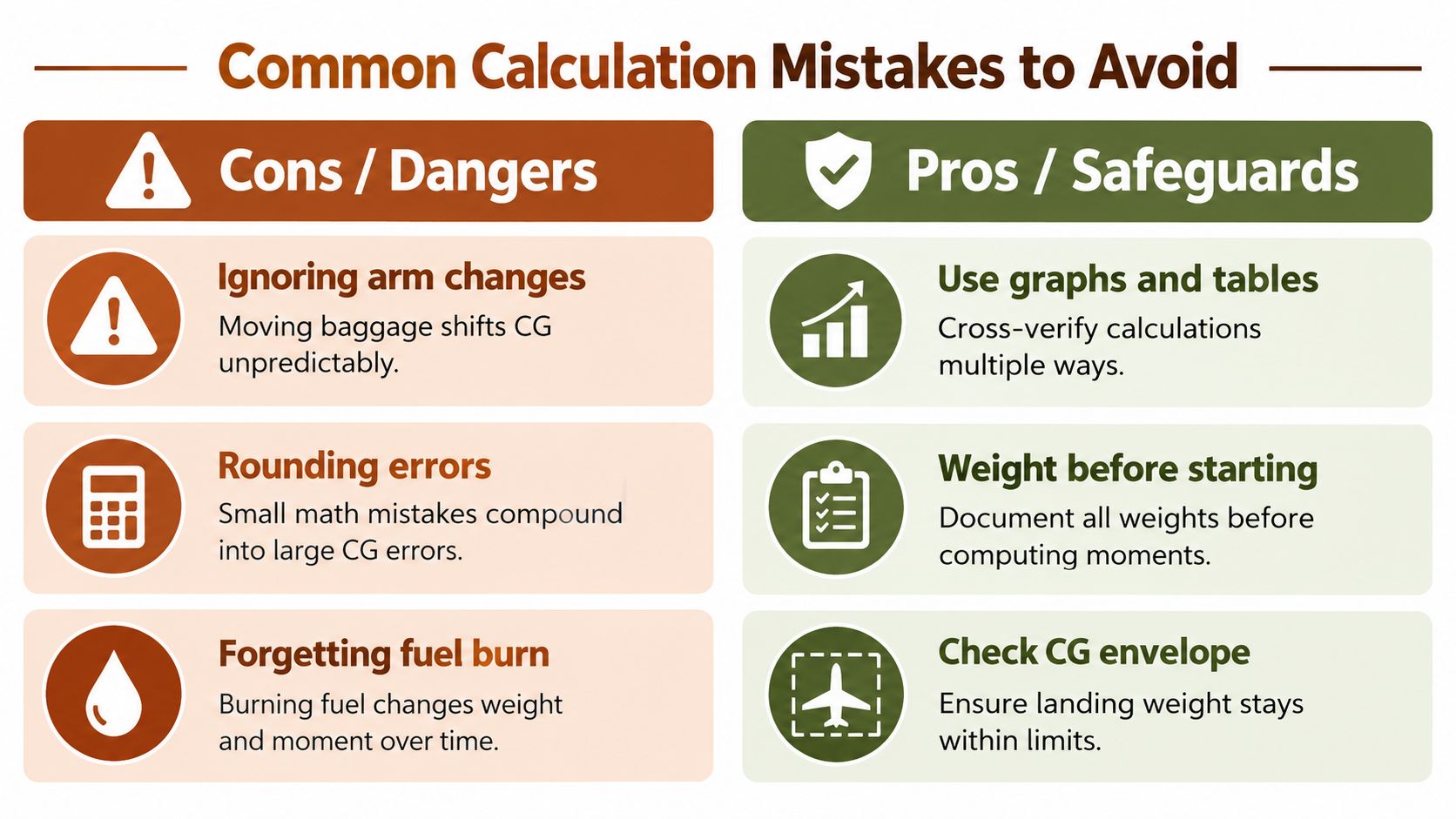
Most errors don't come from difficult mathematics. They come from using the wrong input, mixing units, or accepting a result that doesn't pass a physical sanity check.
Fuel quantity isn't automatically fuel weight
Aircraft fuel gauges and flight planning often describe fuel by volume, while weight and balance uses weight. A tank quantity must be converted using the fuel density specified by the aircraft documentation or operating guidance. Don't enter a gallons figure directly into a pounds column.
The same warning applies to baggage and occupants. Estimates may be useful during an early planning discussion, but the final calculation should use defensible weights, especially when the loading is near a limit.
The empty-aircraft record can become outdated
Avionics installations, repairs, interior changes, paint, equipment removals, and other modifications can change the aircraft's empty weight and empty CG. If the airplane has changed since its last weighing or approved update, an old baseline can make every later calculation wrong.
Check the aircraft's current documents before opening a calculator. Verify the empty weight, empty CG or moment, equipment configuration, and the revision of the applicable handbook or supplement.
Watch the moment scale
Some worksheets use full moments in pound-inches. Others use a moment index, such as a moment divided by a scale factor. The worksheet should state which convention it uses. If you enter an indexed moment where a full moment is expected, the final CG can become obviously absurd or subtly wrong.
Sanity check: Your final CG should fall somewhere between the arms of the significant loads, unless the aircraft's datum convention or negative arms requires a more careful interpretation.
A quick review catches many mistakes:
- Recheck units: Confirm pounds, gallons, inches, and any moment index are being used as the worksheet expects.
- Recheck direction: A load aft of the current CG should generally pull the calculated CG aft, while a forward load should generally pull it forward.
- Recheck totals: Add weights and moments independently, preferably with a calculator and a second method.
- Recheck the envelope: A legal weight doesn't guarantee a legal CG.
- Recheck fuel burn: The landing condition can differ from takeoff condition.
This short video can reinforce the basic workflow, but it doesn't replace the aircraft-specific POH, weight and balance report, or operating limitations.
Your Preflight Weight and Balance Checklist
A kitchen-table calculation and a ramp decision should use the same logic. The difference is that the ramp introduces distractions, last-minute baggage, uncertain passenger weights, and changing fuel plans.
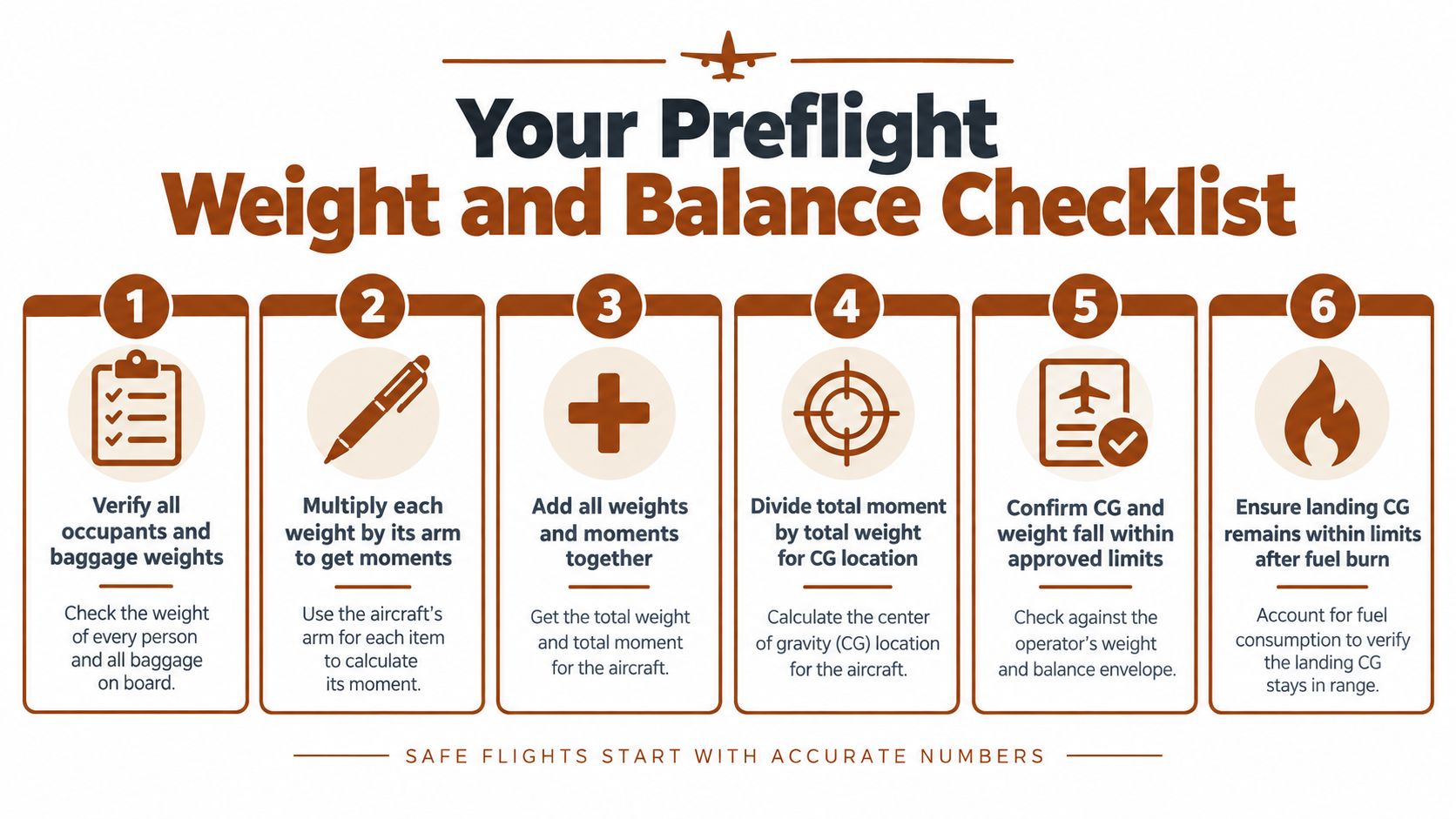
Use a repeatable sequence:
- Confirm the aircraft baseline. Check the current empty weight, empty moment or CG, equipment status, and applicable documents.
- Record the actual load. Include every occupant, bag, removable item, and planned fuel quantity. Ask for realistic weights when the margin is limited.
- Assign each item to a station. A bag in an aft compartment doesn't have the same arm as a bag on a seat or in a forward compartment.
- Calculate each moment. Multiply each weight by its correct arm. Keep the units consistent.
- Add and divide. Sum the weights and moments, then divide total moment by total weight to find the loaded CG.
- Check the complete flight. Compare takeoff, landing, and any relevant intermediate conditions with the approved weight and CG envelope.
Passenger movement matters too. Tell occupants where they need to sit before starting the engine, and don't treat a seat change as irrelevant if it changes the station arm. Secure baggage so it can't move into a different location during turbulence or maneuvering.
Fuel planning deserves special attention. The tank's arm may be forward or aft of the airplane's current CG, so burning fuel can move the CG in either direction depending on the design. Calculate the expected landing condition rather than assuming that less fuel always makes the airplane balance better.
Go or no-go: If the calculation is uncertain, the documents don't agree, or the result is close to a limit, stop and resolve the uncertainty before flight.
For the oral-exam side of this topic, review a structured checkride oral exam guide and practice explaining not only the formula, but also why each loading change affects the airplane.
Mastering Performance for the FAA Written Exam
Weight and balance questions become faster when you understand the physical story behind the numbers. You should be able to look at a loading diagram and predict the direction of the CG shift before calculating it. That prediction gives you a valuable error check during both the exam and real flight planning.
Start with manual work. Write the station, weight, arm, and moment in an organized grid. Then practice identifying the changed variable quickly: a passenger moved aft, baggage was added, fuel was burned, or the aircraft baseline changed. The best study session isn't just a search for the correct answer. It includes an explanation of why the correct answer makes sense.
A platform such as flyCowboys FAA written test prep can provide exam-style practice for performance and weight-and-balance topics alongside other knowledge areas. Its study approach includes explanations, adaptive review, and practice testing, which can help you find calculation errors and revisit concepts that haven't become automatic yet.
Don't memorize isolated answers. Practice the sequence until it feels natural:
- Identify the aircraft data source.
- Convert the load into the required units.
- Calculate each moment.
- Sum weight and moment.
- Find the CG.
- Check the approved envelope.
- Consider fuel burn and the landing condition.
That sequence prepares you for more than a written test. It gives you a reliable way to challenge a result that looks suspicious, even when a computer or electronic flight bag produces it instantly.
flyCowboys offers FAA knowledge-test practice with weight-and-balance content, explanations, adaptive review, and PSI-style practice exams in an iPhone study platform. Use it to rehearse the calculation process and identify weak areas, then visit flyCowboys to explore the available pilot study tools.