· 15 min read
Aviation Weather Book Guide: Picks for Students and Pilots
Find the right aviation weather book: compare the FAA handbook and top study guides, and see which suits student or advanced pilots.
The most popular advice about choosing an aviation weather book is to buy the most thorough one and read it cover to cover. That's a poor study plan if you can decode every group in a METAR but still can't explain what you'll do when the destination forecast improves while conditions along the route deteriorate.
Choose a book for the problem you need to solve. Passing the written exam, understanding icing, and deciding whether to depart require overlapping knowledge, but they don't require the same reading strategy.
Table of Contents
- Which Aviation Weather Book Fits Your Training Stage
- What a Useful Aviation Weather Book Must Cover
- The FAA Aviation Weather Handbook as the Core Reference
- Side-by-Side Comparison of Textbooks and Study Guides
- Real Scenarios for Students and Advanced Pilots
- Where Weather Books Stop and Decisions Begin
- Build Your Weather Book Stack and Start Reading
Which Aviation Weather Book Fits Your Training Stage
A student preparing for the written exam should start with the FAA Aviation Weather Handbook, then add a question bank to test understanding. An experienced pilot planning cross-country flights should open a practice-oriented text first and keep the FAA handbook available for technical clarification.
Quick-pick aviation weather books by reader
| Reader | Start With | Why It Fits | Level |
|---|---|---|---|
| Student pilot studying for the written exam | FAA Aviation Weather Handbook (FAA-H-8083-28A) | Official FAA source for weather theory, hazards, and services | Student |
| Student pilot who wants exam-style weather questions | Pilot's Handbook of Aeronautical Knowledge, paired with a question bank | Weather chapters establish knowledge-test concepts; the question bank supplies drills | Student |
| Pilot planning real cross-country trips | Weather Flying by Robert N. Buck | Practical focus on weather decisions during flight planning | Intermediate to advanced |
| Exam retaker who needs question practice | Test-prep study guide from ASA or Gleim | Drill-style questions across the weather sections | Student |
| University aviation student | Course textbook assigned by your program | Matches the syllabus and assessments | Student |
The Pilot's Handbook of Aeronautical Knowledge isn't a substitute for a dedicated question bank. Use it to understand the broader subject, then practice answering questions without relying on familiar wording.
Choose for the task ahead
Choose by the next decision you need to make, not by how thick the book looks. For an instrument student, that may mean connecting weather interpretation to route selection and alternates alongside an IFR study guide.
The table is a starting point, not a permanent ranking. Before buying another title, inspect its examples and explanations against the checklist below.
For the common case, a student with several weeks before the written exam, buying more books usually isn't the first fix. Finish the weather chapters in your primary reference before adding another explanation of the same material. Add a second book when you can name the gap it must fill.
What a Useful Aviation Weather Book Must Cover
A useful aviation weather book teaches system knowledge, meteorological interpretation, and operational application. The FAA Aviation Weather Handbook supports that framework through its coverage of the weather-service program, weather theory and hazards, and weather products and decision-support tools.
System knowledge means knowing what you're looking at: who issues a product, whether it's an observation or forecast, and what area it describes. Meteorological interpretation means understanding why a front, cloud layer, or unstable air mass could create a hazard. Operational application means using that understanding to select a departure window, change a route, or stay on the ground.
Check the pages that matter
Don't judge a candidate by its contents page alone. Open a worked example, read the answer, and ask whether you could explain the reasoning without copying the author's words.
- Check currency. Compare the edition with the handbook currently available from the FAA. Older atmospheric explanations can remain useful while descriptions of weather products become outdated.
- Inspect decoded examples. METAR and TAF exercises should show the decoded answer, including timing and change groups, rather than leave you guessing whether you interpreted them correctly.
- Check hazard coverage. Look for winds aloft, icing, turbulence, convective hazards, AIRMETs, and SIGMETs, with explanations of their operational significance.
- Require answer explanations. A question bank should explain why the correct answer fits and why plausible alternatives don't.
- Look for decisions. Find an example that asks whether to go, delay, reroute, or divert. Check whether the author identifies what additional information would change the answer.
A companion explanation of aviation weather theory can help when the obstacle is conceptual. It won't repair a study routine that consists only of recognizing answers.
Buying test: A book that defines every code but never asks what you'll do with the forecast is incomplete preparation for flight planning.
Score each candidate as strong, partial, or missing against the checklist. A missing feature isn't automatically disqualifying, but it tells you what your instructor or practice source must supply. Don't pay for attractive diagrams if the book leaves your actual learning problem untouched.
The FAA Aviation Weather Handbook as the Core Reference
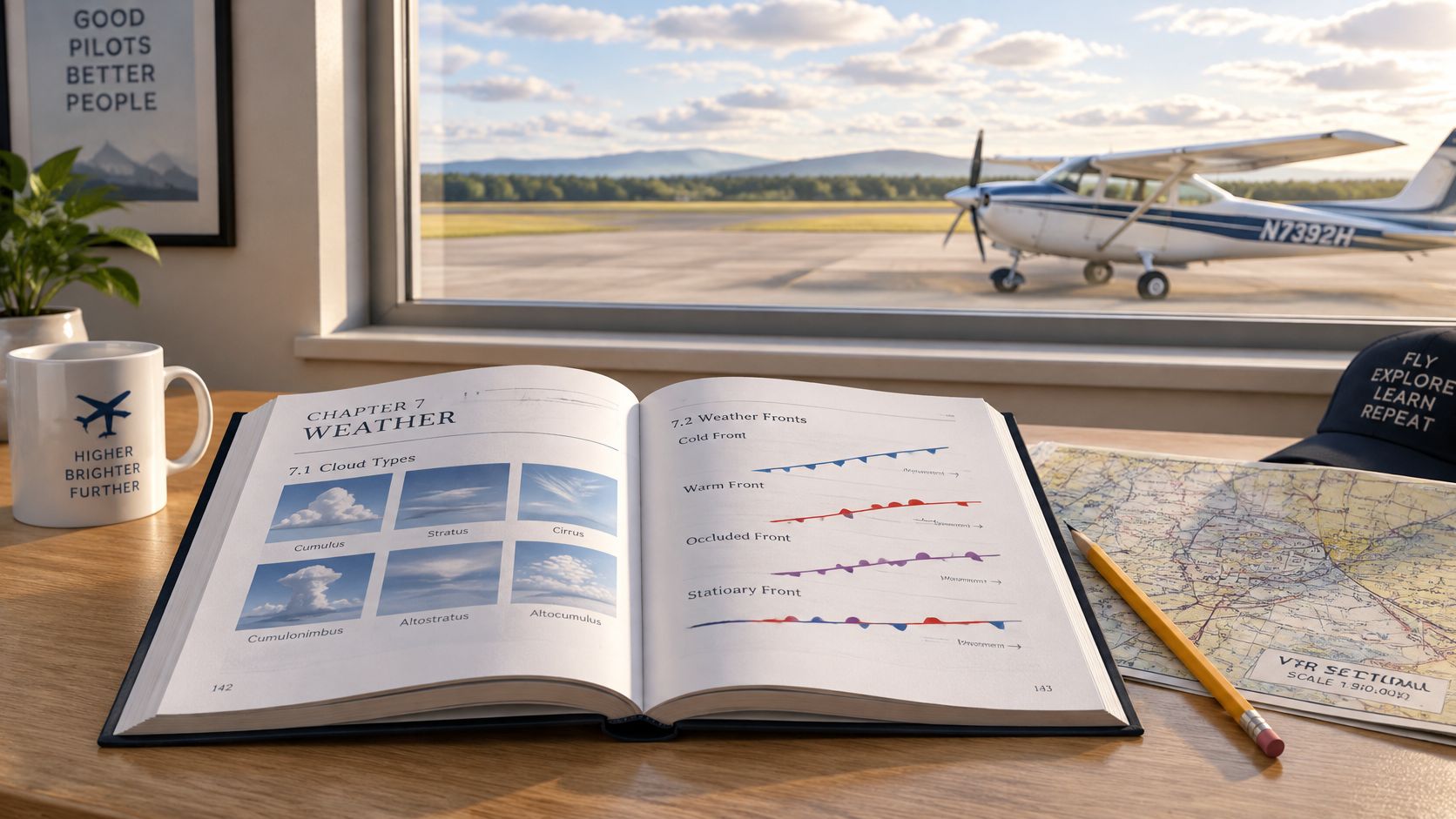
The FAA Aviation Weather Handbook is the most authoritative single weather reference for FAA-oriented training. If you own only one aviation weather book, this is the one to keep accessible, even when another text is easier to read.
The FAA's publication history traces its predecessor to CAA Bulletin No. 25 in 1943, records the modern FAA-H-8083-28 issue on November 25, 2022, and describes consolidation of material from at least six advisory circulars followed by the updated, similarly organized FAA-H-8083-28A revision in 2024. That consolidation matters more to a working student than the publication's age: theory, hazards, and services belong together because pilots use them together.
Keep the reference where you can consult it alongside charts and briefing products.
Read it as a reference, not a novel
The trade-off is density. The handbook explains subjects systematically, but it doesn't always provide the learning sequence a tired student needs after a flight lesson. Reading continuously can create familiarity without revealing whether you can apply anything.
Use this reading order:
- Start with hazards. Read the relevant material on icing, turbulence, thunderstorms, and restricted visibility. Connect each mechanism to recognizable conditions and an operational consequence.
- Move to services before planning. Read the product and weather-service material with an actual briefing open. Identify what each product contributes and what it cannot establish.
When an unfamiliar term interrupts your progress, resolve it immediately. Don't highlight an entire paragraph and assume you'll understand it during revision.
Check before paying
Check the current edition on the FAA website before ordering a printed or electronic copy. The named revision in a retailer's title isn't proof that it's the latest official version.
Start with the free FAA PDF. Pay for print if you learn better by annotating pages or want a desk reference without another screen; pay for an electronic edition only if its navigation improves your study routine. You're buying a format, not more official authority.
Side-by-Side Comparison of Textbooks and Study Guides
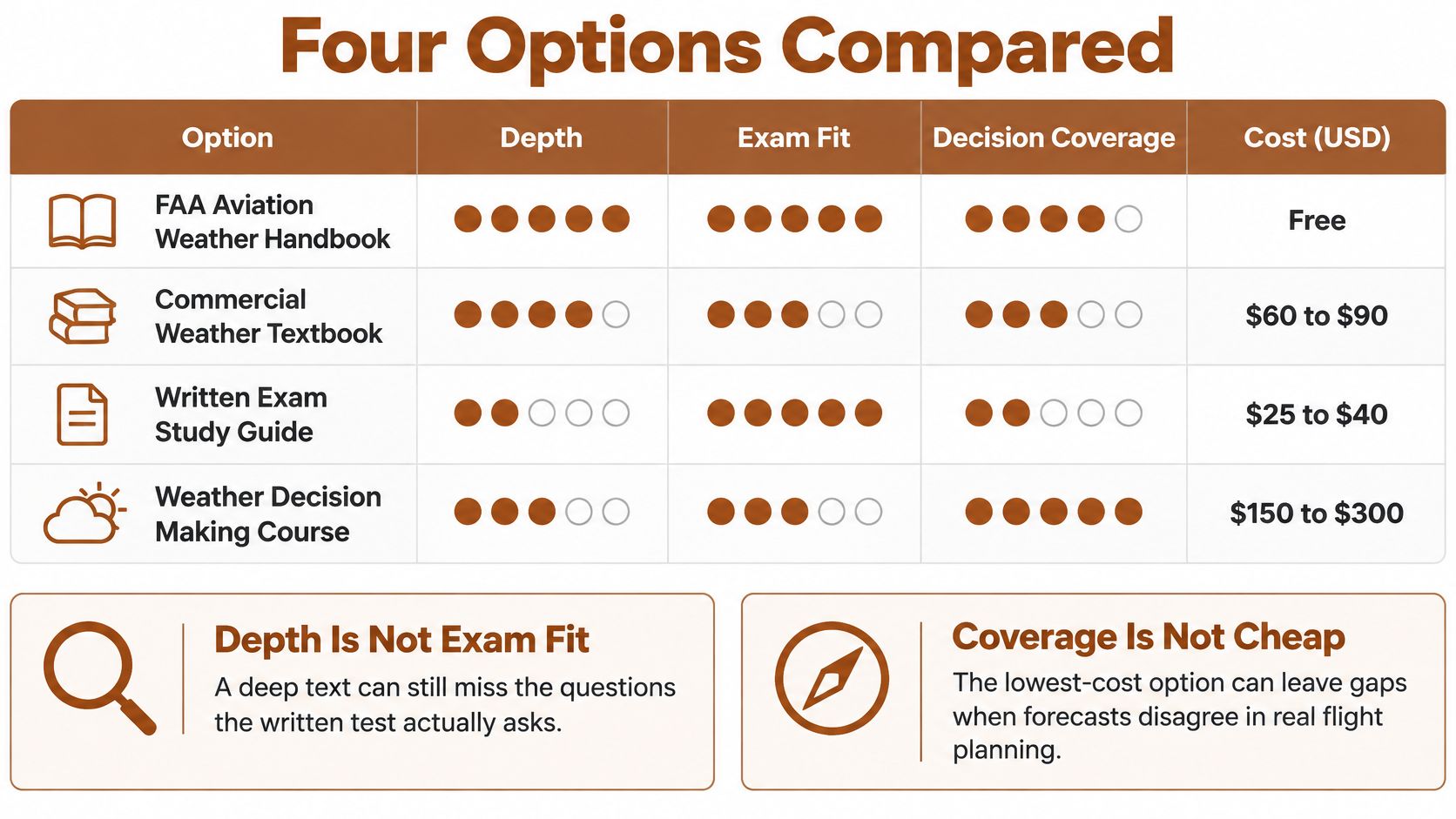
| Book | Depth | Exam Fit | Decision Coverage | Cost |
|---|---|---|---|---|
| FAA Aviation Weather Handbook (FAA-H-8083-28A) | Deep, consolidated reference | High for weather theory and services | Moderate; product explanations need scenario practice | Free FAA PDF; Kindle edition listed at $26.99 on Amazon |
| Pilot's Handbook of Aeronautical Knowledge | Broad syllabus, moderate weather depth | High for written-exam concepts | Limited compared with a dedicated operational text | Free FAA PDF |
| Weather Flying by Robert N. Buck | Deep, practice-oriented discussion | Moderate; built for judgment rather than test-prep drilling | Strong emphasis on flight-planning judgment | Paid; price depends on edition and format |
| ASA or Gleim weather test-prep chapters | Focused on exam questions | High for targeted practice | Limited unless supplemented with scenarios | Paid; price depends on guide, format, and bundle |
For the paid rows, edition, print or electronic format, and test-prep bundling set the price. Compare the exact package rather than a generic shelf tag.
Depth isn't exam fit
The FAA handbook gives substantial technical depth, but you still need practice retrieving that knowledge under exam conditions. ASA and Gleim guides are more direct when your immediate problem is misreading question wording or overlooking a detail in a coded report.
A METAR visibility item shows the split. A study guide trains the precise decoding task and helps you recognize distractors. It is less useful when deteriorating conditions around a front force you to explain whether a sensible route home still exists.
The Pilot's Handbook of Aeronautical Knowledge earns its place by connecting weather to the rest of pilot training. That breadth helps early, then leaves less room for sustained weather treatment than a dedicated reference gives.
Decision coverage needs inspection
Weather Flying is the stronger starting point for practical discussion rather than a syllabus-shaped reference. Read it for judgment, and check descriptions of products, equipment, and procedures against current official guidance before applying an example to your aircraft.
Before buying any practice-oriented text, inspect a flight-planning example. Look for the escape route, the uncertainty, and the point where continuing stops being reasonable. A gripping account of a difficult flight does not automatically transfer into a method you can use when two forecasts disagree.
A good operational example explains not just why the pilot continued, but what would have made the pilot stop.
Choose the book that matches the next problem you need to solve: missed written questions, weak product interpretation, or a go/no-go habit that holds up when the briefing is ambiguous.
Real Scenarios for Students and Advanced Pilots
Say you're a student approaching the written exam and keep missing icing questions despite decoding METARs confidently. Read the handbook's icing discussion, close it, and explain the mechanism aloud before returning to question practice. If you still miss the questions, ask your instructor to separate a conceptual misunderstanding from a wording problem.
Study with the weather products visible, rather than treating the textbook as an isolated assignment.

From instrument training to seasonal refreshers
An instrument student planning an initial IFR cross-country should read about freezing levels, cloud moisture, and icing before comparing a practice text's examples with the actual briefing. If the example assumes equipment or performance your aircraft doesn't have, don't import its conclusion. Review the aircraft limitations and plan with your instructor.
An advanced pilot preparing for convective-season flying needs a different sequence. Start with the practice text's route and timing decisions, then use the handbook to clarify unfamiliar products. If the text makes the solution look obvious only after the outcome is known, rewrite the exercise using only information available before departure.
For a video-based study session, pause before any planning conclusion and write your own decision and missing-information list.
For instructors and university students
A flight instructor can assign handbook reading that matches the next lesson rather than a large, disconnected block of weather theory. For an exam retaker, add focused question practice after identifying the weak topic. If the student answers correctly but can't explain why, change the exercise instead of assigning more identical questions.
A university student should put the assigned course textbook first because lectures, terminology, and assessments follow that text. Use the FAA handbook to clarify technical points and compare product descriptions. When the sources appear to conflict, identify whether the difference concerns atmospheric theory, publication currency, or the instructor's stated assumptions.
Each reader needs a different starting page. The useful choice is the book that helps resolve the task in front of them, with instructor support when reading alone doesn't settle it.
Where Weather Books Stop and Decisions Begin
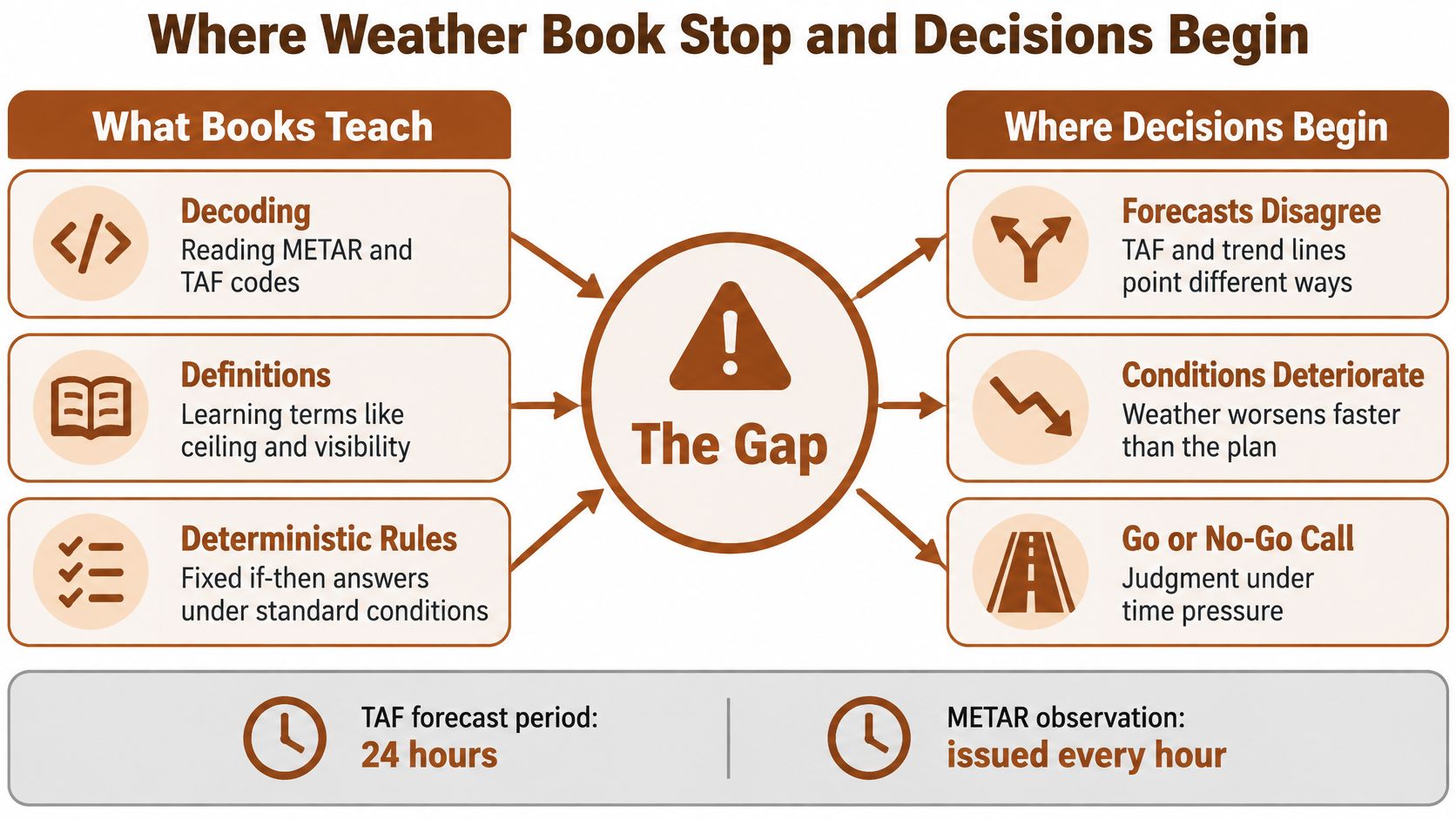
Decoding is necessary, but it doesn't establish whether a flight is sensible. The FAA's operational weather guidance states that TAFs are prepared by 123 National Weather Service Weather Forecast Offices for more than 700 airports, generally cover 24 hours, with some covering 30 hours, and may be amended as conditions change.
The same guidance describes approximate METAR/TAF dissemination look-ahead distances, summarized below. These concern product availability in specified contexts, not forecast accuracy, reception guarantees, or the geographic reach of an airport forecast.
METAR and TAF look-ahead ranges by altitude tier
| Product or Altitude Tier | Approximate Look-Ahead | Practical Use |
|---|---|---|
| Surface radio | About 100 NM | Checking nearby departure and arrival conditions |
| Low altitude | About 250 NM | Reviewing products relevant to VFR cross-country legs |
| Medium altitude | About 375 NM | Reviewing products along medium-altitude routes |
| High altitude or specified CONUS context | Up to 500 NM | Reviewing long-route products in the specified contexts |
Resolve disagreement with an action plan
The FAA Aviation Weather Handbook's risk guidance explains that uncertainty grows with forecast lead time, timing errors are more common than errors about whether weather will occur, and pilots should compare actual conditions with expectations and change plans when personal minimums are exceeded. A forecast is therefore a planning input, not permission to ignore contrary observations.
The graphic captures the learning gap, but its timing labels shouldn't be read as a complete description of product schedules or exceptions.
- Improving TAF, worsening satellite trend. Treat confidence in the departure window as reduced. Check observations and cloud trends, identify a usable alternate route or airport, and delay if improvement isn't occurring before your departure trigger.
- Low icing probability, serious consequences. Don't confuse low probability with acceptable exposure. If the aircraft lacks appropriate capability or a reliable escape route, choose a route clear of the threat, delay, or cancel rather than relying on the favorable probability.
- Uncertain thunderstorm timing. Select alternates outside the threatened corridor and set a latest acceptable departure window. If updates remove the weather margin, delay or cancel; airborne, divert while an unobstructed option remains.
An aviation app can make products easier to compare, but it can't choose a defensible risk threshold for you.
Decision discipline: Change the plan when a preset trigger is reached, or sooner when new information invalidates your assumptions. Don't wait for every forecast to agree.
How uncertain is uncertain enough? When you can no longer preserve the margins, alternatives, and aircraft capability on which your plan depends.
Build Your Weather Book Stack and Start Reading
Build a small stack: a reference, a practice source, and a planning habit. The reference is the FAA Aviation Weather Handbook. The practice source is a question bank for a student or an operational text for an experienced pilot; the habit is writing down the conditions that would change the plan.
You don't need a shelf of competing explanations. You need a way to discover what you don't understand and a reliable place to resolve it.
Put the stack to work
- Read a relevant hazards chapter. Choose the subject that connects to your next lesson or planned operation, then summarize the hazard without looking at the page.
- Work a focused question set. Record each miss as a knowledge gap, decoding error, or question-reading error. Revisit the underlying explanation before repeating the drill.
- Write trip-specific triggers. Identify what would make you delay, divert, or cancel, including how you'll recognize that an escape option is becoming unusable.
- Evaluate another book before buying. Check its currency, worked examples, hazard coverage, answer explanations, and operational reasoning. Buy it only if it fills an identifiable gap.
Our flyCowboys app covers weather theory, METARs, and TAFs, so it can supply the question-practice part of that routine. It doesn't replace a CFI, official FAA publications, approved flight-training programs, required tests, or the aircraft flight manual and pilot operating handbook. Keep the handbook in your stack and take unresolved operational questions to your instructor.
A useful study session ends with something specific: a corrected misconception, an explanation you can give clearly, or a better-defined planning limit. Finishing pages is less important than being able to explain what you'd do differently.
Start with the FAA handbook this week.
flyCowboys offers FAA written-exam practice with weather topics and plain-English explanations to help you check what you've learned from your reference book. Visit flyCowboys to practice weather theory, METARs, and TAFs alongside your reading and instructor-led training.