· 17 min read
Runway Hold Short Line Markings: Meaning and Pilot Rules
Learn what the runway hold short line means, how its yellow markings work, and what pilots must do at each stop, with exam-style examples.
You're taxiing with your instructor, following the yellow centerline and trying to keep up with the radio. Ahead, a yellow pattern stretches across the pavement. The taxiway continues beyond it, and the runway still seems far away. You read back the hold-short instruction correctly, but where, exactly, should you stop?
That's the important connection: the words on the radio must become a stopping point on the pavement. Recognizing a runway hold short line is only part of the skill. You also need to know which side you're approaching from, what your clearance permits, and where the entire aircraft will be when you stop.
Table of Contents
- What the Runway Hold Short Line Protects
- Reading the Four Yellow Lines and the Side You Stop On
- Where the Line Sits Beyond the Runway Edge
- Hold-Short Clearances, Phraseology and Readback
- Signs, Lights and What to Do When Unsure
- Exam Scenarios and How to Solve Them
- Practice Hold-Short Questions Before Your Written Exam
What the Runway Hold Short Line Protects
On an early taxi lesson, the route can feel like a continuous task: follow the centerline, make the turn, find the departure runway. A holding-position marking interrupts that flow. Even if the pavement ahead looks like more taxiway, you've reached a boundary that requires a deliberate decision.
A runway hold short line, formally a runway holding-position marking, keeps an aircraft outside the protected runway area until entry is authorized. At a towered airport, that authorization comes from air traffic control. At a non-towered airport, the pilot must assess traffic and follow the applicable procedures.
Think of it as a painted stop sign, with an important difference. You don't stop, look, and automatically continue. Your next action depends on your clearance and the operating environment.
The airplane belongs behind the boundary while its pilot resolves that decision.
Protection starts before the runway pavement
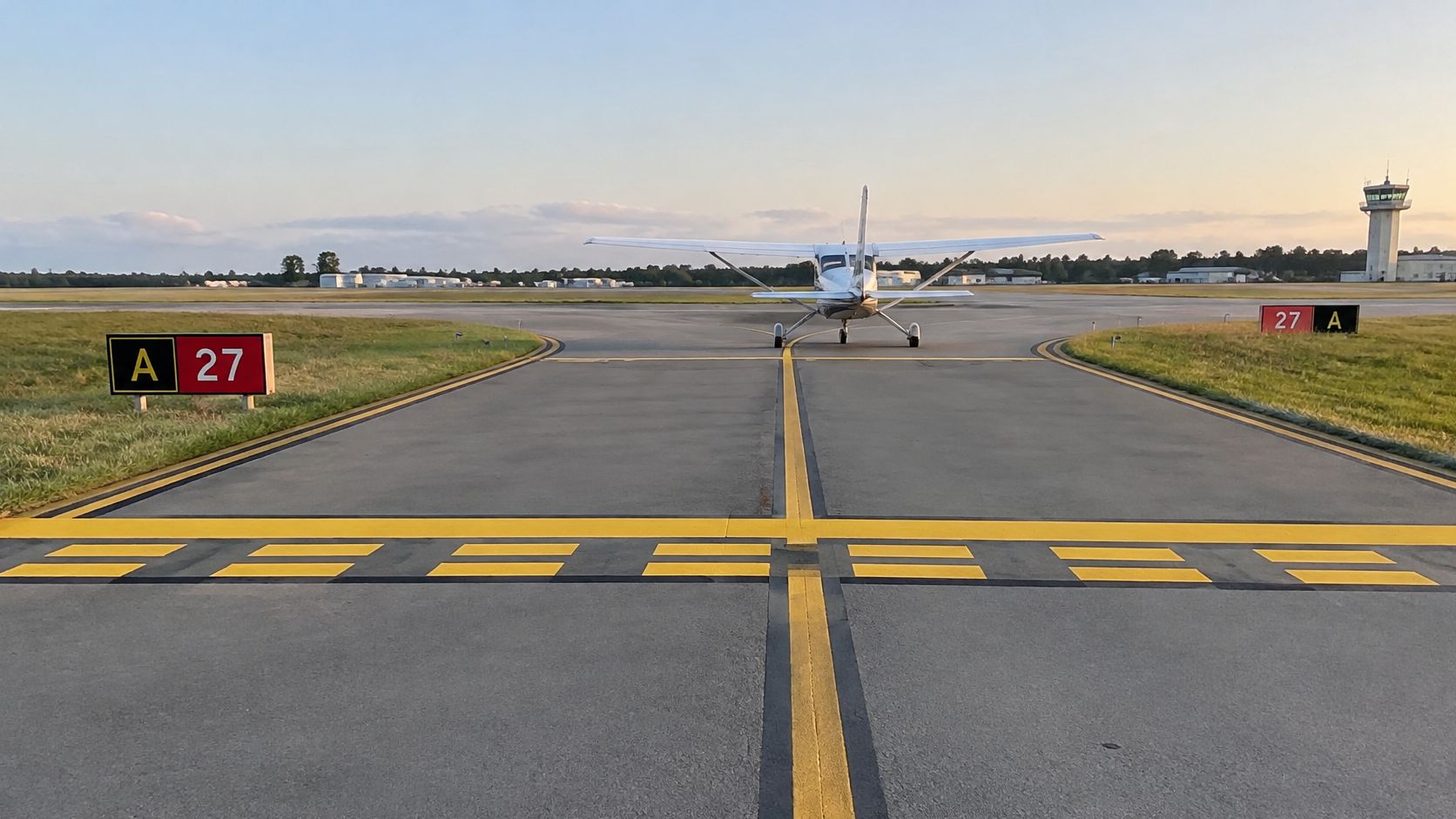
The marking isn't decoration or merely a convenient place to wait. It separates ordinary taxi movement from an area that must remain protected for runway operations. An aircraft can create a conflict before its wheels reach the visible runway edge.
Airport layout and mitigation matter, too. As of calendar year 2024, 98 airport locations that had contributed to reductions in the FAA's Runway Incursion Mitigation inventory experienced an average 77% fewer incursions per year after mitigation activity, according to the FAA's William J. Hughes Technical Center. That finding concerns mitigation at those locations, not the effect of painted hold-short lines alone.
Practical rule: Treat the holding position as a decision boundary, not another marking to roll over while finishing a checklist.
For a student preparing for the knowledge test, the task is recognizing the marking and choosing the correct action. For an instrument student, it includes distinguishing runway protection from ILS protection. For an instructor, it means checking whether the student can connect a clearance to the airplane's actual position, rather than repeat familiar words.
Reading the Four Yellow Lines and the Side You Stop On
Hold-short marking elements and what each tells the pilot
| Element | Standard | What It Tells the Pilot |
|---|---|---|
| Two solid lines | Placed on the side where the aircraft must hold | Stop on this side until cleared |
| Two dashed lines | Placed on the runway side | Runway entry requires authorization at a towered airport |
| Line width and gap | Each line and intervening space is 12 inches (30 cm) under the FAA marking reference | Distinguishes the holding-position pattern from ordinary centerline guidance |
| Line extent | Across the taxiway or runway; normally perpendicular to the taxiway centerline | The boundary applies across the pavement |
| Taxiway centerline | A single continuous yellow line | Ordinary taxi guidance, not a stop line |
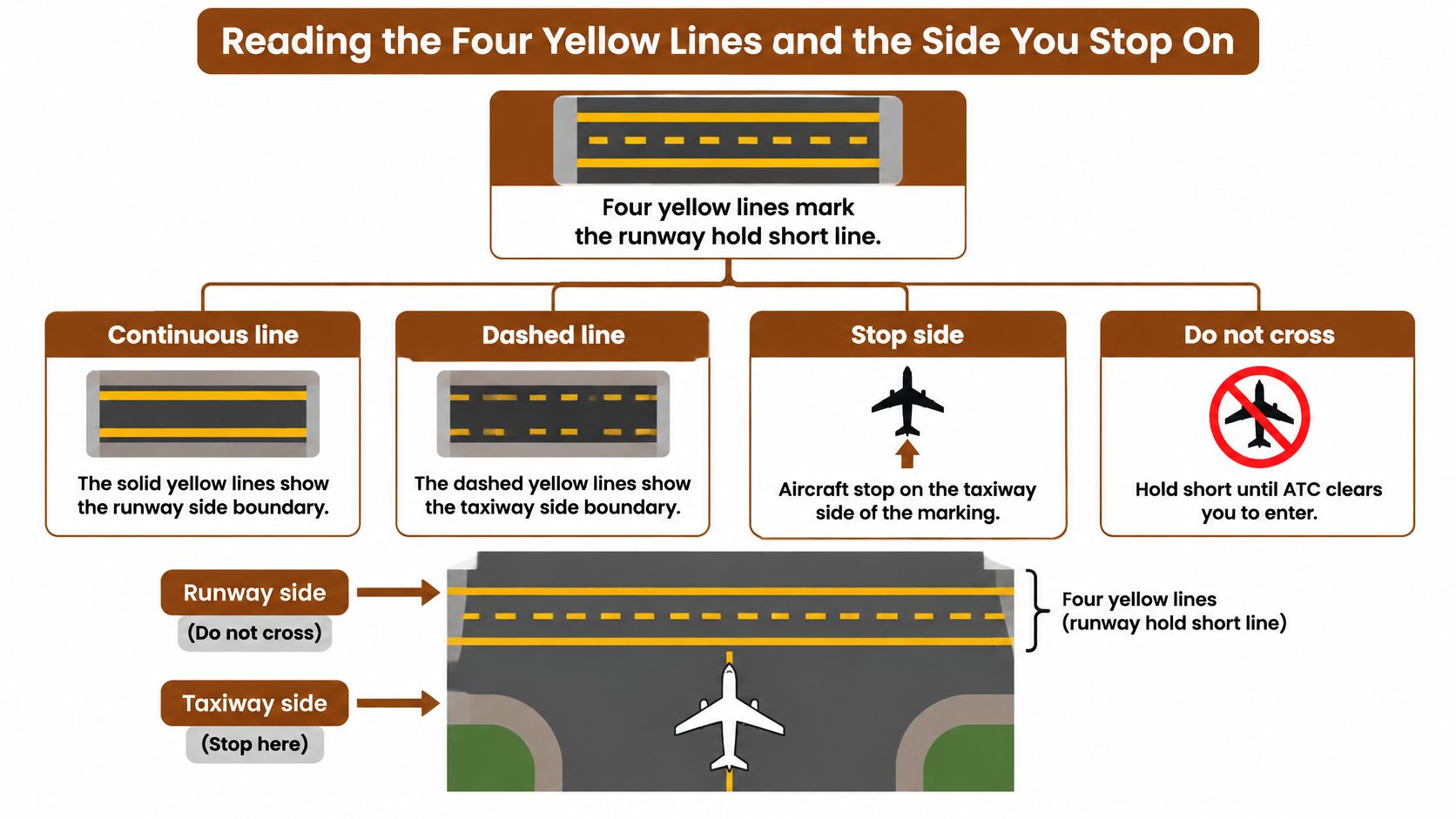
The FAA Aeronautical Information Manual describes the runway holding-position marking as four yellow lines, two solid and two dashed, with the solid lines on the side where the aircraft must hold. The pattern is direction-sensitive. Its meaning depends on which side your airplane approaches.
Use the solid-line side as your reference when studying the pavement arrangement.
Approaching and exiting are different decisions
When taxiing toward a runway, you normally encounter the solid lines first. Without authorization to enter or cross at a towered airport, stop before the marking. Position the aircraft so no part of it extends beyond the holding position, not merely so the main wheels remain behind it.
That distinction matters because you sit behind the nose. Your eye position isn't the front of the airplane, and a nosewheel stopped just short of the paint doesn't necessarily mean the aircraft is properly positioned. Learn the appropriate sight picture in your training aircraft with your CFI.
When leaving a runway, you normally approach the dashed lines first. Continue beyond the holding-position marking so the entire aircraft is clear, rather than stopping with the tail still inside the protected area. Seeing the nose pass the paint isn't enough.
The direction rule also explains why dashed lines don't mean unrestricted permission. They identify the runway side of this marking. They aren't an independent clearance to enter another runway or continue along an uncertain taxi route.
Connect the pavement to the sign
A runway holding-position sign uses white runway identifiers on a red background. Beside the taxiway, it helps you confirm which runway the painted boundary protects. Match the identifier to your clearance instead of assuming every holding position belongs to your departure runway.
For a visual review, compare the pavement pattern with the aircraft's direction of travel.
On a diagram-based question, use this short check:
- Locate the solid side. Identify the side from which an approaching aircraft must hold.
- Place the aircraft. Decide whether it's approaching the runway or leaving it.
- Check permission. Determine whether the stated clearance authorizes the proposed movement.
Don't answer from the airplane's heading alone. The relationship among the airplane, marking, and clearance determines the action.
Where the Line Sits Beyond the Runway Edge
You're holding short of a protected runway area, not just avoiding the visible pavement. That's why an apparently long stretch of taxiway may remain between your stopping point and the runway.
The FAA's runway-safety best practices warn that Precision Obstacle Free Zone requirements can place a hold-short line as far as 400 feet from the runway. Parallel-taxiway geometry can also put the marking somewhere a pilot doesn't expect. Neither situation permits moving closer just to improve the view.
Say you turn from a parallel taxiway toward your assigned runway. You see a holding-position marking almost immediately, but the runway appears farther ahead. The correct question isn't whether there's room to taxi closer. It's whether you've reached the boundary protecting that runway.
Separate runway protection from ILS protection
Holding positions occur at taxiway-runway intersections and at designated positions associated with runway intersections. You may also encounter a separate holding position protecting an instrument landing system critical area.
Don't treat an ILS holding position as another name for the standard runway hold-short marking. An ILS critical-area marking has a ladder-like configuration and serves a different purpose: keeping aircraft from interfering with protected navigation signals when that protection applies.
A taxi route can therefore include more than one meaningful stopping location. An instruction to hold short of an ILS critical area must be matched to that position, not automatically to the runway holding position farther ahead.
Brief the stopping points before moving
Use your airport diagram or EFB to turn the taxi route into specific decisions:
- Locate the assigned runway. Identify its relationship to the ramp and other runways.
- Trace the cleared route. Follow each taxiway and identify every runway intersection along it.
- Find the holding positions. Use available airport information, then positively identify the markings and signs during taxi. Don't assume a diagram depicts every pavement detail.
- Flag compressed decisions. Pay particular attention to high-speed exits and short taxi distances, where you may reach a boundary sooner than expected.
- State the next stopping point. Say it aloud before releasing the brakes.
A displaced threshold can also distract you. The start of the landing portion of a runway isn't a substitute reference for the holding position on your taxiway. Follow the marked boundary rather than estimating protection from threshold paint.
Extra pavement beyond a hold-short line is not extra permission.
If the expected marking doesn't appear where you thought it would, slow down and resolve the mismatch. Stop at the position protecting the runway you intend to enter, unless your current authorization permits proceeding.
Hold-Short Clearances, Phraseology and Readback
Clearance wording and the required pilot action
| Clearance Wording | What It Requires | Pilot Action |
|---|---|---|
| Taxi to Runway 27 | Routing toward the runway, not blanket runway-crossing permission | Obtain explicit authorization before crossing an intervening runway |
| Taxi to Runway 27, hold short of Runway 18 | An explicit stop before the intersecting runway | Read back the restriction and stop at its marked position |
| Cross Runway 18 | Permission to cross the specified runway | Verify the runway and traffic picture, then cross promptly when safe |
| Hold short of Runway 18 | Remain outside its marked holding position | Wait for further authorization before entering |
| Non-towered taxi toward a runway | Pilot traffic assessment, not an ATC clearance | Cross only when clear, using extreme caution and looking both ways |
These are simplified wording comparisons, not complete model taxi clearances. In practice, your clearance also identifies the taxi route and may contain additional restrictions.
The FAA Runway Safety Best Practices brochure states that controllers must issue explicit crossing or hold-short instructions for each runway along a taxi route, including inactive or closed runways, and must obtain readbacks of runway hold-short instructions. The same guidance warns that incursions can occur even after pilots correctly read back those instructions.
Hearing isn't the same as executing
A correct readback lets the controller check what you said you understood. It doesn't establish that you've identified the correct line, slowed the aircraft, or protected enough stopping distance.
Consider a student who acknowledges a restriction while turning onto an unfamiliar taxiway. The student then changes frequency, starts a checklist, and looks up expecting the runway to be farther away. The communication was correct; the aircraft's movement wasn't.
The solution is to translate the clearance into an immediate cockpit task:
- Name the clearance limit. State the next runway where you must stop, rather than rehearsing only the destination.
- Make the restriction visible. Annotate the airport diagram or place a brief reminder on your kneeboard without obscuring instruments or controls.
- Confirm before moving. Identify the next stop while stationary, then keep your attention outside as you approach it.
- Defer competing work. Complete nonessential checklist or frequency-management tasks while safely stopped when they would distract from the boundary.
Use radio-procedure practice to build accurate responses, but pair every spoken restriction with a location on the diagram. Fluency is useful only when you know what the words require the aircraft to do.
Permission and visual judgment work together
A crossing clearance applies to the named runway. It doesn't authorize a crossing of another runway farther along your route, and switching to Tower doesn't itself authorize entry.
At a non-towered airport, there's no controller issuing that crossing permission. Look both ways, assess runway and approach traffic, and cross only when the runway is clear. A radio transmission announcing your intention doesn't reserve the runway or establish that other pilots have heard you.
The readback is a communication check. Compliance is an aircraft-position check. Keep both in your taxi routine.
Signs, Lights and What to Do When Unsure
Paint isn't your only cue. The red-and-white runway holding-position sign helps confirm the runway identity, while the marking establishes the pavement boundary. You'll commonly find the sign on the left side of the taxiway, with additional signs where the installation requires them.
Don't expect every holding-position sign to carry an arrow. Ordinary runway holding signs display runway identifiers; arrows appear in particular configurations and on other sign types. Read the sign's actual message rather than treating an arrow as a required feature.
Use lights as a warning, not permission
Runway guard lights are flashing yellow lights installed at some holding positions. They draw attention to the runway boundary, particularly when the airport environment makes the paint harder to notice.
Flashing yellow guard lights don't replace a clearance, and they aren't a signal that changes to grant entry. At a towered airport, their presence should prompt you to verify the runway and your authorization. Don't confuse them with red stop-bar lights, which are a different lighting system.
Resolve uncertainty while safely stopped
When the instruction, sign, and diagram don't agree:
- Stop before entering the protected area. If you're already on a runway, make your position known immediately rather than stopping without communication in a conflict area.
- Ask for clarification. Identify the runway or taxiway you're uncertain about and ask the controller to repeat or confirm the instruction.
- Read back the clarified restriction. Include the runway identification and your aircraft call sign.
- Verify your location. Match the diagram to the visible signs and markings before resuming movement.
When unsure: Preserve your position outside the boundary and ask. Don't use forward movement to investigate an uncertain crossing.
Asking for clarification is an expected part of safe ground operation. A brief pause is preferable to guessing which runway the controller meant.
Exam Scenarios and How to Solve Them
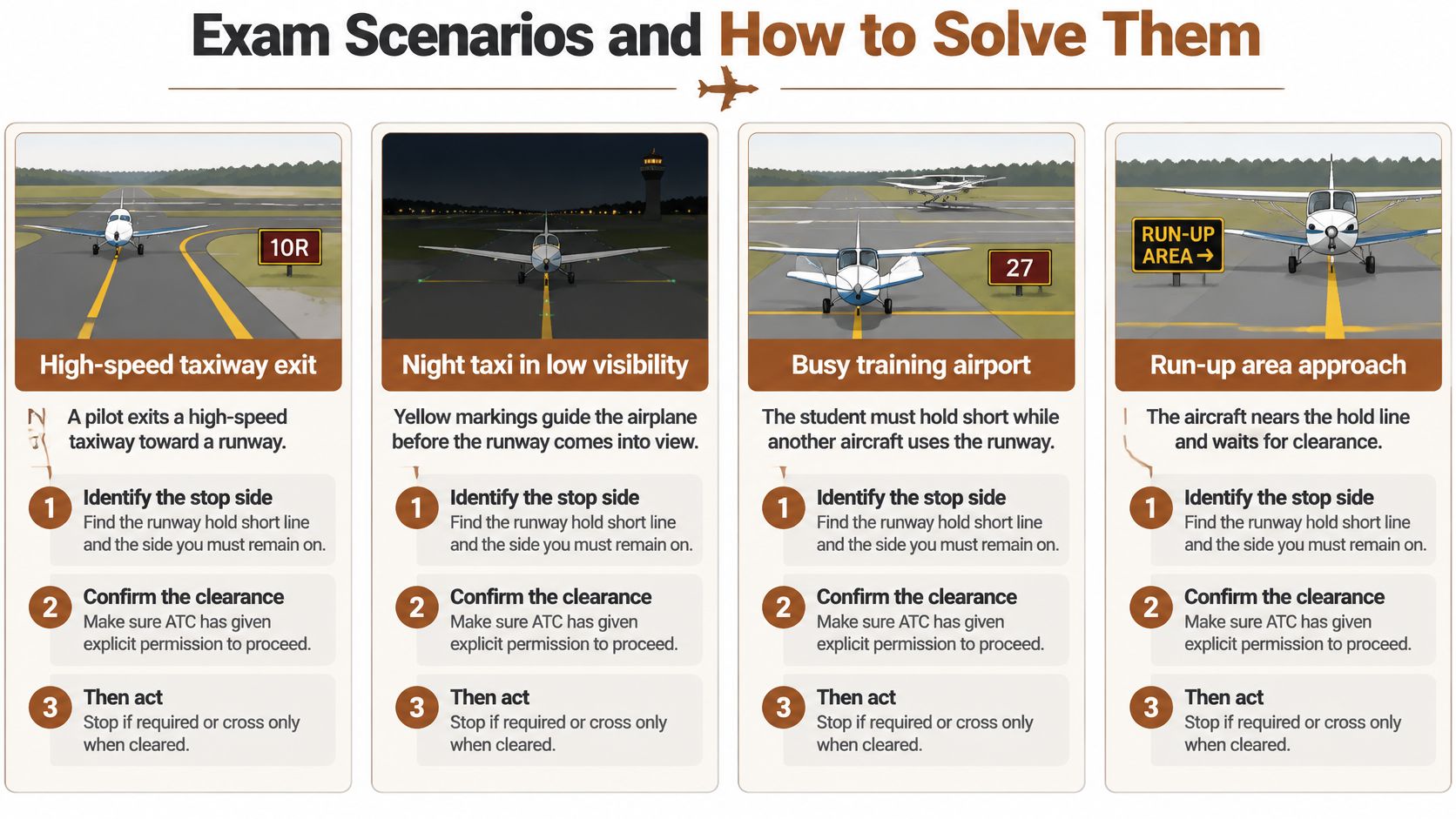
Solve airport-marking questions by separating position, permission, and action. A familiar-looking marking can appear in an unfamiliar layout, so avoid choosing an answer merely because it contains standard radio language.
Use the scenarios below as movement decisions, not vocabulary quizzes.
A high-speed exit leads toward another runway
You've left the landing runway on a high-speed exit. Your route to the gate approaches another runway, and a holding-position marking lies ahead with the solid lines nearest you.
Answer: Hold unless your clearance explicitly authorizes crossing that next runway. Being cleared to taxi toward the gate doesn't resolve an intervening runway crossing.
The trap is treating all movement after landing as one uninterrupted exit. Leaving one runway and entering another are separate decisions. Identify which runway the next marking protects.
A short route includes an explicit crossing
You're approaching a runway on a short taxi route when ATC issues a crossing instruction. You've already configured the radio and are tempted to continue immediately.
Answer: Verify that the instruction applies to your aircraft and the runway ahead, assess traffic, and cross promptly when safe. If the visible traffic picture conflicts with the instruction, stop before entry and query ATC.
Radio preparation doesn't replace runway identification. Nor does a clearance require you to ignore an aircraft that appears to create a conflict.
A closed runway intersects the taxi route
The airport information identifies an intersecting runway as closed. Your taxi clearance contains no explicit permission to cross it.
Answer: Don't infer authorization from the closure. Remain outside the holding position and obtain an explicit instruction.
The word closed describes runway status, not permission for your aircraft to occupy it. Construction activity, vehicles, or other airport operations may still require protection.
An aircraft is on final at a non-towered airport
You reach the holding position while another aircraft approaches to land. You've announced your intention to cross.
Answer: Remain clear, allow the approaching aircraft to land, and reassess after it has cleared. Check the rest of the runway and approach environment before proceeding; the first aircraft's departure from the runway doesn't guarantee there's no other traffic.
Your announcement communicates intent. It doesn't give you priority or compel the approaching pilot to accommodate a crossing.
For knowledge-test preparation, connect these decisions to the airport-operations tasks in the Private Pilot ACS. Explain why each incorrect option fails: wrong boundary, missing authorization, incomplete traffic assessment, or confusion between a destination and permission to cross.
A strong answer describes what the pilot does with the airplane. Repeating the clearance without identifying the resulting movement leaves the most important part unanswered.
Practice Hold-Short Questions Before Your Written Exam
Study these questions until you can explain the decision without recognizing a memorized answer. Change the aircraft's direction, runway status, or clearance wording and check whether your reasoning still works.
A useful practice loop combines closed-book questions with a quick diagram exercise. For each answer, point to where the airplane belongs and describe what additional information or authorization would permit movement.
Build a repeatable review habit
- Work a scenario each study day. Begin with the airplane's location, then identify the clearance limit.
- Answer without notes. Complete airport-marking and runway-incursion questions before consulting explanations.
- Diagnose the mistake. Separate marking-recognition errors from clearance errors and traffic-assessment errors.
- Revisit missed questions. Try them again the following day and explain the answer in your own words.
Use the FAA private pilot written-test practice guide to organize broader exam preparation. Before scheduling, make sure airport-marking questions no longer require notes or guesswork.
Our flyCowboys question bank covers every topic on the FAA Private Pilot Knowledge Test, so you can practice these decisions alongside related airport-operations questions.
Keep the ground training practical, too. Ask your CFI to have you identify the next holding position during taxi, describe the current clearance limit, and demonstrate the correct stopping sight picture in your aircraft. Written-test confidence should support that habit, not replace it.
This week, open your airport-markings practice set and complete every hold-short question before moving to another topic. Review each missed answer until you can describe both the required action and the reason.
At flyCowboys, we offer knowledge-test question practice and practice exams using the same layout as the PSI screen, the official system at every FAA testing center. Start with airport markings and hold-short decisions, then bring any unresolved taxi questions to your next lesson with your CFI.