· 15 min read
Radio Procedure for Pilots: The Complete Communication Guide
Master standard radio procedure for VFR and IFR flying. Learn readbacks, phraseology, and real ATC communication examples that build confidence.
You're sitting at the hold short line, engine ticking over, thumb hovering over the push-to-talk switch. You know how to fly the pattern. What stops you cold is the sentence you have to say next, out loud, to everyone listening. Think of that switch like a phone call with consequences. Once you key it, controllers, other pilots, and your own next move all depend on whether the words came out clear, complete, and in the right order.
Table of Contents
- Why Radio Procedure Matters Before Your First Solo
- How Standardized Phraseology Came to Be
- Anatomy of a Standard Pilot Call
- Pattern Work at Towered and Untowered Airports
- Readbacks That Close the Loop Safely
- IFR Clearances, Amendments, and Lost Communications
- When Something Sounds Wrong and How to Recover
- Building Radio Confidence Before Exam Day
Why Radio Procedure Matters Before Your First Solo
Your instructor climbs out, closes the door, and suddenly the right seat is empty. The airplane feels lighter. The frequency feels louder. You're toggling between ground and tower, trying to remember if you already got the ATIS letter, and another airplane just called downwind faster than you can process it.
That shaky first call is normal. Every controller has heard hundreds of them, and most would rather hear a slow, correct call than a fast, confident wrong one.

A shared language, not a memory test
Radio procedure isn't memorization for its own sake. It's a shared, predictable language that keeps you and a controller from mishearing each other when an accent, engine noise, a blocked transmission, or simple fatigue is in play. When both sides expect the same structure, your brain only has to fill in the details that change, like runway, altitude, and position.
That's why standard words beat clever wording. If you invent your own phrasing, the controller has to decode you while also sequencing traffic. If you use the expected pattern, they can listen for what's missing and catch it early.
A good radio call doesn't make you sound experienced. It makes you easy to understand.
Where to focus first
If you're short on time, start with the anatomy of a first call and towered versus untowered pattern work. Those are the calls you'll make on a solo. Then work through readbacks and IFR clearances, because that's where small omissions create runway and altitude risk. Save the recovery skills for last, but don't skip them. Noticing that something sounded wrong, and asking cleanly, is the skill that protects you when the script breaks.
You don't need a perfect radio voice before solo. You need calls that are complete enough for someone else to build a mental picture of where you are and what you want.
How Standardized Phraseology Came to Be
The rules feel less arbitrary once you know they were earned. Civil aviation radio became practically useful during the 1930s, when U.S. airlines began installing radios in aircraft and dispatch facilities to monitor flights, as traced in the history of air flight communication. After World War II, traffic expanded and informal wording stopped scaling. Too many pilots and controllers meant too many ways to say the same thing, and too many ways to misunderstand it.
In the early 1970s, the FAA formalized the fix through a pilot/controller glossary incorporated into the Aeronautical Information Manual (AIM). The glossary gave specific meanings to specific words and phrases, so a term didn't shift meaning from one facility to the next. If you're building that vocabulary now, reviewing an aviation glossary alongside the AIM helps you connect each term to the situation where you'll hear it.
Built to travel across borders
The U.S. system was designed to be broadly compatible with International Civil Aviation Organization (ICAO) practices. That's why a U.S. pilot flying abroad recognizes most of what a controller says, even if local details differ. A common structure reduces the translation work your brain does under workload.
Concrete habits came straight from that standardization:
- Say numbers individually: Digits in frequencies and headings are enunciated separately, so similar sounding numbers don't blur together.
- Use "point" in frequencies: A readback marks the decimal clearly instead of leaving the listener to guess where it falls.
- Name airways phonetically: V12 is spoken as "Victor Twelve", not as a letter and a mumbled number.
- Standardize call signs and routes: Predictable pronunciation helps when accents and first languages differ.
Precision beats nuance here because there's no time for a follow-up question on short final. Brevity, active listening, and accurate readbacks aren't style preferences. They're the behaviors the system was built around, and they're still the core of safe communication today.
Anatomy of a Standard Pilot Call
You're ten miles out from a controlled airport, coffee run finished, ATIS copied, and it's time to call. Don't compose a paragraph. Build the call from four named parts, in order, and you'll sound clear even when you're nervous.
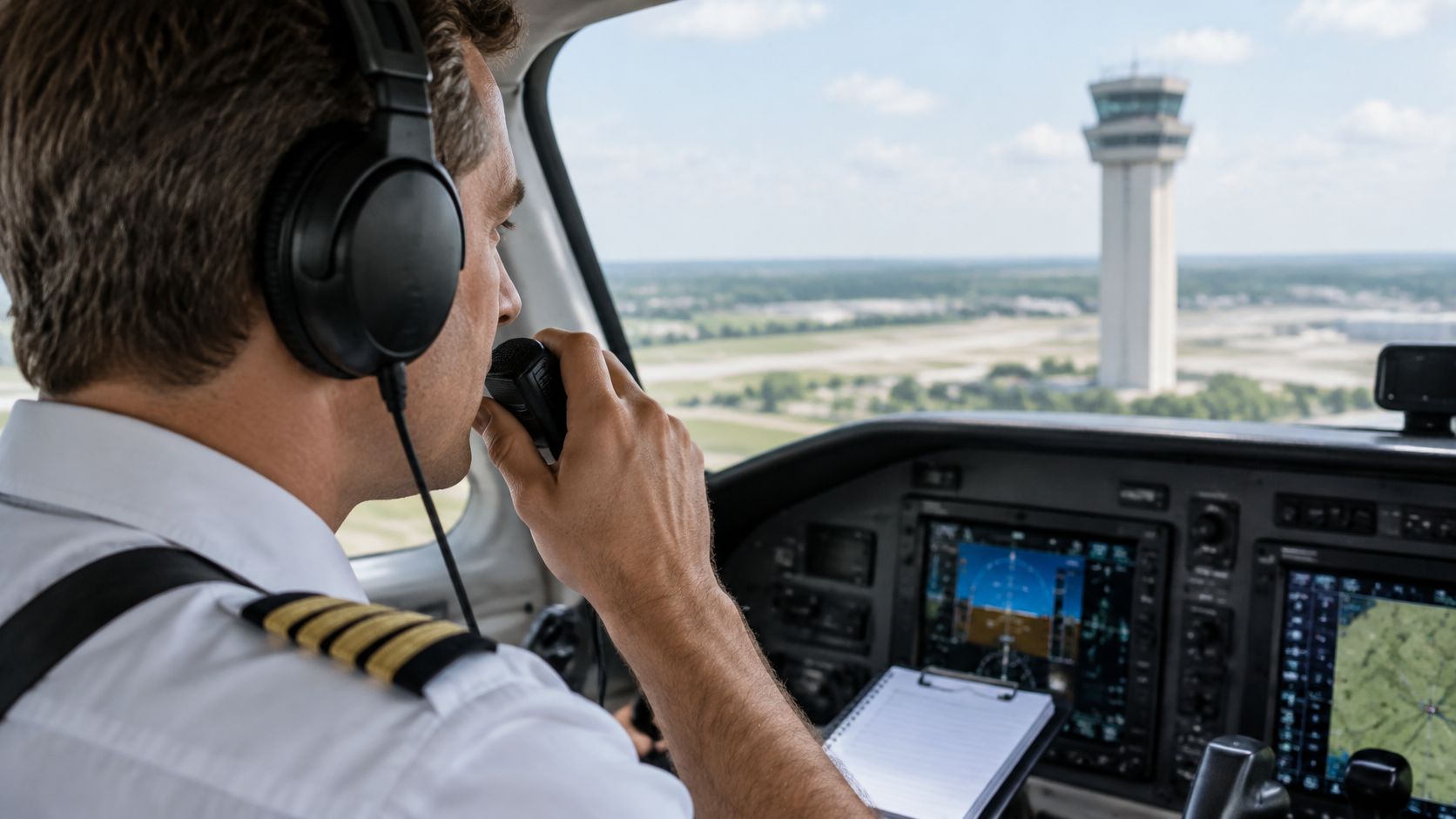
The four parts in order
- Who you're calling: Name the facility first so the right controller listens up, for example, "Concord Tower."
- Who you are: Give your full call sign with aircraft type where it helps, such as "Cessna One-Two-Three-Four-X-Ray."
- Where you are: State position in a way the controller can plot, like "ten miles north," plus altitude when it's relevant.
- What you want: Make the request or report plainly, such as "landing," and add the ATIS letter you've received.
Put together, it sounds like this: "Concord Tower, Cessna One-Two-Three-Four-X-Ray, ten miles north, landing, with information Bravo." Controllers like that exact shape because they can check off each element as you say it. Nothing forces them to ask, "Say again your position."
The details around the call
Acknowledge the ATIS by letter so the controller knows you already have runway, wind, and altimeter information. When you're entering Class C or Class D airspace, your direction and position matter even more, because the controller is fitting you into traffic they can already see.
Students often ask about filler. "With you" adds nothing when you're checking in after a frequency change, because your call sign, altitude, and assigned altitude already tell the story. "Over" belongs to older radio habits and isn't needed in normal ATC exchanges. Say your message, release the switch, and listen.
Practical rule: If the controller has to ask who, where, or what you want, the call was missing a part. Fix the structure, not your voice.
Rehearse the skeleton out loud before you start the engine. On frequency, you'll only be swapping in the current position and request.
Pattern Work at Towered and Untowered Airports
Use the same airplane and the same runway, and pattern work still sounds different depending on whether a tower is open. What changes isn't your flying. It's who owns sequencing.
At a towered field, the controller owns it. Your job is to follow instructions, make requested reports on downwind, base, or final, and read back runway and hold short instructions exactly. You don't announce your own plan for the pattern. You respond to theirs.
At a non-towered or part-time-towered airport, you and the other pilots share that sequencing job on the Common Traffic Advisory Frequency (CTAF). Aircraft within 10 nautical miles should continuously monitor and communicate as appropriate on the published CTAF until clear of the area or movement surface, under FAA guidance for non-towered airport operations.
A side by side comparison
| Moment | Towered | Untowered on CTAF |
|---|---|---|
| Arriving | Call tower, follow entry instructions | Announce position and intentions using the airport's published name |
| Downwind | Report if instructed | Self-announce leg, runway, and intention |
| Final | Cleared to land by tower | Self-announce final and runway |
| Departing | Cleared for takeoff by tower | Announce departure runway and direction |
Use the airport's correct published name on CTAF, not just the city name. Similarly named fields can share a frequency area, and a vague call creates confusion for traffic that isn't even at your airport. Keep transmissions to safety-essential information, such as arrivals, departures, takeoffs, and landings.
Where no CTAF, UNICOM, or tower frequency is published, MULTICOM 122.9 is used for self-announcements. Two-way radio use isn't universally required at airports without operating towers, so your calls supplement visual scanning. They never replace looking for traffic and checking the runway environment yourself.
Readbacks That Close the Loop Safely
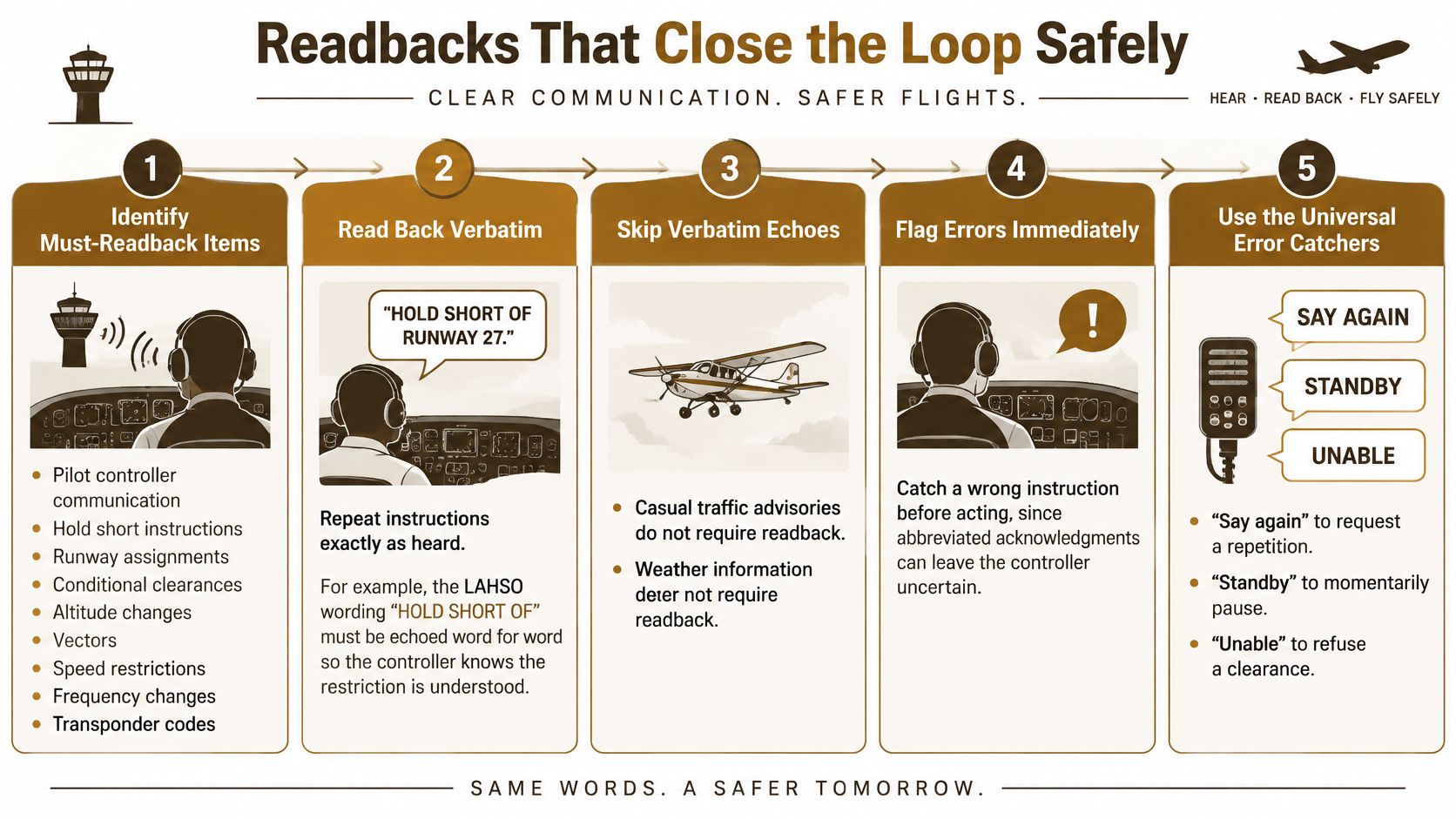
A readback isn't repeating everything like a parrot. It's a closed loop. The controller says something safety-critical, you say it back exactly, and they listen for the error. If neither of you closes that loop, a wrong runway or altitude can sound agreed upon when it isn't.
FAA guidance expects pilots to monitor the assigned frequency continuously, use standardized words from the Pilot/Controller Glossary, include the aircraft call sign when acknowledging communications, and read back clearances or instructions that affect runway or taxiway safety, as set out in FAA radio communications procedures.
What must come back verbatim
- Hold short instructions and runway assignments: These protect the runway environment, so the controller needs to hear the runway and the restriction.
- Conditional clearances: Anything that depends on traffic or a position must be echoed with its condition intact.
- Altitudes, vectors, and speed restrictions: A single wrong digit changes separation.
- Frequency changes and transponder codes: Identify the facility and frequency to be contacted, so a wrong tune is caught before you disappear.
For Land and Hold Short Operations (LAHSO), the acknowledgment must explicitly include "HOLD SHORT OF" followed by the runway, taxiway, or point. A casual "wilco" leaves the controller uncertain whether you understood the restriction at all. That one phrase is the proof.
Casual traffic and weather information don't need verbatim echoes. Acknowledge traffic in sight, or state that you're looking, and move on.
Three catchers that always work
"Say again" asks for a repeat when you missed part of a transmission. "Standby" buys a moment when you're heads-down or task saturated. "Unable" refuses a clearance you can't safely comply with, and it's a complete, professional answer. Using one of these is never a failure. Guessing is.
IFR Clearances, Amendments, and Lost Communications
IFR radio work feels harder because the clearances are longer and every item matters at once. Listen to the shape of one: "Cleared to ABC via the XYZ transition, climb and maintain six thousand, expect flight level two-zero-zero in three-zero miles, departure frequency one-two-four point five, squawk four-one-two-zero."
Reading back an IFR clearance
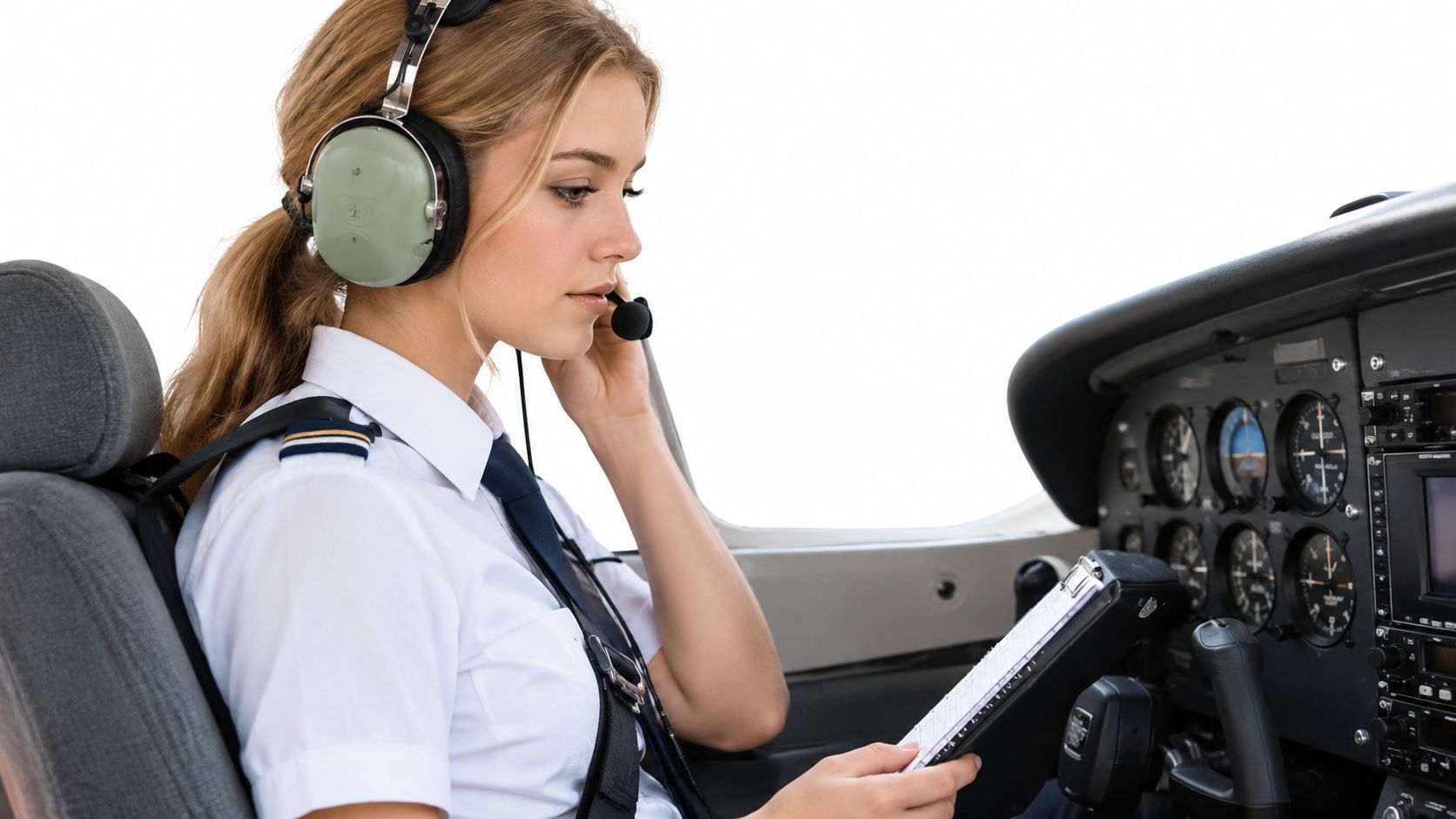
Treat the clearance as a checklist you speak back in order. Destination and route, initial altitude, expected altitude, departure frequency, and transponder code all come back verbatim. Write while you listen, then read from your notes, not from memory. If you're studying these structures for the written, an IFR study guide helps you practice recognizing each element before you hear it at speed.
Cleared as filed shortens the route portion because ATC is approving the route you already submitted. A full route clearance means something changed, so every fix and transition must be copied and read back. Don't assume the new route matches your flight plan just because the destination stayed the same.
Amendments work the same way at smaller scale. A new altitude or vector replaces the old one, and your readback confirms the replacement. If a clearance doesn't match what you filed or what makes sense for your position, query it before you fly it. "Verify" plus the item you're unsure about keeps the question short and specific.
When the radios go quiet
Students sometimes imagine lost communications as improvisation. It isn't. Under 14 CFR 91.185, you follow the last assigned route or specified vector route, then an expected route, and finally the filed route. Altitude is the highest applicable of the prescribed alternatives for the segment, and clearance limit timing governs when to begin the approach.
That predictability is the point. ATC protects airspace based on what that rule says you'll do. If you invent a shortcut, you've left the airspace they're protecting for you. One common confusion is the squawk code. It's assigned in the clearance, so set and read it back then. Don't wait until departure to wonder whether the code on the panel is yours.
When Something Sounds Wrong and How to Recover
Most guides teach you the ideal script. Real safety lives in what you do when the script breaks, because errors aren't rare exceptions. Research reported in a 1997 Flight Safety Foundation publication examined approximately 5,900 pilot communication elements and found at least one communication error in 59% of them, detailed in the Flight Safety Foundation analysis of pilot and controller communications. FAA safety databases for 1993 also identified communication problems as causal or contributing factors in 40% of pilot deviations in that same analysis.
Those aren't abstract failures. They look like ordinary moments you've probably already heard on frequency.
Recognizable trouble spots
- Similar call signs: Another aircraft with a call sign close to yours takes a clearance, or you nearly take theirs.
- Blocked transmissions: Two pilots key at once and you hear only a squeal or half a sentence.
- Partial readbacks: You echo the altitude but drop the heading, and nobody notices until you're turned the wrong way.
- Expectation bias: You hear the runway you expected instead of the runway assigned.
FAA guidance warns that improper or abbreviated call signs can cause pilots to act on another aircraft's clearance, as explained in AIM guidance on radio communications phraseology. Full call signs and complete readbacks are your defense.
Recovery moves you can rehearse
Say "say again" rather than guessing at a garbled digit. Use "verify" when a clearance conflicts with your expectations, for example, "Verify cleared to land runway two-seven left." If transmissions overlap and workload spikes, fall back on aviate, navigate, communicate. Fly the airplane first, then sort out the words.
Recovery is a rehearsable skill, not a personality trait. Practice noticing uncertainty in branching scenarios and you're training the exact moment that matters.
Building Radio Confidence Before Exam Day
Confidence on frequency comes from preparation you do before you key the mic. Build a short pre-flight radio routine and run it the same way every flight, so the first call of the day isn't also the first time you've thought about it.
A pre-flight radio checklist
- Copy the ATIS early: Write the letter, active runway, wind, and altimeter where you can see them.
- Brief your first call: Say the four parts out loud in the cockpit before taxi, using today's position and request.
- Pre-write readback items: Leave blanks for runway, altitude, frequency, and squawk so you only fill in numbers.
- Listen before you transmit: A few seconds of monitoring tells you who's in the pattern and how busy the controller is.
Then practice in small, focused sessions. Rotate through hold short clearances one day, CTAF pattern calls the next, and IFR clearances and lost communications after that. Finish each cycle with the phraseology you're weakest on, not the calls you already enjoy. Pairing that habit with your checkride oral exam preparation keeps radio knowledge connected to the scenarios an examiner will pose.
Tools that simulate ATC exchanges let you rehearse call and response without an instructor beside you. flyCowboys' "Talk to Tower" AI phraseology drills are one option for practicing tower scenarios and readback discipline between lessons. Whatever tool you use, judge it by whether it makes you notice and repair mistakes, not just repeat perfect scripts.
Controlled confidence on the radio is learnable. Short, regular practice turns the push-to-talk switch from the scariest button in the airplane into the most predictable one.
Ready to turn shaky first calls into clear, closed-loop communication before your checkride? flyCowboys combines ACS-aligned written prep with Talk to Tower AI radio drills, so you can rehearse phraseology, readbacks, and recovery calls anytime. Visit flyCowboys to start practicing the exact exchanges you'll hear on frequency.