· 17 min read
Private Pilot Knowledge Test Endorsement Guide
See who signs a private pilot knowledge test endorsement, which 14 CFR rules apply, and how to document A.32 before the PAR exam.
An authorized instructor signs AC 61-65H endorsement A.32 for the airplane private pilot knowledge test, code PAR, after training under 14 CFR 61.105, or the applicant presents acceptable home-study completion evidence under 14 CFR 61.35. Finishing an online course doesn't automatically produce either document.
The popular advice to finish ground school and book the written leaves out the most important check: what eligibility document will you hand the testing center? A course-completion badge, a practice-test score, and an instructor's signed finding of preparation aren't interchangeable. Getting the paperwork right lets you take the test; understanding the material prepares you to pass it and use that knowledge in flight.
Table of Contents
- Who May Endorse the PAR Knowledge Test
- What Endorsement A.32 Certifies Under Part 61
- Home Study Certificates Compared with Instructor Sign-Offs
- Aeronautical Knowledge the Instructor Must Verify
- How to Record and Present the Endorsement
- A New Endorsement After a Failed Attempt
- Schedule the Written Only After Real Readiness
Who May Endorse the PAR Knowledge Test
Only two sources can produce the eligibility evidence a testing center accepts for the PAR exam: an authorized instructor who has trained you, or a home-study course whose completion the FAA accepts. Everything else, including strong practice scores, is supporting material rather than admission proof.
| Training path | Who may sign | Rule or reference | Document to present |
|---|---|---|---|
| Part 61 student with a CFI | Authorized instructor, usually the CFI | 14 CFR 61.35, 61.103(d), and 61.105; AC 61-65H A.32 | Logbook or training-record endorsement A.32 naming the PAR test |
| Part 141 pilot school student | Authorized instructor within the approved curriculum | 14 CFR Part 141 approved-course records | School endorsement or graduation evidence the testing center accepts |
| Acceptable home-study course | The provider, only after its completion standard is met | 14 CFR 61.35 home-study completion evidence | Course endorsement or certificate; confirm the format with the provider and PSI |
| Question bank, video, or app only | Nobody; software cannot endorse | Not a substitute for instructor or accepted-course evidence | None until a qualified person signs or acceptable course evidence is issued |
| Retest after a failed attempt | Authorized instructor, in a new endorsement | Failed Airman Knowledge Test Report plus additional training | New endorsement for the areas the report identifies; retain the original report |
For airplane applicants, the FAA identifies the private pilot knowledge test as PAR, and the eligibility requirement under 14 CFR 61.35 calls for evidence of the required training or acceptable home-study completion before testing. Treat that evidence as an admission requirement, not a souvenir from studying.
Match the document to your training
If you're learning with a CFI, bring your ground-training record and study results to that instructor. The instructor can review your preparation and make the appropriate entry in your logbook or training record. You present that signed entry, not merely the practice results that helped the instructor evaluate you.
A student at a pilot school should work through the school's documentation process. An outside instructor does not need to add a separate signature to records issued through an approved curriculum. Ask the school's training office which eligibility document it will issue and how you should present it.
Home-study students need to separate three things that are easy to blur: access to lessons, completion of the course, and a document the testing center accepts. Finishing the material does not by itself tell you whether the downloadable certificate is the evidence 14 CFR 61.35 requires, so confirm the exact format before you book.
What software cannot do
A question bank can expose weak weather knowledge or repeated navigation mistakes. It cannot exercise an instructor's professional judgment or independently sign an endorsement.
- Instructor-led training: Obtain the signed training-record or logbook entry.
- School or home-study training: Obtain the qualifying completion evidence and verify its acceptance.
- Independent practice only: Arrange an instructor review before treating study progress as testing eligibility.
For written-exam study, flyCowboys replaces ground school while flight training with your CFI stays exactly as is. It does not replace certified flight instruction, official FAA publications, approved Part 61 or Part 141 programs, FAA tests, or aircraft manuals and pilot operating handbooks.
Choose the table row that describes how you trained, then obtain that document before booking. This eligibility sign-off is separate from the later practical-test endorsement. A signature opens the testing-room door; readiness decides the score.
What Endorsement A.32 Certifies Under Part 61
Say you arrive for a ground lesson with completed quizzes and a course dashboard showing every lesson finished. Your instructor asks you to explain a weather decision, work a loading problem, and apply an airspace rule. That conversation isn't an extra obstacle after studying. It gives the instructor a basis for signing.
Think of a driver's-education document that specifically establishes preparation for the road test, rather than merely recording classroom attendance. The distinction is between participation and verified preparation for a named examination.
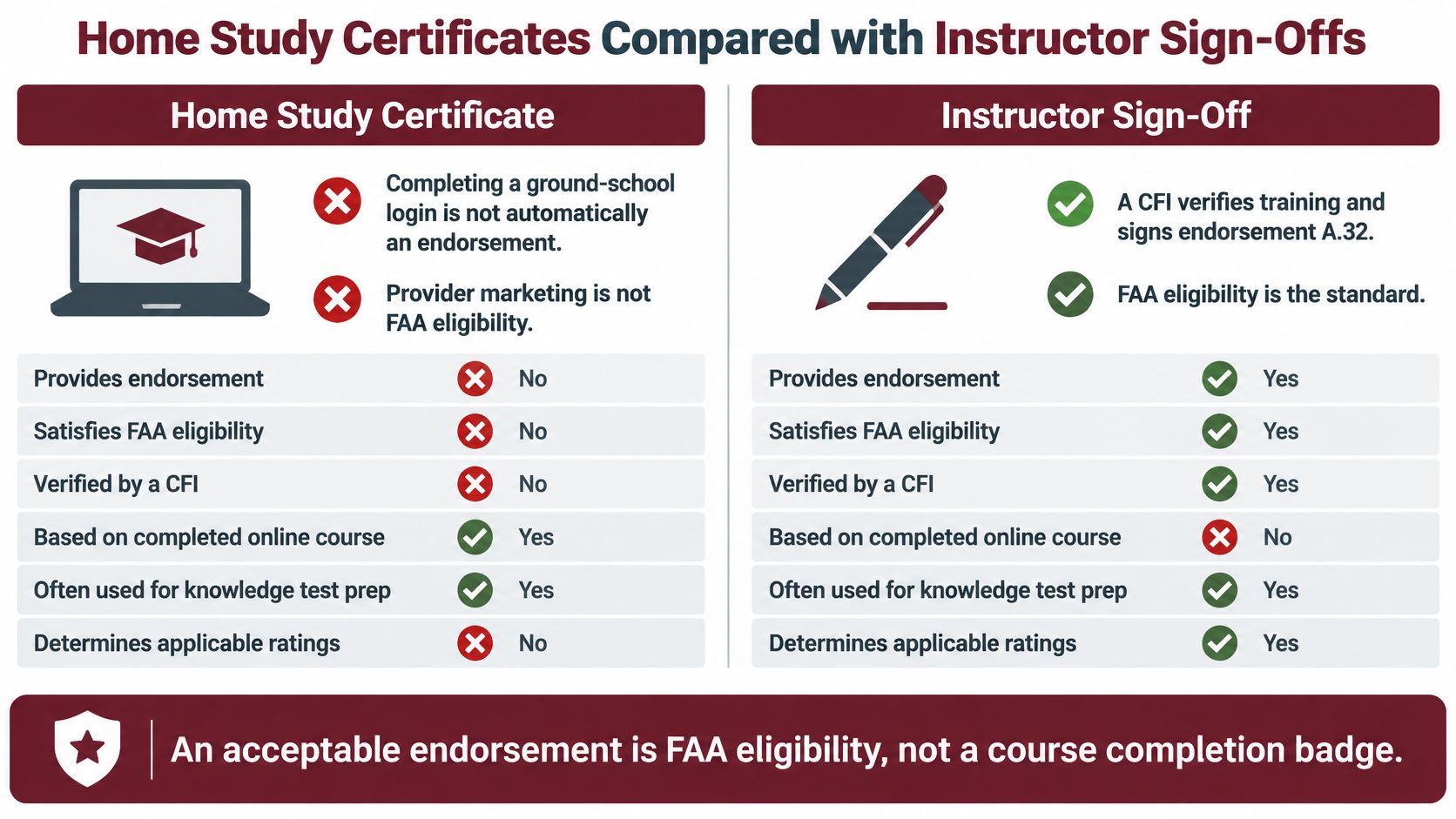
The comparison below helps separate those purposes.
The regulations behind the signature
The FAA's AC 61-65H endorsement guidance identifies A.32 as the aeronautical-knowledge-test endorsement tied to 14 CFR 61.35(a)(1), 61.103(d), and 61.105, certifying the required training and the instructor's determination that the applicant is prepared for the specific test.
Read those references in the order a student encounters their practical effect:
- Testing eligibility: The testing center needs evidence that you meet the knowledge-test training requirement.
- Certificate eligibility: Aeronautical-knowledge preparation is part of qualifying for the private pilot certificate, not just arranging an exam appointment.
- Training content: Your preparation must cover the required knowledge areas rather than whichever topics happen to appear in a familiar practice set.
The instructor attests to preparation across the required knowledge areas, not merely completion of a question bank.
Your quizzes can support that determination. They can show which topics you studied, which mistakes persisted, and whether corrective work helped. They aren't the instructor's signed statement.
Keep the scope specific
An appropriate entry identifies the applicant and the knowledge test being endorsed. It shouldn't leave a testing-center employee guessing whether the instructor meant an airplane knowledge test, an instrument test, or a practical test.
The sign-off also doesn't establish medical eligibility, certify completion of flight experience, or authorize the checkride. Those requirements remain separate.
For additional context on the endorsement discussion, this video can accompany your instructor review.
Read the finished entry as a statement someone outside your flight school must understand. A vague or wrong-test endorsement can become a check-in problem even when the underlying instruction was sound.
Home Study Certificates Compared with Instructor Sign-Offs
A home-study completion certificate isn't automatically an instructor endorsement, although acceptable home-study evidence can provide its own route to testing eligibility. The document's purpose and acceptance matter more than the name printed across its top.
FLYING's online ground-school guide highlights differences in provider endorsement practices and the importance of checking compliance, completion requirements, and documentation. A course may teach the right subjects while requiring a separate assessment before it issues testing eligibility.
Similar study progress, different paperwork
Consider these hypothetical students:
- Maya completes an online course. She downloads a certificate, but checks its acceptability before scheduling. If it only records participation and doesn't qualify as eligibility evidence, she can ask her CFI to review her preparation and issue the appropriate instructor endorsement.
- Jordan trains through a pilot school. His school issues documentation through its approved course process. He confirms that document with the testing center rather than assuming he needs a separate freelance instructor's signature.
- Sam studies independently. He performs well on familiar practice questions but has neither accepted course-completion evidence nor an instructor endorsement. His next appointment should be a preparation review, not the knowledge test.
None of these situations can be resolved by asking whether the student owns a document called a certificate. You need to know what the document establishes and who stands behind it.
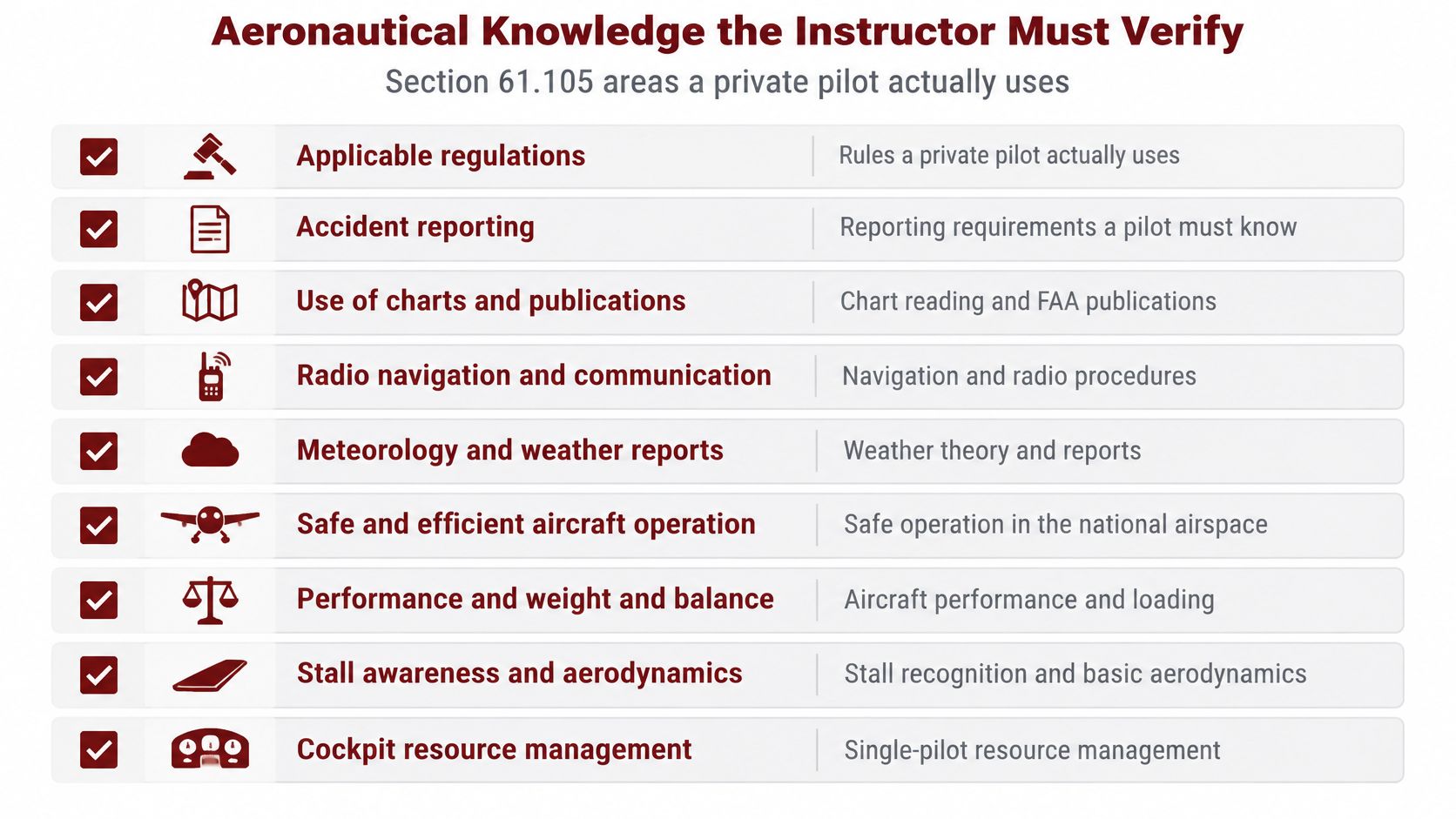
The training topics below also help you judge whether a course covers meaningful preparation rather than just completion milestones.
Verify the output before buying a course
Ask an online ground-school provider concrete questions:
- Completion standard: What work must I complete before you issue testing eligibility?
- Document wording: Can I inspect the exact endorsement or completion-evidence format?
- Issuing authority: Does an authorized instructor sign it, or does it qualify through the acceptable home-study route?
- Testing-center acceptance: Has PSI accepted this format, and how should I present it?
Confirm acceptance directly with PSI rather than relying only on marketing language. A provider's previous acceptance experience is useful, but it doesn't excuse an incomplete or incorrectly issued document.
Keep the legal and educational questions separate. An accepted document answers whether you may sit for the exam. Being able to explain unfamiliar weather, performance, and regulatory problems answers whether your preparation extends beyond memorized question patterns.
Aeronautical Knowledge the Instructor Must Verify
The instructor needs evidence that you understand the knowledge a private pilot uses, not just evidence that you've spent time studying. That means working across regulations, accident reporting, FAA publications, aerodynamics, weather, navigation, aircraft performance, airport operations, communications, emergencies, and human factors.
The Airman Certification Standards, usually shortened to ACS, help organize that review around operational tasks. Use the private pilot ACS guide to understand how the codes connect study topics to the decisions you'll make as a pilot.
Turn mistakes into a useful review plan
A total practice score can hide a concentrated weakness. You might answer most regulation questions correctly while repeatedly misreading performance charts. An instructor needs to see that pattern, not just the combined result.
The FAA's frequently missed ACS report for the second quarter of CY2025 reports that PA.IX.A.K3 was missed by 73.33% of applicants represented in that report. That finding supports targeted review of named knowledge areas; it doesn't mean every student has the same weakness.
Make a missed-item record that captures more than the correct answer:
- Knowledge area: Record the ACS code or topic associated with the mistake.
- Reason for the miss: Separate a misunderstood concept from a chart-reading or calculation error.
- Corrective work: Identify the reference, explanation, or worked problem that resolved it.
- Remaining uncertainty: Write down what you still can't explain without looking at the answer.
Demonstrate application, not recognition
A useful pre-endorsement review combines a full-length practice test with instructor questions on your weak areas. Decode a weather report, solve a weight-and-balance problem, interpret a sectional chart, and apply a regulation to a realistic flight.
For example, don't stop after identifying a forecast visibility value. Explain how it would affect your planned departure and what additional information you'd seek. For loading, explain why the result is acceptable or unacceptable rather than only producing a calculated value.
Consistent practice results show recall. The endorsement requires the instructor's finding that you're prepared.
Bring your missed-item list, chart problems you still struggle with, and questions you can't answer in your own words. That gives the instructor specific material to evaluate and correct.
Once the knowledge review supports a signature, the documentation must preserve that determination clearly.
How to Record and Present the Endorsement
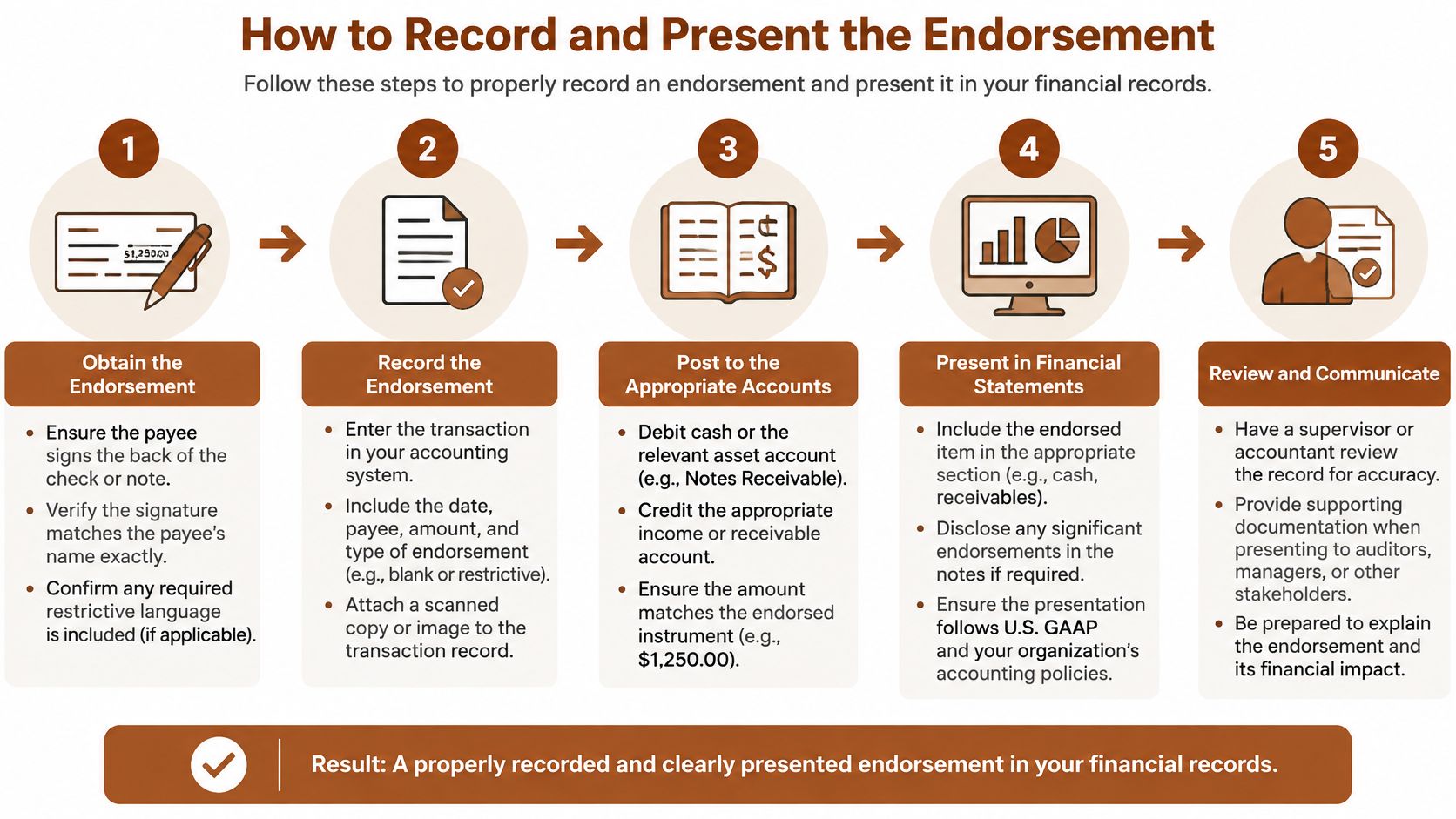
Prepare the endorsement while you and your instructor can still fix it together. Discovering a missing signature at the flight-school desk is inconvenient. Discovering it at check-in can interrupt your test appointment.
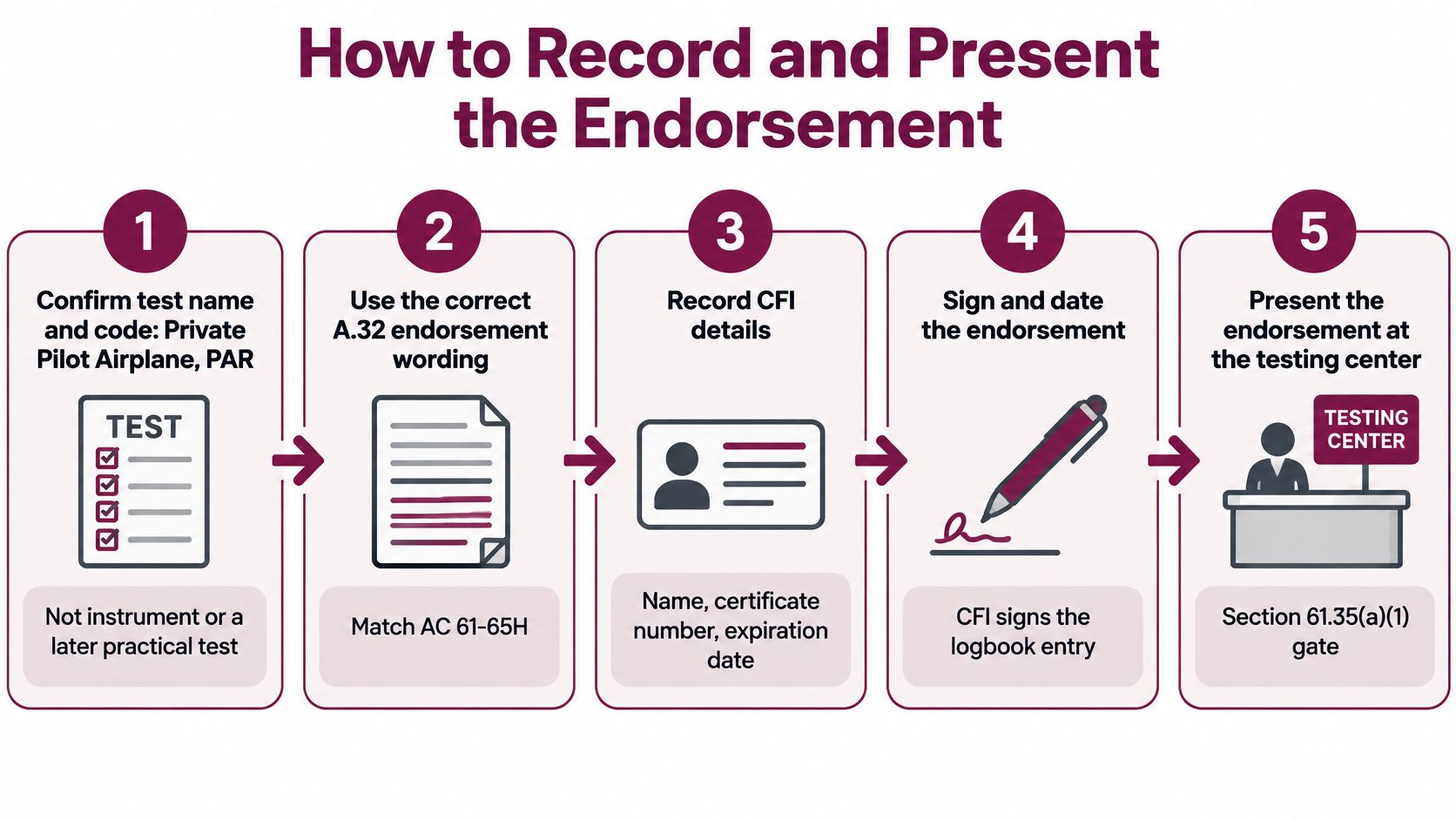
For a first attempt using an instructor endorsement, follow this sequence.
Complete the entry before test day
- Confirm the examination. The entry should identify Private Pilot Airplane, PAR. Check that neither a different rating nor a practical test appears in the wording.
- Use the applicable FAA endorsement text. Have your instructor verify the appropriate advisory-circular wording rather than copying an old entry without reviewing it. Include the applicant's name and the instructor's required identifying information, signature, and date.
- Choose a usable record. Put the endorsement in your logbook or a reliable training record you can present. Keep a photo or scan as a backup, but don't assume an image on your phone is the only evidence the testing center will need.
- Check what the statement certifies. The wording should establish completion of the required aeronautical-knowledge training and preparation for the named knowledge test. A bare statement that you attended lessons doesn't communicate the same finding.
- Confirm check-in requirements. Ask PSI what form of endorsement it accepts and what identification you must bring. The FAA knowledge-test center guide helps you organize appointment preparation, then verify the actual requirements for your booking.
- Retain the result. Keep the Airman Knowledge Test Report after testing, whether you pass or fail. It gives you and your instructor a record of the outcome and any reported knowledge deficiencies.
Catch the defects that matter
Read the entry aloud with your CFI. Check your name against your identification, verify the test designation, and make sure the instructor's details and signature are legible. A smudged signature or a nickname that doesn't match your government ID can both stall check-in.
- Wrong examination: Fix a test-name mismatch before scheduling.
- Attendance-only certificate: Establish whether it qualifies as accepted home-study evidence.
- Unreadable digital badge: Obtain a document the testing center can inspect and retain as needed.
Use the sequence above and the applicable FAA wording when checking your paperwork.
Don't improvise a correction yourself after your instructor signs. A hand-edited initial or a date written over another date makes the record look altered rather than corrected. If something is missing or inaccurate, return it to the issuer so the final record remains clear and attributable.
A New Endorsement After a Failed Attempt
A failed attempt requires a new authorized-instructor endorsement documenting additional training and competence to pass. Don't return to the testing center relying only on the original eligibility sign-off.
The FAA Private Pilot Airplane ACS requires attention to deficient knowledge areas and an instructor endorsement confirming satisfactory knowledge after corrective instruction. The retest process also requires the failed Airman Knowledge Test Report and the new instructor endorsement.
Build a deficiency-specific training record
Keep the original report intact and give your instructor a readable copy. The reported ACS codes identify the knowledge areas that need attention, even though they don't reproduce the exact questions you missed.
Your retest preparation should leave you with identifiable records:
- Failed test report: Preserve the result and the listed deficiency codes.
- Additional-training record: Document the corrective instruction connected to those deficiencies.
- New instructor endorsement: Obtain the statement establishing that additional training was given and that you're competent to pass.
Say your report points to weather interpretation and aircraft performance. Your instructor can have you decode unfamiliar weather products, discuss the operational consequences, and solve new performance problems. Repeating the exact practice questions you already remember wouldn't give the same evidence of improved understanding.
Close each knowledge gap
Ask the instructor to identify the reviewed ACS codes in the training record so the corrective work is traceable. For each area, you should be able to explain the underlying concept and work through a fresh application.
Retest discipline: Correct the deficiency, demonstrate understanding, and obtain the new sign-off before booking another attempt.
A home-study login streak or an improved dashboard score doesn't replace this instructor review. The relevant evidence is what additional training occurred and why the instructor now considers you prepared.
Don't treat a failed result as a direction to restart every chapter without a plan. Begin with the reported deficiencies, investigate related misunderstandings, and expand the review when the instructor finds a broader gap.
Keep the report and new endorsement together for check-in. Review any dates or instructions printed on the report with your instructor and PSI rather than assuming your original appointment paperwork answers every retest question.
Schedule the Written Only After Real Readiness
Book when your knowledge and documentation agree, not when a course dashboard first looks complete. If you can recognize familiar answers but can't explain the reasoning, another focused review is more useful than an exam appointment.
Our scheduling benchmark is 85% or higher consistently on practice exams. That's a preparation benchmark, not a substitute for the instructor's judgment or the testing center's eligibility requirements.
Make the booking decision deliberately
Use the readiness review to organize your final check. Look for stable performance across full-length practice tests, an ability to explain your mistakes, and no unresolved pattern of weakness in an important knowledge area.
- Bring the weak-area record: Give your CFI the items you still can't explain, not only your best score.
- Obtain the correct evidence: Secure the instructor endorsement or verified acceptable home-study document.
- Confirm acceptance: Check that PSI will accept the document in the form you'll bring.
- Then schedule: Choose the appointment after the preparation and paperwork checks are complete.
Our flyCowboys question bank covers every topic on the FAA Private Pilot Knowledge Test. Use that practice to produce a useful review record for your CFI, not as a claimed source of endorsement authority.
Wait when the evidence is mixed
Strong scores with unresolved conceptual gaps call for instructor review. Sound understanding with incomplete paperwork calls for document correction. Neither problem is solved by booking a seat and hoping it works out.
Flight training with your instructor continues alongside written preparation. The practical benefit of a well-prepared knowledge test is that you can apply the same weather, navigation, performance, and decision-making concepts during lessons.
Before paying for an appointment, make sure you can answer both questions plainly: Why am I prepared, and what document proves I'm eligible? If either answer is uncertain, resolve it first.
Visit flyCowboys for private pilot question practice and explanations that help you identify what to review before requesting an endorsement. Bring your missed topics and practice results to your CFI, complete the readiness review, and confirm your eligibility document before booking the PAR test.