· 14 min read
Airport Safety Flag: Sizes, Rules and How to Choose
Learn what an airport safety flag is, its FAA size and color standards, where it is required, and how to choose and maintain a compliant one.
An airside vehicle flag should measure at least 3 ft by 3 ft, with alternating orange and white squares at least 1 ft on each side. If you're checking a vehicle on the ramp, the flag's job is to make it easier for pilots and ground crews to spot, not to give the driver clearance or replace airport procedures.
A fuel truck crossing a taxiway while a jet is on approach is exactly the kind of situation where conspicuity matters. The flag helps the truck stand out against concrete, asphalt, and grass, much like a high-visibility vest helps a road worker stand out near traffic. But a flag only works when it's visible, correctly sized, and backed by the airport's communication and movement controls.
Table of Contents
- What an Airport Safety Flag Is
- Standard Sizes and Colors at a Glance
- Where Airport Flags Are Required
- Flags That Mark Hazards and Work Zones
- Flags in the Wider Runway-Safety System
- Misconceptions About Airport Flags
- Choosing a Flag That Meets the Standard
- Inspecting, Fixing and Confirming a Flag Before Each Shift
What an Airport Safety Flag Is
An airport safety flag is a high-contrast, orange-and-white checkerboard mounted on a staff to help pilots and ground crews identify airside vehicles. The FAA standardized it as a daytime visibility device in Advisory Circular AC 150/5210-5B in 1986, and AC 150/5210-5C retained the core dimensions and pattern, as described in the FAA vehicle-flag advisory circular.
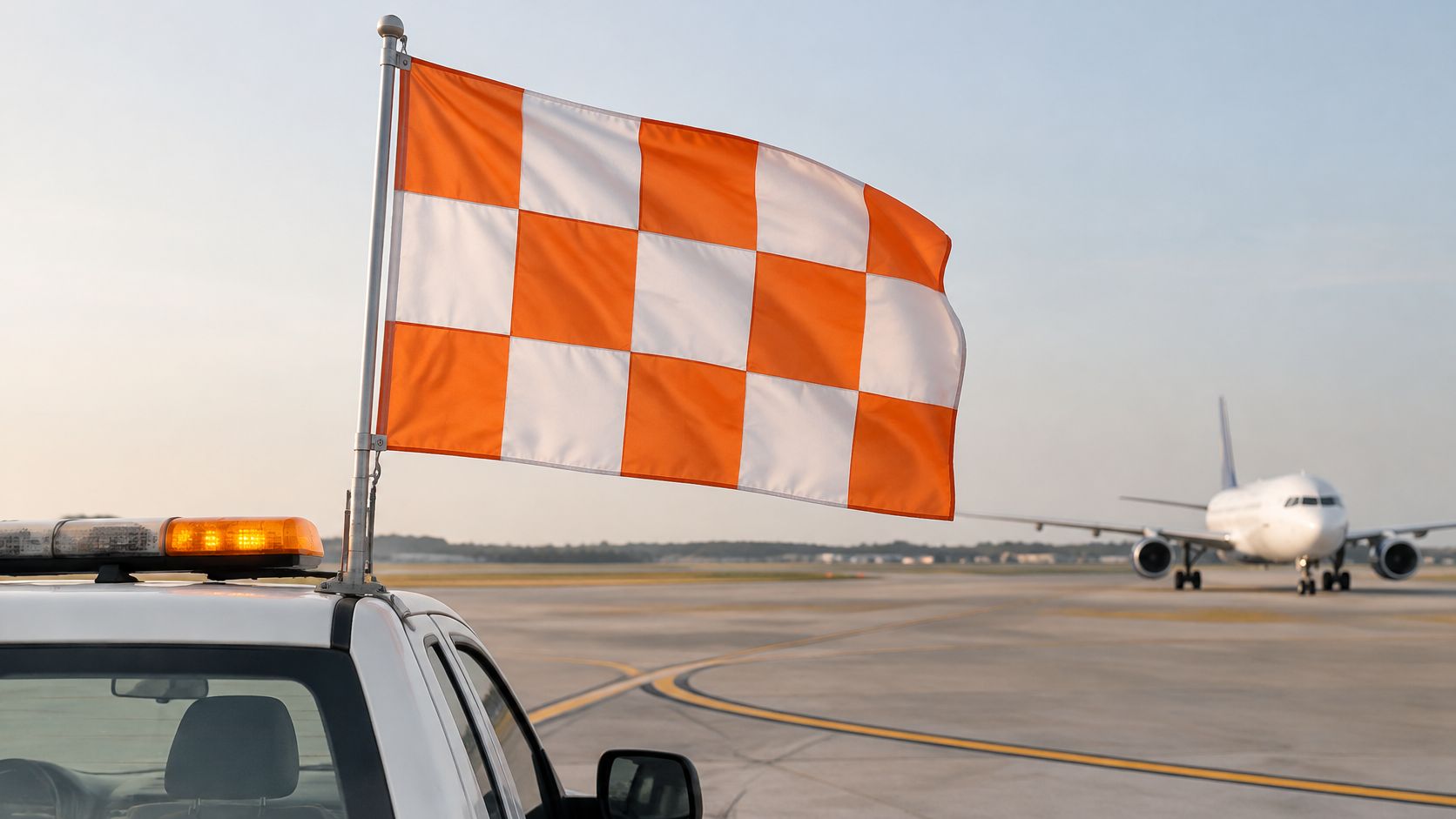
The FAA specification calls for a square flag at least 3 ft by 3 ft, divided into orange-and-white squares at least 1 ft on each side. The pattern's contrast helps pilots spot vehicles from the air and helps drivers and operations staff recognize ground traffic on the surface. Pilots on approach or taxi, ramp drivers, and airport operations teams all rely on that visual cue.
The flag is a defined piece of airport ground-safety equipment, not just a generic warning symbol. The advisory circular also recognizes alternatives in some circumstances, including an appropriately equipped escort or continuous two-way radio communication with air traffic control. Federally funded airport vehicles may face effectively mandatory compliance when grant or passenger-facility-charge conditions require it.
For terminology and related aviation concepts, browse the flyCowboys aviation glossary. The practical distinction is straightforward: a flagged vehicle is easier to detect, but the flag doesn't authorize its movement or replace the airport's operating procedures.
Standard Sizes and Colors at a Glance
For an airside vehicle, start with the 3 ft × 3 ft minimum and check that the orange and white squares are each at least 1 ft per side. A larger flag presents a more visible target at distance, and the checkerboard has to stay recognizable while the vehicle moves rather than blurring into a single patch of color.
| Flag type | Minimum size | Pattern | Typical use |
|---|---|---|---|
| Airside vehicle flag | 3 ft × 3 ft (0.91 m) | Alternating orange and white squares, at least 1 ft (305 mm) per side | Vehicles on the airside without a radio escort |
| Checkerboard obstruction marker | 3 ft (0.91 m) or larger | Aviation orange and white, about 1 ft (0.30 m) squares | Extensive or closely grouped obstructions |
| Work-zone flag | 20 × 20 in (50 × 50 cm) | Alternating orange and white | Barricades around construction and temporary hazards |
The FAA visual-aid guidance sets out marker geometry and calls for stiffeners on rectangular flags so they hold their shape in calm wind. A rectangular marker that droops can lose its recognizable pattern even when the fabric and color are otherwise correct.
Check color as well as size. Aviation orange needs to meet the applicable FAA color specification, and "looks orange" under shop lighting is a weaker standard than that. Inspect the flag in the conditions where it will be used, and confirm the orange and white blocks stay distinct at working distance.
A useful ramp-side test is to look at the flag from across the ramp. If the squares blur together, the flag may be too small, faded, or built with the wrong pattern. Matching dimensions on paper is only the first control: a correctly sized flag works as one layer of the airport's marking and operating system, and it never substitutes for the procedures that govern where a vehicle may go.
Where Airport Flags Are Required
Under FAA AC 150/5210-5C, a vehicle in the aircraft operating area needs a readily visible flag unless an appropriately equipped escort or continuous two-way radio contact with ATC covers that gap. At an airport without ATC facilities, plan on flags for all vehicles.
| Situation | Flag required? | Basis |
|---|---|---|
| Vehicle in the aircraft operating area, no escort and no continuous two-way radio with ATC | Yes, a readily visible flag is required | FAA AC 150/5210-5C |
| Vehicle with an appropriately equipped escort | Flag may be replaced by the escort | AC 150/5210-5C alternatives |
| Vehicle with continuous two-way radio contact with ATC | Flag may be replaced by radio contact | AC 150/5210-5C alternatives |
| Any vehicle at an airport without an ATC facility | Yes, required on all vehicles | FAA AC 150/5210-5C |
| Federally funded airport vehicle | Effectively mandatory where grant or passenger-facility-charge conditions apply | Federal grant and passenger-facility-charge conditions |
Treat the flag as the visual layer in a wider control set. It helps a tower controller, escort, or nearby driver pick the vehicle out early, but it does not replace a clearance, a working radio, marked routes, or the operator's runway-incursion procedures. If radio contact is lost or the escort drops back, the flag can become the requirement that keeps that vehicle compliant.
Mounting is part of compliance in practice. Put the flag high enough to remain visible above the vehicle, and keep it clear of the cab, equipment, and any load. A flag hidden behind a cab or cargo is not a useful visual cue while the vehicle is moving.
AC 150/5210-5B set the original standard in 1986, and AC 150/5210-5C retained the core dimensions while recognizing operational alternatives. Airport operators can still add local conditions beyond the federal baseline, so confirm the applicable circular and site rules before putting a vehicle into service.
The check for each vehicle is simple: does it have continuous ATC contact or an escort for the whole movement? If not, flag it.
Flags That Mark Hazards and Work Zones
Flags also help crews identify temporary hazards and construction areas. For example, a crew resurfacing a taxiway edge can set barricades around its work, add flags to make the barricades easier to see, and mark a cable run with checkerboard markers. The details matter: a marker that comes loose can become foreign-object debris, while a barricade that's too tall near an active surface can compromise aircraft clearance.
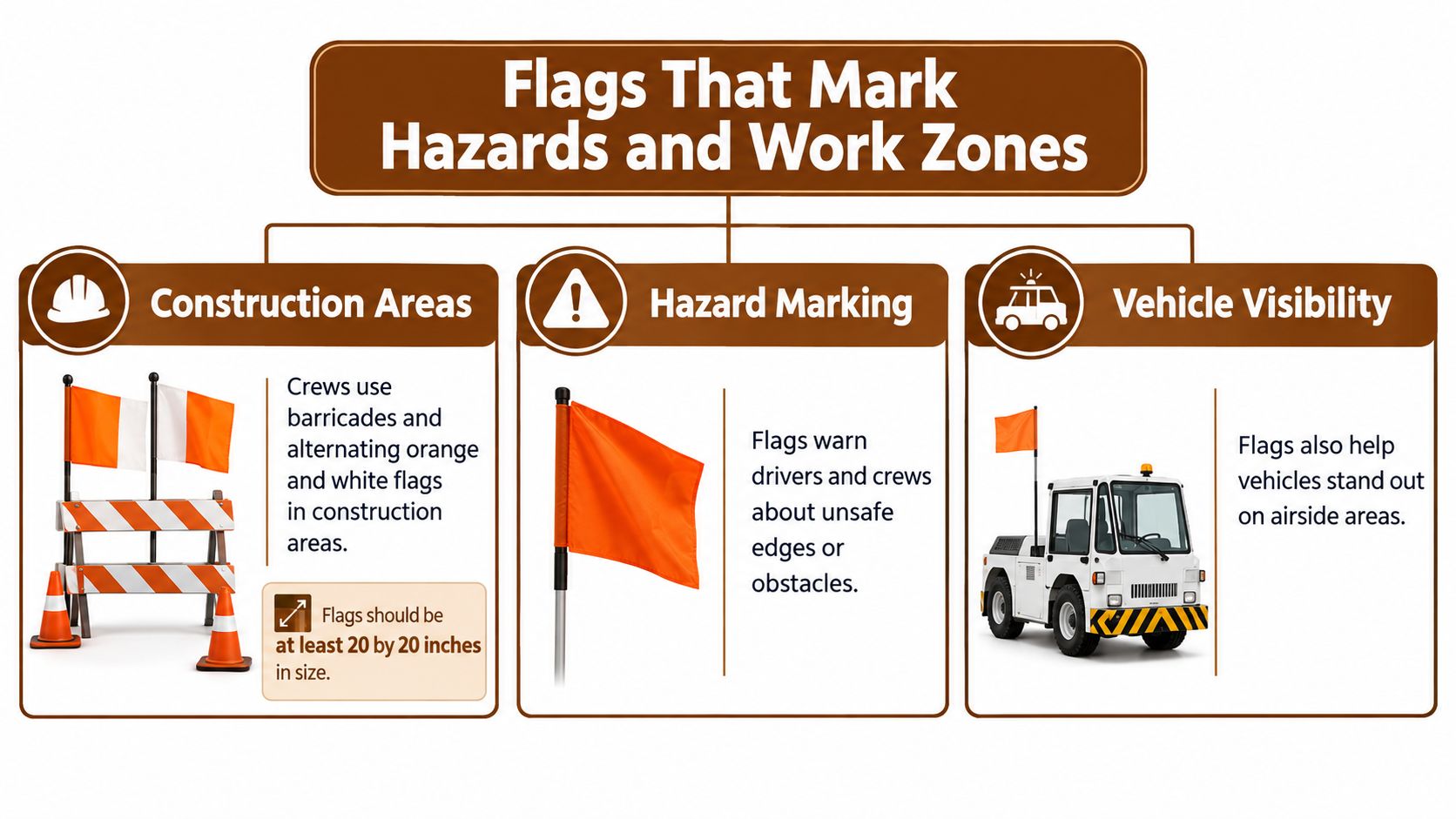
Under FAA construction and obstruction-marking guidance, barricades can be supplemented with alternating orange-and-white flags measuring at least 20 by 20 inches, or 50 by 50 cm. Crews must fasten them securely so they can't detach and become debris. Near active runways, taxiways, safety areas, and aprons, barricades are limited to 18 inches high, excluding supplementary lights and flags.
Obstruction markers use a different scale. For extensive hazards, checkerboard flags should measure 3 ft or more, with orange and white squares of about 1 ft each. Flags marking extensive or closely grouped obstructions should generally be spaced about 50 ft apart. Larger markers and regular spacing make grouped obstacles easier to recognize as a hazard area.
Practical rule: Near a runway or taxiway, check barricade height first. For an obstruction, check marker spacing. If a flag could come loose, fix its fastening before the area is put into service.
The orange-and-white pattern carries across uses, but the dimensions and placement change with the hazard being marked. Localized work-zone hazards call for smaller flags on barricades; extensive or grouped obstructions call for larger, spaced checkerboards.
Flags in the Wider Runway-Safety System
A flag is one layer in a larger system of surface controls. Yellow taxiway markings help identify holding positions and closed or hazardous areas, while runway-incursion reporting addresses aircraft, vehicles, or people incorrectly present on protected runway areas. A flag, closed-area marking, or light-gun signal can indicate an operational conflict or surface hazard, not merely a visual caution.
The same flashing red light-gun signal requires different actions depending on who receives it. For an aircraft in flight, it means “airport unsafe, do not land.” For an aircraft on the ground, it means “taxi clear of the landing area or runway.” For vehicles or personnel, it means “clear the taxiway or runway,” according to FAA air traffic control guidance on light-gun signals.
That difference is why memorizing colors alone can fail. A pilot taxiing beside a flagged work zone and a closed-area marking needs to interpret the surface context and follow the applicable instructions, rather than treating the flag as a general-purpose permission or a complete explanation.
Use a short decision check when you encounter a signal or marker:
- Identify the receiver. Are you in an aircraft in flight, an aircraft on the ground, or operating a vehicle or working on foot?
- Identify the cue. Is it a flag, a marking, or a light-gun signal?
- Act on its meaning for you. If the signal is ambiguous or blocked, continue monitoring the assigned frequency and clarify it. Don't enter a runway based on an assumption. Review radio procedure and communication practice alongside airport surface rules.
A flag helps make a hazard or vehicle visible. It can't replace radio discipline, movement instructions, markings, or a stop-and-verify response when the situation is unclear.
Misconceptions About Airport Flags
A flag gives a vehicle right of way. It doesn't. The flag helps others detect the vehicle; it doesn't grant clearance or override air traffic control instructions.
Any orange-and-white flag qualifies. Color alone isn't enough. The flag's dimensions, square pattern, condition, and mounting all affect whether it can be recognized.
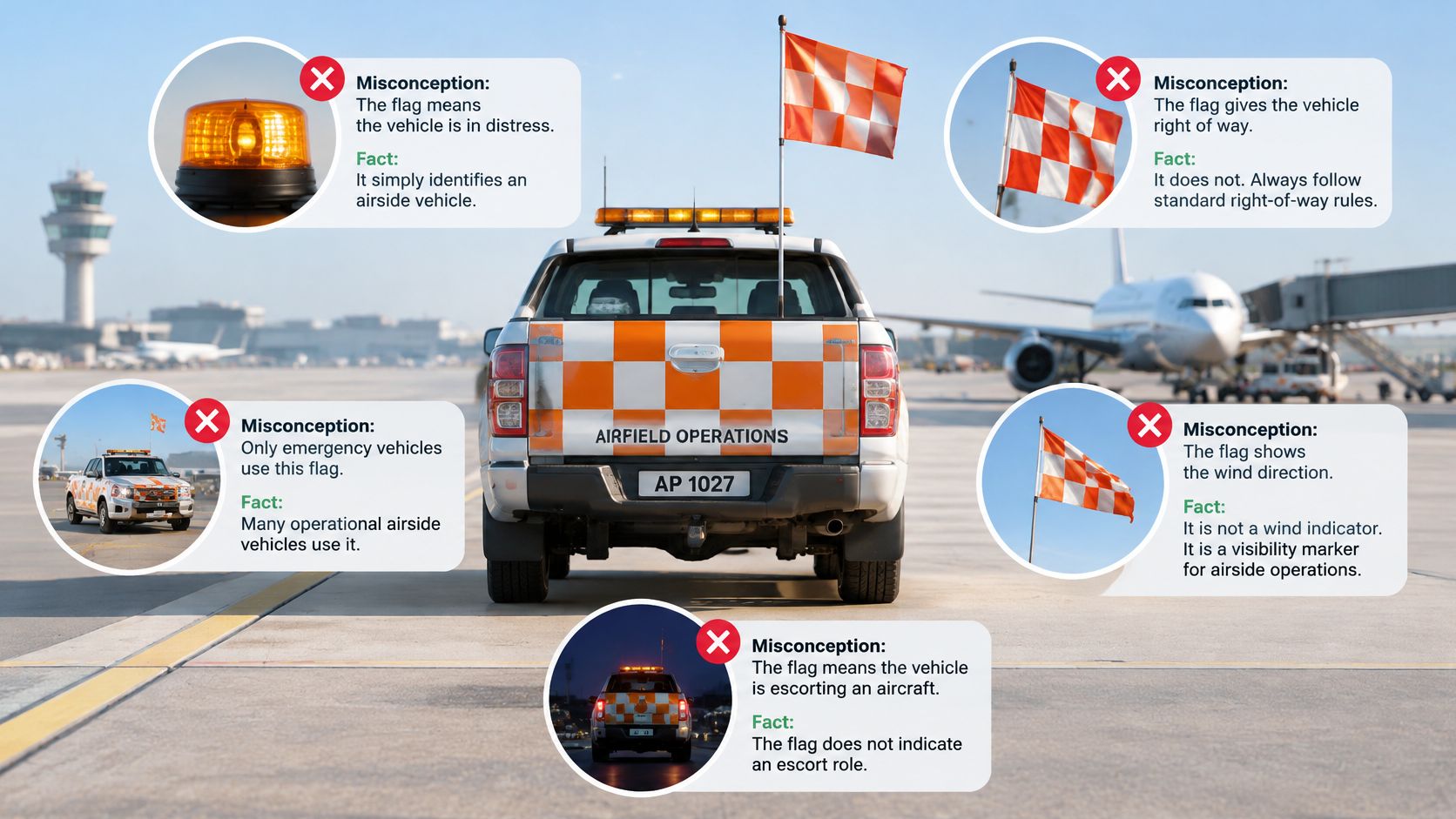
A flag replaces radio contact. Only the alternatives allowed by the applicable advisory circular can replace the flag requirement in particular situations. A flag doesn't provide clearance or remove the need to follow airport procedures.
A flag works at night. The checkerboard is a daytime conspicuity device. Night operations rely on the airport's applicable lighting rules and procedures, not on assuming a fabric flag will be visible.
A faded flag still works. Fading reduces contrast. If the orange has worn toward tan and no longer separates clearly from the white squares or the background, replace it. A worn flag is like a stop sign with faded red: it may still be present, but it no longer gives the intended visual cue.
A new ramp driver should be able to repeat these corrections: the flag doesn't grant right of way; the pattern and size matter; it doesn't replace clearance; it isn't a night light; and a faded flag should be replaced.
Choosing a Flag That Meets the Standard
Check the flag before buying, in this order:
- Confirm the size. For an airside vehicle, choose a flag at least 3 ft by 3 ft so the flag meets the stated minimum.
- Check the squares. Look for alternating orange and white blocks; the pattern needs to read clearly, not blend into a solid patch.
- Verify the square size. Each square should be at least 1 ft on each side, so the checkerboard matches the vehicle-flag dimensions.
- Verify the color. Check the product specification for aviation orange that meets the applicable FAA color specification; a color that only looks bright under indoor lighting may not provide the intended contrast outdoors.
- Inspect the construction. For rectangular shapes, confirm that stiffeners keep the fabric from drooping in calm air. Double-stitched hems and secure fastenings help resist wear and detachment.
- Check the mount. Choose a staff and bracket that hold the flag above the vehicle and keep it visible past the cab or any load.
- Match the flag to its use. Vehicle flags, barricade flags, and obstruction markers have different size rules, so don't substitute one type just because its colors match.
- Confirm local requirements. Ask the airport operator which advisory circular and local procedures apply before placing a vehicle into service.
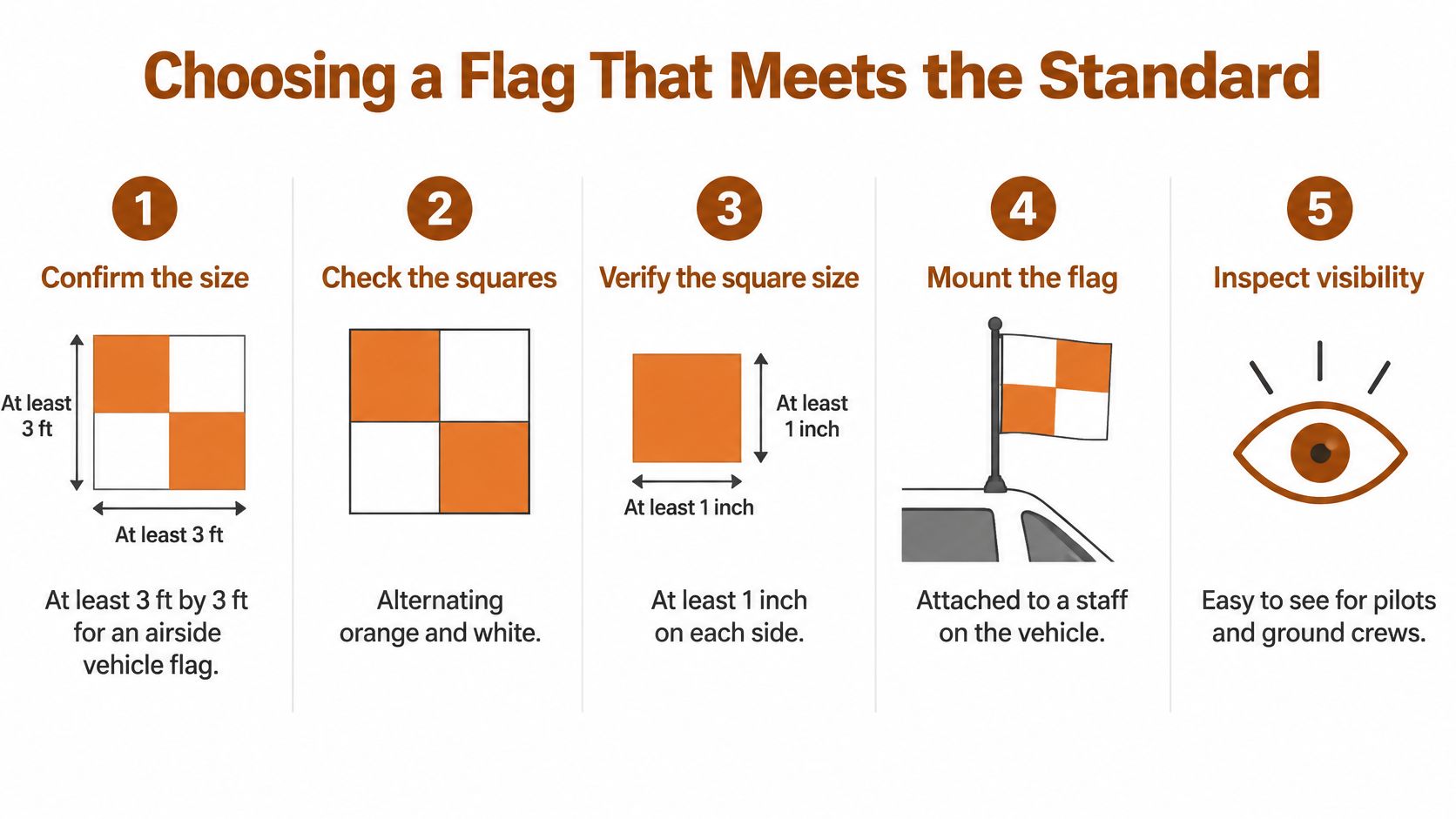
A low-cost flag that fails the size or color check isn't compliant just because it's inexpensive. Buy for the actual operating use, then check the delivered flag against its product specifications before mounting it.
Inspecting, Fixing and Confirming a Flag Before Each Shift
Check every flag before a shift, after wind or rain, and after contact with a vehicle, equipment, or a load. Fading weakens contrast, drooping can erase the checkerboard shape, and torn fabric can separate and become debris.
| Symptom | Likely cause | Fix |
|---|---|---|
| Flag blends into the background | Faded orange and lost white contrast | Replace the flag; contrast is its only job |
| Pattern droops in calm air | Rectangular flag without stiffeners | Add stiffeners or switch to a rigid frame |
| Flag hidden behind cab or load | Staff too short or wrong mount | Raise the staff so the flag clears the vehicle |
| Edges frayed or torn | Wear, wind, and sun exposure | Replace it; loose fabric can become debris |
| Flag separated or lost | Failed fastening | Remove it at once, then refasten or replace |
| Squares hard to tell apart | Faded or undersized pattern | Replace with a flag meeting the 1 ft square standard |
A missing or frayed flag on the apron is a foreign-object-debris concern. Remove it at once; don't tie loose fabric back onto the vehicle and send it out. Retire a flag whenever its squares no longer look distinct from the background, regardless of how small the visible damage appears.
Use this go-or-no-go routine before the vehicle moves:
- Confirm the operating arrangement. Check whether the vehicle has an escort or continuous two-way radio contact with the tower.
- Check the flag requirement. If neither alternative applies, verify the required vehicle flag and its pattern.
- Check the mount. Make sure the staff lifts the flag above the vehicle roof and any load.
- Check the fabric and fastening. Confirm that the attachment is secure and any rectangular flag has a functioning stiffener.
- Check visibility. View the flag from the driver's seat and from a distance. Replace it if the pattern blurs.
- Confirm local rules. Check the current advisory circular and airport procedures with the operator.
- Record the result. Log the inspection and any replacement so the operator knows which flags are in service.
If any check fails, stop, fix the flag, and only then move the vehicle airside.
Use flyCowboys to practise FAA knowledge-test topics, including airport operations and radio procedures, with adaptive question practice and AI-based ATC drills. Add focused surface-safety and communication practice to your study routine before your next knowledge test.